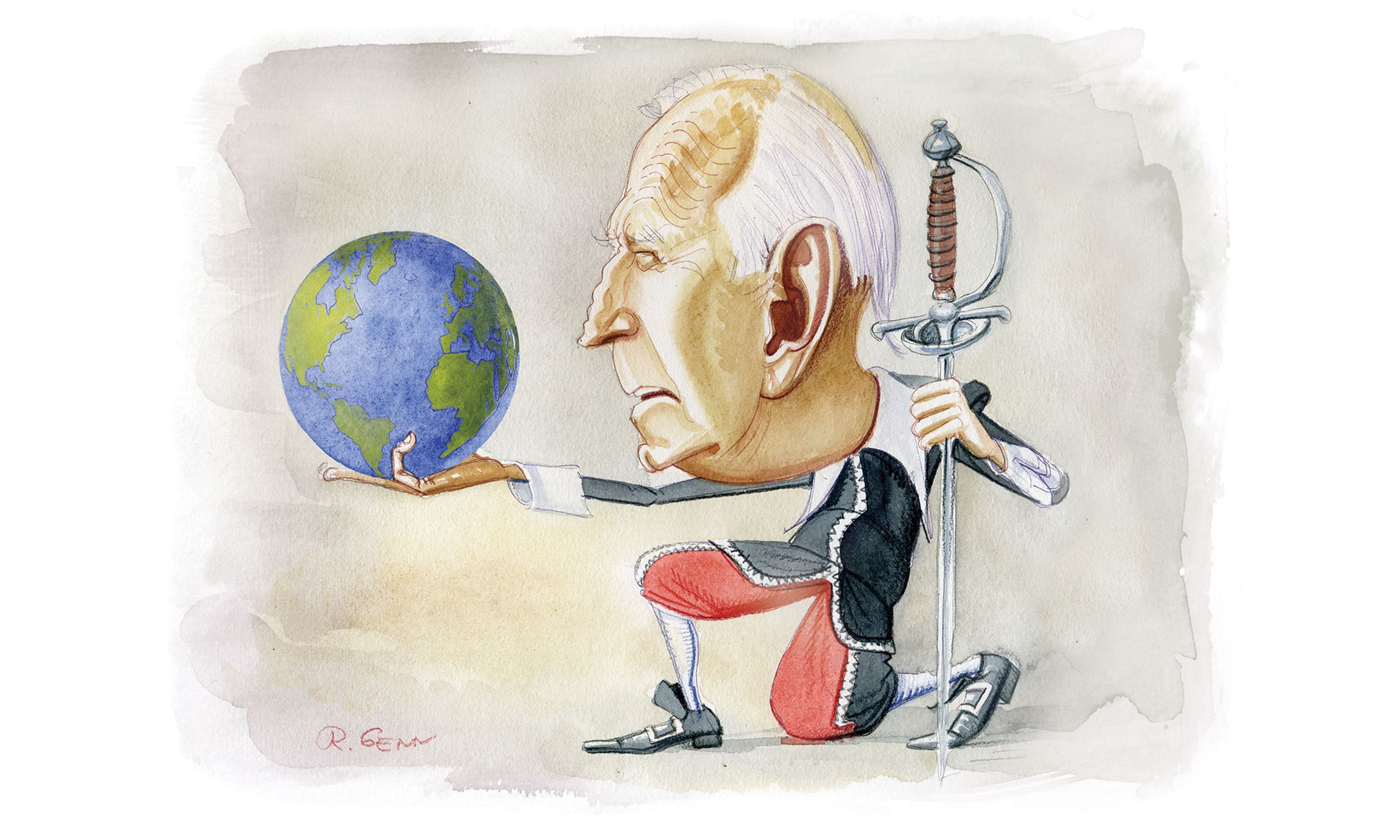
Does President Biden have a foreign policy? And if he does, how does it compare with those of his predecessors?
We can assess foreign-policy differences by looking at the choices presidents make in response to two sets of questions. First, what primary objective should America pursue? Should it maintain a geopolitical balance of power that promotes stability, taking a live-and-let-live attitude toward values (as in the Nixon-Kissinger willingness to coexist with the totalitarian Soviet Union)? Or should it emphasize democratic values and alliances to defend and spread open societies, since democratic nations tend to live in peace with one another (e.g., Reagan’s “we win, they lose” approach to the USSR)?
Second, what means should the United States employ? Should it rely primarily on military and economic power to defend national interests and avoid diplomatic entanglements (Trump’s “America First” policy)? Or should it promote arms control and use military force only with multilateral consent (like George H. W. Bush in the Persian Gulf War)?
Combined, the two choices make possible four overall approaches — strategic restraint (restrained balance of power plus reluctance to use arms), globalist diplomacy (democratic values plus reluctance to use arms), great-power politics (activist balance of power plus willingness to use arms), and defending/promoting democracy (democratic values plus willingness to use arms). Presidents choose aspects of all these approaches; none is fully sufficient. But there is usually an emphasis.
President Obama opted for “strategic restraint.” His foreign policy reduced American strategic commitments around the world and, after a brief military surge in Afghanistan, downplayed the use of military force. Obama declined, for example, to send lethal arms to Ukraine after Russia annexed Crimea and occupied Donbas in 2014, arguing in restrained balance-of-power fashion that Russia had greater interests in Ukraine than the West did.
President Trump, like Obama, pruned American commitments abroad. But he championed a strong military force. He wanted to play “great-power politics” and de-emphasize democracy, even calling for Russia, an autocracy, to rejoin the G-7 democratic powers.
Biden has adopted objectives more ambitious than either Obama’s or Trump’s. In multiple crises, he has pledged to support Ukraine, deter China, and backstop Israel with “whatever it takes,” for “as long as it takes.” But he has also been more strategically unfocused than his recent predecessors. He tends to follow rather than shape events — “I’m a great respecter of fate,” he has told the press. His long record in politics and frequent flip-flops on strategy incline him to procrastinate and muddle through. He reacts in the moment, spraying commitments in shotgun fashion wherever a threat emerges. This spontaneity of style and lack of strategic focus are potential pitfalls. He takes on large commitments without mobilizing the means to follow through.
Let’s analyze in more detail the strategic choices that the Biden administration has made and, in the process, compare Biden with Obama, Trump, and occasionally Reagan.
Strategic Restraint
There have been clear signs of strategic restraint in Biden’s approach, especially at the outset. Most obvious was his precipitous military withdrawal from Afghanistan, a gamble that a force presence was not needed to guarantee the Taliban’s pledge that it would deny safe haven to al-Qaeda and other terrorists. In some telling comments at the time, Biden asserted that strategic commitments can be reduced without decreasing military leverage:
Look, I know there are many who will loudly insist that diplomacy cannot succeed without a robust U.S. military presence to stand as leverage. We gave that argument a decade. It’s never proved effective — not when we had 98,000 troops in Afghanistan, and not when we’re down to a few thousand. Our diplomacy does not hinge on having boots in harm’s way — U.S. boots on the ground. We have to change that thinking.
Consistent with this statement, Biden has ruled out sending U.S. combat troops into conflict situations. He nonetheless responded vigorously to the 2022 Russian invasion. A few weeks before the war began, he warned that Russia would be “held accountable if it invades.” He then led NATO in one of the strongest allied military buildups against Moscow since the Cuban missile crisis. He thus seems less allergic than Obama to both ideological conflict and the military playbook.
Biden’s trade policy also shows strategic restraint. He inherited and embraced Trump’s hard-nosed protectionism, especially toward China. This approach rejects countries’ reciprocal opening of markets to each other’s goods, investments, and technology. As outlined in Biden’s document on national-security strategy, “we have to move beyond traditional Free Trade Agreements,” as we are “charting new economic arrangements” to protect national security, level the playing field with a global corporate minimum tax, and ensure supplies in emergencies. Trade policy became industrial policy, focused on decoupling or de-risking from China and “re-shoring” supply to friendly countries.
Globalist Diplomacy
But Biden also began his administration with a flood of diplomatic initiatives. “As we close this period of relentless war,” he told the U.N. in September 2021, “we’re opening a new era of relentless diplomacy.”
Talks in Moscow in the summer of 2021 were the most notable example — and turned out to be most untimely. As Russia mobilized for war, the New York Times heralded the Biden–Putin summit as “a serious conversation,” “the deepest in years.” The talks focused on what negotiators described as “strategic stability” — traditional arms-control discussions plus concerns about new technologies, including the use of artificial intelligence to command weapons systems.
Biden made similar diplomatic overtures to China and Iran. In March 2021, Secretary of State Antony Blinken held out collaboration as one of three pillars of U.S. interaction with China, along with competition and confrontation. But by May 2022, he had dropped the collaboration pillar. In the Middle East, Biden revived nuclear negotiations with Iran and called Saudi Arabia a “pariah state.” With the Iran talks stymied, he visited Saudi Arabia and, like Trump, pursued normalization between moderate Arab states and Israel. By late September 2023, Biden’s national-security adviser, Jake Sullivan, declared the Middle East to be “quieter today than it has been in two decades.” Eight days later, Hamas’s attack on Israel shattered the calm. Another crisis and set of strategic commitments were added to Biden’s foreign-policy agenda.
The purpose of Biden’s globalist diplomacy, Blinken explained, was not to try to contain Russia, China, or Iran. Rather it was “to uphold the international rules-based order that our countries have invested so much in over so many decades, to the benefit, I would argue, not just of our own citizens but of people around the world.” This diplomatic outreach was therefore not primarily about spreading democracy or pursuing great-power politics.
Great-Power Politics
Russia’s invasion of Ukraine turned back the clock on world affairs. As the bombs fell, President Biden embraced great-power politics. He not only supplied Ukraine with massive military and economic assistance, but he also supported Finland and Sweden, two powerful neutral countries throughout the Cold War, in their efforts to join NATO. Existing NATO allies strengthened their commitments. Germany, a persistent footdragger on defense expenditures, announced a Zeitenwende, or turning point, in Germany’s obligations for the defense of Europe.
In Asia, Japan stepped up. Fumio Kishida, Japan’s prime minister, warned that “Ukraine today may be East Asia tomorrow.” India too adjusted its foreign policy. After maneuvering snakelike between Moscow and the United States during the Cold War, it has become a member of the Quad, a security partnership — between the United States, India, Japan, and Australia — devised to counter Chinese threats in Asia.
Taiwan became a flash point. If Russia succeeded in Ukraine, might China imitate it in Taiwan? In 2020, China had already abandoned treaty obligations and ended Hong Kong’s democratic politics while the world was distracted by Covid. Putin and China’s president, Xi Jinping, met in February 2022 — just days before the Russian invasion — and declared a “no limits” partnership to roll back the U.S.-led liberal world order. Since then, China has not endorsed Russia’s attack, but it also has not condemned it; and it has supplied to Russia weapons components later found in Ukraine and has purchased large amounts of Russian oil and gas to help Putin finance the war.
Defending/Promoting Democracy
The Sino–Russian partnership and hostility to the liberal international order have led Biden to cross the line of great-power politics and defend democratic values directly. Great powers, though competing, also collaborate to maintain a common system. Russia and China do not, however, accept the existing system. That system reflects democratic norms; they prefer autocratic norms (one-party politics; state-run economies and media; traditional and cultural, not individual, rights). Democracy in Kyiv and Taipei alarms Putin and Xi because it suggests that similar systems would be possible in Moscow or Beijing. What alarms the United States and its allies is autocracy in Ukraine, Belarus, and Moldova, which might lead to democratic backsliding in Slovakia, Poland, Hungary, Romania, and the Baltic states.
In contrast to Trump, Biden had spoken eloquently about democracy. He told the United Nations in September 2021: “The United States will champion the democratic values that go to the very heart of who we are as a nation and a people: freedom, equality, opportunity, and a belief in the universal rights of all people. It’s stamped into our DNA as a nation.” At the NATO summit in Vilnius in July 2023, he doubled down on this commitment: “We will not waver. I mean that. Our commitment to Ukraine will not weaken. We will stand for liberty and freedom today, tomorrow, and for as long as it takes…. Our commitment to our values, our freedom, is something we can never, never, ever, ever walk away from. It’s who we are.” Biden, however, is often loose with the lip. In that speech, more than ten times he added phrases such as “I mean it” or “I’m not joking,” as if there might be some doubt about his credibility.
Biden has also inaugurated a new Virtual Summit for Democracy, held in December 2021 and again in March 2023. This gathering, along with separate regional summits of Latin American and African countries in 2022, emphasized democratic values. Cuba, Venezuela, and Nicaragua were not invited to the Americas Summit, and Biden reiterated to African leaders that commitment to democracy was “in our DNA.”
Biden has, in sum, fashioned a scattered and ambitious foreign policy. Can he deliver on his promises? Material means are lagging. Larry Diamond, of Stanford, detects a shortfall in funds to bolster democracy abroad. Similar shortfalls afflict arms expenditures. In late 2023, there was a $19.2 billion backlog in U.S. arms sales to Taiwan. And Biden’s 2024 budget proposal increased defense spending by only 3.19 percent, less than the expected rate of inflation.
Meanwhile, Russia and China have met Biden’s “relentless diplomacy” with “relentless rearming.” As the Stockholm International Peace Research Institute documents, military spending under Putin in constant 2021 U.S. dollars skyrocketed from $16.9 billion in 1999 to $65.9 billion in 2021. Only China’s outlays vaulted more steeply, from $42.1 billion to $285.9 billion.
Negotiating with an armed adversary while being relatively unarmed can be deadly, because the adversary may talk forever inside negotiations while it achieves its objectives unopposed outside negotiations.
Two factors in particular create significant headwinds for Biden and his objectives. The first is economic. For the past 40 years, global markets expanded under free-market policies known as the “Washington consensus.” President Reagan prioritized economic growth that supported the defense and alliance commitments that ended the Cold War. Now the U.S. and world economy are reversing course. Slower growth and massive debts weaken support for defense.
Not only the U.S. and its allies but China, too, is decoupling. It fears that its firms may gain too much leverage abroad and thereby circumvent Communist Party rule at home. As Australia’s former prime minister Kevin Rudd has said, “China’s market-based reform program stalled in 2015 and has generally been in reverse since 2017.”
Decoupling may be necessary. Trade with China was rarely conducted on equal terms and often exposed the West to technology theft. But decoupling also comes at a cost. Just as every step toward globalization fostered more-efficient markets and lower-priced goods, every step back from globalization raises costs and prices. If divisions between the West on one hand and China and Russia on the other deepen, trade will be further hindered, and the costs of deglobalization will only rise higher.
A second headwind is nationalism. Domestic retrenchment is growing, not just in allied countries but in the United States itself. The refrain is now heard often in Congress: Why are we spending over $100 billion a year on Ukraine when we have social and economic problems at home? Why are we securing their border when we are not securing ours? Election-year politics in 2024 will only make it worse. While compounding foreign-policy commitments, Biden has done little to temper partisan polarization in the country.
To counter these headwinds, the American people must see a visible and sustained increase in burden-sharing by America’s allies. “Visible and sustained” means an ongoing and roughly equal sharing of military and economic burdens. A fair metric for comparison would be America’s share of total allied GDP, which is roughly 30–40 percent. In the fall of 2023, the U.S. was carrying around 50 percent of the load in Ukraine. That was an improvement from the 70 percent the U.S. carried during the Cold War. To be sure, all these numbers are approximate, but the U.S. share still remained disproportionate. At Vilnius, NATO leaders committed to raising defense expenditures as a share of GDP from 2 percent to “a minimum of” or “at least” 2 percent. Still, only eleven of 31 members have met the original 2 percent standard.
The willingness of Americans to accept costs is malleable. Consistent and purposeful leadership can increase it, as President Reagan did when he mobilized a massive military and diplomatic campaign against the Soviet Union, all the while assuring the American people that a peaceful victory was possible. Is that kind of leadership evident today?
Does Biden have a foreign policy? He has too many. He is pursuing objectives far more ambitious than those of Obama or Trump, without having secured the means to achieve them. Either he will retreat to a foreign policy of “strategic restraint,” letting Ukraine’s military efforts shipwreck on allied economic and political divisions and exposing Taiwan and potentially Israel to existential peril, or he will galvanize and sustain an economic and military resurgence of NATO and Asian allies to “defend/promote democracy” in Ukraine, Taiwan, and Israel.
Or maybe he’ll continue to muddle through, with occasional flourishes of “great-power politics” and “globalist diplomacy.” But that would be a reaction, not a strategy.
A more detailed version of this essay appears in the forthcoming book Presidential Leadership and Foreign Policy: Comparing the Trump and Biden Doctrines, edited by Stanley Renshon and Peter Suedfeld.











Comments