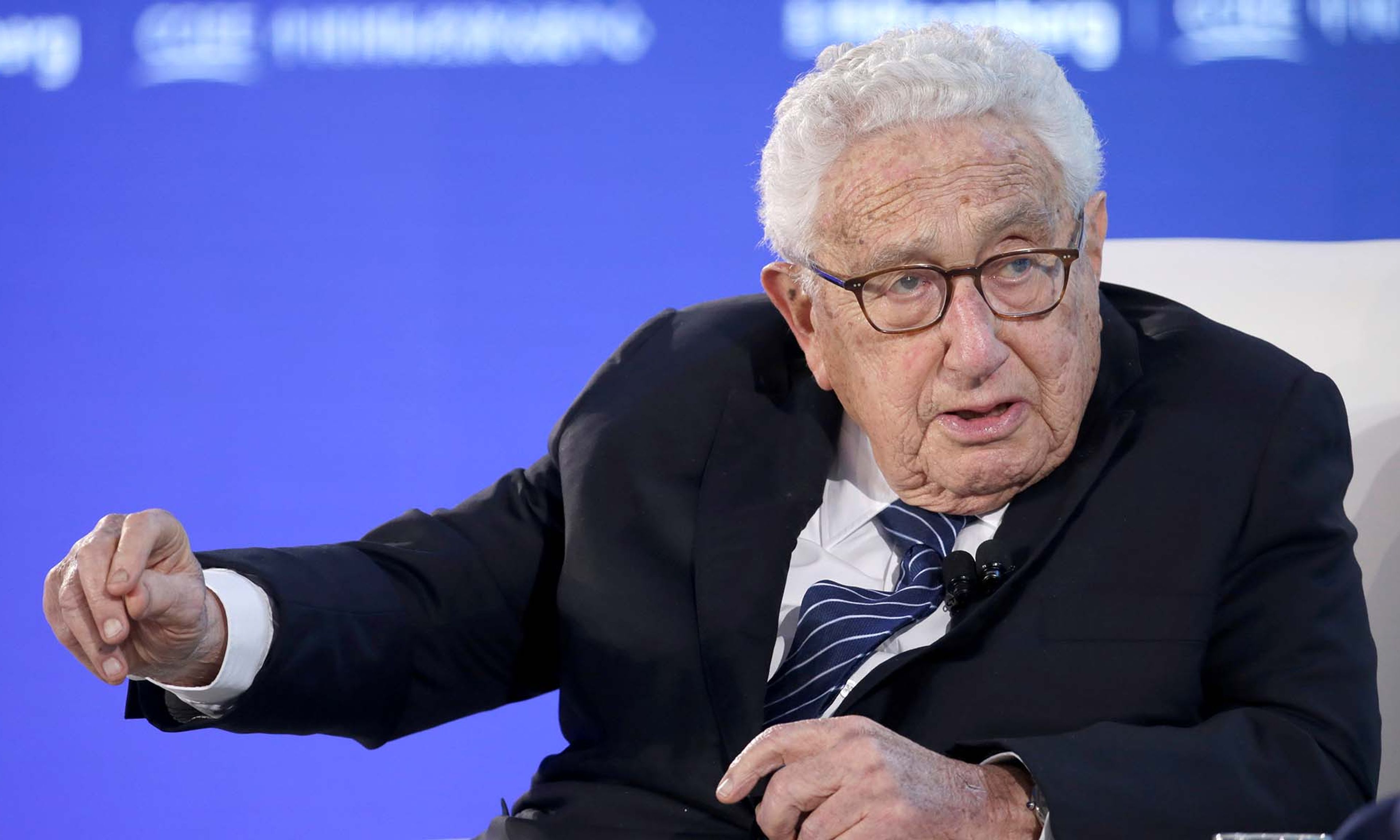
Henry Kissinger — former secretary of state and assistant to two presidents for national-security affairs, Cold War statesman, historian, and political celebrity — passed away in November shortly after celebrating his 100th birthday. Quite possibly, no other person to hold his positions has had his or her life and tenure so hotly litigated and relitigated. This is impressive, given that Kissinger was a government employee for only eight years. Even more impressive is that, despite an abundance of Kissingerology, the late statesman’s most enduring contributions remain largely unknown.
After the news of his death became public, social and print media erupted in celebration, accusing Kissinger of genocide and war crimes. But the attacks, whatever one makes of their substance, were curious in the double standards they held the late secretary to. Kissinger’s “sins” were not unique, nor did he bear primary responsibility for them. The war in Vietnam, including the Cambodia bombing, and the coup in Chile are at the top of the list of his alleged offenses. But the Nixon administration’s strategy in Vietnam was an escalation of what John F. Kennedy and Lyndon Johnson had already done there and in Laos, and the coup in Chile was not much different from what Dwight Eisenhower orchestrated in Guatemala. In Cambodia, the Nixon administration attempted to destroy the stronghold of Khmer Rouge communist rebels, which the Vietcong used for supply and training. To that extent, the campaign was a success and defensible for easing the pressure on the U.S. forces in Vietnam, but it failed to destroy the Vietcong leadership or the Khmer Rouge. Many Cambodians perished during the campaign, but the number pales in comparison with the 1 million who died in Pol Pot’s genocide. If there is a criticism to be made on humanitarian grounds, especially with the benefit of hindsight, it is that the operation was too limited in its scope. Kissinger also advised Richard Nixon on Vietnam and Chile, but the administration’s policies were executed with the unanimous consent of the cabinet and under presidential orders. Nixon bears the most responsibility for them.
When Melvin Laird, a secretary of defense under Nixon, died in 2016, there was no celebration of the death of a war criminal even though Laird commanded the military that executed the war in Vietnam. Nor was there any reference to the coup in Chile, despite Laird’s full-throated endorsement of it at the time. The name of Vernon Walters is unfamiliar to most Americans even though, as the acting director of the CIA, he oversaw the coup in Chile. The blame skips them all to arrive at Kissinger’s grave.
Kissinger’s unique identity and character help explain why he is held to double standards. It is difficult not to suspect that being a German Jew with a heavy accent — and not just that, but a Republican at a time when few Jews found themselves in Republican administrations — had something to do with it. But Kissinger bears a share of the responsibility, too. Often, former cabinet officials go away. He never did — and he lived a long life. When he died, it had been nearly 47 years since he had left the government, and he spent all those years not just writing books but appearing on television and in print media, arguing with the Left and the Right, giving speeches to elite audiences at home and abroad, and commenting on every foreign issue of high and sometimes of low significance. Moreover, he did not wait for historians to assess him. He was his own advocate, vigorously defending what he had done in government and thereby making himself synonymous with those actions.
It is a pity, for there is much more to the man, and his legacy is most relevant today for reasons that have nothing to do with Vietnam or Chile.
Kissinger owed his fame to Nuclear Weapons and Foreign Policy, a book he published in 1957. The discussion over how best to employ nuclear weapons did not reach the government until 1948, because President Harry Truman considered them terror weapons never to be used again. Their deterrent value during the Berlin airlift in 1948 changed his mind and triggered a debate over the best declaratory policy. Only four years later, the first thermonuclear weapon, Ivy Mike, was detonated, adding a new layer to the nuclear discussion. So, in 1954, the Eisenhower administration adopted the massive-retaliation declaratory policy, announcing that any attack by an aggressive force would result in a disproportionate response, including the use of thermonuclear weapons.
In Nuclear Weapons and Foreign Policy, Kissinger challenged massive retaliation. Assessing the moral quandaries and strategic feasibility of Eisenhower’s doctrine, he concluded that the U.S. policy was not the most effective deterrent. His most interesting observation was that deterrence relies on credibility, but the threat of thermonuclear war in response to minor incursions was not credible. Rather, the retaliatory threat should to some extent correspond to the magnitude of the aggression. Four years later, the Kennedy administration adopted the policy of flexible response. The Berlin crisis of 1958–61 vindicated Kissinger’s thesis practically, with the Soviet Union backing off its claim to West Berlin after the Kennedy administration substituted a conventional-military threat for the nuclear one. Perhaps Kissinger’s most enduring legacy, flexible response remains the declared U.S. policy to this day. Few academics in history could have claimed so great an influence.
Nuclear Weapons and Foreign Policy also dispels myths about Kissinger’s supposed amorality. The foreword grapples with the moral question of weaponry, stating that “obviously immorality arises not from the type of explosive or the explosive power” but “from the use to which weapons are put.” Kissinger nods to the superiority of democracy. And while it is easy to look at Kissinger as the paragon of realpolitik, the book ends on a highly idealistic note: “As the strongest and perhaps the most vital power of the free world we face the challenge of demonstrating that democracy is able to find the moral certainty to act without the support of fanaticism and to run risks without a guarantee of success.”
Kissinger’s loyalty to the values of a free society should not be surprising. A Bavarian Jew persecuted by the Hitler Youth turned professor at the most celebrated academic institution in the country to which he had immigrated, Kissinger could not have failed to see the contrast between societies or to become an American patriot. Preserving the republic would be one of the two moral imperatives that guided him as a government official.
His other book published in 1957, A World Restored, informs us of his second moral imperative. A study of the Congress of Vienna and originally his doctoral dissertation, its thesis is in the title. The Congress of Vienna did not create a new world order, but it brought back the Peace of Westphalia established at the end of the Thirty Years’ War. That order would endure for another century, its collapse beginning in Bavaria when Kissinger was still a child there.
Our Cold War statesman was an intellectual child of enormous shooting wars. Kissinger was born only five years after World War I, its memories still fresh and its tales still told. He came of age in the midst of World War II, fighting as a U.S. Army soldier. And the Congress of Vienna, the topic of his dissertation and subsequent book, concluded two decades of French Revolutionary and Napoleonic wars. Fear of another great war, thermonuclear this time, preoccupied him, and he wanted to prevent another unraveling of the world. He rearticulated this goal in a 1975 speech, “The Moral Foundations of Foreign Policy,” in which he contemplated the possibility of nuclear holocaust and stated that “the necessity of peace is itself a moral imperative.”
As a statesman, then, Kissinger cared intimately for the preservation of the republic he cherished and peace between the two superpowers. This alone should end any discussion about whether his statesmanship was amoral. His policy views, however, too often overlooked immediate moral questions in service of his two moral ends.
Kissinger’s greatest blind spot was the importance of ideology. It lost him friends at home, from the anti-Communist Right to the human-rights Left, but failed to win him friends in Moscow.
In his 1975 speech, he advocated “peaceful co-existence” with the Communist enemy on the ground that a thermonuclear war would not be in the interest of either side. But as Kissinger would later admit — rather, complain — Americans wanted more than coexistence. Their fear of thermonuclear war did not prevent them from demanding that their government economically press the Communist world on human rights and the overall morality of its conduct. The Soviets, too, managed to balance fears against ideology.
Against this tendency, A World Restored rescued a few last breaths for a dying system wherein monarchs, not ideologies, dictated states’ conduct. The French Revolution, which led to wars throughout Europe, was in part an ideological undertaking. New ideologies, especially nationalism and communism, then rose to join liberalism and revolutionize polities and politics. The United States, a young nation across the ocean, had been conceived in liberalism. But Kissinger’s heroes in Vienna, Viscount Castlereagh and Klemens von Metternich, though brilliant statesmen, were remnants of a brand of politics that was losing ground in a new era. They briefly restored a world unconcerned with ideology, but it was bound to collapse. Kissinger’s complaints about the moral demands of the American people and American intellectuals (he would protest that American foreign policy is run half by lawyers and half by theologians) show that he appreciated this reality. But he never accepted it.
Kissinger also conceded that the Soviets were ideological communists, but he hardly understood why that should change anything. He believed that liberalism was superior to totalitarian Marxism, but he failed to recognize that this superiority meant that the American regime could last longer and become richer than the Soviet Union. Instead, he expected America to decline and did his best to design an international order somewhat favorable to the U.S. before that decline happened. Significantly, he also failed to realize that promoting human rights was not simply a luxury or even a moral imperative but also a strategic asset.
Kissinger’s conservative critics, most prominently Ronald Reagan, thought that Soviet subjects in the USSR and Eastern Europe were poor souls and that America had a responsibility to take their hands. But Reagan also saw them as American allies who would undermine the Soviet Union and its satellite regimes from within if provided American support. Most infamously, Kissinger sabotaged a meeting between Soviet dissident Aleksandr Solzhenitsyn and President Gerald Ford to protect relations between the two states. Reagan managed to elevate dissidents while engaging with the Soviet Union diplomatically. Unlike Kissinger, he understood that a regime that denied its people conscience, hope, and free markets could not endure, that Americans were rich in spirit and wealth, and that America’s best was yet to come. And while no less terrified of thermonuclear war than Kissinger was, Reagan understood an idea that was present in Kissinger’s scholarship on nuclear weapons that Kissinger himself seemed to have forgotten: Often, you must act without certainty as to the effect your action will have. Reagan and Kissinger shared the two moral imperatives of preserving the republic and preventing a thermonuclear war, but Reagan did not believe that peaceful coexistence was possible. The countries’ opposing ideological views threatened each other’s existence, and he feared that this made the thermonuclear world unstable. To prevent the Cold War from turning hot, it had to be won.
Reagan’s understanding of foreign policy was not shallow, but it was simple. He shared this virtue with Winston Churchill. Kissinger, as you would expect from an originally German Harvard intellectual, over-complicated strategy. His “linkage diplomacy,” which tried to harmonize a chain of shared and disputed interests between the superpowers, is a good example of this tendency. It was too perfectionist and too ambitious to succeed. His peculiar personality charmed people at first but often alienated them eventually. Not many in the cabinet or Congress liked their work edited and overridden by a man too confident of his intelligence — someone who caused headaches by doing things such as devising a military plan for the “Christmas bombings” in Vietnam without involving the Pentagon, simply to realize after the bombers were deployed that, because they were nuclear-capable, the aircraft and their crews were poorly suited to a conventional bombing campaign and, further, that their loss would diminish our nuclear capabilities. Under Reagan, linkage diplomacy was dropped. Some linkage is inevitable, but overall harmony was counterproductive. Each problem, to the extent possible, would be solved on its own terms. Reagan’s choice for secretary of state was George Shultz, as intelligent as Kissinger but much easier to work with (unless you were Caspar Weinberger, who protests this sentence from the grave). The contrast in how they resolved inter-agency conflicts illustrates Kissinger’s unique personality. As the secretary of state, Shultz endeavored to form a working relationship with Reagan’s many assistants for national-security affairs, while Kissinger improved the relationship between the two positions by holding them concurrently. Like Churchill, Reagan and Shultz appreciated the simple value of maximizing power and the inherent weaknesses of the enemy. Kissinger needed a large board to see all the pieces, America’s and the enemy’s. Reagan used common sense and basic principles instead.
Kissinger was brilliant, but the world is not. Politics is chaotic because human nature is unpredictable. We return to ideology. For Kissinger, it might have been obvious that the Soviet Union would like to prevent a thermonuclear war and preserve itself at all costs, but for the Soviets it was not as obvious. Or perhaps the correct paths to survival and peace were not as obvious. Just as Americans do, the Soviets externalized their values and believed that those values contributed to their power against their adversaries.
Kissinger’s indifference to ideology was even more obvious in his naïve observation that the Islamic Republic of Iran must decide whether it wanted to be a nation or a cause. A missionary regime will always be a cause. But Kissinger never conceded as much, even after eight years of working for a missionary state and spending most of his adult life in a missionary country, and that was his folly. Of the two revolutionary forces of international politics, he mastered nuclear-weapons strategy but dismissed ideology at great peril.
Policy-makers often sacrifice immediate moral concerns for greater moral ends. To some extent, this is inevitable, but, at some point, it becomes an excuse to do the easy thing. Too often, Kissinger took the easy route. And in contrast to Reagan’s strategy, Kissinger’s sacrifice of immediate moral imperatives set back even the ends of achieving world peace and securing the strength of the republic.
The questions are perennial, as are the debates over the answers. Kissingerian realpolitik lives on in our government’s pursuit of commercial peace with and downplaying of human-rights abuses by China, in the caution with which we have armed Ukraine, in the military budgets that accept and effect American decline, in our inattention to Iranian dissidents, in the crises our conflict-phobia has caused and the paralysis that our overthinking has created. Kissinger’s tenure is marked more by failure than success. Nontheless, he was a giant; his contemporary imitators are not.











Comments