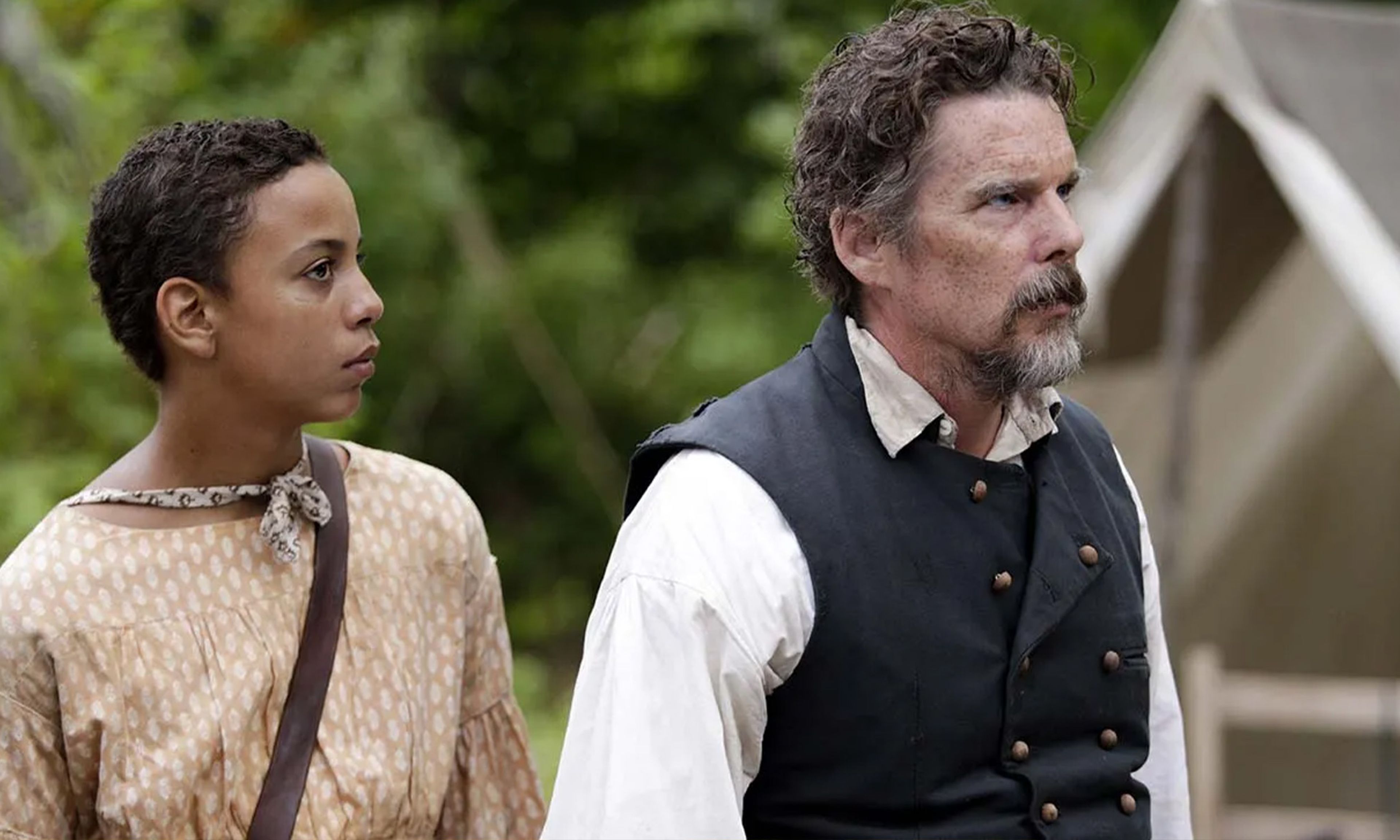
When it comes to films and TV series about slavery, I share the general weariness with moralizing melodramas wired to win awards. But to replace that genre with cartoonish horror films, as some have done lately, seems a poor remedy. Which is why, when I first started watching The Good Lord Bird, Showtime’s 2020 series about the militant abolitionist John Brown (played by Ethan Hawke), I quit after the first half hour. The first episode’s ridicule of Brown’s religiosity, and its relish of the pre–Civil War mayhem in Bleeding Kansas, made the series seem part of this unfortunate trend.
My mistake. Ridicule and mayhem pervade The Good Lord Bird, but they are but two ingredients in a rich brew of comedy, irreverence, tragedy, and reverence of the profoundest kind. Mixing these ingredients would likely defeat an ordinary artist. But James McBride, the author of the 2013 novel by the same title, and executive producer of the series, is no ordinary artist. He blends these disparate elements deftly in the voice of his narrator, Henry Shackleford, an enslaved boy bereft of family and friends who, like Huck Finn, casts his lot with a hunted fugitive. Another Huck echo is Henry’s dialect, which may defy academic classification but brings pure delight to the ear.
Before going any further, I must highlight the series’ musical soundtrack, which eschews the weighty orchestral score typical of Oscar bait in favor of a brilliant compilation of classic gospel, from the Zion Travelers to Elvis Presley and the Spirit of Memphis Quartet; set off by rhythm and blues by Elmore James and Taj Mahal; and topping the list, Mahalia Jackson and Nina Simone. McBride is an accomplished musician, and it shows.
The series opens with a teaser, in which Henry (played winningly by Joshua Caleb Johnson) reflects on Brown’s disputed legacy, concluding, “Me? I loved the man.” This sets the stage, but the love in question is slow to develop. In the first episode, set in Kansas, Henry’s enslaved father is killed in a shoot-out between Brown and a half dozen pro-slavery Missouri Red Shirts. So while making his getaway, Brown grabs Henry and spirits him away to join his band of anti-slavery guerrillas.
Having mistaken Henry for a girl, Brown pronounces him free and gives him a dress, a bonnet, and a new name: “Onion.” But Henry, or rather Onion, does not feel free. A slave until this moment, he is loath to depart from the hard-won wisdom that “no man or woman in bondage has ever prospered stating they true thoughts to the boss.”
The first step in that direction occurs when Frederick (Duke Davis Roberts), Brown’s dim-witted but good-hearted son, sights an ivory-billed woodpecker and tells Onion it’s a Good Lord Bird. (In the novel, Frederick explains, “It’s so pretty that when man sees it, he says, ‘Good Lord.’”) He then adds, poignantly, that “one feather from a Good Lord Bird will bring you understanding that’ll last your whole life. Understanding’s what I lacks, Little Onion.” Touched in spite of himself, Onion gives Frederick an ivory-billed woodpecker feather that John Brown had bestowed upon him.
From this moment of connection, The Good Lord Bird series expands into an American bildungsroman, in which Onion follows “the Old Man” (as he calls Brown) through the battles of Bleeding Kansas; becomes separated from him for a season in the rough town of Pikesville, Missouri; gets rescued by Brown’s crew; accompanies Brown on a fundraising tour of upstate New York and Canada; and takes part in the thwarted raid on Harpers Ferry in October 1859.
Needless to say, this history is dogged by disputation, the main issue being whether Brown’s zealotry was inspired by old-time Calvinist religion or impelled by some rare species of insanity. These opposites, too, are mingled in Onion’s voice, the religious side responding to Brown’s selfless courage and kindness, the insanity side reinforced by the wariness of Bob (played by Hubert Point-Du Jour), an ebony-skinned slave in his twenties who is as expert at reading other people as he is at making himself unreadable. Bob intends to flee north and rescue his family from bondage, not to die for the cause in Kansas. Onion calls him “the bravest coward I ever met.”
The Good Lord Bird contains no sermons about the prejudice of whites toward blacks, much less the distrust of blacks toward whites. This is for a good reason. To all these characters, white and black, such attitudes are as common as dirt. What matters is the shape taken by a particular attitude in the particular individual who happens to be crossing one’s path at the moment. To judge that person correctly requires fine-tuned intuition and — very important — a sense of humor. Indeed, one of the series’ chief joys is watching the characters size each other up shrewdly (with humor) or foolishly (without).
As for the creators of the series, their judgment fails in the depiction of Brown’s friend and supporter Frederick Douglass. The two men first met in 1847, when Douglass visited the Brown home and got an earful of John’s ambitious plan to ignite a slave rebellion along the lines of the Haitian Revolution at the turn of the 19th century and Nat Turner’s Rebellion in 1831. According to the historian David S. Reynolds, Douglass was impressed by the depth of Brown’s conviction, writing later that it seemed “as though his own soul had been pierced with the iron of slavery.” But Douglass could not support the plan, and at their last meeting, in August 1859, when Brown begged him to join the Harpers Ferry raid, he refused.
That later scene is powerful because of Hawke’s searing performance as an old man crushed by disappointment. But as Douglass, Daveed Diggs, a celebrated star of the musical Hamilton, doesn’t hold up his end. Douglass was not without his foibles. For example, he lived for a while with Anna, his wife of many years, and Ottilie Assing, a German journalist rumored to be his mistress. About this ménage à trois McBride has quipped, “You can’t do that in Brooklyn now!” Nor was Douglass without humor. He was known to riff playfully on his own lofty manner of speaking, and Diggs does that well, especially in the scene where he gets tipsy with Onion. But in any dramatization of the period, the actor playing Douglass must be able to summon the requisite ferocity and gravitas. And here Diggs falls short.
There is plenty of ferocity and gravitas in the rest of the series, especially episode 2, wherein Onion is re-enslaved and involved in a plot by other slaves to forge documents of manumission and safe passage. The trial and hanging of the leader, Sibonia (Crystal Lee Brown), resonates powerfully with McBride’s epigraph to both the novel and the series: “All of this is true. Most of it happened.” Sibonia is fictional, but to watch her on the scaffold with eight other souls while the soundtrack plays Nina Simone’s wrenching rendition of the Bob Dylan song “I Shall Be Released” is as true as anything I have ever seen in a film.
While awaiting his execution in the Jefferson County Jail in Charles Town, Virginia, Brown laid down the sword and picked up the pen, writing scores of letters and winning accolades from all but the hard-core South. “The situation was thrilling,” wrote Douglass years later. “An old man in the center of an excited and angry crowd, far away from home, in an enemy’s country, . . . yet calm, collected, brave, with a heart for any fate — using his supposed dying moments to explain his course and vindicate his cause.”
But crucial as those weeks turned out to be, The Good Lord Bird wisely passes over them in favor of a private visit by Onion on the eve of Brown’s execution on December 2, 1859. In a 2020 interview about the series, McBride credited Hawke and Johnson, who were sitting on either side of him, with making this “a breathtakingly beautiful scene.” He was right.












Comments