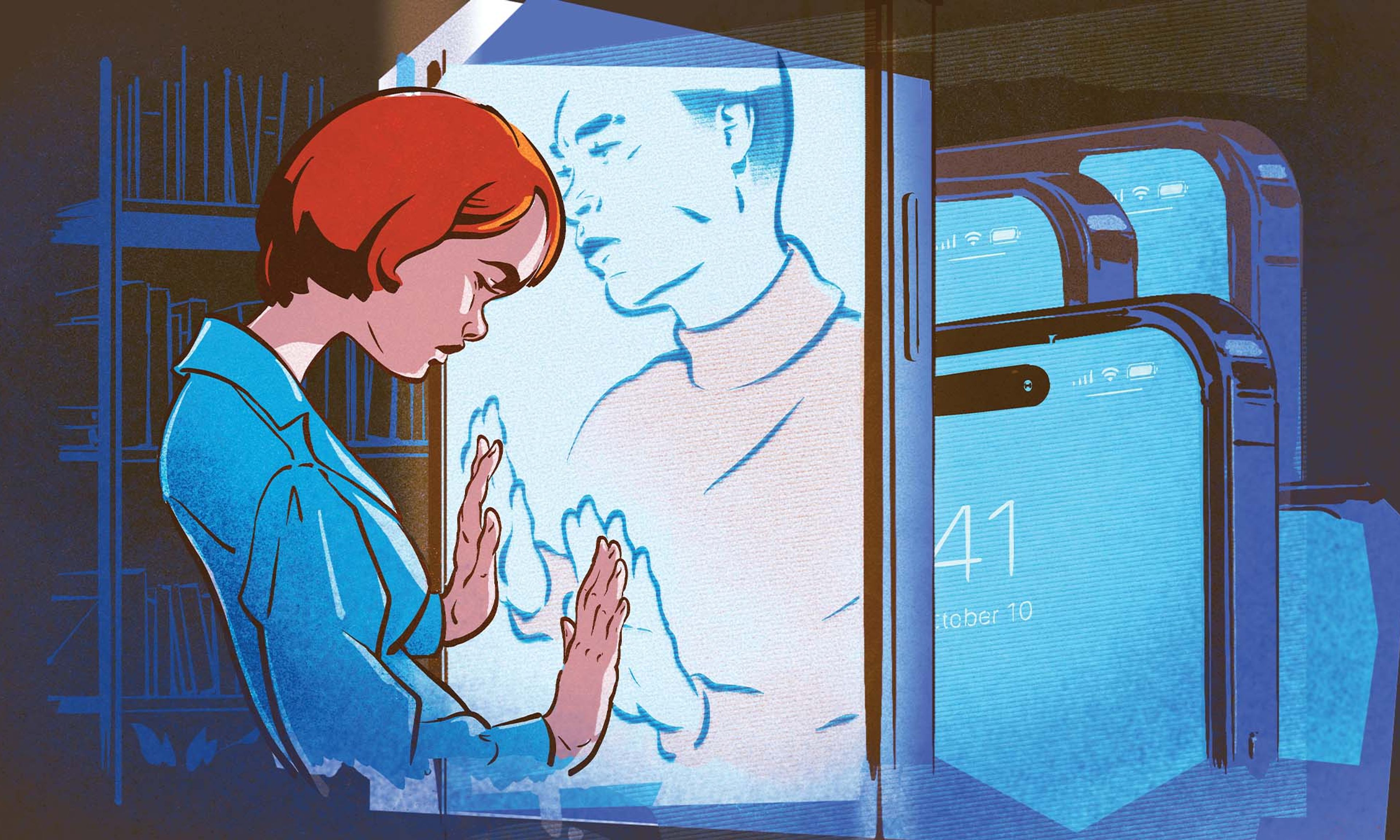
‘Long ago, before you were born, there were many more things here,” my mother used to tell me when I was still a child. ‘Transparent things, fragrant things, . . . fluttery ones, bright ones, . . . wonderful things you can’t possibly imagine.’” In Yoko Ogawa’s fable-like 1994 novel The Memory Police, set on an unnamed island, things have been disappearing. The objects themselves — ribbons, bells, stamps, emeralds — do not vanish, but their significance is swept away; the island’s residents cease to understand them, to register their meaning.
Christine Rosen’s new book, The Extinction of Experience: Being Human in a Disembodied World, argues that we are undergoing “the disappearance of experience”: “Certain types of experience — some rooted deeply in our evolutionary history, such as face-to-face interaction and various forms of pleasure-seeking; others more recent and reflective of cultural norms, such as patience and our sense of public space and place — are fading from our lives.” Rosen identifies this change with the emergence over the last few decades of “mediating technologies” (e.g., smartphone, internet) that interpose themselves “between us and the world.” Less and less do we encounter the world directly, bodily, through the immediate engagement of our senses. Instead, the world arrives filtered through our screens and software. We no longer read the book of nature; we read its Wikipedia page.
Rosen’s is a book of horrors, a catalogue — the best I know of to date — of the various ways in which human experience is being commodified and expropriated by our omnipresent digital apparatus. Her work adds a new dimension to a growing literature of digital skepticism, complementing the efforts of authors such as Nicholas Carr, Matthew Crawford, and L. M. Sacasas.
Experience is an evasive concept. The root per, which figures in both the Greek em-per-ia and the Latin ex-per-ientia, signifies a “crossing” or “passage,” a movement from one condition to another. The French philosopher Emmanuel Falque writes: “There is no experience . . . without some change of the self, without the act of being transformed or metamorphosed or without recognition of ‘no longer being the same.’ Experience passes through us and changes us deeply.” Experience, we might say, is the transformative knowledge we acquire through engagement with the world as it discloses itself to us. The “experienced” sailor knows “in his bones” the patterns of wind and tide, because he has spent rough weeks and months and years at sea. The experienced physician knows how to soothe and heal, because he has learned to match every condition with its remedy. Experience develops powers of discernment, judgment, and mastery.
The effect of placing technology in front of the world, Rosen argues, is to interrupt the processes, small and large, by which we become experienced. To take just one of her many disturbing examples: SmileScan is “a machine that uses a small video camera to scan a person’s face . . . [and then] delivers a verdict on the intensity and authenticity of the smile and ranks it on a percentage scale of 0–100.” In 2009, SmileScan was employed by the Keihin Electric Express Railway Company in Japan to prod workers to look cheerier. (Because digital devices and applications are predicated on data-gathering, almost all of them have implicit surveillance capacities; digital technology hates privacy.) The key effect of a technology such as SmileScan, Rosen argues, is not to validate our intuitions (“What a jolly person!”) but to undermine them, and to encourage us to subordinate our assessment to that of the machine. Was that a genuine smile, or is he faking it? We are tempted to defer to the computer — much as we use our smartphone’s calculator rather than rely on our mental multiplication tables, or use GPS to navigate our own neighborhoods — to double-check our impressions against the machine, which offers a false promise of objectivity. So, in fact, the computer does not backstop our judgment; it begins to replace our judgment. The logical end point is of course not that smiles disappear but that, like the residents of Yoko Ogawa’s island, we gradually outsource our ability to discern their nuance.
The Italian thinker Giorgio Agamben refers to the “non-translatability” of experience in modern times. For Agamben, events take place, but they no longer press into us, changing and transforming us by the friction of encounter; they simply happen, passing in front of us like a dumb show. Digital technologies, as Rosen makes clear, intensify this sense of non-translatability. The remote employee who spends all day in front of his computer, typing up memos, creating presentations, receiving and sending emails, reports at the end of the day: “Nothing happened” — that is, he experienced nothing.




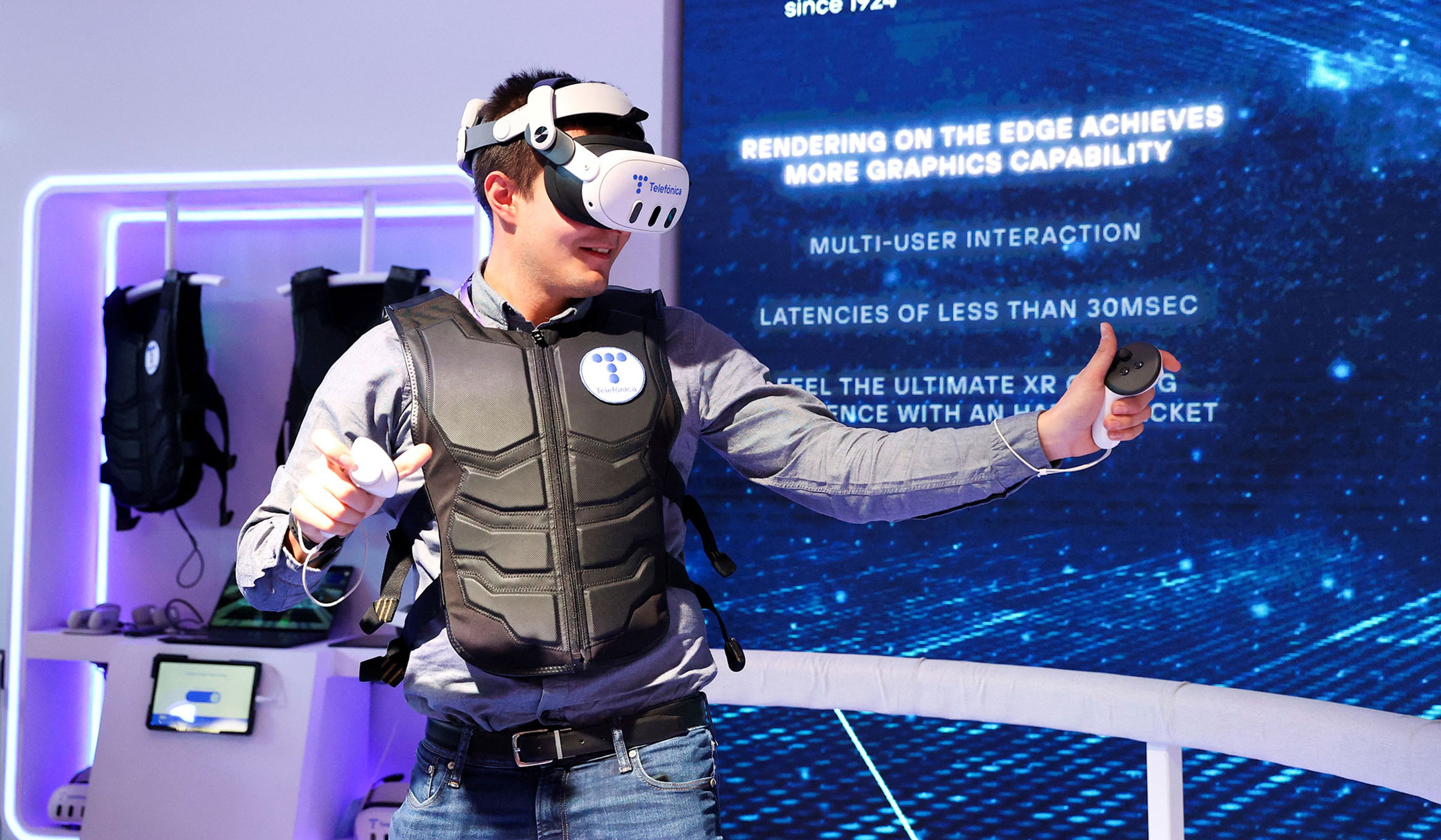

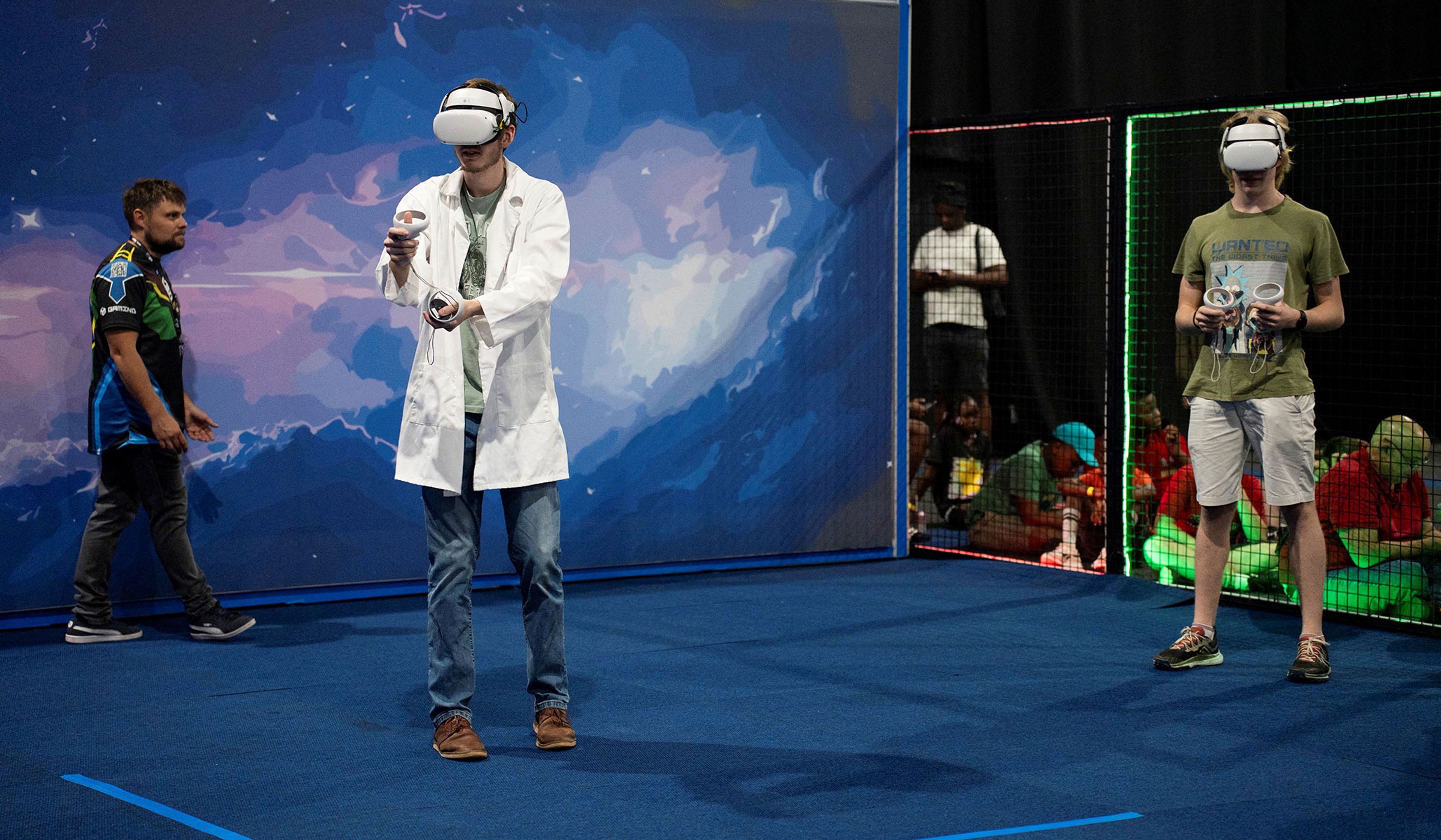
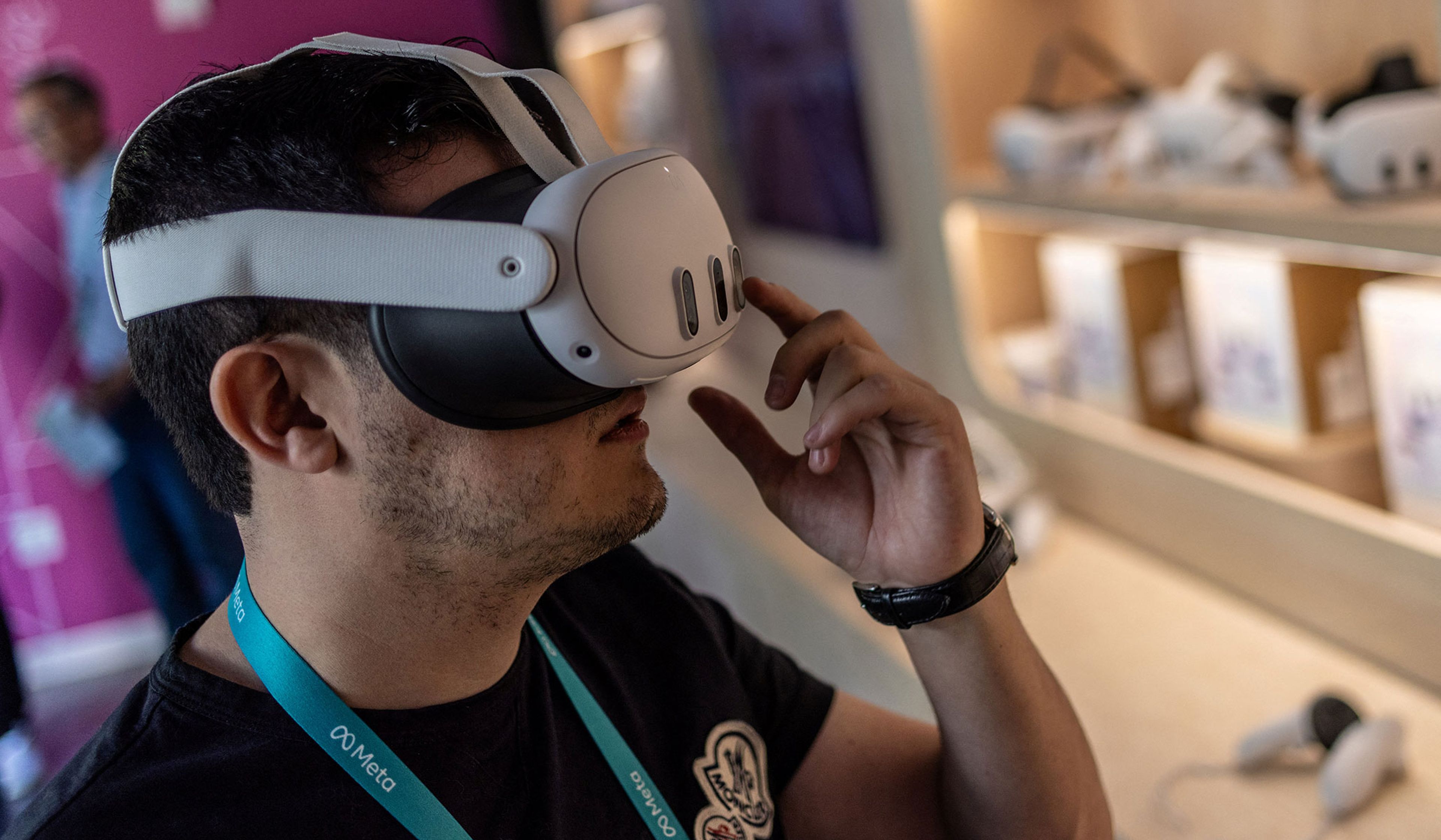
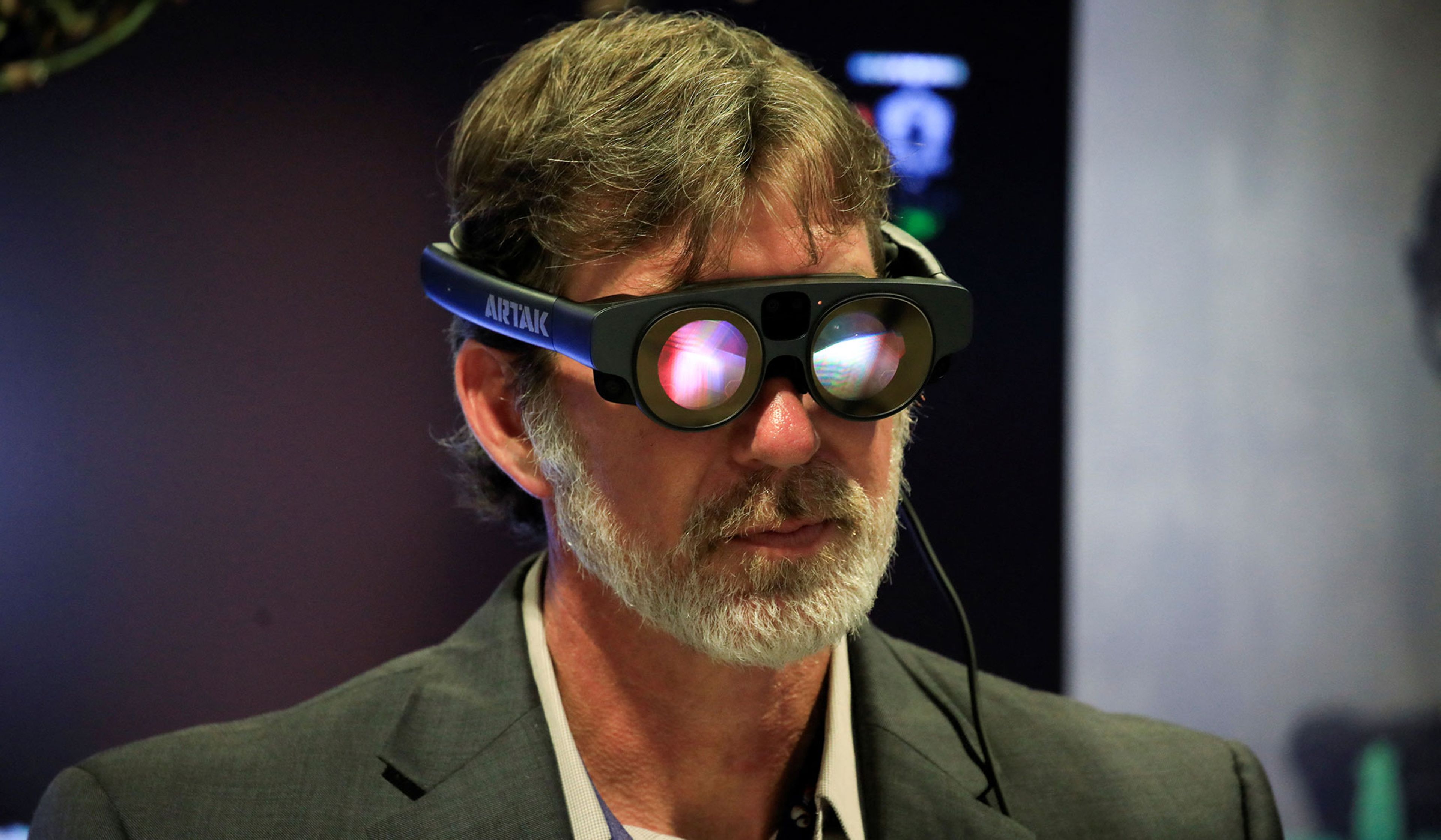
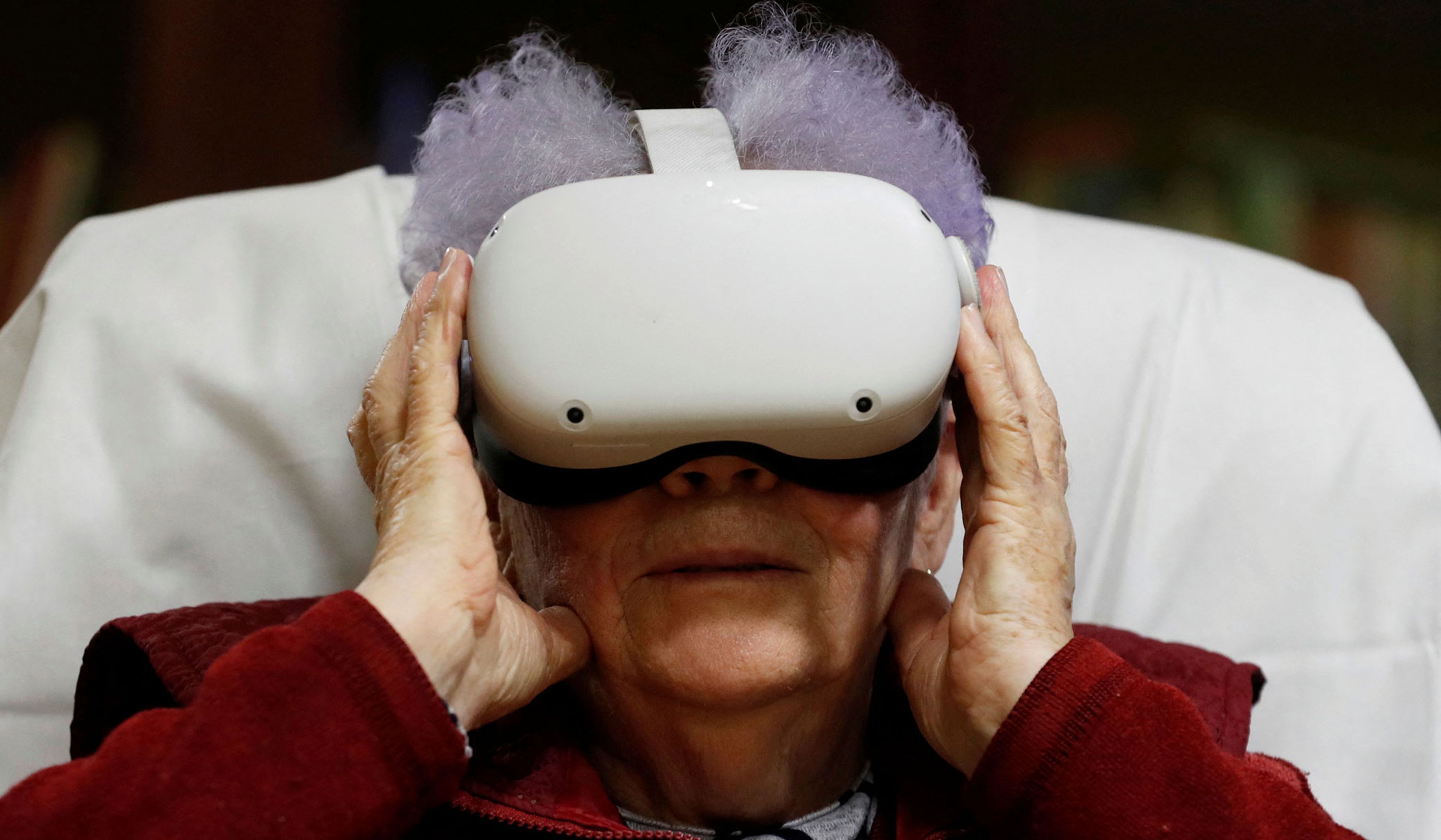
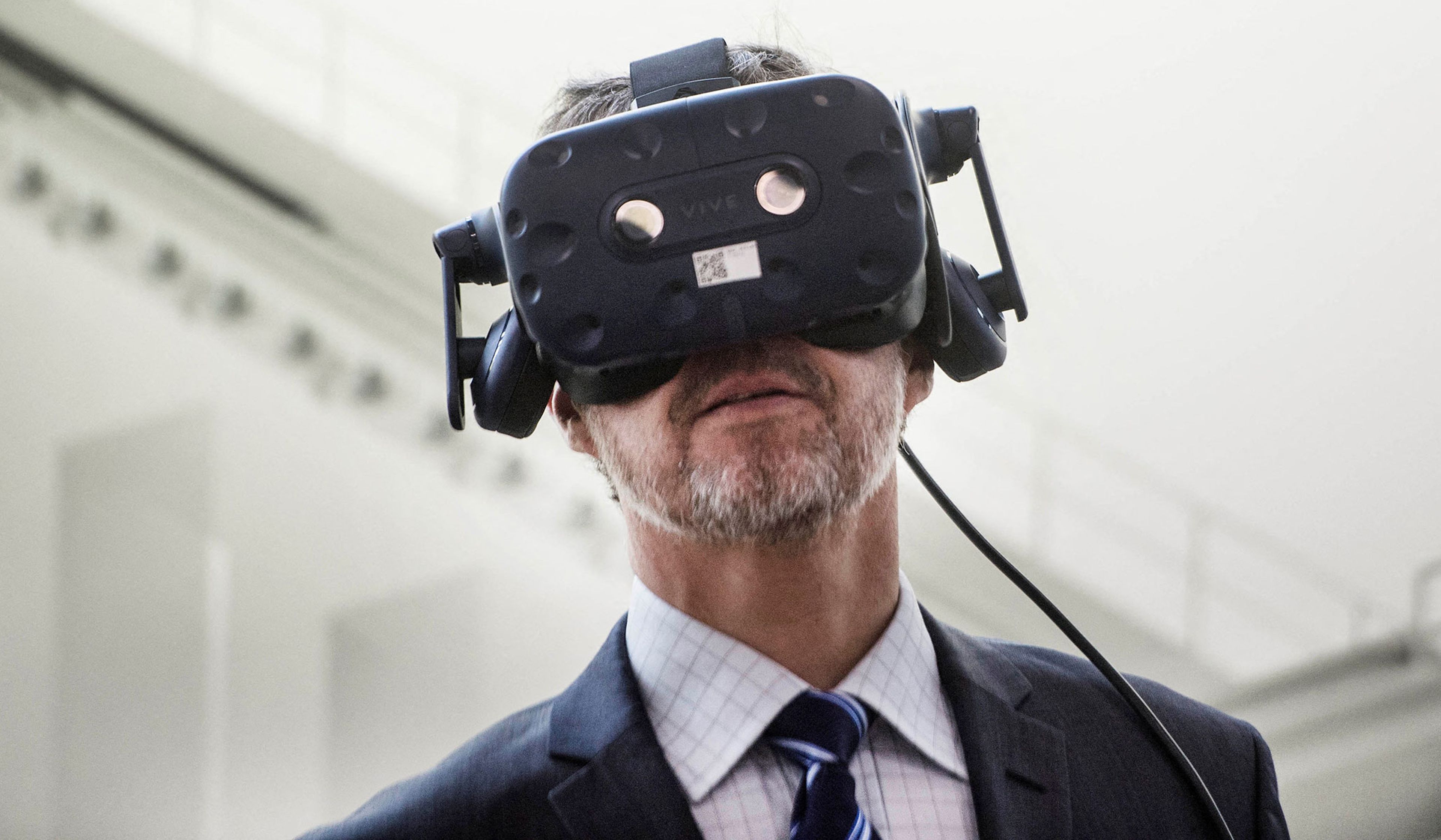
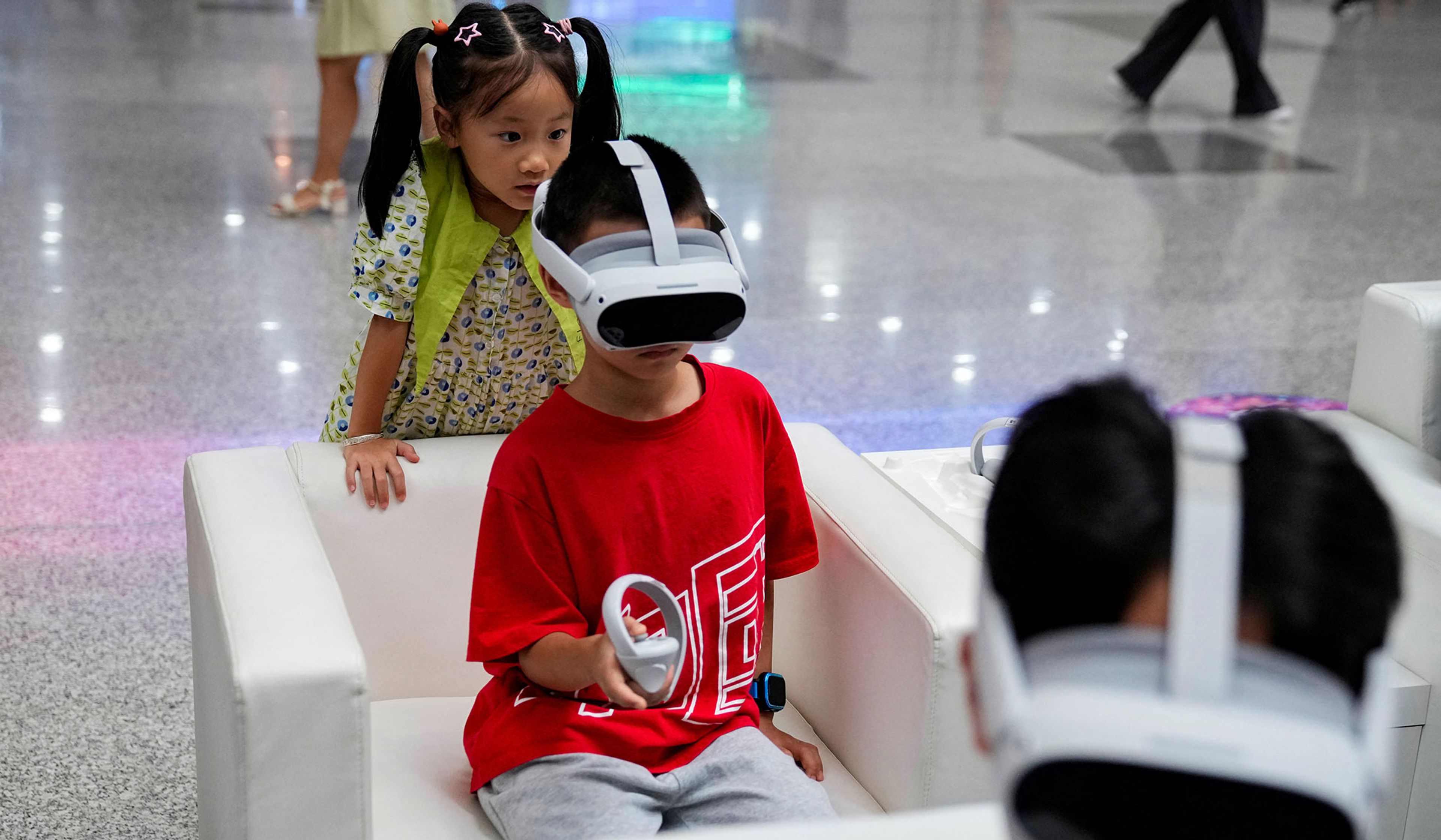
A man uses a JioDive smartphone-based virtual reality headset in the Jio exhibitor stall at the India Mobile Congress 2023 in New Delhi, India, October 27, 2023.
Anushree Fadnavis/Reuters
Our engagements with digital technology tend not to “show up” as experience in the way that “real-world” engagements do — steering the sailboat through a squall, for instance — because digital technology is, in an important respect, not there (unlike the boat and the storm, which are immediately and unavoidably there). Its appeal depends on its transparency, the ease with which it becomes an extension of our natural capacities. The seductive power of the iPhone is that it is much more pleasant to manipulate than any of the “real” objects around it; so it is not the iPhone that stands out in our perception but everything that is not the phone. The drive of our digital technologies, as Rosen notes, is toward “seamlessness,” “frictionlessness,” toward lowering resistance — which is to say, toward reducing precisely the direct, bodily engagement through which events become experience.
The philosopher Hans-Georg Gadamer writes: “Experience is experience of human finitude. The truly experienced person is one who has taken this to heart.” Digital technologies are designed to negate the sense of limitation that forms the core of all experience. It is no coincidence that the ultimate “problem” that Silicon Valley aims to “solve” is death, as if mortality were a defect of code. And for that reason, the relentless drive of current technologies is toward complete integration with the body, or, rather, complete assimilation of the body to digital technology. This will be called “transcendence.” In fact, it will be the final extinction of experience — and, functionally, the extinction of the human.
What, then, can we do? In her concluding chapter, Rosen writes: “A decade ago, a book about how technology is changing us would offer solutions for a more balanced relationship with our devices, such as take a digital Sabbath, avoid multitasking, and put those phones away at the dinner table! These are no longer enough.” She advises, instead, an “Amish approach to technology, cultivating a robust skepticism about each new device and app, even if most of us will not be as strict as the Amish in rejecting them. The Amish ask the right questions before embracing something new: How will this impact our community? Is it good for families? Does it support or undermine our values?”
This is not an altogether satisfying answer. But there is a more radical way to construe Rosen’s suggestion that might begin to show the difficult way forward. The solvent effect of digital technology on every form of community — families, schools, churches, cities, nations — means that there are few groups well defined enough anymore to make and enforce these kinds of decisions. The stability and integrity of Amish community make possible kinds of judgments that are impossible elsewhere. So, before we can adopt the Amish decision-making process, we will have to adopt the Amish commitment to a particular Ordnung, a particular order or rule of life. That is, we will have to reconstitute the “we” that can make authoritative communal judgments. We will have to reestablish communities, from the family upward, that are devoted enough to a certain vision of life that they can withstand the siren call of digital “convenience.” Digital technology has broken down most efficiently those communities whose bonds were already fraying; it has been held in check most effectively by those communities who know who they are and what they value. Founding, or refounding, communities of this type will not be easy under current technological conditions, and we should acknowledge that, at least in the near term, these communities will unavoidably find themselves sharply at odds with the prevailing culture. But it is difficult to see an alternative.
Conservatives have a particular role to play here. The conservative outlook depends upon the possibility of experience: that the world is not essentially different from one generation to the next, that the knowledge acquired over a lifetime carries authority and can be passed down with profit to those who come after. Because of their attention to the inheritances of history and experience, conservatives are, or ought to be, wise to the madness of trying to create a seamless, frictionless existence. The limitations that the world imposes on us are not the denial but the confirmation of our humanity. As digital technologies become more and more integrated into our lives, someone must hold on to the human difference. The narrator of The Memory Police observes: “The island is stirred up after a disappearance. . . . [But] soon enough, things are back to normal, as though nothing has happened, and no one can even recall what it was that disappeared.”












Comments