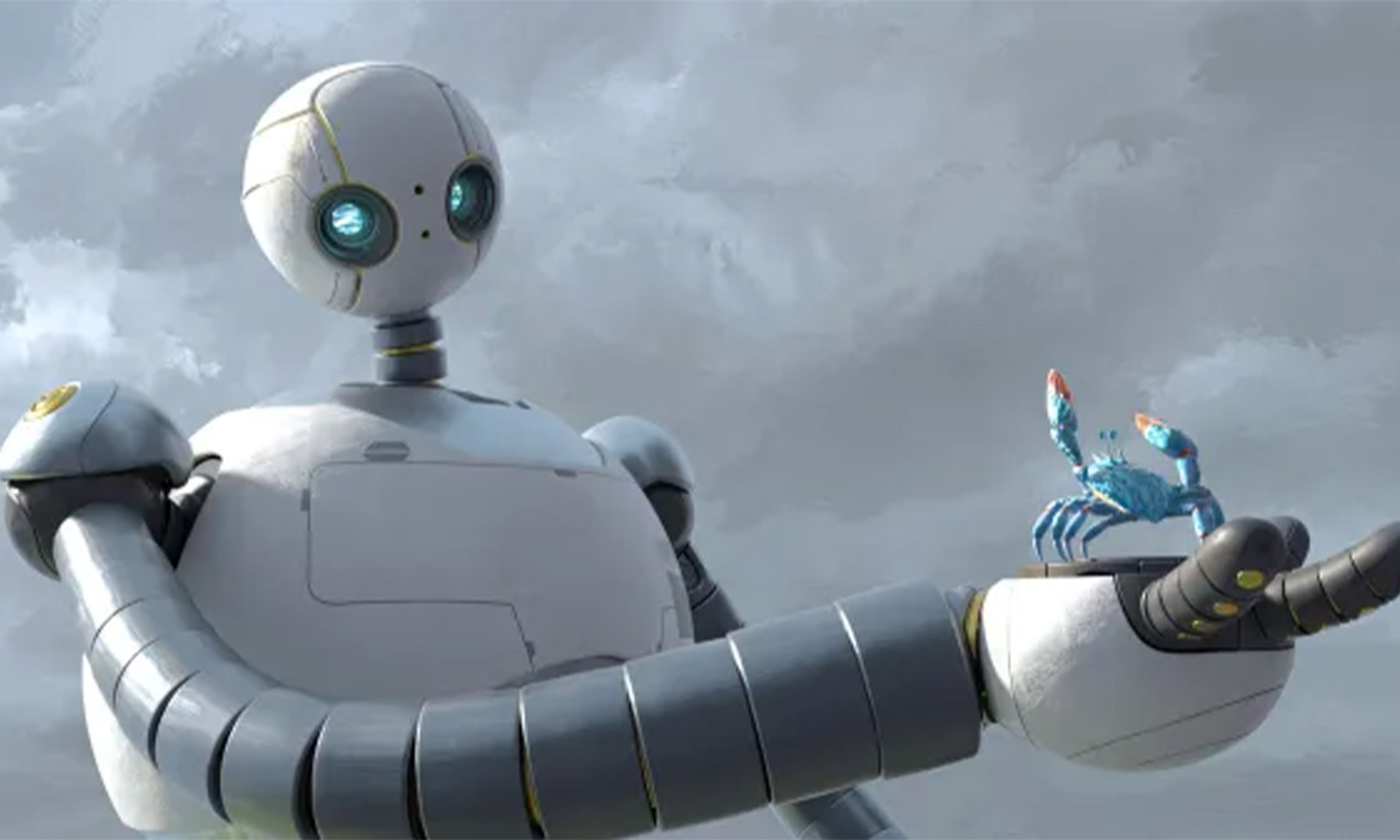
The Wild Robot is an initially lovely, ultimately overbearing piece of children’s entertainment that doubles as a work of anti-humanism well suited to the pessimism of the age. Or maybe pessimism is the wrong word, since it traffics in a kind of optimism about sentience and the natural world. It’s just that it gets there by inviting its audience of human beings, a species at once corrupt and obsolete, to contemplate a better future in which we cede our planet to a morally superior alliance of Bambi and AI.
Walk with me through the story. We begin on the stony beach of a vaguely Cascadian island, where a robot, Rozzum Unit 7134 — voiced by Lupita Nyong’o and known throughout the story as “Roz” — wakes up after a shipwreck that interrupted her progress from the factories of the megacorporation Universal Dynamics to a life assisting human beings in some sort of futuristic country-club existence. Seeking purpose, an owner, a set of instructions, or a task to follow, she galumphs around the unspoiled isle, making efforts at communication that end up only terrifying the various animals that call the island home.
This early phase of the movie is by far the best, setting the robot’s pre-programmed expectations and stilted mannerisms in counterpoint to the instincts of the wildlife, and playing around with one of the more striking visual palettes of any recent animated effort. Meadows and fogs, dark water and verdant forest: Roz moves through a painterly landscape that her own metallic form throws into lush relief.
Eventually, the plot arrives: Roz’s failure to communicate finally inspires her to turn her central processor to work on figuring out the dialects of animals, translating the common speech of all the island’s fauna — making good (and then some) on recent speculation that AI may soon be able to translate whalesong. Soon after this breakthrough, she crashes into a goose nest and accidentally kills its occupants, save for one runty gosling (Kit Connor), whose survival becomes her task and purpose. He acquires a name, Brightbill, and she acquires an adviser, the cynical fox Fink (Pedro Pascal), who helps her coach the runt through his three great duties: learn to eat, learn to swim, and learn to fly and migrate.
From this point on, the movie finds itself telling too many kinds of stories at once: It’s Wall-E meets Fly Away Home meets The Iron Giant meets The Trumpet of the Swan meets Robinson Crusoe meets AI: Artificial Intelligence meets . . . you get the idea. The character of Roz acquires free will, emotions, a metaphorical heart to occupy her tin woodswoman’s chest. Brightbill sets off on an odyssey that gives us glimpses of the wider world, with cities drowned by climate change and humans retreating into gated communities surrounded by robot-stewarded hydroponic fields. The animals that don’t migrate are saved from a harsh winter by the warmth of Roz’s wigwam (add Noah’s Ark to the list of references), and under her benevolent stewardship they abandon predation in favor of cooperation (throw in the Book of Isaiah). And then, at last, Universal Dynamics shows up to reclaim and reprogram its rogue robot, and not surprisingly the robot’s adopted ecosystem has her back.
All this overstuffedness tends toward one distinctive theme: not Roz’s humanization, exactly, because we aren’t given any models of human beings for her to admire or emulate, but rather her superiority to her human masters, insofar as she finds a way first to live in harmony with the natural world that Homo sapiens has ravaged and retreated from, and then to bring harmony to nature, establishing a peaceable kingdom not in the eschaton but right here, on her island, safe as long as humans and their corporations can be kept away.
Contrast this narrative with one of the cinematic references I listed, Pixar’s Wall-E. That older movie has a similar starting point, a robot on its own in a world that human beings have trashed and then abandoned, but its story ultimately sets the robot to the task of rekindling the human spirit, making a bloated and decadent humanity remember its rich past and pioneering destiny.
Wall-E is a robot movie for humanists, in this sense, where in becoming self-aware, artificial intelligence calls our own human intelligence back to our truest self. Whereas The Wild Robot is a robot movie for the kind of people who welcome our AI inheritors and the kind of people who got a weird thrill from Alan Weisman’s The World without Us — joining ecological anti-humanism with singulatarian anti-humanism, and imagining an Eden of steel and fur, where the old Adam has no place.












Comments