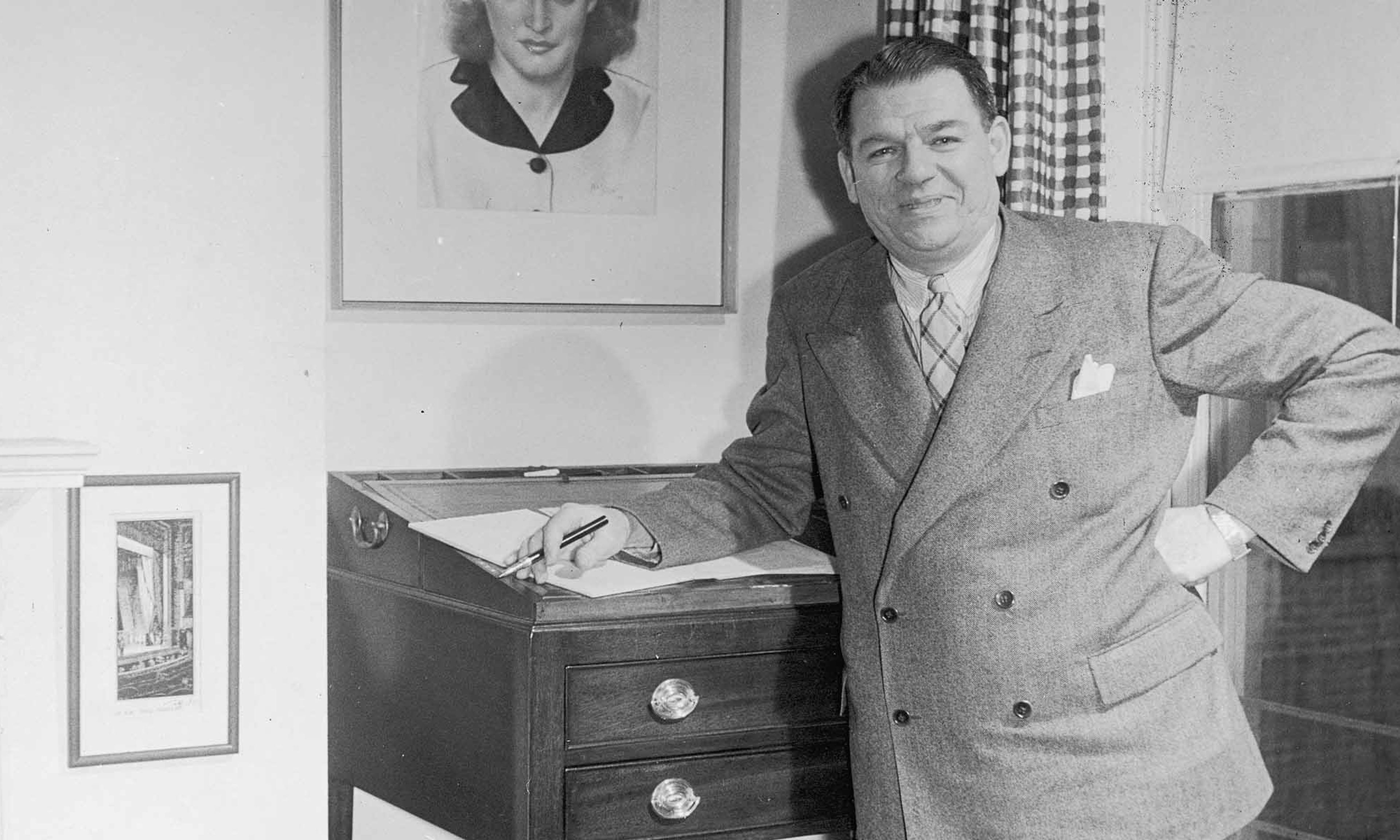
What are we seeking when we read the diaries, journals, or correspondence of great men? In this cynical age, in which examples of hypocrisy are not just expected but actively pursued, many of us are looking either for a hint of scandal or a chink in the armor — some sign that an admired figure is not, in fact, without faults, or, by the same token, some confirmation that a disliked figure is, it turns out, eminently worthy of disfavor.
The lyricist and librettist Oscar Hammerstein II would seem to be a prime candidate to be taken down a few notches by the cognoscenti. In partnership with the composer Richard Rodgers, Hammerstein, who was born in 1895 and died in 1960, dreamt up several of the most lasting, consequential, and — to the chagrin of the jaundiced and sardonic-minded everywhere — buoyantly life-affirming, lesson-teaching musicals of the 20th century. Oklahoma! (1943), the earliest fruit borne of what became a rich, decades-long collaboration, offered a grand, festive vision of America on the move, while Carousel (1945) took a tragic, rather tawdry tale — about the romance between loutish carnival barker Billy Bigelow and the woman he loves, Julie Jordan — and wrung from it wisdom about resilience and redemption, embodied in the show’s most famous tune, “You’ll Never Walk Alone.”
Because Rodgers composed melodic, sweet-sounding music and Hammerstein wrote straightforward, plainspoken words, modern audiences are apt to scoff at such songs as “Oh, What a Beautiful Mornin’,” from Oklahoma!, or “Climb Ev’ry Mountain,” from The Sound of Music (1959), which, in fairness, came in for criticism from the beginning from those who claimed to be smarter and savvier than the songs’ makers; film critic Pauline Kael, then with McCall’s, described the film version of The Sound of Music as “the sugarcoated lie that people seem to want to eat.”
Todd Purdum’s 2018 dual biography, Something Wonderful: Rodgers and Hammerstein’s Broadway Revolution, was largely sympathetic, but the instinct to diminish these exceptional men was evident in the details included about Rodgers’s alcoholism and Hammerstein’s affair with a showgirl — as though we should be singularly shocked by the moral lapses of men who so earnestly espoused virtuous behavior.
Happily, cynical readers who crack the spine of the epic-length Letters of Oscar Hammerstein II with the expectation of encountering a man substantially different from his public image will be sorely disappointed. It turns out that Hammerstein was not too good to be true but as good as his admirers would hope. “Having spent the last two-and-a-half years working with his correspondence,” writes the book’s editor, Mark Eden Horowitz, “I am convinced that Hammerstein was not only a great man of the theater — a richly talented writer and an astute businessman — but also a profoundly good human being.”
Indeed, strewn throughout this volume’s thousand-plus pages are numerous glimpses into Hammerstein’s gentle, considerate, courteous soul. In January 1929, he writes a striking series of letters to his soon-to-be second wife, Dorothy Blanchard Jacobson, about his hopes for a blissful future together. “My dream is to make the fortune which seems to be piling into my lap, . . . and then to settle down to a beautiful life with my beautiful girl, and aim only to write masterpieces, or nothing,” he writes. In another letter written the same month, he expresses the almost corporeal agony he experiences upon being apart from her. “The thing I refer to feels almost physical — like the silver chord which binds a mother and child,” he writes. “There is a golden chord which ties me to you, and the longer we are parted, the more it stretches — and hurts me.” What gives weight to these lovesick dispatches is the fact that the couple — who each had children with previous spouses and who later had a son of their own, James Hammerstein — remained married until Oscar’s death.
Examples abound of Hammerstein’s plain, ordinary decency, courtesy, and kindliness. No pushover and sometimes quite merciless in matters of business, he insists on controlling the casting in his productions but, in some wonderfully revealing letters included here, seeks to avoid causing undue offense to those who wished to be part of his latest blockbuster. In letters from 1944, he gently pushes back on suggested casting for the role of Julie Jordan in Carousel, an ingénue in Rodgers and Hammerstein’s conception. When an agent proposes 46-year-old Shirley Booth, Hammerstein writes, “Shirley Booth, who is a very good friend of mine is also a very good actress and completely unsuited for the part of ‘Julie.’”
Years later, when preparing the film version of South Pacific, Hammerstein writes to director Joshua Logan to express his misgivings about Italian actor Rossano Brazzi’s singing voice (“We just played an Italian record made by him, and his voice did not sound good at all”), and when the decision is reached to dub Brazzi, the librettist does contortions to let the performer down easily, arguing that his inferior singing would obscure his superior acting: “We all think it would be a pity for you to succeed so brilliantly in one department and open yourself to criticism in the other department.” Of course, Hammerstein was a showbiz man through and through — the son of theater manager William Hammerstein, he writes in a missive to Dorothy that he was “born a trouper” — so perhaps he was simply speaking the language of the savvy schmoozer.
At the same time, Horowitz’s exhaustive approach clearly demonstrates that Hammerstein was sensitive, caring, and honorable, whether addressing a colleague, business associate, or friend — or writing on behalf of a stranger. During World War II, Hammerstein writes to actress Lena Horne at the request of his son William, who was then serving in the Navy and whose friend in the service, who was African American, coveted an autographed photo of Horne. “His name is Nick,” Hammerstein writes. “I don’t know his last name. You could send the picture to me and I would forward it or if you wish you could send it to . . .” What appealing, unpretentious decency this request exudes! Included, too, are answers to fans’ inquiries — in 1949, Hammerstein explains to one Francis S. Milton that the mixed tenses of “Some Enchanted Evening” in South Pacific referred to an idealized, rather than a specific, romance: “In other words, on some enchanted evening, any evening at all, one may — is likely to — see a stranger and at that time (even then), somehow one knows that she will see him again — tomorrow, the next day, or sometime in the future” — and earnest apologies for unintended slights, as when, in 1959, he claims to Tennessee Williams that he was misquoted in having expressed disapproval of the playwright’s works: “You and I may be on opposite sides as philosophers, you more preoccupied with the seamy side of life, I with the brighter side,” Hammerstein writes, declining, in his apology to Williams, to apologize for himself, either. “But I believe we should go our separate ways and follow our separate inclinations without feeling it necessary to disapprove of each other.”
Hammerstein humors requests for his wisdom that seem to come in from all corners. In 1957, when invited to submit some words to a volume consisting of “best advice,” he answers, “Develop the habit of being honest with yourself,” and in 1960, when asked by a high-school freshman about his view of “the greatest need today, to elevate and edify youth,” he replies, sharply but sincerely, “To direct them back to elementary and very old-fashioned principles, to stress the importance of honesty and faith in goodness and respect for elders.”
Although Hammerstein’s liberal political convictions can induce eye-rolling — there are many references here to the United World Federalists — he was, in fact, a man of the old school whose belief system was sturdy, sound, and true. In 1960, to a longtime friend who takes issue with the “pure unadulterated treacle” of The Sound of Music, Hammerstein fires off a defense of the majority who loved the show against the minority who condemned it: “Who the hell is ‘we’? You and a very small minority who agree with you? It is certainly not the people who see the show every night and rush to the box office to buy tickets for future performances, nor the strangers who fill my desk with letters thanking me for the beautiful evening they have spent.” Here, Hammerstein is not merely trumpeting box-office sales but pointing out the way in which a work of popular art connects with an appreciative public, one that was not to be condescended to.
We knew that Oscar Hammerstein II was a good man, because of the words he set down on paper and gave to the world. Think of Bloody Mary’s extraordinary refrain in “Happy Talk” from South Pacific — “You gotta have a dream / If you don’t have a dream / How you gonna have a dream come true?” — and its sublimely simple line of reasoning: One cannot hope to realize a dream that is not first dreamt, so it follows that one must dream in order to achieve what one wants. It is nice to know that the fellow who penned these words, whatever his flaws or foibles, largely lived up to their impossibly beautiful ideals.












Comments