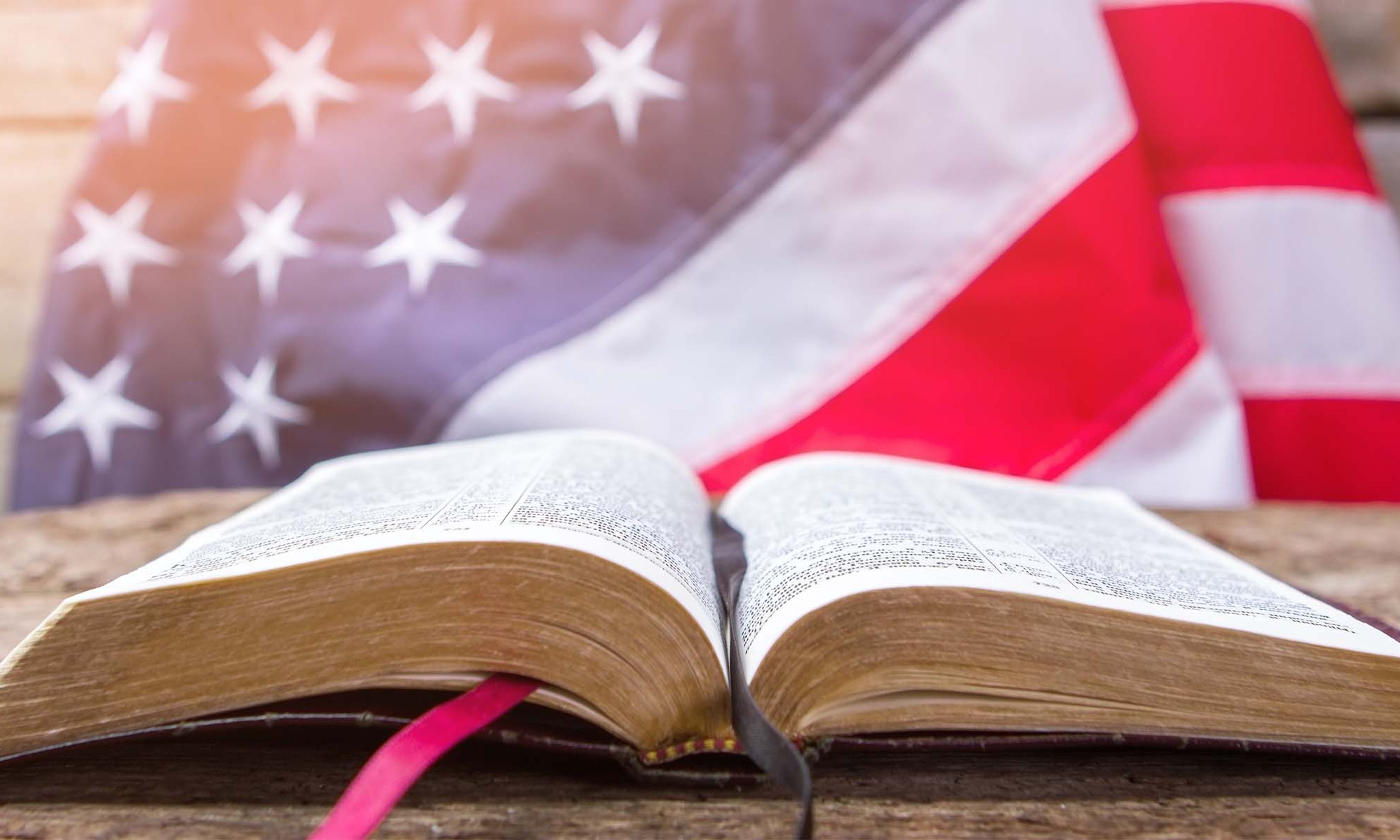
I’m a confirmed Protestant, but with so many family members and friends who are Catholic, I am content with a live-and-let-live ecumenism. I have one red line, though — the King James Version of the Bible is, as far as I’m concerned, the only translation worthy of the great truths and profound sentiments of the Good Book.
My wife and I got married in a Catholic service, but I insisted our priest use the KJV for the readings. The same goes for any other solemn occasion. When I had selected passages for another blessed event, I found my wife sitting at the kitchen table going through printed-out copies with a pen. What was she doing? I asked. She explained that she was editing out the “thou”s and “shalt”s as a courtesy to our friends doing the readings who might be intimidated by the archaic language. No, you can’t do that!
Mark Noll’s new book is dedicated to the proposition that throughout American history, most everyone in this country would have agreed with me.
Noll is a prodigious scholar of Christianity and the author and editor of dozens of books. America’s Book is the sequel to In the Beginning Was the Word: The Bible in American Public Life, 1492–1783. Together, the two books constitute a rigorous, extremely well-informed history of one of the most important aspects of American civilization.
That said, America’s Book is not for the faint of heart. It clocks in, including the notes and index, at 864 pages. It’s hard to see anyone who isn’t a specialist or an extremely diligent reader actually reading every word. I mean no disrespect to Noll’s considerable achievement to wonder why he could render roughly 300 years in a sprightly 448 pages in the first volume and took nearly 900 pages to cover a little more than 100 years in the second. The editor in me is inclined to believe that less is more, but no one asked me to edit America’s Book.
The story of the King James Version begins with William Tyndale, a giant of Anglo-American history. The 16th-century scholar and priest was a supremely talented wordsmith. He set about translating the Bible into English over opposition from authorities, particularly the Catholic Church. It is said that a learned man once rebuked Tyndale for his efforts, to which the translator replied: “If God spare my life, ere many years I will cause a boy that driveth the plough, shall know more Scripture than thou doest.”
It wasn’t idle boasting. Tyndale, who had to live a life on the run, paid the ultimate price for his vision. After getting betrayed to Catholic officials in Antwerp, he was condemned as a heretic and burned at the stake.
But his translation was a work of literary genius. It introduced many commonplace phrases into the language (“apple of his eye,” “cast the first stone,” “scapegoat,” “two-edged sword”) and formed the basis of subsequent English translations, most importantly the version authorized by the Protestant king of England James I as he sought to buttress his rule.
The result was the single most influential work in the English language. The KJV matches or surpasses Shakespeare in its literary brilliance, and yet shockingly, counter to a cardinal rule of good draftsmanship, it was completed by committee.
Noll picks up the story in America after the Revolution. The colonists had used the Bible, which in their reading condemned monarchy, as a battering ram in the revolutionary cause. After independence, they hoped freely chosen public devotion to the Bible would become the substitute for the state-sponsored churches of Christendom, a guarantee of the virtue necessary for ordered liberty. “It was as if,” Noll writes, “Martin Luther and Thomas Jefferson had met, argued, converted each other, and then determined to work in harness.” The foundation of the cooperative arrangement was the King James Bible.
There were tensions within this broad agreement. So-called proprietary Protestants — Congregationalists, Presbyterians, and Episcopalians — embraced free exercise but still wanted various forms of public support for religion. Sectarian Protestants — the Baptists and various dissenters — rejected any form of coercion. The proprietary Protestants, who represented the elite of the new nation, were “the Federalists at prayer,” Noll writes; the sectarians, on the other hand, allied with the Jeffersonians.
In a democratic society, the playing field tilted markedly away from the establishment. “Sectarian Protestants surged in the new republic,” Noll writes, “because of down-to-earth preaching, general earnestness, eagerness to evangelize the frontier — and aggressive reliance on the Bible alone.”
This dispensation got an enormous boost from the explosive growth of Methodism, a deeply democratic revival movement that didn’t engage in the nation’s political debates, instead focusing on personal holiness achieved through intense engagement with Scripture.
As Methodism’s founder, John Wesley, put it (betraying his classical education), “God himself condescended to teach the way: for this very end he came from heaven. He hath written it down in a book. O give me that book! At any price give me the Book of God! I have it. Here is knowledge enough for me. Let me be homo unius libri” (a man of one book).
Over time, Methodism influenced the flavor of all of American Protestantism. This Bible civilization, which succeeded in fostering a thriving Christianity without Christendom, required Bibles — and lots of them.
American printers produced 1,023 editions of the Bible from 1801 through 1840. Tellingly, from 1794 to 1815, printers published 186 novels — and 246 editions of the Bible. Almost all of them were the KJV.
The American Bible Society was founded in 1816 and began the production and distribution of the Bible on an industrial scale. In 1830, the country had about 2 million total households, and the Society printed 786,000 Bibles in the three years from 1829 to 1831 alone. In a number of states, auxiliaries reported delivering Bibles to every household that didn’t yet have one.
The common schools, or tax-supported public schools, did their part by making Bible readings part of the curricula. The belief was that the KJV was nonsectarian, a historic part of the American project and a pillar of morality. Catholics and Jews, naturally, objected to the use of a Protestant Bible in the schools. Over time, various courts ruled against such readings, yet many upheld them. As a mid-19th-century Massachusetts decision put it, the Bible was “the best book” to inculcate the “virtues which are the ornaments of human society, and the basis upon which a republican constitution is founded.”
For all this, much of Noll’s book is the story of the decline of the Bible civilization. The sectional conflict over slavery played out in rival interpretations of the Bible. The proslavery advocates simply argued that the Bible sanctioned the enslavement of non-Hebrews, and that the New Testament accepted slavery without question — case closed. Antislavery writers countered, among other things, that American slavery was vastly different from the servitude in the Bible and that the institution involved flagrantly violating the teachings of Jesus. The inability of the Bible to speak decisively to this central moral and social question struck a damaging blow to its status.
Meanwhile, the postbellum growth of Catholic, Jewish, Mormon, and other non-Protestant populations — as well as divisions among Protestants — eroded the once exalted standing of the KJV. Bible-reading in schools gave way under pressure, although as late as 1950 the New Jersey Supreme Court upheld it in the state (“The Old Testament, because of its antiquity, its content, and its wide acceptance, is not a sectarian book when read without comment”). The sources of American information and entertainment broadened immeasurably, shrinking the Bible’s relative market share.
(Throughout the period covered by the book, as Noll scrupulously catalogues, African Americans built and maintained their own robust Bible culture particularly focused on the themes of exodus and freedom.)
It’s not as though the presses stopped. From 1866 to 1875, the ABS published another eleven and a half million Bibles and New Testaments. When the Society shut down its own printing plant in 1922 to outsource the job instead, it had produced more than 76 million Bibles in 68 languages. The Bible remained an important touchstone in churches, in homes, and in the culture, just not the near universally accepted guide for the nation and guarantor of its virtue once envisioned.
In his epilogue, Noll addresses the present. This is a vantage point from which the Bible has fallen even farther than at any time he writes about in the main body of the book. But he takes heart from a large-scale survey not long ago that showed Bible-reading — almost equally prevalent now among Protestants and Catholics — retaining notable purchase, and the KJV still hanging in there.
Still, the book that has done so much to shape our understanding of God and ourselves, to comfort and inspire countless millions, to influence our literature, rhetoric, and public life, is sure to slip farther in the consciousness of the nation and individuals. With that in mind, Noll’s concluding thought in this formidable work — “that a democratic republic needs something like the Bible more than Bible believers need a democratic republic” — has an unmistakably monitory note.












Comments