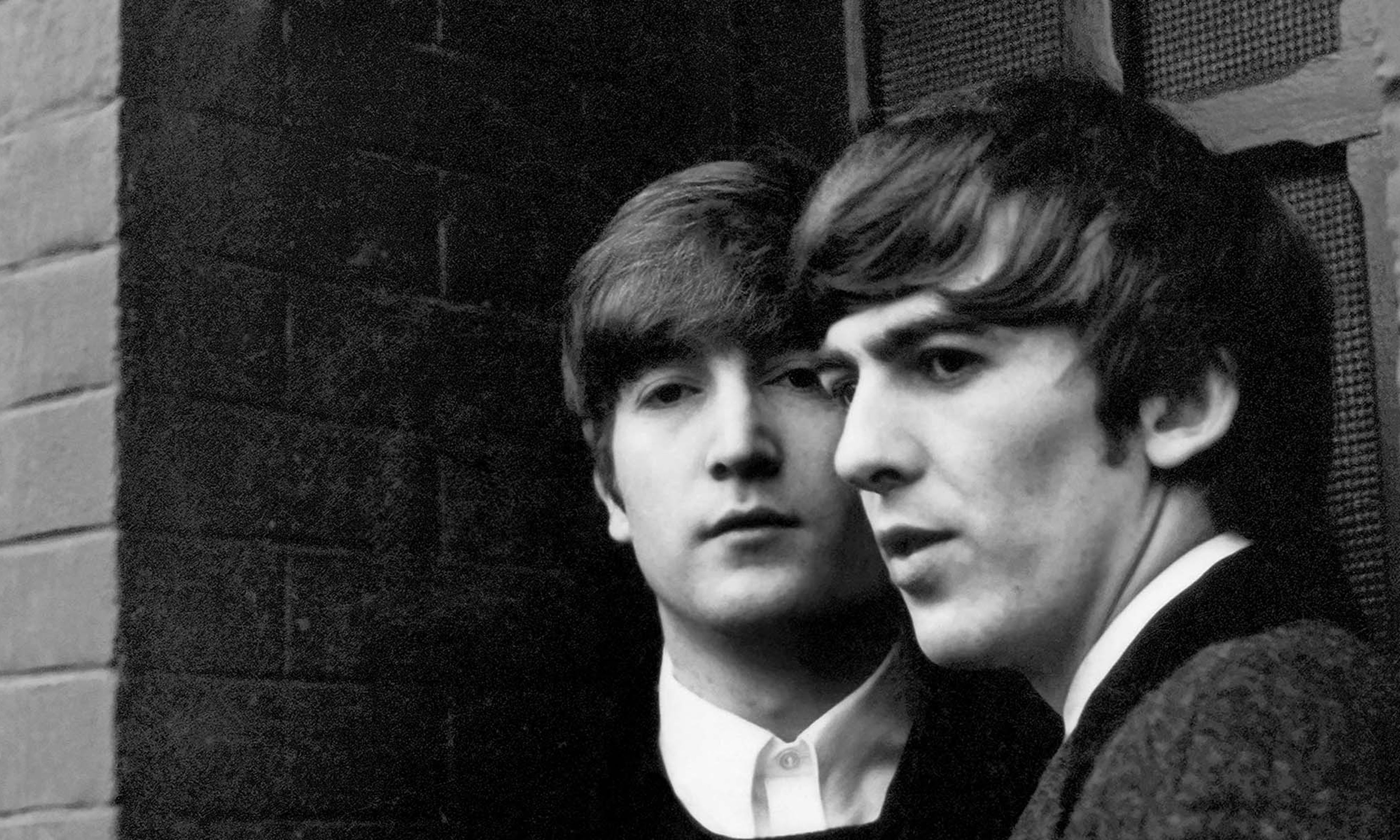
Inside the mind of Paul McCartney a certain thought used to pop up from time to time, then vanish, invariably prompting resolutions to act followed by resolute inaction. This went on for 60 years. The thought was this: A long time ago — what year? who knew? when the Beatles were young, just starting to hit it big — all four bandmates had been given Pentax cameras, and Paul had taken a lot of photographs. Where the hell were they all? Neither Paul nor Sir Paul ever bothered to try to hunt the collection down; it’ll surface at the right time, he thought.
That time was the pandemic. In 1964: Eyes of the Storm, a hefty new coffee-table volume, McCartney presents a little over a quarter of the nearly 1,000 photographs that were miraculously discovered, “lovingly preserved,” at his MPL archive in 2020. The images cover the Beatles’ travels through six cities — their native Liverpool, London, Paris, New York, Washington, D.C., and Miami — from December 1963 to February 1964, when Beatlemania, soon to conquer the world, first swept America.
The photographs, and Paul’s introductory essays and captions, are all rich with emotion. But on the important archival questions raised by the discovery of so historically significant a collection — who lovingly preserved it? who discovered it? by what means was it preserved? — Paul is silent, withholding.
“Who is looking at who?” he asks in the foreword. “The camera always seems to be shifting, with me photographing them [the fans], the press photographing us, and those thousands and thousands of people out there wanting to capture this storm.” In this sense, 1964 is a classic work of photography: ever mindful of the multiplicity of lenses in use at any given moment, of the interplay, inevitable and illuminating, between view and viewership. “I’m not trying to claim to be a master,” says the man who has mastered every other popular art form, “only an enthusiastic photographer who happened to be in the right place at the right time. . . . We were moving at such speed that you just had to grab, grab, grab!”
* * *
With their debut on The Ed Sullivan Show on February 9, 1964, watched by 73 million people, the Beatles seemed to many to be an overnight sensation; in fact, the Lennon–McCartney partnership was already more than halfway over. Eyes of the Storm constitutes a landmark in the literature of the Beatles for the documentary record it presents of the final stages in their rise to dominance, marked by an intimacy no other photographer, no non-Beatle, could ever hope to match. If Some Other Guy had taken all these shots and discovered them in his attic, the auction would have generated millions.
Here are fresh-faced John, Paul, George, and Ringo, and their entourage, romping, yawning, sunbathing, drinking, smoking, reading, traveling, and, in a few shots, performing music. Affectionate close-ups of the Beatles’ inner circle — family members, Cynthia Lennon, manager Brian Epstein, producer George Martin, roadies Neil Aspinall and Mal Evans, Jane and Peter Asher, chain-smoking publicist Tony Barrow (coiner of the term “Fab Four”), even the opportunistic Noo Yawk deejay Murray Kaufman, a.k.a. “Murray the K” — reveal that Paul, who later designed the Abbey Road cover, always possessed a keen eye for framing and portraiture.
Young Paul made it a point to chronicle the Beatles’ chroniclers. In addition to legions of frenzied fans and press men wielding cameras, we see such notable contributors to the Beatles mythos as Harry Benson, the British photographer whose 1964 pillow-fight photo, similar in composition to the raising of the flag at Iwo Jima, is one of the most widely circulated images of Beatlemania. We also get a glimpse of Michael Braun, the seldom-seen author of Love Me Do! The Beatles’ Progress (1963), an early fly-on-the-wall account of the group that became a touchstone for all subsequent biographers. A photo Paul took in Paris captures posters of les Beatles that used images taken by Astrid Kirchherr, the German artist whose portraits of the band helped establish the iconography of rock.
* * *
One arresting image presents a tight shot of a police officer on a motorcycle, a revolver holstered at his hip: “the first time,” Paul notes, “I had ever seen anything like that.”
That Beatlemania had a violent undertow was clear at all points. When she fell behind and missed the limousine after the Beatles’ performance at the Hammersmith Odeon, in December 1964, Pattie Boyd, George’s girlfriend and future wife, was assaulted by crazed female fans who kicked her and pulled her hair. In 1966, after John Lennon’s comments about Jesus were reported, Beatles records were burned and the Ku Klux Klan issued death threats. Lennon was assassinated by a gunman in 1980. George Harrison was stabbed multiple times by an intruder in 1999.
Surveying the scenes of chaos and creation preserved in this, his most visual album, McCartney is reminded of “the madness of the 1960s . . . the madness that enveloped us everywhere.” He writes in these pages of “pandemonium,” “insanity,” “bedlam,” “mass hysteria,” and the distinct feeling among the Beatles of a “need for flight or escape, as if we could end up trapped” (emphasis in original). Likewise, in her scholarly introduction, historian and New Yorker essayist Jill Lepore observes that becoming “the first truly global mass culture phenomenon” subjected the Beatles to “the stress of being photographed constantly, unendingly, and with the worry that they were about to travel to a country where they expected, like [President] Kennedy . . . to be greeted by frenzied crowds and hordes of photographers and — a worry never admitted — exposed to possible gunmen.”
For all his conjuring of madness unleashed, however, Paul denies he saw Beatlemania in dark terms. “You might think that all this was terrible, that it was painful, and that we felt like animals in a cage,” he writes.
I can only speak for myself, but I did not feel that way. This was something we had always wanted. . . . I felt like we were the stars at the centre of a very exciting film. . . . There was never any malice. The people running after us just wanted to see us, just wanted to say hi, just wanted to touch us.
Of the ordinary citizens captured in his snapshots, nurses and train workers, Paul declares:
These are my people. . . . I grew up in a working-class family in Liverpool. . . . My relatives were exactly like these people. You’ll find them — the bus driver, the postman, the milkman — not only in my songs but in many of these photos.
The other Beatles did see Beatlemania differently. “So this is America. They all seem out of their minds,” Ringo said, a famous quote cited by Lepore. George Harrison, as Lepore also recounts, lamented the band’s loss of privacy in real time.
Omitted entirely from 1964 is the view of America in 1964 expressed by John Lennon in 1970, in his bilious Rolling Stone interview with Jann Wenner: “When we got here you were all walkin’ around in f***in’ Bermuda shorts with Boston crew cuts and stuff on your teeth. . . . The chicks looked like 1940s horses. There was no conception of dress or any of that jazz. We just thought, ‘What an ugly race.’”
* * *
In Miami, where the Beatles swam and boated and relaxed as never before, Paul began using color film. In promotional interviews for 1964, he has identified as one of his favorite images the shot showing shirtless George, lithe and primal, expressionless in sunglasses as he rises from a swimming pool to receive his cocktail from a svelte woman, visible only from the neck down, wearing a bright yellow bikini.
The blooming of color photography in Paul’s work speaks to the larger flowering, identified by the catchall term “the Sixties,” in which the Beatles figured centrally. “We were in the vanguard of something more momentous, a revolution in the culture, especially as it affected the youth,” Paul says. “Although we had no perspective at the time, we were, like the world, experiencing a sexual awakening.”
That, too, is seen with Eyes. Here are the most sensuous portraits ever taken of Jane Asher, the patrician actress who was Paul’s girlfriend and longtime fiancée before she broke it off, amid reports of his infidelity, and the cute Beatle married Linda Eastman, one of the first women to work professionally as a rock photographer. Paul’s view from a window in the Asher home on Wimpole Street, in Marylebone — where he moved in and wrote some of his most memorable songs, including “Yesterday” — brings us into his and Jane’s intimate space. “Sometimes fans would be allowed in our dressing room” reads Paul’s caption, anodyne to the point of comic, below an image of a striking brunette photographing a clearly smitten John Lennon.
Again, we are left with questions about Paul’s withholding, a nagging sense that he is trying to tell us something without being explicit, as photography often does — and it has to do with sex. In one of the book’s few double-page spreads, Paul presents an image of Lennon and an unknown man staring at each other, expressions serious, in close profile. The “other man” is Robert Freeman, the photographer perhaps most essential to the Beatles’ visual canon, as he shot four of their album covers: With the Beatles, Beatles for Sale, Help!, and Rubber Soul. “They lived in the same apartment block in London for a while,” Paul notes dryly.
As has been recounted in various books about the Beatles, and as Paul surely knew and remembers, among John’s many extramarital affairs — grab, grab, grab! — was a dalliance with Freeman’s wife, Sonny Spielhagen Drane, a German beauty who modeled for the Pirelli Calendar. Freeman angrily confronted Lennon, according to one account.
Both Cynthia Lennon and Pattie Boyd confirmed the affair to me in recorded interviews. Boyd further confirmed to me — citing what George Harrison had told her during the Rubber Soul sessions — that Sonny Freeman was the inspiration for “Norwegian Wood,” the 1965 song in which, as John later acknowledged, “I was trying to be sophisticated in writing about an affair” (adding, lamely, “I can’t remember any specific woman it had to do with”).
But Paul is not done. Near the end of Eyes of the Storm, opposite a pair of photos of Cynthia and John looking their happiest, Paul places a photograph of a casually attired man sullenly smoking a cigarette, his gaze directed as if peering disapprovingly on the Lennons. Once again, it is Bob Freeman.
As with the album covers that followed Rubber Soul, it would appear 1964 offers clues to a Beatles mystery. In this case, it is one the author may not wish us to solve. The limited aperture Paul McCartney has always brought to the business of self-disclosure evokes the barb directed at him by George Harrison in “Savoy Truffle” on the White Album:
We all know “Ob-La-Di-Bla-Da” But can you show me where you are?










Comments