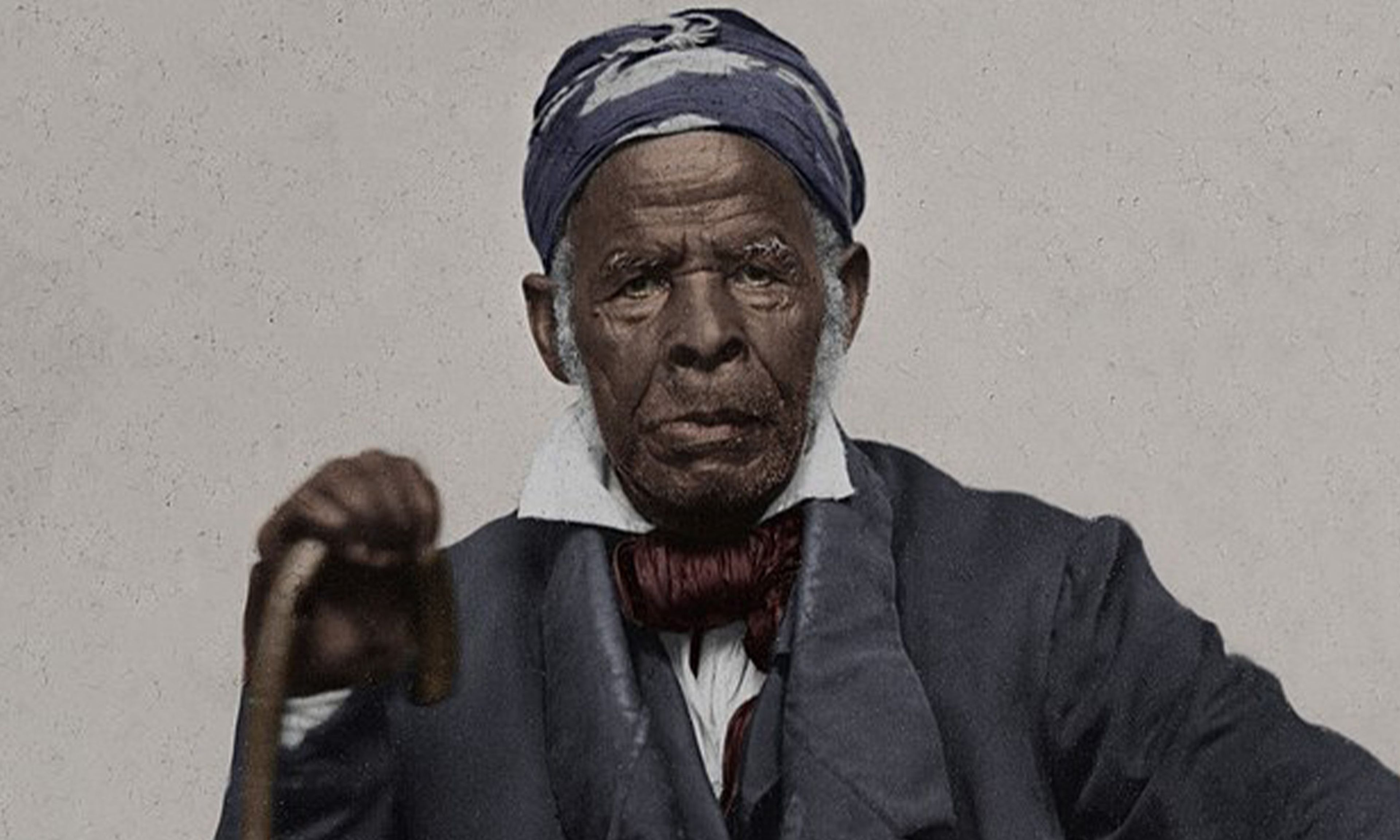
When starting to learn Arabic, few students of the language would expect the journey to lead them back to slavery in the antebellum South. There are, however, a handful of documents written in Arabic that are enlightening about that dark chapter in U.S. history. Among them, and the most notable for now, is a brief autobiography written by Omar ibn Said, who was captured in West Africa and sold into slavery in the U.S. at the age of 37, arriving in Charleston, S.C., in 1807. Years later, he wrote down the major events of his life in Arabic, the language of his education in Islamic schools in Senegambia.
Until now, the understanding of Omar ibn Said’s life has been hampered by amateur scholarship, first by pro-slavery racists in the 19th and the early 20th century and then by well-intentioned but ill-equipped scholars later in the 20th century. Mbaye Lo and Carl W. Ernst have at last offered the first proper academic study of him and his autobiography, along with the scattering of other documents he left behind. They’ve done so in clear prose, mostly void of jargon and accessible to a broad audience.
Lo and Ernst see their mission as giving Omar ibn Said his voice back through the documents he left behind. In the 19th century, they say, he was used as a prop by those wishing to defend slavery. His conversion to Christianity, arrived at by reading an Arabic Bible given to him by his owners, was proof, so the narrative went, of the benevolence of the institution of slavery. Lo and Ernst doubt the sincerity of this conversion and find ample evidence in his Arabic writings to back their case.
In one sense, ibn Said’s conversion while enslaved cannot be considered to have been done of his free will. No doubt, if given the choice, he would have remained in his native Africa and remained Muslim. Lo and Ernst see in his Arabic writings, in which he continues to quote from the Koran and other Islamic texts, a clear indication that he remained Muslim even after his baptism in 1820 at the Fayetteville Presbyterian Church, where the Owen family, his enslavers, attended services. Omar ibn Said became at that time a bit of a celebrity; he was cast as an Islamic scholar who eagerly converted to Christianity and, it was said, hoped to Christianize Africa.
Others said that he refused to return to Africa despite his owner’s offering him that possibility. The missionary John Leighton Wilson asserted in 1855 that Omar “was expelled from his own country for crime, but found the Savior here, and loves the country where he has found so inestimable a treasure.” The authors doubt that Omar was expelled and sold into slavery by his own people, instead finding it most likely that a non-Muslim tribe captured and sold him. “Like most of the clergy who took over Omar’s story,” Lo and Ernst write, “Wilson provides no evidence to back his claims. He was evidently unaware that selling Muslims into slavery was legally prohibited in Senegal during the rule of Almaami Abdul Kader (1776–1807), which includes the date of Omar’s capture.”
Omar did indeed write in a document in Arabic that he wanted to go back to Africa, and Lo and Ernst are right to doubt those who say he did not wish to return. Regarding his conversion, however, the truth may be more complicated than the authors suggest. As they say, we cannot know what he actually thought, because even the written record he left behind is sparse and ambiguous. Lo and Ernst have decided that his conversion was entirely insincere, but they ignore another potential reading of the documents.
While Omar did continue to quote the Koran and the texts of Islamic thinkers, he also quoted extensively from the Bible. Some passages indicate a sort of pan-Abrahamic view in which Omar may have come to see “belief,” particularly belief in either Christianity or Islam, as a category distinguished from unbelief. Of his enslavement, he wrote that “I reside in our country by reason of great harm. The unbelievers seized me unjustly, and sold me to the Christians.” He was referring to the non-Muslim tribes who seized Muslims in Senegambia to sell to American slave traders.
He described his first owner in the United States, a man named Johnson, as “a complete infidel, who had no fear of God in anything.” In contrast, he wrote of the Owen family: “Is there not among you a lineage like this, who fears God so much?” Importantly, he wrote that “Jim, with his brother, has me read the Gospel. . . . This opened my heart to the way of guidance, to the way of Jesus the Messiah, to a great light.” In the Arabic, he notably used the Christian name for Jesus (yesuu’), not the Islamic one (‘iisa), an indication that he was indeed reading the Arabic Bible given to him.
Lo and Ernst write of Omar that “he evidently did not self-censor, since no one could read what he wrote.” If that is the case, why doubt his conversion, which is stated so plainly? That said, his conversion was clearly one of circumstance. He did not come to a dramatic rejection of Islam to embrace Christianity. He simply accepted that he was now in a Christian country and Christianity was how one worshiped here. “Before I came to the Christian country,” he wrote, “my religion was the religion of Muhammad, the messenger of God, may blessing and peace be upon him.” His habit of quoting both the Koran and the Bible would be consistent with a view that the two Abrahamic faiths and their texts are both legitimate forms of belief.
From our perspective today, it is difficult to believe that a slave could embrace the religion of his captor, a religion that, as it was practiced, justified his enslavement. It is important to remember, however, that Islam too endorsed slavery, and it was practiced in the Muslim world even after it was banned in most of the Christian world. Omar is unlikely to have been an abolitionist in today’s understanding of the term. In the West Africa of his early life, Islamic rulers banned the enslavement of fellow Muslims but not slavery writ large. Omar was certainly unhappy to be captured and enslaved, but there is no indication that he had a religious objection to the institution itself. Instead, he distinguished between the “infidel” Johnson, from whom he escaped, and the devout Owen family, who treated him as well as could be expected within the institution of slavery. None of that justifies what happened to Omar, but it is important to remember when we contemplate how he might have understood his circumstances.
Lo and Ernst are also determined to revive Omar’s reputation as a scholar. They note that early readers of his autobiography dismissed his writing as amateurish and filled with errors, but they astutely pick up on quotes of Islamic thinkers used by Omar that escaped the pseudo-scholars who read his text in the 19th century. He begins his autobiography, after a long passage from the Koran, with the disclaimer “I cannot write my life, I forget too much about my language and the Arabic language. O my brothers, do not blame me.” Lo and Ernst say that his readers took this passage too literally and that a statement of feigned humility was standard for the time.
That Omar was literate is impressive enough, given the time and circumstance. But was he an adept scholar, as Lo and Ernst suggest? First, we have to judge by the standards he would have set for himself. In Islamic thought, Arabic grammar is a religious science, because God gave mankind the Koran in that language, and therefore to understand God’s book one must understand the language in which it is written.
Many modern grammarians dismiss the idea of proper grammar in any language, but the point here isn’t whether there is good and bad Arabic. The question, rather, is what Omar and his milieu would have understood to be good Arabic. His text is filled with grammatical and spelling errors that would not have been accepted as merely stylistic difference. This takes nothing away from the value of the document or of Omar’s experience. Still, other manuscripts from Omar’s era in West Africa show a level of Arabic closer to what was acceptable in Islamic scholarship.
Omar, like every slave, deserved his freedom. He was literate, unlike most of his fellow slaves, and so left a valuable firsthand account of slavery. We are right to read it with a generous amount of skepticism towards his claims about his conversion to Christianity and about his owners’ benevolence. But scholars looking at his life should take care to avoid a different sort of romanticization. The sober reality is that, rather than being a brilliant Islamic scholar, Omar was a man who lost his rights and dignity unjustly and left a humble text to preserve his story.
But while Lo and Ernst have occasionally reached too far in correcting the narrative of Omar ibn Said’s life, they have done an impressive job of providing a new translation of a difficult text and providing a much improved interpretation of his writing compared with those offered by their predecessors. They have also opened the door to using the Arabic language to study U.S. history from a period much earlier than the early-20th-century migration of Syrian (broadly understood) immigrants, which usually provides the start date for Arabic texts written in the United States.












Comments