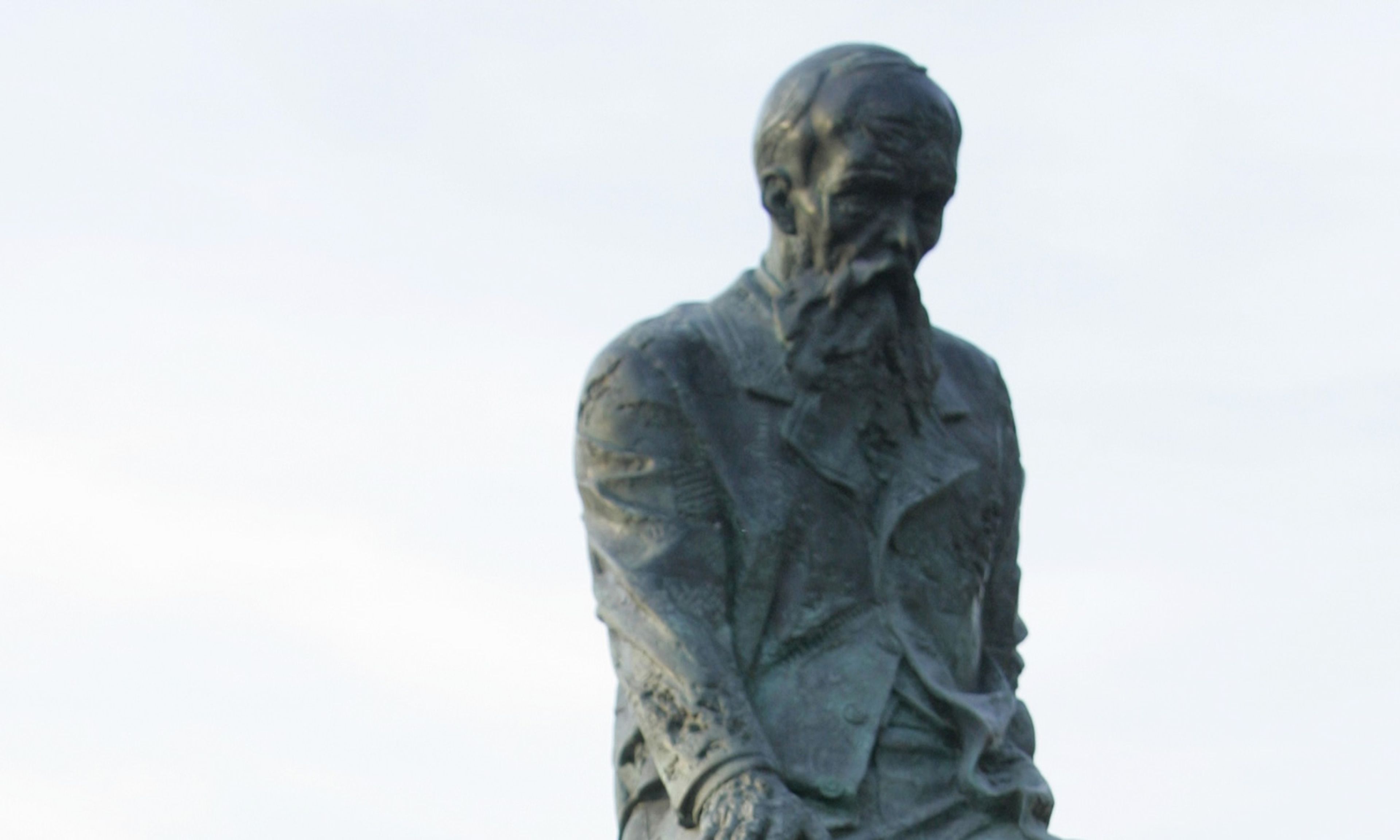
Mikhail Bakhtin, Russia’s greatest literary critic and arguably its most important philosopher, studied ancient Greek and Latin literature and neo-Kantian philosophy before turning his attention to the Russian classics. So great is the prestige of literature in Russia that philosophers often express their ideas as commentaries on a great writer, and so Bakhtin’s first masterpiece, Problems of Dostoevsky’s Poetics (1929; expanded edition 1963), can be read either as the most insightful book ever written about Dostoevsky or as an essay on ethics and human nature elucidated with examples from Dostoevsky’s fiction. In the present volume, Bakhtin asserts that he always regarded himself, first and foremost, as a philosopher.
Devoutly Russian Orthodox, Bakhtin says in The Duvakin Interviews that his loyalty was to Christianity generally. Since the dominant trend among the pre-revolutionary intelligentsia was militantly atheist, and since the Soviet government endeavored to extirpate all faiths, Bakhtin always found himself in opposition. Arrested in 1929 for giving informal lectures on Kant, he barely escaped being sentenced to the Solovetsky Islands camp in the far north — a virtual death sentence — and served his term in Central Asia. Nonconfrontational by temperament, he kept himself and his unpublishable work inconspicuous, eluded the Great Terror of 1936–38, and was rediscovered decades later by admirers who arranged for the many studies he had written in the intervening years to be published.
From the start, Bakhtin opposed the intelligentsia’s denial of human freedom and responsibility. As determinists, intelligenty (members of the intelligentsia) regarded choice as an illusion. Human action, in their view, is only a complicated reflex (like the narrowing of pupils in bright light), and crime results automatically from social injustice. Claiming the right to kill to establish socialism, they conducted terrorism on a scale never seen before. As two revolutionary women in Solzhenitsyn’s novel August 1914 explain to their skeptical niece, the terrorist is beyond ordinary morality because he is merely the agent of higher forces: “Let him lie! . . . Let him kill! . . . The Party takes all blame upon itself — so that terror is no longer murder, expropriation is no longer robbery.” In the Soviet period, it was common to say that mass terror was the work of “history.” Both before and after the revolution, killers had an airtight alibi.
Is it any wonder, then, that the young Bakhtin’s key ethical concept was what he called “the non-alibi”? All attempts to blame society for our actions, to avoid responsibility by “living representatively” of the Party or some other collective, are futile because, he repeats in a much-quoted phrase, “there is no alibi.” One must “sign” one’s actions.
Not only are people free to choose among actions, they are also free to change themselves, the choosers. In ancient biographies or adventure stories, people remain the same. By contrast, the 19th-century realist novel shows characters gradually growing as a result of what happens to them and of the choices they make, so that by the end of the work they are truly different. In ancient adventure stories, one could readily rearrange the order of adventures, but Dorothea Brooke and Anna Karenina learn from experience and would not act the same way were the same circumstances to occur again.
This ability of people to change, to act unexpectedly, constitutes the essence of humanness. One can confidently predict the orbit of Mars, but people are “unfinalizable,” and so long as they live retain their “surprisingness.” We all resemble Dostoevsky’s characters, who “acutely sense their inner unfinalizability, their capacity to outgrow . . . from within and to render untrue any externalizing and finalizing definition of them. As long as a person is alive he lives by the fact that he is not yet finalized, that he has not yet uttered his ultimate word. . . . The genuine life of the personality takes place . . . at his point of departure beyond the limits of all that he is as a material being, a being that can be spied on, defined, predicted apart from his will, ‘at second hand.’”
A social scientist can know everything about a person and yet miss precisely what makes him a person. In life, as in realist novel,
an individual cannot be completely incarnated into the flesh of existing sociohistorical categories. There is no mere form that would be able to incarnate once and forever all of his human possibilities and needs, no form in which he could exhaust himself down to the last word, . . . no form that he could fill to the brim, and yet . . . not splash over the brim. There always remains an unrealized surplus of humanness.
To deny that “surplus,” to treat a person as thoroughly knowable “at second hand” — as socialists often do — is to commit the supremely unethical act of treating a person as an object. From that error unimaginable horrors could (and did) follow.
The right way to approach another person is through dialogue, by which Bakhtin means an open-ended conversation in which each person learns from the other, expresses thoughts never fully entertained before, and becomes somewhat different in the process. It is as “unfinalizable” as its interlocutors. Dialogue in this sense is the opposite of instructing another to accept approved beliefs. It is also the opposite of Marxist dialectics, in which each step follows inexorably from the preceding one. No wonder Bakhtin tried to remain inconspicuous.
Language, too, is essentially dialogic. The structuralists of his day or the Chomskians of ours analyze sentences, but people speak not in sentences but in utterances, for which sentences just provide the material. Utterances are always addressed to someone, and the expectation of a response shapes them from the outset. People do not learn rules and then begin to speak, they enter into the stream of communication. By the same token, our personality largely consists of inner speech, dialogues we hold with imagined others, and especially those — such as parents — whose response matters to us. People are essentially social in the sense that one shapes a unique self by dialogue with others (and with God). Translator Margarita Marinova chooses as her introduction’s epigraph a celebrated passage from Bakhtin’s Dostoevsky book: “In dialogue a person not only shows himself outwardly, but he becomes . . . that which he is . . . not only for others, but for himself as well. To be means to communicate dialogically. . . . Two voices is the minimum of life, the minimum for human existence.”
Two very different voices resound in the interviews that Victor Duvakin conducted in 1973 with an aged and ailing Bakhtin two years before his death. A literary scholar who lost his university job in 1966 for supporting dissident writer Andrei Sinyavsky, Duvakin created an oral library of interesting literary people. As Dmitry Sporov observes in this volume’s afterword, in Soviet conditions, the spoken word, preserved in memory, played an especially important role in preserving culture: “Only in memory,” Sporov explains, could Soviet people “exist and think freely, and avoid participating in the building of socialism.” It was more than likely that these interviews would never be widely known.
When Bakhtin first became famous in the West, literary theorists, amazingly enough, imagined this religious devotee of Kant to be a Marxist! Apparently, for English professors, Bakhtin’s view of language as social testified to his socialism, and his status of “Soviet critic” implied “Marxist.” To Russian experts, aware that original minds were almost always dissenters, it suggested the opposite, as these interviews show.
Bakhtin recalls that as a university student, he “never sympathized with the extremists. . . . Not at all,” and he thought that students ought to focus on their education. In one remarkable passage, he maintains that he opposed not only the Bolshevik coup of October 1917 but also the liberal revolution of February 1917:
Bakhtin: I’ll tell you this, but there’s no need to record it.
Duvakin: We can erase it later. . . .
Bakhtin: I did not welcome the February Revolution. I thought . . . that it’ll all certainly end very badly. . . . All those intellectuals were utterly incompetent to govern. . . . So, inevitably, the extreme left, the Bolsheviks, would take over. And that’s what actually happened.
It was either the monarchy or the Bolsheviks, and Bakhtin makes clear that Russia’s best hope was the czar’s reformist minister, Stolypin, who tried to create a class of independent farmers owning their own land and supporting the regime. When Duvakin repeats the cliché that Russians are not made to be independent, Bakhtin points out that collective farms have not worked out so well.
Bakhtin was educated before the revolution, and he knew Greek, Latin, French, and German; his highest praise for an intellectual is “European.” That description fails to fit the monolingual and Soviet-educated Duvakin, who, we are surprised to learn, has never heard of Kierkegaard or Swift’s “Modest Proposal.” Bakhtin seems like a figure from another world somehow stranded in Soviet Russia.
The Soviet experience has nevertheless shaped his views on literature. “Tragedy in its pure form, the kind created in antiquity, by the likes of Aeschylus, Sophocles, and even Euripides, is in fact . . . quite naïve,” he reflects, because these dramatists could not have known what real tragedy is. “They didn’t come in contact with the abyss, weren’t really familiar with actual terror” as those living under Stalin were. In a similar spirit, he argues that “there has never been, and cannot ever be, happy poetry. If there’s no hint of the end, of Death, . . . there can’t be real poetry. . . . Otherwise it won’t be actual poetry, just stupid delight for the herd.” Perhaps, he reflects, that is true of the arts generally.
Those not familiar with Bakhtin’s ideas should start with his book on Dostoevsky or his essays on the novel as a genre. Intended for those who already know Bakhtin’s works, the present volume captures the voice and spirit of the person who created them — appropriately enough, in dialogues.










Comments