Across the first two eras of Disney animation — the Snow White to Sleeping Beauty years of Walt himself, and the great revival that began with The Little Mermaid in 1989 — the template for an animated movie was so consistent as to barely require elaboration: a familiar fairy tale as scaffolding, a prince or princess in the leading part, a romance, a comic-relief sidekick, friendly animals, a menacing villain, a bumbling henchman, songs, swordfights, cut.
With the release of Raya and the Last Dragon, we can say that the third era of Disney — the computer-animated era, now just over ten years old — has established a new template. The magic is still there, and usually the cute animals and princesses. But the source material is now a general cultural mythos rather than a familiar story. The romance is replaced by a sibling bond or parent–child relationship or platonic allyship. And the characteristic antagonist is no longer a wicked queen or grand vizier. Instead it’s usually some impersonal force, some moral or spiritual disturbance, whose defeat is accomplished through suppression or reconciliation rather than, say, pitching a bad guy off a tower.
Tangled, the first movie of the computer-animated era, was also the last to follow the old template, giving us a Rapunzel with modern twists inside a classic arc. Frozen, the mega-hit of 2013 and the soundtrack of my daughters’ kindergarten years, was a transitional movie. It was loosely based on Hans Christian Andersen’s Snow Queen but adapted his Scandinavian backdrop for a very different story; it had a traditional romance that was ultimately just background to the real love story between the royal sisters; it had a half-drawn villain, but the real antagonist was clearly the dark and wintry side of Queen Elsa herself.
Then came Moana, Frozen II, Onward, and now Raya, in all of which the new formula has been clarified and the old one left behind. (One could add 2012’s Brave, a Pixar-Disney fairy tale that generally followed the new formula as well.) In each the story has been fashioned out of a general tradition — Polynesian myth, a Nordic–New Age mish-mash, Dungeons and Dragons, South Asian folklore — rather than following a famous fairy tale. In each the central relationships are platonic: Moana’s bonds with her father and grandmother and the demigod Maui; the two sisters in Frozen II; the two questing brothers and their late father in Onward; and now in Raya, the title character’s link to her father and her friends. In each the antagonist is more a force than a person — a goddess or dragon with no personality beyond apparent malevolence in Moana and Onward, a mist born out of colonialist sins in the Frozen sequel, and in Raya a roiling mass of purplish darkness that embodies human division and mistrust.
That division is responsible for sundering Kumandra, an ancient kingdom that mashes up various Southeast Asian images and signifiers — Cambodian temples, Filipino weapons, Vietnamese topography, and so forth. Once united and protected by a flock of brightly colored dragons, it fell into a civil war that gave birth to the malevolent but impersonal Druun, whose roiling touch turns humans into stone. Their spread was stopped only by a sacrifice that made all the dragons disappear and left Kumandra divided into five feuding, distrustful kingdoms: Fang, Heart, Spine, Talon, and Tail.
Our heroine, Raya (Kelly Marie Tran), is the daughter of Heart’s chieftain, whose kingdom protects a jewel forged by dragon magic that keeps the Druun at bay. The father, an idealist, wants to reunite the warring kingdoms with pho-bowl diplomacy, but his attempt at a summit is wrecked when Raya naïvely trusts Namaari (Gemma Chan), the daughter of the rival chief, and lets her infiltrate Heart’s inner sanctum. Soon the jewel is shattered, the Druun are loose, and it’s up to Raya to track down the world’s last dragon to help her put the world to rights.
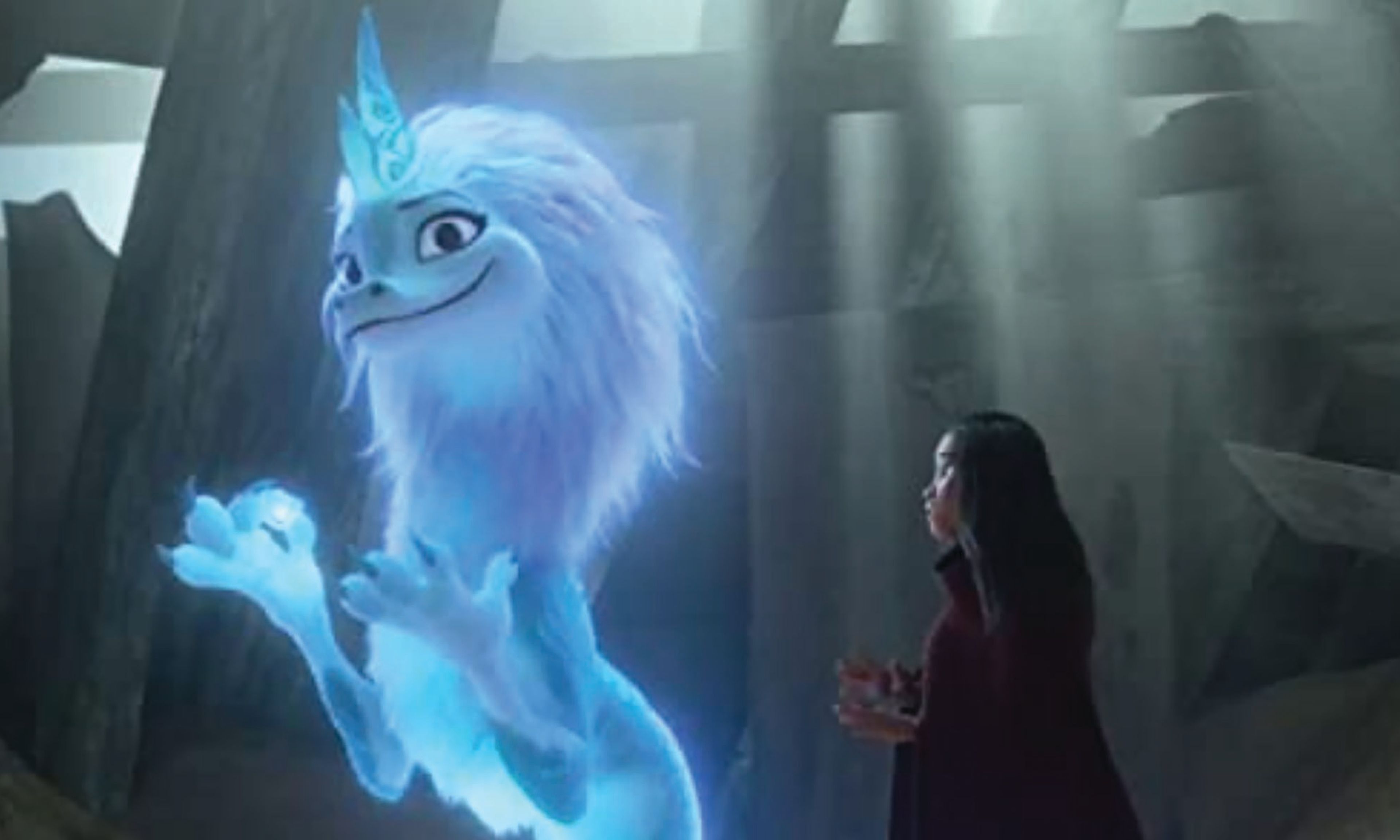
This being Disney, the beast of myth turns out to have the voice of the comedian Awkwafina, whose goofy dragon is just one of the collection of misfits who assemble under Raya’s banner — an orphan soup-maker, a hulking warrior, an infant con artist — as she travels from kingdom to kingdom seeking pieces of the fractured jewel. Meanwhile, it’s clearly Namaari, her rival and enemy and spiritual sister, whose help Raya really needs to Make Kumandra Great Again.
The quest is a lush, color-saturated experience: This mythic Southeast Asia may be a somewhat random collage of very different cultures (as the Internet’s cultural-sensitivity watchdogs have been quick to point out), but as a fantasy realm it looks terrific. As storytelling, though, the movie is banal, lacking both the terrific songs that hoisted Moana above its pedestrian plotting and the gonzo wokeness that made Frozen II so interesting.
The narrative in Raya evokes certain progressive themes, with intersectional, female-led solidarity triumphing over occult forces and structures of division and oppression. But it doesn’t have the full-tilt, smash-the-patriarchy-to-save-the-earth zeal of the second trip to Arendelle. And in the absence of that kind of ideological commitment there’s more time to think about what else is missing — especially true love and true wickedness, the old Disney marriage plots and the old Jafar-Gaston-Maleficent villainy as well.
One might suspect a political influence in their absence, or at least in the absence of romance, which is dicey to depict under an ideological regime that insists on gender interchangeability. But whatever the reason, I really miss them — love and evil both. The new Disney’s films are fine, they’re pretty to look at, they’re entertaining enough for a late-COVID-era afternoon with kids . . . but romance and wickedness are the spice of entertainment, and without them Raya and the Last Dragon goes down like a Kumandran pho with all the flavors taken out.












Comments