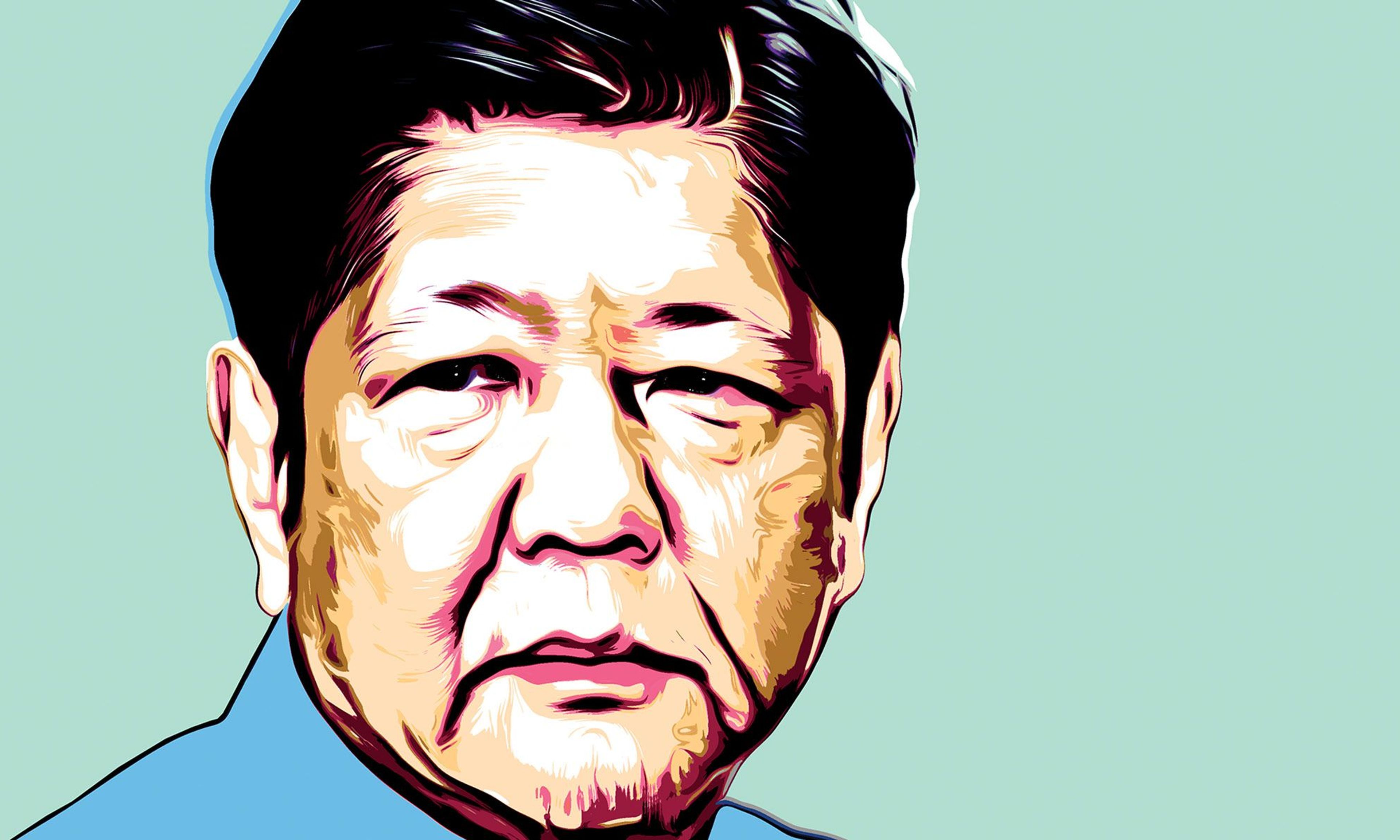
In December, the chief of staff of the armed forces of the Philippines was “aboard a supply boat when it was blasted with a water cannon” and “surrounded and shoved by Chinese coast guard ships” in the “disputed South China Sea,” according to the Associated Press. The waters between the Philippines and China have only gotten hotter since then, and it has nothing to do with climate change. But the Philippines has the right man in power to deal with it. He would also be the right man in power if we were to come to blows with China over Taiwan.
Ferdinand Marcos has quite a familiar name, except that he’s “Jr.” and likes to go by “Bongbong.” Bongbong’s father, who ruled from 1965 to 1986, is infamous for imposing nine years of martial law, complete with plenty of alleged kidnappings, torture, and assassinations. Mommy Imelda Marcos, who yet lives, is known mostly for those 3,000 pairs of shoes she was forced to leave behind when the duo made a hurried exit to the U.S. But despite his myriad faults, Marcos the Elder favored the “special relationship” with America that began when the archipelago became a U.S. territory in 1898 and was strengthened during the 1941–45 Japanese invasion. (Tell a Filipino “I shall return!” and you get delighted laughter.)
That pro-Americanism is what the 66-year-old Marcos Jr. has brought back. He has been a prominent figure in Philippine politics for decades, during which he has made it clear that he favors a closer relationship with the U.S. and is willing to accept a more distant one with China.
His predecessor, Rodrigo Duterte, became president in 2016 promising to pursue an independent foreign policy that would diversify the country’s partnerships and reduce its dependence on the United States. Duterte threatened to end the Visiting Forces Agreement between the Philippines and the United States, which has long determined the rules, guidelines, and legal status of U.S. soldiers during military exercises in the Philippines.
He expressed admiration for China’s authoritarian model and criticized the U.S. for its human-rights concerns and alleged interference in the Philippines’ domestic affairs. China jumped at the opportunity to wine and dine him and promised investments and infrastructure projects (which never came to fruition). Yet by the end of his term, even Duterte was beginning to take China’s forays into the unfortunately named South China Sea personally.
By and large, Filipinos and members of the Filipino government like and trust Americans, and don’t like or trust the Chinese. It’s not just about fishing-rights disputes. Local news is filled with stories of Chinese involvement in illegal gambling, drugs, and human-trafficking. (As for Spain, the mother country, it seems to have left behind only the last names of most Filipinos, a few islands where Spanish is still spoken, and a Catholic Church that’s routinely ignored.)
Marcos is enthusiastic to engage not only with the U.S. but with its allies as well. Since taking office in June of last year, he has pursued much warmer relations with Japan, South Korea, and Australia. In February he visited Japan and secured $13 billion in investment pledges and another $3 billion in loans. (When you live in the Philippines and hear that China is to undertake a project, you know to greatly discount the possibility, but the Japanese do what they say.)
In May, Marcos said Manila had agreed in principle to joint South China Sea patrols with the United States, Australia, Japan, and South Korea to preserve the freedom of navigation; he expects them to start this year. More important, Marcos told Reuters in May that, while the Enhanced Defense Cooperation Agreement (EDCA) reached with the United States in 2014 was originally conceived to improve disaster responses, “now there’s an additional aspect to it” because “tensions across the Taiwan Straits seem to be continuing to increase,” threatening the safety of the approximately 200,000 Filipinos who live in Taiwan. The EDCA thus would “prove to be useful for us should that terrible occurrence come about,” a Chinese cross-channel invasion.
That is exactly what the U.S. wants to hear. Everything Marcos is saying and doing indicates that he’s putting his country behind the U.S. position that Taiwan — a democracy with 23 million souls that produces more than 60 percent of the world’s semiconductors and more than 90 percent of the most advanced ones — is not to be part of the People’s Republic.
It would be folly to think that the Communist Party and Chinese leader Xi Jinping have abandoned their dream of seizing Taiwan. The best-case scenario for the U.S., however, would be not to repulse such an invasion militarily at a tremendous cost in life but to convince Xi that the odds just aren’t in his favor. The revered Chinese philosopher of war Sun Tzu emphasized nothing more than that avoiding war and great numbers of casualties should be a military leader’s principal goal.
In January, a team of military experts brought together by the Center for Strategic and International Studies sought to calculate the probable military losses of an armed conflict over Taiwan. It concluded that they would be “enormous” for every likely direct participant — the United States, China, Taiwan, and Japan. The group speculated that Chinese missiles would probably destroy U.S. air bases not only in Japan but as far away as Guam, and that China would sink two U.S. aircraft carriers and between ten and 20 destroyers and cruisers as the invasion opened.
The Philippines’ location is important because of its proximity not only to Taiwan and to the People’s Republic of China but also to critical channels. The most obvious is the Taiwan Strait, which would be the path used by PRC landing vessels. At the narrowest part, it’s 81 miles wide. If China is able to make a landing, it would want to control two other waterways to resupply its troops and keep American-led forces from supplying Taiwanese forces.
One, the Miyako Strait, lies between Taiwan and Japan’s island of Okinawa. Japan is busily fortifying Okinawa for military action, and it’s home to about 30,000 U.S. military personnel. U.S. and Japanese armed forces have drawn up a draft plan for a joint operation in case of a Taiwan emergency, according to a report in the Guardian. According to the plan as reported, U.S. forces would initially establish temporary bases on the Ryukyu island chain (which includes Okinawa), from which they would deploy missiles to strike Chinese targets on either the mainland or Taiwan. Japanese armed forces would provide logistical support. China would probably want to avoid that strait.
The third crucial waterway is the Bashi Channel, between Taiwan and the Philippines. At the narrowest point, it’s less than 90 miles wide, and on a clear day you can see across it. China would like to control it because it would be vital for bringing in the massive supplies that the People’s Liberation Army would need to sustain an offensive. For the U.S., conversely, it would be invaluable for supplying the Taiwanese armed forces. Even before a hot conflict, control over the channel could potentially allow China to monitor and limit naval traffic passing through the South China Sea into the Pacific. Moreover, the Bashi Channel is one of the few deepwater routes suitable for submarine transit from China’s naval bases in Hainan and the South China Sea to the broader Pacific Ocean. Kaohsiung, the Taiwanese port that handles over 60 percent of the island’s trade, sits close to the channel. If the Chinese landed on Taiwan, they would need Kaohsiung and its Bashi Channel supply routes to ensure the operational mobility of their growing submarine fleet, a key component of their blue-water-navy ambitions. Finally, an enormous number of non-Chinese communications cables, whose disruption would greatly serve China’s interests, are laid in the channel. For all of these reasons, it could be that whoever controls the Bashi Channel controls the fate of Taiwan.
So the Philippines wants support in keeping China away from its claimed waters and the fish and minerals they may contain, plus financial aid and assistance for the natural disasters, such as typhoons and massive seismic activity, that it regularly suffers. The U.S., in exchange, has secured more EDCA bases: four more atop the original five agreed upon in 2014. Of those first five, four can host aircraft. Of the newest four, one is an air base and another a naval base. Three are on the island of Luzon, close to Taiwan, and one is in Palawan Province, adjacent to the South China Sea.
The South China Sea Strategic Situation Probing Initiative, a Chinese think tank, has said that the new military sites “definitely will be used against China’s operations around Taiwan,” that “the Philippines may be passive but involved in the Taiwan issue,” and that this would be a “big thing for China.” Indeed, Mao Ning, the spokesperson for China’s ministry of foreign affairs, said with touching concern for the Filipino people that “the comments on the locations of the new military bases also speak to the concern shared by many insightful people in the Philippines, who worry that this may draw their country into the whirlpool of a potential conflict in the Taiwan Strait.”
Marcos’s time as president of the Philippines is limited: He gets one six-year term under the constitution. One hopes it is enough for him to set the archipelago back on the American-led path, which is best for it and likeliest to secure peace in the region.












Comments