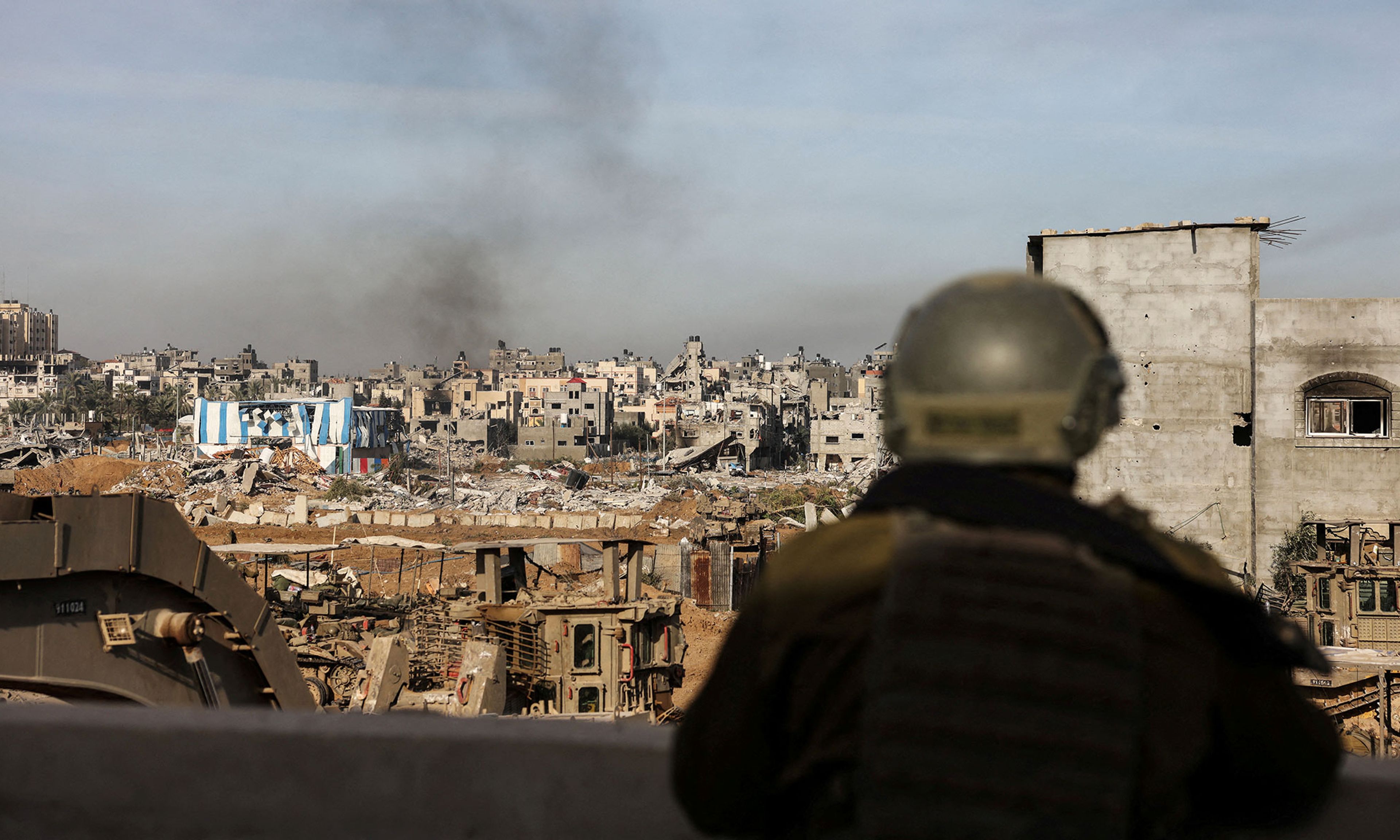
The Israeli campaign in Gaza has transitioned to a new phase. The Israel Defense Forces withdrew five reserve brigades from the Strip in late December and will soon begin their push toward Rafah in southern Gaza. Concurrently, a series of post-war plans have come into view, in particular the Biden administration’s proposed grand bargain that would establish a Palestinian state in return for the normalization of Israeli–Saudi relations. A Palestinian state as an outcome of Hamas’s October 7 attack is insane: Is it now a tenet of U.S. policy that major rewards should accompany major crimes?
Observers of international events, and especially Americans, must be alive to the political and strategic considerations that dominate Israeli decision-making. The only way that Gaza can be governed in a sustainable and stable manner is through the participation of Arab states, and in particular the Gulf Arabs, and the only power that can deliver their participation is the United States. A grand bargain is impossible unless the U.S. exerts enough leverage to induce one.
Gaza has plagued Israeli strategy for a generation despite Israel’s wish to be free of Gaza. Israel’s borders have changed several times, affecting the West Bank, the Golan Heights, the Sinai Peninsula, and the Gaza Strip. The first three areas are all salient in Israeli policy, politics, and culture. Gaza is not.
The West Bank is central to Israeli security concerns. In hostile hands, it would serve as a constant springboard for terrorist activity and conventional offensives. It is also a core part of Israeli self-image: The biblical land of Israel — Judea and Samaria — is centered on the West Bank, while most Jewish cultural, historical, and religious sites of significance — like those of Judaism’s Abrahamic cousins — are there. This cultural reality need not result in a maximalist territorial policy or a religion-driven approach, but it does make the West Bank issue far more difficult to disentangle.
The Golan Heights, which dominate the country’s north, are the most strategically critical terrain in Israel. When the region was under Syrian control, Israeli civilians were subject to repeated bombardment and sniping. By holding the Golan, Israel has a commanding position vis-à-vis its most persistently aggressive neighbor state, Syria — a position that for reasons of simple self-preservation it cannot relinquish.
The Sinai Peninsula was at one time a crucial buffer against Egyptian invasion and reduced the economic leverage Egypt could apply. With the Sinai in hand, Israel no longer had to fear Egyptian closure of the Straits of Tiran, Jerusalem’s casus belli in 1967. But American diplomatic skill and Israeli military victory shifted Egypt’s allegiance from the Soviet to the Western camp and allowed Israel to return the Sinai as part of its settlement with Egypt after the 1973 Yom Kippur War. This enabled a transformation in Egyptian society and politics that holds to this day. Despite deep-rooted cultural antisemitism, Egypt is a predictable neighbor that has a constructive relationship with Israel and is divested of all regional ambition.
Gaza came under Israeli control through historical accident. Egypt took control of the Strip after 1948. Israel gained it after 1967. But it has no intrinsic cultural link to Jewish history or religious consciousness. Nor is it of particular strategic importance. Since Israel’s border with Egypt was no longer a primary military concern, Egyptian governance of Gaza would have been acceptable as part of the peace settlement. But Egypt refused to retake control of the Strip. A perhaps apocryphal anecdote implies that Egypt, understanding the barbs that the Palestinian question set not only for Israel but also for Jordan, Syria, and Lebanon, saddled Israel with Gaza as a final punishment after nearly 30 years of hostility.
Ever since, Israel has struggled to develop a solution to the Gaza problem. The intifadas made it politically impossible to allow unobstructed Palestinian movement between Gaza and the West Bank, while the supposed overall structure of Palestinian governance, the Palestinian Authority, is manifestly incapable of administering both the West Bank, where it is based, and Gaza. West Bankers and Gazans are also culturally different, with distinct political economies and clan structures despite their nominal shared affiliation as Palestinians. Direct rule of Gaza by Israel was and remains politically poisonous, both for Israeli society and because of the damage it would do to the Palestinian Authority’s credibility — after all, according to the Oslo process, the PA should be Israel’s primary partner in resolving the Israeli–Palestinian conflict.
Israel sought to wash its hands of Gaza in 2005, withdrawing from the Strip under a “unilateral disengagement” that the Ariel Sharon government executed at significant political cost, even bulldozing Israeli settlements. The hope was that Gaza, a relatively inconsequential piece of territory, could leverage its geographic position to become a sort of Macau on the Mediterranean. With direct economic access to Israel, by the mid 2000s an innovation powerhouse, and to Egypt, the gateway to North Africa and the region’s fifth-largest economy, a Gaza controlled by a moderate civil administration was to become wealthy as a free-trade zone and tourist destination with world-class beaches and high-quality seafood.
The reality was rather different. A civil war erupted within the fledgling Palestinian state, primarily in Gaza, between Fatah, the core of the Palestinian Authority, and Hamas, a radical Islamist, Iranian-backed splinter group that opposed any compromise with Israel. Hamas unequivocally won this conflict in 2007. Ever since, Israel has faced a pervasive threat from Gaza, which it has tried to manage through continuous border surveillance and a limited ground incursion every half decade, first in 2008–09, then in 2014.
The events of 10/7 have made it impossible for Israel to contain Hamas any longer. It must be eliminated as a military force in Gaza, for it has constructed a robust enough strategic network to pose a kinetic threat to Israel. If it remains in Gaza, another 10/7 is virtually guaranteed.
The U.S. has demanded that Israel abandon any ideas of direct rule over Gaza, a proposal the Israeli religious Right wants to revive, and turn the Strip over to the Palestinian Authority. This same Palestinian Authority has not held an election in the West Bank since 2006. If it had held one at any point since, Fatah would have lost, and the leadership of the PA, including its president, Mahmoud Abbas, would have been out of power and out of cash. Moreover, Hamas would have won: All opinion polling for the past decade has shown that Hamas’s popularity has grown in the West Bank, a result of the PA’s unchecked corruption and incompetence. Putting the PA in charge of a largely hostile population in Gaza would set up a clash in which Hamas or Hamas-like elements could take charge once again. It would also threaten the PA’s credibility to govern the nearly 3 million Palestinian residents of the West Bank, risking a Hamas takeover there, too.
Indeed, the fundamental objective of Hamas’s strategy is to take control of the West Bank, the focal point of Palestinian politics, and thereby insert itself into Iran’s anti-Israeli, anti-American regional network. A PA takeover in Gaza as demanded by the U.S. would encourage this unacceptable development. Similarly, American demands for “restraint” and a “lighter footprint” provide significant elements of Hamas’s command structure, including Yahya Sinwar, the architect of 10/7, a far greater chance of surviving and preserving the organization’s capabilities. Its threat will persist to some extent in any case, since it has significant assets in Lebanon and is poised to enter into a full-fledged partnership with Hezbollah that would give it access to Lebanon’s Palestinian-refugee camps for recruitment and to Iranian-supported ratlines into Jordan and Syria.
Israel has recently signaled its desire to turn to the Palestinian clan network in Gaza as an alternative governance structure. There is reason in this, since Hamas has always viewed the clans as a threat to its authority, which it justifies in terms of Islamist universalism rather than deep-seated historical and social ties. In a way, the clans are to Hamas what the postimperial Russian bourgeoisie was to the Bolsheviks — a system to be co-opted if necessary but ideally to be destroyed in a revolutionary movement with universalist ambitions.
In the West Bank, the clan system is a potential alternative to the Palestinian Authority, since the clans have been able to work within the PA’s structure as separate centers of power. But in Gaza, the clans are fragmented after 16 years of Hamas rule, which undermines the viability of this strategy. A clan-led Gaza might be functional as an interim arrangement. In six to twelve months, however, it would become apparent that Gaza’s administration, much like the PA’s in the West Bank, rested on Israeli security support, again undermining its legitimacy and raising the prospect of a Hamas resurgence.
The Gulf Arabs, with their wealth and political cachet, provide a partial solution to this problem. A joint Gulf Arab–directed administration of Gaza that allowed for the cultivation of a new governance network could stabilize the situation and prevent a resurgence of radicalism.
The Biden administration’s Middle East policy responds to this strategic reality with a projected grand bargain, as articulated by arch Biden-whisperer Tom Friedman in a late-January New York Times column, that has the allure of sophistication but lacks real substance. It would package the creation of a Palestinian state and normalization of Israeli ties with Saudi Arabia together with unspecified but “resolute” measures against Iran. Riyadh signaled its knowledge of the plan when its foreign ministry issued a statement that reaffirmed Palestinian statehood and Israel’s return to its 1967 borders as the sine qua non of diplomatic normalization.
Two considerations, however, militate against the strategic viability of this approach.
Politically speaking, the culture of the Middle East makes Saudi or Emirati transformation of Palestinian society a tall task. Arab society is thoroughly radicalized and antisemitic because every ruling elite has promoted school curricula that teach students to hate Jews and look forward to the collapse of Israel in a struggle akin to the Algerian war against France. Palestinian society is particularly poisoned, a result of decades of antisemitic propaganda in Palestinian education and of the intention declared by the most radical elements of the Palestinian national movement to destroy Israel.
If the Gulf Arab solution is preferred, then, only the U.S. can deliver it. Only Washington has the inducements — economic, political, and military — to convince Riyadh and Abu Dhabi that they must transform their societies along with that of the Palestinians.
In turn, this would demand the curbing of Iranian territorial expansion and ambitions of regional dominance. If the U.S. were to demonstrate unmistakably its commitment to undermining Iranian power in the long term, and by extension to defending the Gulf Arabs from Iranian reprisal and supporting the current Gulf monarchies during the cultural transition of their subjects, then the Gulf States might well think they can execute a grand bargain. As at the high point of American diplomacy in the Middle East, between 1969 and 1975, the U.S. might succeed if it positioned itself as the only interlocutor with whom the Arabs could speak if they wished to achieve any of their objectives vis-à-vis Israel or otherwise.
Militarily speaking, the U.S. has shown no desire to seriously curb Iranian power. It has persistently signaled a desire to avoid escalation and telegraphed every retaliation against Iranian proxies to the point of absurdity. The latest Iranian-proxy strikes on the Tanf complex and the U.S. responses are demonstrative. Iran is attacking al-Tanf and surrounding bases because they interrupt Iranian supply lines to Syria and Lebanon and because they shelter Jordan from direct Iranian pressure. A handful of “precision self-defense strikes” by the U.S. will not halt this pressure. The Gulf Arabs understand this. They have no desire to engage in serious strategic dialogue with Washington and Jerusalem over Iran strategy, since Washington does not have an Iran strategy.
Gaza’s fate is a small part of a much broader strategic struggle. Unless this is recognized, any diplomatic master plan will degenerate into a diplomatic parlor game.
Unfortunately, current U.S. policy-makers are not clear-eyed and historically sensitive. The secretary of state and national-security adviser are engaged in faux shuttle diplomacy, zipping between Arab capitals and Jerusalem to process their way to de-escalation, the holy grail of the Biden administration’s security policy.
This effort is doomed, simply because the power that seeks to gain from war, Iran, has no incentive to deviate from its strategic path. Hence the most likely result of current U.S. policy is not a stable settlement but a rupture between Israel and America over Gaza.












Comments