The other night my aunt called me — my aunt who died two years ago. This was in a dream. She spoke in her characteristic singsongy voice, sounding cheerful. I was too shocked to speak right away, and considered asking her, “Aren’t you dead?” Not wanting to insult her (she was sensitive and often took things the wrong way), I didn’t. She was just calling to catch up.
It was good to “hear” her voice. My aunt outlived my mother, her twin sister, by 25 years. I can easily conjure the sound of my mother’s voice, last heard for real 27 years ago, but she has not spoken to me in my dreams for a long time.
Memories are records of something, but they’re made of nothing.
Can you have a memory of someone you never knew? Someone never seen, who bears no passport to your dreams, not even to the waiting room of your mind’s eye — but who nevertheless is somehow of you?
That brings me to Raytsya Lazareva Psheversker Krakhmalnik. What a name — the name of my great-grandmother, my mother’s father’s mother. And it was only last year that I learned her full name, 100 years after she died. A cousin chased down a series of unlikely European connections to obtain photos of records from the archives in Odessa, which were then closed because of Covid lockdowns in Ukraine.
My great-grandparents are buried in the Vienna Jewish Cemetery. The names on the single gravestone are Wilhelm and Rosa Krochmalnik, with two death dates, nine months apart in 1921. Could they have died of the Spanish flu, as my mother suspected? I’d never thought much about it until our own pandemic struck. No maiden name for Rosa appears, and nowhere in the cache of family photographs and documents handed down had I ever come across it.
We knew this much about our family from Odessa: In 1902 the parents sent their older son, my grandfather, then age eleven, by himself to live with relatives in Vienna so he could attend school. (This was possibly because Jewish children in Odessa were subject to the numerus clausus on the admission of Jews to Russian schools — we’re not sure.) They sent their younger son to Vienna a bit later, and then at some point the parents followed. (Was it before or after the 1905 Odessa pogrom? We don’t know.)
These are the bits and pieces we’ve now added to our knowledge, from an English translation of Russian-language marriage records in the archives of the city on the Black Sea: Wilhelm Krochmalnik had started out as Volf Krakhmalnik. Rosa had started out as Raytsya Lazareva Psheversker. In 1890, Raytsya, age 23, married Volf, age 37. (If only one could know that story.) Both were listed as having Austrian citizenship; presumably whatever cities or shtetls they were born in were part of the Austro-Hungarian Empire at the time. From the Internet, I gather that “Raytsya” is a Ukrainian name, and I’ve learned of a small branch of Hasidic Jewry, the Pshevorsk, originating in the town of Przeworsk/Pshevorsk in southeastern Poland. I speculate that the name “Psheversker” means “one from Pshevorsk.” A good portion of the population of Przeworsk/Pshevorsk were Jews. Before World War II, about 1,400; after World War II, none.
When the Krakhmalniks came to Vienna from Odessa, they Germanified their surname and given names. My grandfather was born Genrikh, and went by the nickname “Grischa”; in Vienna, he became Heinrich. He became Henry Kronik, an American, after fleeing Vienna for New York in 1938 with his wife and three daughters — my mother and her twin, then 13, and an older sister. Long after he was Henry, he received letters from cousins and old friends still calling him “Grischa.” He saved all of them, and after he died, my mother saved them, tied up in string in shoeboxes at the top of her closet. These letters, in fountain-pen German script on airmail paper almost lighter than air, are now in boxes in my attic, resting over my head when I sleep, in a language I can’t read. A heavy lightness.
Knowing Raytsya’s name fills in a blank in my ancestral memory. But inside that filled blank are more blanks — I’ll never know anything about her except her name, her Odessa marriage, her Vienna resting place. I have two pictures of her, this woman who was my great-grandmother, in which I try to see a family resemblance, but it’s not really there. Before her, our ancestry is nothing but blanks. As the keeper of the boxes of documents and photos, I wonder where all these bits of paper and other matter will end up. Soon they’ll have no memories attached to them at all. They’ll be records of nothing, made of something.
And there’s also the matter of objects. My china closet is peopled with memories, but only for me. My kids will inherit this stuff, but as stuff. (“Mom, our house looks like an antique store.”) That small white porcelain pitcher that my mother loved — I’m the end of the road for it as a memory.
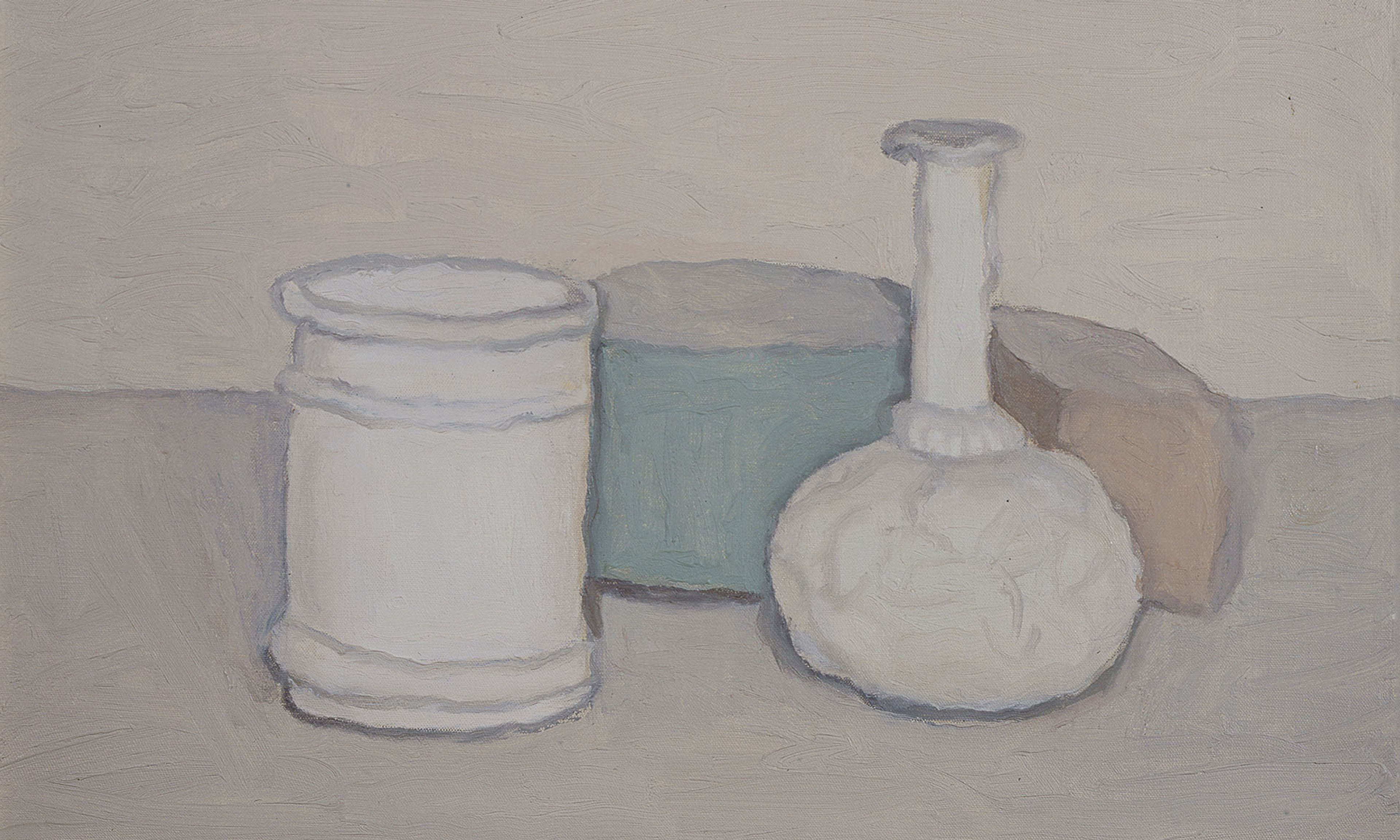
Around my house I have prints of still lifes by the Italian painter Giorgio Morandi. His still lifes of grouped bottles and pitchers on tabletops, with their recurring objects and ever-muted palette, remember each other. When asked about his attachment to a particular object that he painted again and again — the meaning it held for him — Morandi said, “In the end, it is just a white bottle.”











Comments