Very rarely does the whole world face the same problem at the same time. I’m not talking about the staples: aging, want, crime, and the rest. I’m talking about something specific, such as the coronavirus. It is truly a common enemy, worldwide. It’s as though Earth had been invaded by hostile extraterrestrials.
Has this extraordinary situation served to draw the world closer? Not that I can tell.
Well, how about the coronavirus in one country (to adapt a phrase from Stalin)? I have the United States in mind. Has this common enemy served to draw Americans closer? On the contrary, it has heightened our divisions, I think. The bonds of affection — Lincoln, this time, not Stalin — are very strained.
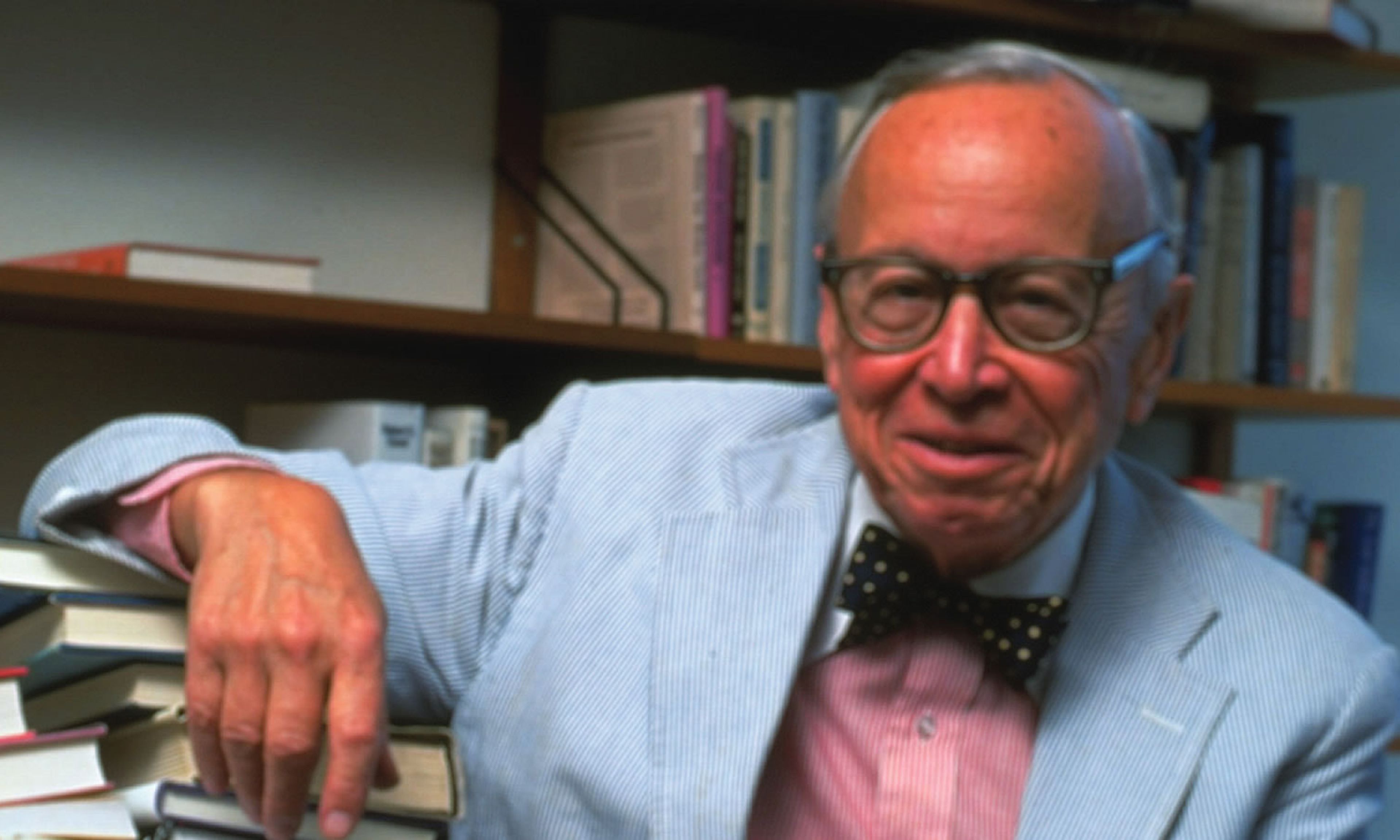
In recent weeks, I have thought of a book, published almost 30 years ago: The Disuniting of America: Reflections on a Multicultural Society. First appearing in 1991, it was reissued in 1992 and 1998. It was a hit with many conservatives, which was surprising, given the source: Arthur M. Schlesinger Jr., that high priest of liberalism.
He was in his mid 70s when he wrote Disuniting. He had published his first book more than 50 years before, when he was 21. That was his senior thesis at Harvard, a study of Orestes Brownson, a 19th-century New Englander who wrote, preached, organized, etc. Schlesinger followed that up with The Age of Jackson, a hit in 1946.
Writing about Schlesinger in 2001, William Leuchtenburg, a fellow historian, walked down Memory Lane. “I recall one afternoon in 1946 overhearing a grizzled bookseller on Fourth Avenue saying to another, ‘How do you figure this business? A book on Jackson a best-seller!’”
The Disuniting of America was a best-seller too. Schlesinger had a lot to say, all life long, that is true. But also, he could write — which made him a best-seller. Here is a stylish, and typical, sample from Disuniting:
Those intrepid Europeans who had torn up their roots to brave the wild Atlantic wanted to forget a horrid past and to embrace a hopeful future. They yearned to become Americans. Their goals were escape, deliverance, assimilation.
I wish Disuniting could be a best-seller today, too. It is “ripped from the headlines,” as they say — the headlines of right now. It is dated only in small, trivial ways. The book is an expression of the old liberalism, supplanted by leftism and other flavors of illiberalism. It is conservative, in one sense: protective of the “American Creed,” as Schlesinger writes (with no irony and with those capital letters).
Sitting down with the book recently, I marked it up, excitedly. It is possible to mark up a book so much, you render your markings useless.
Schlesinger opens by observing that the Cold War is over and new wars have begun: not over ideology but over those old standbys: race, ethnicity, and tribe. As he proceeds, he quotes Chinua Achebe, the Nigerian novelist who lived from 1930 to 2013. (It was he who wrote Things Fall Apart, whose title is borrowed from Yeats.) The greatest weakness of the Nigerians, Achebe said, is “their inability to face grave threats as one people instead of as competing religious and ethnic interests.”
For his part, and discussing America, Schlesinger warns that “the contemporary sanctification of the group threatens the old idea of a coherent society” — a society never based on race, ethnicity, or religion, but on “a common adherence to ideals of democracy and human rights.”
What Schlesinger wants to know is, “Will the center hold? Or will the melting pot give way to the Tower of Babel?” In speaking of the center, holding or not holding, Schlesinger is borrowing from the same poem as Achebe. You may remember, also, that Schlesinger wrote a book called “The Vital Center” (1949).
As for Babel, Schlesinger writes quite a bit in Disuniting about English and bilingualism. There have always been many languages in America, he says, as immigrants have landed, but these languages have given way to the common tongue, English — which is critical for all concerned.
On Election Day a few years ago, I looked at my ballot and saw that it was in both English and Spanish. There was a yes-no question for voters to vote on. What you saw was “Yes/Sí” and “No/No.” Oh, come on, I thought. How insulted a Spanish-speaker must be to see “No/No” — and “Yes/Sí,” for that matter.
Schlesinger is big on integration and assimilation. Unironically, he uses “melting pot,” as you may have noticed, above. Schlesinger is a defender and admirer of this pot. But he points out that melting is a two-way street. They, the newcomers, must want to integrate and assimilate; but we, the native-born, must want those things for them, too.
This is a burning issue in France (sometimes literally). Is it that Muslims, many of them, won’t become Frenchmen? Or that Frenchmen, many of them, won’t let them? But back to America.
“For a long time,” writes Schlesinger, “the Anglo-Americans dominated American culture and politics and excluded those who arrived after them” — including people from Italy. I thought of my friend Pat Gigliotti (whose first name was originally “Pasquale,” but who became “Pat” when a teacher of his, an Irish nun, had trouble with the original).
Pat grew up in Kansas City. Certain mothers forbade their daughters to date him because he wasn’t “white.” He was Italian. Later he lived in Southern California and was called an “Anglo.” Pat told me, “I can’t tell whether that’s a promotion or a demotion.”
He further pointed out that people around him were called “Latino” — yet the original “Latin lover,” Rudolph Valentino, was an Italian.
About black Americans, it is hard to be so lighthearted. “We must face the shameful fact,” says Schlesinger: “Historically, America has been a racist nation.” In their treatment of black Americans, white Americans “betrayed” their Creed, he says.
This summer, many prominent newspapers and magazines have decided to capitalize “black,” in reference to people and culture; some of them are doing the same with “white.” I myself recoil from those capital letters. I think they accent apartness (a word that, in Afrikaans, is “apartheid”). I think they constitute yet another blow to E pluribus unum, “Out of many, one.”
Also, the phrase “black culture” — or “Black culture” — is interesting. There are subcultures in America, naturally, as there are in countries all over. But it should not be forgotten that black culture is part and parcel of American culture, across the board. Thomas Sowell once pointed out to me that the average black family has been on these shores longer than the average white family.
The New York Times has embarked on its “1619 Project,” which places slavery at the heart of the American founding. A historian and teacher, Arthur Schlesinger has a lot to say about the teaching of history. “History is to the nation rather as memory is to the individual,” he writes. He also writes, “History is a weapon.”
Beware “compensatory history,” he says: the kind of history that tries to make up for neglect, oppression, and other sins. Out-groups have always been attracted to this kind of history, understandably. Schlesinger gives the example of Irish Americans. Also, beware “history as therapy.” In one of his killer lines, Schlesinger writes, “Low self-esteem is too deep a malady to be cured by hearing nice things about one’s ethnic past.”
Schlesinger thinks history ought to be taught warts and all — and don’t get too fixated on the warts. I think of a line that Jeane J. Kirkpatrick once uttered: “Someday, Americans will have to face the truth about themselves, no matter how pleasant it is.”
I had to smile — or did I more like grimace? — when reading Schlesinger on higher education: “The situation in our universities, I am confident, will soon right itself once the great silent majority of professors cry ‘enough’ and challenge what they know to be voguish blather.” I think Professor Schlesinger, 30 years later, would find himself still waiting.
In 1991, he was more worried about primary and secondary schools than about universities. The “ethnic and racial pressures” on these schools were great. “If separatist tendencies go on unchecked,” he writes, “the result can only be the fragmentation, resegregation, and tribalization of American life.”
Christopher Columbus — more than 500 years after his death — is in the news because Americans are vandalizing, toppling, or demanding the removal of monuments to him. Schlesinger strikes me as very wise: “Let our children try to imagine the arrival of Columbus from the viewpoint of those who met him and also from the viewpoint of those who sent him.”
On the subject of freedom of speech, Schlesinger is clearly uncomfortable to have allies on the right and adversaries on the left. He is a free-speech champion. And right-wingers are supposed to be the censors (as sometimes they are). But left-wingers, too, prove excellent censors. And they may find that, in altered circumstances, they are the censored rather than the censoring.
As if trying to get through to dull-witted children, Schlesinger writes, “No one needs the First Amendment more than those who seek to change society. Radicals are always in the minority and minorities gain most from the protections of the Bill of Rights.”
He also gives us this killer — and ungainsayable — sentence: “It is ironic that what the multiculturalists began as a joyous celebration of diversity ends as a grim crusade for conformity.”
I have said that The Disuniting of America is ripped from today’s headlines, and it is. But if Professor Schlesinger could revise it — he died in 2007 — he would surely spend time on political polarization. Red states and blue states. Fox News and CNN. Everyone in his own political camp, at daggers drawn with the enemy (and not the coronavirus). Is this worse than the ethnic, racial, and other divisions that Schlesinger takes up? There is some overlap, I think.
Above, I used the word “ungainsayable,” in homage to William F. Buckley Jr., who used it with some frequency. I have never heard anyone else use it. WFB and Schlesinger were old antagonists, but the last book WFB ever read, I believe, was Schlesinger’s Journals: 1952–2000 (published posthumously). He was enthralled with those journals. There were two references to him, both of them mean, he told me — but he was wowed by the journals nonetheless.
He had a plan: to review the journals at great length — 20,000 words or so — for The New York Review of Books, The Atlantic, or a comparable publication. He died before that could happen, however.
I will trust Bill on the journals, which I have not read. Disuniting, I have — and I find it a splendid contribution, made by the author in the twilight of his career. This is a patriotic contribution, too. You can hear in Schlesinger’s book the mystic chords of American memory, which Lincoln hoped would swell again.











Comments