Falls Church, Va.
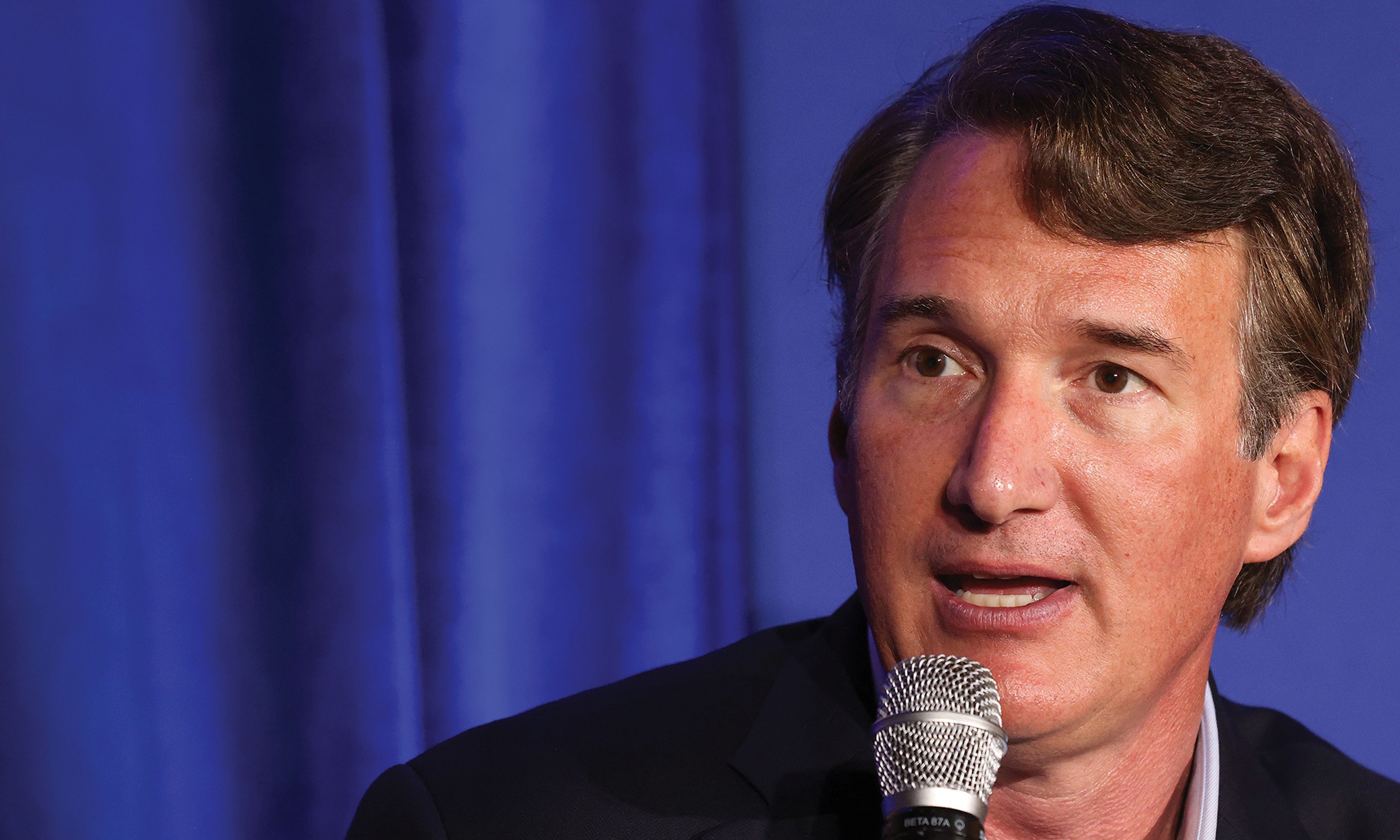
On a recent Saturday afternoon in this northern Virginia city, GOP gubernatorial nominee Glenn Youngkin delivered his stump speech inside a packed Vietnamese restaurant in a strip mall before fielding questions from voters on a wide range of topics — immigration, schools, crime, and more.
Something that goes completely unspoken by Youngkin and voters at the event is the name “Trump.” The same holds true during Youngkin’s 30-minute tour of other Vietnamese-American-owned businesses in the Eden Center strip mall after the event — not a single voter asks him about Trump or the 2020 election. It’s a striking contrast to the Democratic campaign event held just the night before in northern Virginia, where Democratic gubernatorial nominee Terry McAuliffe, who served a term as Virginia governor from 2014 to 2018, and President Joe Biden spent the evening tagging Youngkin as a Trump acolyte. McAuliffe has repeatedly offered to “pay for the gas” for Donald Trump to come campaign for Youngkin, an offer that Youngkin has so far declined.
The state’s gubernatorial election this fall will be one of the first major tests for Republicans during the Biden presidency of whether they can make up ground they lost in suburbia during the Trump presidency.
Virginia’s shift from red to blue did not begin with Trump, but his election exacerbated it. After their last statewide victory a dozen years ago, in the 2009 governor’s race, Virginia Republicans suffered narrow losses in key races. In the 2013 governor’s race, McAuliffe defeated staunch conservative Ken Cuccinelli by 2.5 points. In 2014, the establishment Republican Ed Gillespie fell 0.8 points shy of unseating Democratic senator Mark Warner. But when Gillespie was the party’s gubernatorial nominee in 2017 — as the suburban backlash against Trump was in full swing — he was crushed by nine points. In 2020, Biden carried the state by ten points.
Even in Virginia, where the political necessity of moving beyond Trump is obvious, it hasn’t exactly been a cakewalk for Youngkin. He emphasized his support for Trump while seeking the GOP nomination, and he recently attended an “election integrity” rally at Liberty University — evidence, McAuliffe argues, that Youngkin is courting 2020-election conspiracy theorists. While voters in northern Virginia are interested in other topics, at a recent campaign event in Fredericksburg, one woman asked Youngkin about a delusional theory that Trump could be reinstated this year as president. Youngkin dodged the question without rejecting its premise. McAuliffe pounced, which prompted Youngkin to issue the following statement: “I’ve said that Joe Biden is legitimately our president, so there is no question here. As I tried to say politely the other day, there is no legal proceeding that will change the fact that Joe Biden and his liberal allies are dragging our economy down with their bad policies until 2025, and instead of litigating the past we must be focused on winning in November to stop those policies here in Virginia.”
But so far, the Trump label doesn’t seem to have stuck to Youngkin. The tone and demeanor of the two men couldn’t be more different.
“I am very supportive of legal immigration in America. It is the backbone of America,” Youngkin says during his campaign event at the Vietnamese restaurant, when asked about the border crisis. He blames “Washington” for the “human tragedy” at the border and concludes, “As your governor, I’ll support our immigration laws.”
A 54-year-old father of four and former CEO of the Carlyle Group, a private-equity firm, Youngkin comes across as a more relaxed version of Mitt Romney. The first-time political candidate has spent the summer bankrolling soft-focus ads that center on his biography. In short, Youngkin grew up in Virginia before making it to college on a basketball scholarship, the ads blanketing the airwaves tell viewers, and he went on to live the American dream as a businessman and suburban dad who loves puppies. The lone heckler Youngkin encounters during his visit to the Eden Center strip mall shouts, “I heard that guy played basketball!”
Polling now shows that a significant number of voters in northern Virginia do appear to be moving on from the politics of the Trump presidency, and Youngkin is trailing McAuliffe statewide by the low single digits. “Glenn Youngkin is in a good place now because people are asking a different set of questions,” Tom Davis, a former Republican congressman who represented a district based in Fairfax County from 1995 to 2008, tells me after the Youngkin campaign event. “Voters voted for Biden because they didn’t want Trump in their living room,” Davis adds. “They’re [now] getting all this woke stuff. They’re going to pump the brakes on that.”
The woke stuff largely involves public schools in northern Virginia.
To take just one example: The school board in Fairfax County, purportedly acting in the name of racial justice, recently eliminated a rigorous admissions test at Thomas Jefferson High School for Science and Technology, the state’s premier STEM magnet school. After the test was scrapped, the percentage of newly admitted Asian-American students dropped from 73 percent to 54 percent, and the percentage of black, Hispanic, and white students increased. “We need to maintain admissions policies that are based on a meritocracy,” Youngkin tells concerned parents inside the Vietnamese restaurant.
In nearby Loudoun County, meanwhile, parents have protested the introduction of critical race theory into the curriculum. A recent poll conducted by the GOP firm Public Opinion Strategies found that 59 percent of public-school parents in Fairfax and Loudoun Counties oppose teaching critical race theory in public schools. Youngkin is campaigning on banning critical race theory in public schools statewide.
Perhaps the biggest wild card of all in the 2021 Virginia gubernatorial race isn’t what the public schools will be teaching this fall but whether they will even be open five days a week for in-person instruction.
Fairfax County, home to one out of every seven Virginia residents, “was one of the worst school districts in the country when it came to its reaction to COVID,” says Rory Cooper, a father of three children enrolled in Fairfax County Public Schools. Even after teachers were vaccinated, the school district allowed children to be taught in person only part-time in the spring of 2021, with reduced class sizes and social distancing.
Cooper is a former Republican congressional aide, but he says he gets “messages all the time from people who have worked in Democratic politics or who are very progressive by nature who say they are now a one-issue voter.” That issue is keeping the schools open.
Virginia law now says that schools need to offer five days a week of in-person instruction this fall, but parents are still worried that the teachers’ unions will find a loophole to bring back virtual schooling. “All you need is teachers not to show up, which is what they’ve done over summer school,” says Cooper. “I do worry that we’re going to have, at minimum, disruptions in in-person learning or, worse, a fully virtual environment while they figure it out.”
What exactly would Youngkin do to keep schools open five days a week? “The first thing to do is to stand up and lead and say that our schools should be open five days a week, and we can figure this out,” Youngkin tells National Review in an interview outside the Vietnamese restaurant. “Second of all, we then have to make sure that our schools understand that when they disadvantage our children, they’re not going to actually get their full funding.”
“Finally,” he adds, “we have a moment where school choice should be introduced into our school system.” Youngkin says he’s still working on the details of his school-choice plan, but it will involve education savings accounts.
Youngkin is now firmly opposed to pandemic-related government mandates and restrictions. “Based on what I know today and the facts that I know today, we do not need mask mandates,” Youngkin tells me. “I would encourage everyone to actually get the vaccine. I’ve had the vaccine, but there are actually people who don’t want to get the vaccine for very good reasons, and they should be allowed to make their own decision.” What are those good reasons, I ask, not to get vaccinated? Youngkin cites only one: “People have religious issues with it, and they should be allowed to express their religious beliefs.”
“Based on what I know today, a mandate — let’s call it a mandated vaccine in order to get your life back — is not something that I would support,” he says.
It’s hard to know the exact trajectory of the pandemic and how governments will respond at the state and local levels in Virginia between now and Election Day, but those issues could be decisive. “If things get worse here with the virus and you have the Democrats calling for more lockdowns, I don’t know how much of an appetite they’d have for that in some of the suburban localities,” says J. Miles Coleman of the University of Virginia’s Center for Politics.
At the moment, however, McAuliffe is still favored in the race. “A majority of Virginians seem to be satisfied with the Democrats. [Youngkin] needs to make the case of why we need to fire the people voters approve of,” Coleman says. Joe Biden’s national job-approval rating was still above 50 percent as of this writing, so the national political environment still points to a Democratic win in Virginia in November.
When I ask Youngkin what the worst consequence of another McAuliffe term in the governor’s mansion would be, he cites two proposals: ending Virginia’s status as a right-to-work state and ending “qualified immunity” for police officers.
Qualified immunity might not be something readily understood by voters, but it is at the center of Youngkin’s case against McAuliffe on the issue of crime. “If a police officer is doing their job according to their training, they cannot be sued in court,” and qualified immunity “is very important to law enforcement because it allows them to feel confident that they aren’t going to have frivolous lawsuits against them,” Youngkin argues during the campaign event. “If we lose qualified immunity, there will be mass retirements, mass resignations, among police officers.”
McAuliffe, meanwhile, has in recent weeks opened up another line of attack against Youngkin on the issue of abortion.
Youngkin caused trouble for himself when he was caught on camera saying that he’s trying to avoid talking about the issue, as a campaign tactic. At an event in June, a liberal activist posing as a pro-lifer approached Youngkin and asked him when he would “take it to the abortionists.”
“I’m going to be really honest with you,” Youngkin replied. “The short answer is, in this campaign, I can’t. When I’m governor and I have a majority in the House, we can start going on offense. But as a campaign topic, sadly, that in fact won’t win my independent votes that I have to get.”
When I ask Youngkin about his position on abortion, he makes a strong case that McAuliffe is the one who’s an extremist on the issue. McAuliffe supports abortion “all the way up to the last week of pregnancy, paid for by taxpayer money, and that’s not where Virginians are,” Youngkin says.
In 2019, a Democratic state delegate introduced a bill that would loosen Virginia’s 28-week statutory limit on abortions so that abortion would be legal during the last week of a pregnancy if a single doctor asserted the pregnancy would pose any harm to the mother’s mental health. Asked in February 2019 whether he supported the late-term-abortion bill, McAuliffe said, “Absolutely not,” but just two months later he flip-flopped and said he would in fact sign the legislation.
At the end of our interview, I ask Youngkin whether he’d sign a bill prohibiting most abortions later than 20 weeks in pregnancy, when a baby is capable of feeling pain. “I think that when a child could feel pain, we should go discuss when that is, and that would be a very good moment for us to actually make sure we are stopping taxpayer-funded abortions,” he replies. Youngkin’s reference to “taxpayer-funded” abortions left unclear whether he would sign legislation that would generally protect pain-capable unborn children from abortion, but a campaign aide later confirmed that he does support such legislation.
Both houses of Virginia’s legislature are now controlled by Democrats, and state senators don’t face another election until 2023, so it will be difficult for Youngkin to get much of his legislative agenda enacted if he is elected. But guaranteed Democratic control of the state senate for two more years is one more reason to think Virginia voters might be more comfortable sending to the governor’s mansion a Republican who can, at the very least, tap the brakes on the progressive agenda.










Comments