
• At this rate, Candace Owens is going to discredit antisemitism.
• Biden’s departure from the presidential race followed nearly a month of two rare things. One was press coverage and leaks pulling back the curtain on how the Biden White House works. The other was criticism by Democrats and the press of Biden’s capacity to do his job. The conspiracy of silence, as New York magazine called it, unraveled after Biden’s debate face-plant. But both trends ended abruptly the instant that Biden’s X account announced his withdrawal. Since then, the president has been so rarely seen and heard, with so little on his daily schedule, that one must ask: Who exactly is acting as president now? Biden has not convened a full cabinet meeting since last October. He has been obviously confused in public, and there have been disturbing reports of his not recognizing friends and Democratic lawmakers in private. If Kamala Harris is running the show, she should answer for it on the trail — if ever she is asked a question. If Jill Biden is running things, that’s a different scandal — one Americans never voted for. Is convicted felon Hunter Biden still closely advising his father? We’re not merely in bad hands — we don’t even know whose hands they are.
• House Republicans have produced a report extensively documenting the monetization of the “Biden brand.” That’s the euphemism that Joe Biden’s collaborators — his son Hunter, his brother Jim, and their associates — used as they sold access to Biden to agents of corrupt and anti-American regimes. Among the details: shady business deals with Russian, Romanian, and Ukrainian oligarchs, as well as with Chinese companies with extensive connections to the Chinese Communist Party, involving not just Hunter but also then–vice president Joe Biden. The report also illustrates the complex web of LLCs that the Bidens and their associates used to conceal the flow of payments from foreign agents to Biden-family accounts, a pattern reminiscent of money-laundering. This Biden family business should have been the subject of an aggressive law-enforcement investigation, but Biden-Harris DOJ prosecutors obstructed such efforts by spinning the case as focused solely on Hunter and his tax problems and dragging their feet even there. The DOJ waited so long that any crimes arising out of Joe Biden’s term as vice president exceeded the statute of limitations. House Republicans never had the numbers to seek impeachment articles against Biden. But they have made a strong case that his conduct was impeachable.
• Once he became Trump’s running mate, Senator J. D. Vance (R., Ohio) caught flak for his years of remarks about the “sociopathic” influence of “childless cat ladies” on our politics and culture. He has said that taxes should be higher for childless adults and that parents should be given additional votes to cast for their children. The first proposal, put in different terms, isn’t even controversial — U.S. tax policy has long included it, with bipartisan support — but he made his comments during a period of his political career when he was courting a segment of the Republican Party by being as obnoxious as possible. And the comments were indeed obnoxious. Many good citizens have no children, not all of them voluntarily. There are many ways that government policy could and should be changed to enable families to form and thrive. Attacking and shaming those without children should play no part in that effort.
• By any rational assessment, Josh Shapiro, the competent, popular, and telegenic governor of Pennsylvania, a must-win state for both campaigns in this year’s presidential election, deserved to be on Kamala Harris’s vice-presidential short list. But he was passed over after a cabal of anti-Israel malcontents took special exception to him. A practicing Jew, Shapiro was subjected to a withering shadow campaign in the progressive press, which alleged that “Genocide Josh” — an “outspoken supporter of the Zionist project in Palestine,” the Democratic Socialists of America claimed — would “fracture” the Democratic Party. Yes, Shapiro took a tough stance against antisemitic campus activists, but his stance on Israel was no different from that of Walz. The upshot, as progressive commentator Van Jones put it, is that antisemitism is now “marbled through” the Democratic Party.
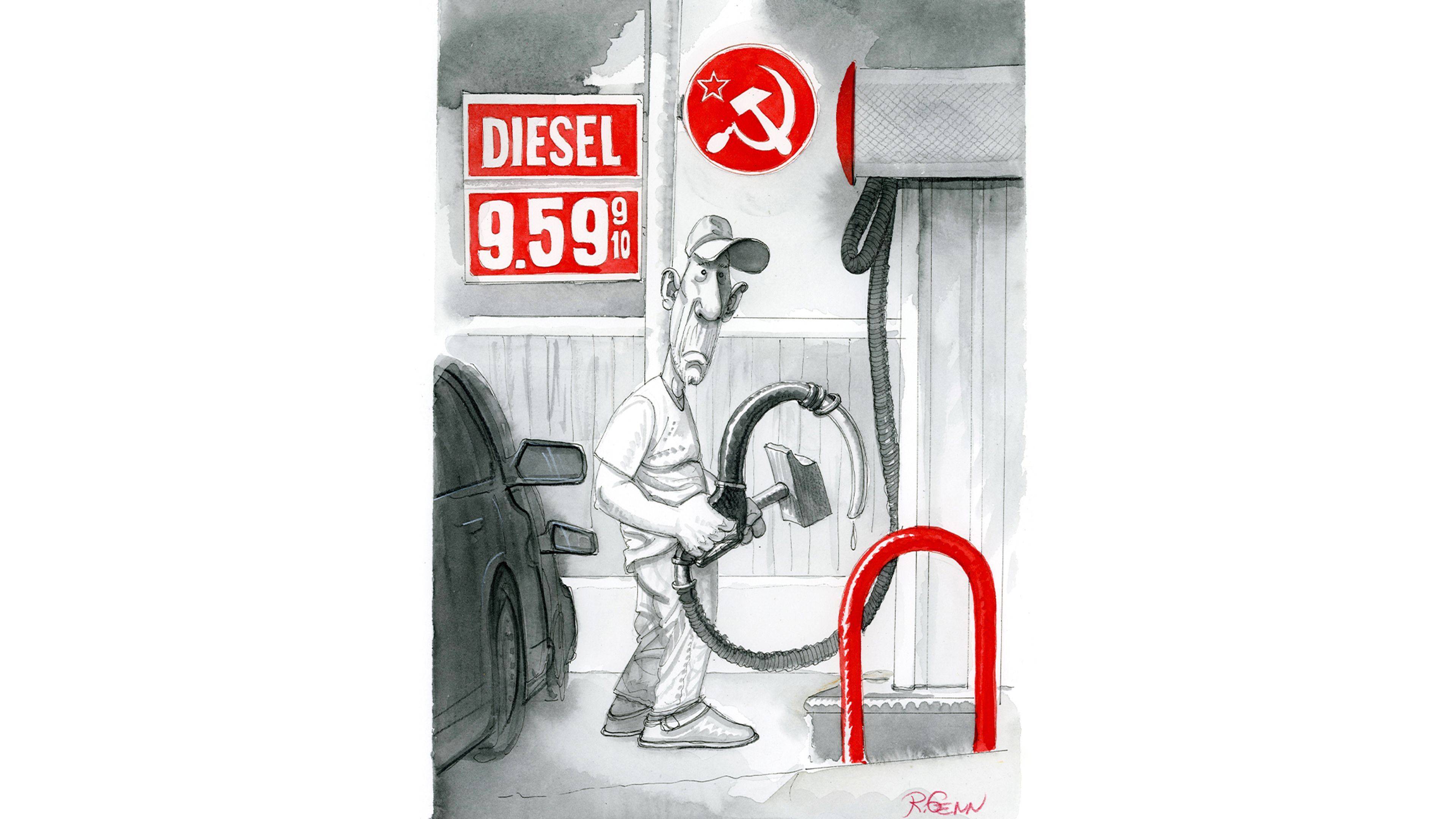
• “It’s a tax on a country that’s ripping us off and stealing our jobs. And it’s a tax that doesn’t affect our country,” Trump said of tariffs at a rally in Pennsylvania. (Studies consistently find that nearly all the burden of tariffs falls on Americans.) In Nevada, J. D. Vance said, “We believe that a million cheap, knockoff toasters aren’t worth the price of a single American manufacturing job.” (This trade-off would be perverse even if it were not a fantasy.) Vance has been tapped as “policy attack dog” by the campaign, and he has been saying in stump speeches that Kamala Harris supported NAFTA (she did not) and that NAFTA sent American car-manufacturing jobs to Mexico. (U.S. car-manufacturing employment increased for the first six years after NAFTA came into effect, and many of the jobs that left Michigan and Ohio moved to Texas and Kentucky.) We’re told that this willful economic ignorance is “populist,” but polling shows that voters don’t actually have strong opinions on trade or globalization. Even though tariffs have been a constant topic of discussion for the past eight years, a recent poll from the Cato Institute and YouGov found that 47 percent of Americans either had no opinion about or had never heard of tariffs. Tariffs raise prices for American consumers, hurt American manufacturers, and create opportunities for political corruption and back-room deals for well-connected Washington lobbyists — which are, incidentally, issues that “populists” claim to be concerned about.
• The downfall of the Heritage Foundation’s Project 2025 is a tale of hubris, but also of how politics abhors a power vacuum. The decision to collect the whole range of Heritage’s recommendations into a single branded document that was touted as though a second Trump administration would use it as a blueprint may have appealed to donors and authors, but it allowed Democrats to paint it as a dark conspiracy. As Trump’s disavowals of the project grew blunter, its leader stepped down and recriminations flew. But Democrats, undeterred, are still running ads against the project and carrying copies of the tome to the convention podium. The press being what it is, Trump has found it harder to escape the proposals of an outside group than Kamala Harris has found it to renounce her entire 2020 presidential platform.
• New York is a wild town teeming with lively stories, and presidential candidate Robert F. Kennedy Jr., an independent, is at the center of one of the weirdest ones of the past decade. In 2014, a dead black bear cub was found in Central Park, far from where any bear naturally roams. A bike had been left at the scene, as if to suggest that the animal had died in a collision. It turned out to have been deposited there by none other than RFK Jr. By his own account — provided in a video recorded to preempt reporting from the New Yorker — he was driving upstate to go falconing when a car in front of him killed the bear cub. His first instinct, apparently, was to stop and toss it in the car, with the intention to skin it and eat it later. Having lost track of the time, he found himself at a Brooklyn steakhouse later that night, with a carcass in tow and a flight to catch. In an act of indescribable logic, he decided to stage the bicycle crash in Central Park. There are 8 million stories in the naked city. This has been one of them.
• Like those represented by her fellow “Squad”-mate Jamaal Bowman, the Democratic voters in Cori Bush’s St. Louis district threw the congresswoman out in this year’s primary election. Bush made a virtue of protesting against her party’s leadership even as representative-elect. She advocated the cancellation of student and medical debt, the elimination of cash bail, and the defunding of police, which is “not a slogan” but “a mandate for keeping our people alive.” Bush was keen on moral and emotional blackmail — tactics she applied while camping out on the Capitol Building steps demanding that Joe Biden indefinitely extend a pandemic-era moratorium on evictions. She developed a monomaniacal animus against the State of Israel. Bush’s priorities were not her voters’, as her constituents communicated with their votes. But Bush is now convinced that the pernicious influence of Jewish money undid her political career. She has promised to take her cry-bully act on the road, from which she will rail against lobby groups such as AIPAC and reclaim her good name. If she is as competent in that pursuit as she was as a lawmaker, AIPAC’s stewards can sleep well.
• Senate Majority Leader Charles Schumer (D., N.Y.), along with 36 other members of his caucus, are advancing legislation to dictate how federal courts should rule. It would direct them to ignore any defense by a president or former president that relied on the claim that he had immunity for the conduct in question. It would also block the Supreme Court from reviewing the constitutionality of the new law: The D.C. Circuit would do that, and under generous standards. The bill is an attempt to circumvent the Supreme Court’s recent ruling on presidential immunity. One need not agree with every portion of that ruling, or indeed any of it, to find Schumer’s legislation a radical attack on the rule of law and an invasion of the proper authority of the courts. If this bill ever passed, the courts would be duty-bound to refuse to follow it. It is troubling enough that more than three dozen senators have endorsed it.
• A federal judge ruled that Google is an illegal monopoly in search services and advertising. The ruling is a solution in search of a problem. It is true that, in the United States, Google pays billions of dollars to the makers of browsers and cellphones to have its search engine presented as the default option. It is also true that in the EU, where regulations force users to choose the search engine they prefer, 90 percent choose Google — almost exactly the same percentage as choose Google here in the U.S., where default options are typically easy to change. Which consumers, then, are being harmed? The timing of the DOJ’s suit is off: The search market is in greater flux today than it has been in two decades. Indeed, while the case was pending, Google supplemented its traditional search engine with a new chat-based AI product, Gemini, that is intended to replace Google search over time. The scale of the competition in AI is such that Google will have its work cut out if it wishes to maintain the position that it has reached with its traditional search engine. Even if it manages to do so, the change that AI will bring to the market is likely to render moot whatever remedies the courts impose.
• Stephen Richer is a key election official in Arizona — specifically, the recorder of Maricopa County, whose seat is Phoenix. A Republican, he was elected in 2020. He has a classic Republican background: the Federalist Society, ISI, AEI, our Burke to Buckley program, etc. But he would not say that the 2020 presidential election was stolen. That put him in the crosshairs of many of his fellow Republicans — and “crosshairs” is all too apt a word. Four people have been arrested for threatening Richer’s life. Trump lied about him. Rudy Giuliani lied about him. Kari Lake lied about him. Richer sued Lake for defamation, and she capitulated quickly. Damages are yet to be determined. Richer’s reelection bid has now been defeated in the GOP primary. One day, perhaps, the Stephen Richers will be appreciated in the GOP, and in America at large: appreciated as “guardrails” — human guardrails — of our constitutional order when being one was dangerous and important.
• In an interview with a local radio station in August, Stacy Davis Gates, the president of the Chicago Teachers Union, was asked to respond to critics concerned about the dismal math and reading scores of students in Chicago public schools. Gates said that tests to measure achievement are “junk science rooted in white supremacy” and that “you can’t test black children with an instrument that was born to prove their inferiority.” She is presumably unbothered by test results finding that 80 percent of black students in Chicago public schools cannot read at grade level and that, in some majority-black schools, zero black students are proficient in math and reading. Gates, an adamant opponent of school choice, sends her son to a private school. Parents whose children are trapped in failing public schools are less sanguine. One mother called in to protest: “I passed every standardized test, and I want my children to be able to do it even though I’m black.”
• “Jewish students were excluded from portions of the UCLA campus because they refused to denounce their faith.” That was the bracing conclusion of Los Angeles federal judge Mark Scarsi in ordering UCLA not to allow anti-Israel protest encampments to exclude Jewish students from having full access to the campus. Scarsi forbade UCLA to hold classes at any time when encampments blocked Jewish students. The suit was brought by religious Jews who complained that it would violate their faith to renounce the existence of Israel and said that protesters blocking access to the library demanded this as the price of entry. On the other coast, federal judge Richard Stearns allowed a suit to go forward that accuses Harvard of failure to enforce its policies evenhandedly; the judge concluded that “Harvard failed its Jewish students,” which seems unanswerable.
• In news that surprised no one, Biden-administration officials announced in July that the Iranian government has aided anti-Israel protests on college campuses and in city streets across the United States. Director of National Intelligence Avril Haines said that the U.S. has “observed actors tied to Iran’s government posing as activists online, seeking to encourage protests, and even providing financial support for protesters.” Soon after, White House national-security spokesman John Kirby confirmed Haines’s report at a press briefing, saying that while not “all protest activity out there on a daily basis is being fully funded by Iran,” the U.S. does “know that Iran has been funding and encouraging some of the protest activity.” Of course, Iranian leadership has made clear where it stands on the anti-Israel protests, with Ayatollah Ali Khamenei telling the demonstrators that they were on “the right side of history” and describing them as forming “a branch of the Resistance Front.” And the protesters earned his praise — Hamas and Hezbollah flags can be found at almost any anti-Israel rally, and chants such as “Globalize the intifada” align with the Islamic Republic’s goals in the region.
• Israel has never shied away from assassination campaigns that target the leaders of their battlefield enemies, but recent weeks have featured an impressive level of Israeli tactical competence. On July 30, the deputy leader of the Iranian-backed terror group Hezbollah, Fuad Shukr, received a telephone call in which he was instructed to ascend to the seventh floor of his Beirut residence. There, the terror mastermind and architect of the 1983 Beirut barracks bombing, which killed more than 240 Americans, was hit by a missile. The following day, a bomb planted inside a secure diplomatic residence in Tehran blew up at precisely the moment that the political leader of Hamas, Ismail Haniyeh, returned to it. He, too, was dispatched. The assassinations have thrown Hezbollah into chaos as it tries to ferret out the traitors who gave Shukr up. Likewise, the operation that killed Haniyeh demonstrated that Iran is so thoroughly penetrated by Israeli intelligence that it has likely stayed the hands of the regime’s thugs, who have not yet meted out their promised vengeance against Israel. These successes have had the additional benefit of exposing those critics of Israel who condemned the operations. If even the minimal collateral damage from targeted strikes on terrorist leaders is too much for you, maybe you’re not so much anti-war as anti-Israel.
• The U.N. revealed that its probe into UNRWA (its Relief and Works Agency for Palestine Refugees in the Near East) confirmed that some of the agency’s staff likely participated in the October 7 massacre. It’s an important admission, though one for which the international bureaucrats deserve no credit. The U.N. was forced to look into UNRWA’s Hamas ties only after Israel exposed the agency’s role. And the report, conducted by the U.N.’s internal audit office, comes with a few caveats. It investigated only 19 staffers whom Israel brought to its attention, finding that nine were likely or highly likely to have joined the attack. UNRWA said that it was not able to find corroborating evidence against the rest. Israel has identified at least 1,200 UNRWA employees with ties to Hamas or Palestinian Islamic Jihad. The U.N., though, said that it has closed the probe and plans to move on without further investigation. Even the generally obsequious press corps at Turtle Bay was shocked by the organization’s choice not to make public the report or details about the precise role of the nine staffers. This is a cover-up designed to give the Biden administration and Western governments permission to resume funding UNRWA. They should not just continue to freeze the funding but burn down the agency.
• The EU Commission quickly distanced itself from Thierry Breton, its single-market commissioner, after he posted a letter to Elon Musk ahead of the latter’s conversation with Donald Trump. In it, Breton reminded Musk that content on X was governed by the EU’s new Digital Services Act. Breton’s offense was not what he wrote but when he wrote it. To Brussels it looked too much like possible election interference, and it might be unhelpful should Trump make it back to the White House. Americans should thank Breton for the wake-up post. The fear of very large fines could lead an American company to censor online speech by Americans in America in order to comply with standards set in a jurisdiction not notably friendly to free expression. American social-media companies should do what it takes to ensure that the censorship regime of the EU stays there.
• On August 6, in a startling gambit, Ukraine invaded the Russian border province of Kursk, far to the north and west of the previous two years’ main battlefields. Elements of at least six Ukrainian-army brigades smashed through the thinly held Russian lines and seized dozens of towns and villages, forcing the hurried evacuation of tens of thousands of Russian civilians. The Kremlin’s response has, so far, been shambolic. Ukraine’s aim is to draw Russian units away from the grinding offensive in the Donbas, embarrass Vladimir Putin, and occupy territory that it may one day trade for the return of Ukrainian land. The move carries with it a significant risk of overextension for an outnumbered and outgunned Ukrainian army. But the invasion of Russia — the first by a foreign army since the Second World War — has quickened hearts and raised morale across Ukraine.








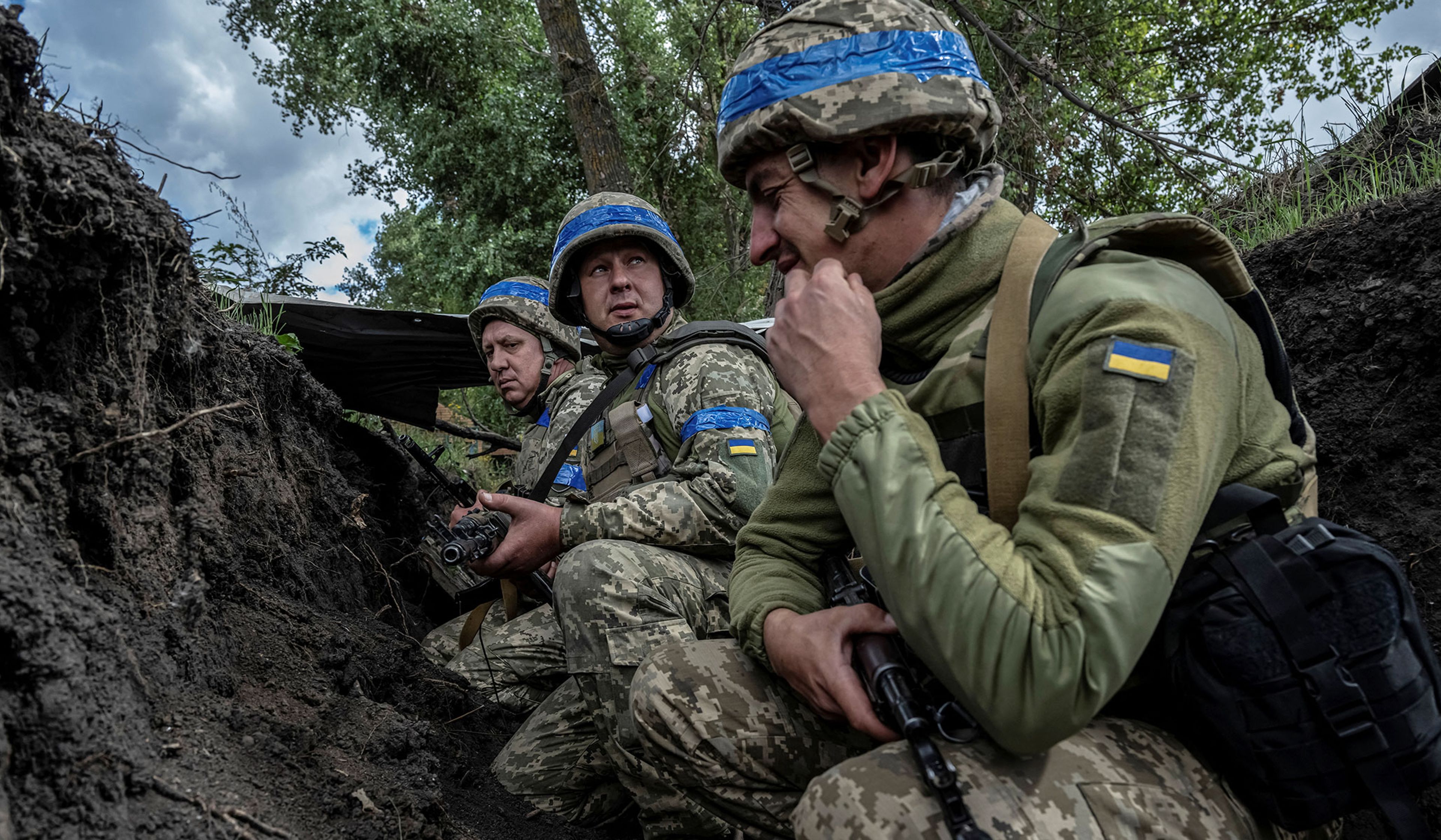






A Ukrainian serviceman stands on a flag of Russia’s Wagner mercenary group near the Russian border in Sumy Region, Ukraine, August 13, 2024.
Viacheslav Ratynskyi/Reuters
• A stunning prisoner swap brought 16 people out of Russian custody and returned eight Kremlin agents to Putin. It was a swap involving seven countries. Among those released from Russian custody were Evan Gershkovich, the Wall Street Journal correspondent, and Vladimir Kara-Murza, the Russian democracy leader. American politicians, starting with President Biden, emphasized the stark difference in values between the United States and Putin’s Russia. It is always difficult for a democracy to know how to respond to hostage-taking by tyrants. After the recent swap — the largest since the end of the Cold War — Donald Trump said, “I’d like to congratulate Vladimir Putin for having made yet another great deal.” That was natural for him to say. We ourselves think it better to congratulate the hostages on their newfound, dear-bought freedom.
• The story of the Venezuelan presidential election, held on July 28, can be told briefly. Before the election, the dictator, Nicolás Maduro, suppressed the opposition, barring several candidates from running, for example. Yet Edmundo González, a former diplomat, ended up on the ballot, representing the opposition, broadly speaking. He won by a wide margin. All credible international observers agree on this. Maduro? He simply refused to go. Then he cracked down viciously on dissent and protest. Venezuelans have been amazingly brave in standing up to the dictatorship that rules them. The United States, and other democracies, should help them in all ways feasible and wise.
• In early August, England was swept by a wave of riots set off by false reports that an illegal Muslim immigrant had killed three little girls in a knife attack (the alleged murderer turns out to be the U.K.-born son of Christian Rwandan immigrants). A firm police response reinforced by some stiff sentences quickly brought the disturbances to an end (there’s a lesson there). Less laudably, the authorities also overreacted to online comments deemed related to the rioting. There are also clear indications that the government will use the riots as an excuse to tighten Britain’s control over online speech still further, with a view to clamping down on discussion of what most Britons believe was one underlying cause of the unrest: the failure to control mass immigration. If that is the plan, it will be as counterproductive as it is illiberal.
• By the conclusion of the Paris Olympics, China had been humiliated by its failure to outperform the United States: Despite a population of 1.4 billion people, it won 40 gold medals, the same as America, which also won far more silvers and bronzes. Frustrated Chinese took to social media to racially insult United States Olympians, claiming that the 28 golds won by African Americans properly belonged to Africa, which is not a nation, or to Israel — this for no reason other than antisemitism. Let the Chinese Communists sulk in the corner if they want. American athletes will continue to crush them without even noticing their resentments.
• Minouche Shafik, the president of Columbia University, has resigned. She follows Claudine Gay of Harvard and Liz Magill of Penn, both of whom stepped down after they failed to effectively handle a series of antisemitic protests on campus — among other issues. In her resignation letter, Shafik said that “it has been difficult to overcome divergent views across our community.” But that was not the problem. Shafik’s problem was that she was sympathetic to the protesters — even after they had started shouting in support of “intifada,” declaring “Death to Zionists,” demanding “Jews out,” and threatening Jewish students that “the Seventh of October is going to be every day for you.” Asked in Congress whether she believed that there had been any antisemitism on campus, Shafik said that she had seen none. Faced with an extended occupation of the university’s grounds and buildings, Shafik did almost nothing. Told unequivocally that the atmosphere at Columbia was hostile, Shafik equivocated until the anarchy escalated to the point that the university had no choice but to call the police. “I have been able to reflect,” she reported, “and have decided that my moving on at this point would best enable Columbia to traverse the challenges ahead.” Maybe. But unless the pernicious ideology that has taken hold in sections of academia is rooted out, nothing major will change as a result.
• In a recent video called “The Truth about Zionism,” Candace Owens, the online personage, informed her audience that “many moons ago, before they decided to establish Israel as a country — I know you’ve read like the short version: [in a mock-whiny voice] ‘Oh, the Holocaust happened and then we realized Israel is like a state.’ No, that’s not how it went down. Catholics and Christians were going missing, on Passover, then they would find bodies — okay? — across Europe, and they were able to trace them back to Jews.” These Jews — bloodthirsty pedophiles and murderers — went on to establish Israel. She has “figured it out.” It’s tempting to dismiss the fetid rants of Owens, who was cut loose from the Daily Wire over her increasingly deranged comments about Jews and Israel after 10/7. The trouble is that she’s known as a “conservative,” with 5.5 million followers on Twitter/X and 2.3 million podcast subscribers. A recent podcast guest was the model Amber Rose, who gave a speech at the Republican National Convention. And Owens isn’t dumb — in fact, she’s smart enough to try to preempt her critics by shouting, in more mockery, “Blood libel!” Which doesn’t change the fact that it’s what she’s doing.
• Disney’s live-action remake of its 1937 classic Snow White cannot escape controversy. First, lead actress Rachel Zegler took a blowtorch to the original film, saying that “there’s a big focus on her love story with a guy who literally stalks her,” that the plot is “weird,” and that “we didn’t do that this time.” Zegler’s Snow White, she said, is “not going to be dreaming about true love” but about “becoming the leader she knows she can be.” Then, Peter Dinklage — the actor with dwarfism best known for his role in Game of Thrones — criticized the presence of dwarves in the film, leading Disney to cast non-dwarf actors as supernatural beings. That didn’t last long, with Disney announcing that it would instead create CGI dwarves — and that it would delay the film by a year. Recent days have somehow been even worse for Disney: Israeli actress Gal Gadot, the bête noire of the Hamasnik crowd, plays the Evil Queen in the film, and once the trailer appeared online, so too did a torrent of anti-Israeli and antisemitic harassment of Gadot. To her post on X discussing the release of the trailer, Zegler added, “And always remember, free palestine.” Zegler’s social-media antics leave the viewing public in an interesting situation: They might decide to skip the film because it stars an Israeli actress; because its other star has done her best to destroy any likeability she may have had; or because Disney cast Gadot in a role where she is jealous of someone else’s looks, and suspension of disbelief can get you only so far.
• Many coma patients are conscious despite their inability to communicate, according to a new study in the New England Journal of Medicine. Researchers gave them simple commands (e.g., “Imagine playing tennis”) and, using neuroimaging, found that one-fourth responded mentally. This finding corroborates a long-standing though controversial intuition in the medical community and may change our understanding of patients diagnosed with severe dementia as well as of the unborn and the newborn. (The word “infant” comes from a Latin word meaning “incapable of speech.”) Because the subjective experience of a person unable to communicate it also tends to evade attempts by others to detect or measure it, the NEJM study warrants serious consideration and a deepened appreciation of the humanity that the nonverbal share with their caregivers and the rest of us.
• Second Lieutenant William Calley became the face of everything wrong with the American war effort in Vietnam when the platoon he commanded wiped out the civilian population of the hamlet of My Lai in central South Vietnam. Calley gave the order to kill and did some of the killing himself. Superior officers were accused of trying to cover the massacre up, but Calley was the lone serviceman convicted (of 22 murders) and was sentenced to life at hard labor. Popular sentiment and politicians rallied to him: President Nixon began the long whittling down of his sentence, and Georgia governor Jimmy Carter declared American Fighting Man’s Day in his state in response to the conviction. Calley, they felt, was the scapegoat for an attrition strategy that was both witless and ineffectual. So it was, but that is no excuse for cold-blooded murder, even in the heat of war. Calley ended up serving three years of his sentence. By the time he was a free man, Southeast Asia had fallen to those who carried out massacres that were more carefully planned. In 2009 he told a Kiwanis Club that he felt remorse “for what happened that day at My Lai.” Too little, too late. Dead at 80, R.I.P.
• Walker Percy’s book Lost in the Cosmos includes a sketch entitled “The Last Donahue Show,” which imagines Phil Donahue, the talk-show host who ruled daytime cable TV during the Seventies and Eighties, interviewing four typical guests (a gay man who cruised parks, a straight adulterer, a pregnant teen, a sex therapist) and three unusual ones (John Calvin, a Confederate artillerist, and an alien from outer space). Percy imagined Donahue dealing with the last three with some consternation, although put to the test he probably would have done fine. Donahue was an intelligent and empathic listener. His show unfortunately began mass media’s long slide to personality, pathology, and voyeurism: endless rounds of me, me, me, first presented as help, then openly offered as bear-baiting and emotional striptease. By the end — that is, now — his old shows looked like Platonic dialogues. Dead at 88, R.I.P.
• In a life devoted to print journalism, Lewis Lapham fancied himself an heir of Twain and Mencken. He lacked their gifts but occasionally gave space in the magazines he edited to those who had them (Tom Wolfe). He deserves credit for helping keep the venerable monthly Harper’s afloat through the long, withdrawing melancholy roar of print. He pioneered the use of short items, often lifted from other sources, like found objects (e.g., Hustler’s style book: how to copy-edit pornography). After leaving Harper’s he pursued an interest in history in a quarterly forthrightly named Lapham’s Quarterly. His left-of-center politics were the sneer of a disgruntled Roman senator (his great-grandfather founded Texaco, his grandfather was mayor of San Francisco). In his last years he could be seen, exiled to smoke on the sidewalk, well turned out in blue blazer and white pants, sometimes practicing his golf swing. Dead at 89, R.I.P.
Politics
A New Race
Donald Trump and the GOP are facing a different race from the one they anticipated. As they say at West Point, no excuse, sir.
The veep of an abruptly retiring president should not escape the administration’s pitfalls — in Kamala Harris and Joe Biden’s case, inflation, ever-swelling debt, porous borders, the Afghan debacle. Yet Harris, who turns 60 in October, is not physically and mentally worn out, and like most vice presidents she has not carved out a distinctive public profile. A healthy cipher is ideally positioned for a sprint down the home stretch.
What she has shown so far, however, is not attractive. Her endorsement of price controls — she called it combating “price-gouging” by grocery stores — earned the derision of even the Washington Post editorial board and our old friend David Brooks at the New York Times. See also every ruler who has tried controlling prices by fiat, from Diocletian to Richard Nixon. Stealing a plank from Donald Trump, she picked a silly one: no taxes on tips. Her party’s platform is pro-abortion down the line; responding to the vibe, Planned Parenthood parked a van outside the Democrats’ convention in Chicago offering free abortion pills.
Harris has reversed hard-Left stances she took in the past — she no longer opposes fracking or proposes “Medicare for All,” moves to the center that would be welcome if sincere, though they suggest the on-the-fly nature of her run. Other Harris retreats have the nature of evasions: avoiding the press (not that most of it would be hostile) and denying that Biden ever gave her responsibility for the southern border.
Then there is the man Harris tapped as running mate, Minnesota governor Tim Walz. He looks like Gramps from some old sitcom, and his manner plays better on the hustings than hers. But his record is dismaying. During his first run for Congress, in 2006, his campaign lied about a DUI arrest and conviction a decade earlier; throughout his political career he has shaded, or allowed others to shade, his 20-plus years in the National Guard, portraying him as having served in combat (sometimes in Iraq, sometimes in Afghanistan; he never deployed to either) and crediting him with a rank — command sergeant major — he did not fully earn. Equally bad are his political instincts. Governor Walz let Minneapolis burn during the George Floyd riots, and he hails its antisemitic congresswoman Ilhan Omar.
Harris-Walz is a tag team that would be vulnerable to an aggressive, principled conservative attack. Unhappily, the GOP is led by Donald Trump. After some days of stupor during which he seemed to be gaping at the new electoral reality, he has gone back to monster rallies. He decorates these and his social-media posts and interviews with insults and fantasies: slighting Medal of Honor winners because so many of them are injured or dead; claiming that Harris faked rally crowds with AI (she didn’t) and that he heard anti-Harris guff during a helicopter ride with her onetime patron Willie Brown (the two men never shared a helicopter). He coined infantile nicknames (“Kambala”), mocked Senator Tester’s weight (you’re not so slim yourself, sir), insisted he was better looking than Harris, and continued his spat with Brian Kemp, the popular Republican governor of Georgia, a state he needs to carry. Substance was no refuge, as he informed the world that tariffs, which he supports, are a tax on foreign countries, not American consumers.
In 2016, these and so many other lies and howlers were the effusions of a feisty outsider. Now they issue from a third-time candidate who has become the oldest man to win his party’s nomination for the White House. Trump’s shtick has not aged well; neither has he.
We go to press while the Democratic convention in Chicago — shades of 1968 — is ongoing. Will tight security and back-room pledges to stick it to Israel later mute left-wing protesters? There are still two more months to run, but without improvement the GOP seems headed for defeat with dishonor.
The Stat
4,392 — the number of pages in the Harmonized Tariff Schedule of the United States, as of August 2024.
The International Trade Commission keeps track of U.S. tariffs in the Harmonized Tariff Schedule, “for use in classification of imported merchandise for rate of duty and statistical purposes.” The schedule is split into 22 sections and 99 chapters, with codes assigned to each category of product according to international standards. Before even getting to the first section, the document includes about 900 pages of notes and rules for interpretation. There you learn things such as that, under the United States–Mexico–Canada Agreement, “pigments or colouring [sic] materials classified under headings 3206 or 3212 shall be disregarded in determining the origin of the goods classified under headings 3207 through 3215, except for any such pigments or materials based on titanium dioxide.” Once you get into the actual tariffs, you learn that imported meat or edible offal of turkeys that is not cut in pieces, frozen, and valued at less than 88 cents per kilogram is taxed at 8.8 cents per kilogram, but if the value is 88 cents or more per kilogram, it is taxed at 10 percent. If it’s not cut in pieces and is fresh or chilled rather than frozen, then it is taxed at 15 cents per kilogram regardless of valuation. Unless, of course, it is covered by one of 17 separate trade agreements, in which case it is free. Imported knitted or crocheted fabrics of a width not exceeding 30 centimeters that contain by weight 5 percent or more of elastomeric yarn but no rubber thread (other than those in heading 6001, naturally) and that are made of cotton are taxed at 8.8 percent. Those made of other materials are taxed at 8 percent. For cotton, there are only 14 separate trade agreements that remove the tariff. For other materials, there are 15.
These are but two examples of thousands of tariffs the U.S. has on its books. Remember that next time someone tells you U.S. trade policy has been made by “market fundamentalists” or “doctrinaire free-traders.”
by Dominic Pino









Comments