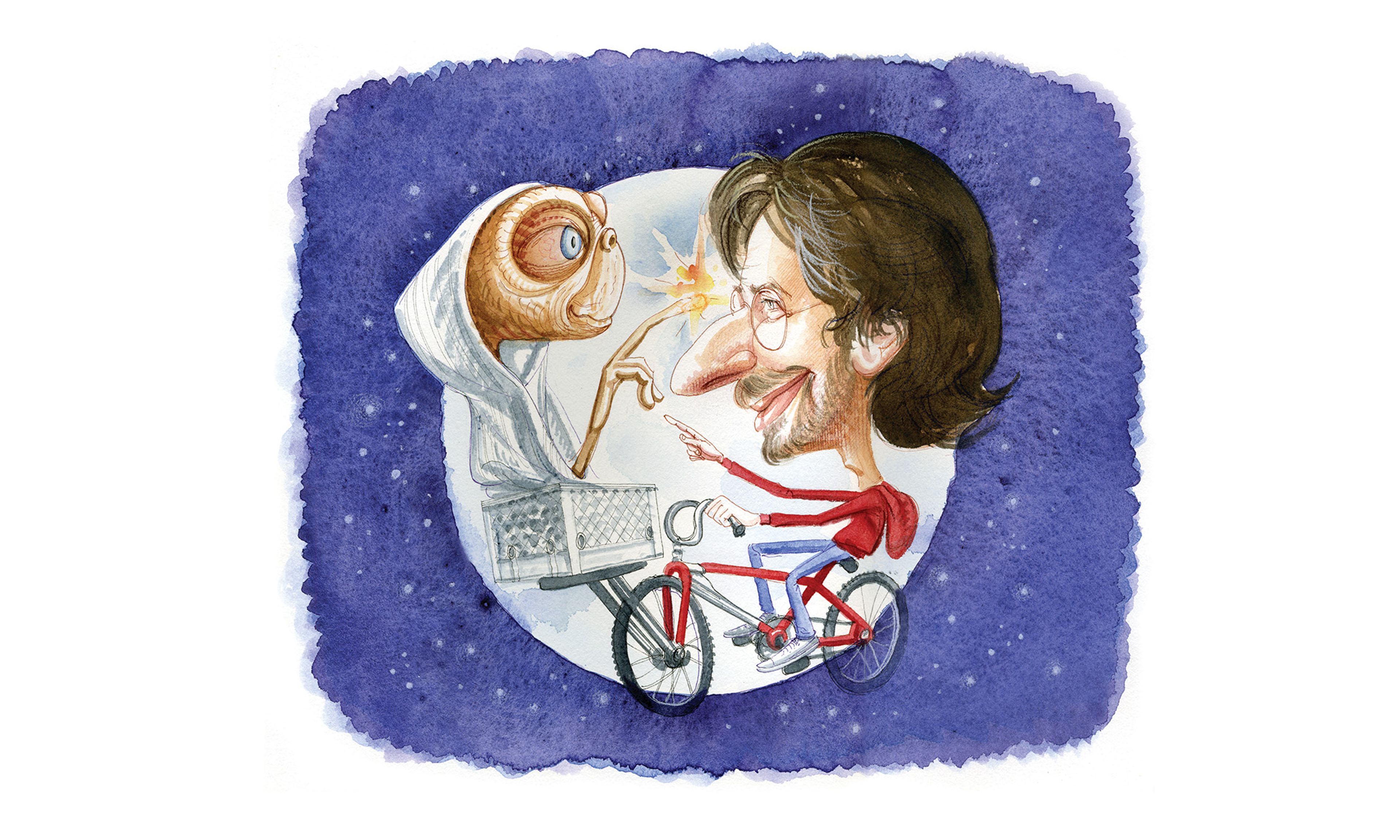
These days, Hollywood seems to think the highest aim of the movies is to spirit audiences to far-off places, fantastical worlds, or alien or otherwise imaginary environments. On the basis of the staggering box-office returns of such fare as the Avatar, Dune, and never-ending Star Wars franchises — not to mention the assorted comic-book- or video-game-derived cinematic universes — audiences appear positively eager to escape to places unknown. Fanciful, far-fetched, or unreal fiction has existed since time immemorial, but in the movies, it dominates as never before.
Once upon a time, Steven Spielberg charted a different course for the American moviegoing public. At the height of his popularity, from the mid 1970s through the late 1990s, Spielberg was so successful because his sentiments, concerns, and attitudes were so ordinary. During those years, Spielberg not only achieved awe-inspiring box-office returns but attained something like a state of communion with moviegoers. His films were beloved not because they took audiences to distant worlds — even if they occasionally featured creatures from distant worlds — but because they took audiences home: to their backyards, their kitchen tables on pizza night, their congested neighborhood streets at dusk on Halloween.
Spielberg grounded many of his films, even those that seemed the most fantastical, in a cozy, commonplace normality that was once recognizable to nearly every American: His films often centered on conventional, middle-class, suburb-dwelling, presumably God-fearing families whose existence was stressed or torn asunder by divorce (E.T. the Extra-Terrestrial), contact by alien beings (Close Encounters of the Third Kind), shark attacks (Jaws), the revelation that a family member was once Peter Pan (Hook), or the sudden emergence of paranormal goings-on (Poltergeist, which Spielberg did not direct but conceived and produced, and which bore his overall branding).
The success of these and other Spielberg films represented a kind of collective self-embrace by the American public: They saw images of themselves both in the ordinariness of Spielberg’s vision and the ordinariness of Spielberg himself. And, from a tender age, I counted myself among their ranks.
I was born in 1983, and by 1991 — the year Spielberg made his winsome, remarkably creative Peter Pan reboot Hook, the first of his films I remember seeing in a theater — I was already intimately familiar with most of his work up to that point. Like most children who came of age during those years, I had thrilled to Raiders of the Lost Ark (1981) and its offspring on television, and I had caught up with Jaws (1975) and Close Encounters of the Third Kind (1977) on videocassette. I had also furtively watched, in cable airings, Spielberg’s 1987 World War II drama Empire of the Sun. Based on an autobiographical novel by J. G. Ballard, this masterly film centers on Jim Graham (Christian Bale), an English boy whose well-heeled existence in Shanghai is suddenly, violently terminated upon the Japanese invasion: Wrested from his parents, forced by necessity from his splendid home, Jim faces the lonely purgatory of an internment camp.
Officially, Empire of the Sun was counted among Spielberg’s grown-up films — one of the first in a series of historical dramas that were perceived, rather cynically and uncharitably, as their maker’s attempt to win critical credibility — but, in practice, it was as understandable and easy to follow as E.T. or Jaws. To an eight-year-old like me, there could be few sights more terrifying than that of Jim carelessly allowing himself to be separated from his mother (Emily Richard) during a mêlée in the early hours of the invasion. (He let go of her hand, my mother would later say to me of Jim’s critical mistake, in a cautionary tone.) And even to an eight-year-old, there could be few sights more essentially reassuring than that of Jim, near the end of his nightmare and the world’s, being rescued by a gaggle of smirking, gum-chewing and/or cigarette-puffing, slump-shouldered, helmet-wearing American soldiers at his internment camp. In Spielberg’s conception of the world, the arrival of Americans in green fatigues can only be a salutary thing.
Was I too young to have seen Empire of the Sun when I did? Possibly, but it doesn’t take age or wisdom to grasp the security of family, the danger of war, or the essential goodness of Western civilization. Of course, I would never have articulated these themes in this manner at age eight, but, then, neither did Spielberg, who trafficked in images and exploited emotions that could be comprehended by anyone with eyes to see. Besides, people are arguably most attuned to the natural order of things — that cozy, commonplace normality I spoke of earlier — when they are young and before they have been otherwise influenced by peer pressure, tendentious teachers, or, today, social media. I sometimes think that I have never been more patriotic than I was in the second grade, when I was tasked with reciting the Pledge of Allegiance over the school intercom one morning. I remember how seriously I took the task, and how gravely worried I was that I might misread the pledge.
From virtually the start of his career and up until relatively recently, Spielberg — who was born in Cincinnati in 1946 and brought up in New Jersey and Arizona — worked from a similarly innocent set of premises: that a family unit ought to consist of a mother, a father, and one or more children; that suburban streets easily traversed by bicycle are the ideal setting in which such children can flourish; that American might, whether exercised militarily or archaeologically, is a force for good. Most people, during Spielberg’s heyday, subscribed to something like this worldview, which meant that his films functioned as affirmations. Spielberg’s own personal political convictions (he is a liberal Democrat) are irrelevant in this analysis; his foundational ideas and attitudes were well within the currents of American life, as his broad appeal demonstrated.
That is not to say that Spielberg was a Pollyanna. In fact, in many films he made a case for something by presenting its absence. The fact that the siblings in E.T. — Elliott (Henry Thomas), Michael (Robert MacNaughton), and Gertie (Drew Barrymore) — are growing up without their father renders them all the more susceptible to becoming attached to the visiting space creature named in the title; it does not diminish the magic of that special movie to admit the reality that they would never have had a need for a little friend if their own dad were home rather than in Mexico with a woman named Sally who was not their mother. Throughout his career, Spielberg has been notably smitten with space travelers, but to a striking degree, they usually intrude on broken homes — like the one he came from. (His parents divorced in 1966, an episode lightly fictionalized in his recent film The Fabelmans.) In Close Encounters of the Third Kind, a blindingly multicolored spaceship swoops up a tot named Barry (Cary Guffey), who happens to live in a single-parent home: His sweet-natured mother (Melinda Dillon) does her best to intervene in the terrifying abduction, but can anyone doubt that the presence of a strong father — say, Tom Cruise’s divorced dad who finds himself caring for his children amid an alien invasion in Spielberg’s 2005 remake of War of the Worlds — might have been useful in this confrontation between human and alien life?
When he presented intact families, Spielberg did so with a profound sense of their fragility. When watching Jaws, we are keenly aware that, among the men at sea in search of the dastardly shark, Amity Island police chief Martin Brody (Roy Scheider) is the only one who has a young family waiting for him back home. Oceanographer Matt Hooper (Richard Dreyfuss) comes across as a nerdy bachelor, and shark-hunter Quint (Robert Shaw) as a dangerous loner, but Brody is a man with something to lose. In fact, Brody is arguably driven by a kind of fatherly obligation: A local child has been killed by the shark, and his own son has a close call himself. And, at the end of Empire of the Sun, Spielberg presents a kind of dream vision of a family that once had been split and now was whole again: Jim, in disbelief, pauses to take in the sight of his long-lost mother. As if to prove she is real, not a vision, he reaches for her hand, her face, her hair. No other director was so attuned to the bond between mother and son, a bond that is perceptible even to the robot child in A.I. Artificial Intelligence (2001). In the last scene, the robot boy, David (Haley Joel Osment), bereft of his long-departed human mother (Frances O’Connor), is given a simulated reunion with her, but the sentiment he expresses at seeing her again is in every way authentic: “I found you,” he says. That same sense of losing a family and then regaining it courses through every frame of The Color Purple (1985), which ends with the extraordinary outpouring of emotion when the sisters Celie (Whoopi Goldberg) and Nettie (Akosua Busia) at last set eyes on each other again.
No less than Norman Rockwell, Spielberg was profoundly patriotic. But like Rockwell, Spielberg expressed his patriotism less through rah-rah chest-puffing than in an exuberant, vividly illustrated, almost half-kidding indulgence in the emblems and iconography of American life. As early as 1979, in his World War II comedy 1941 — an outrageous, often obscene satire written by Bob Gale and Robert Zemeckis — Spielberg displayed an almost giddy appreciation for swing music, USO dances, cigar-chomping fighter pilots, Ferris wheels.
By the same token, the Indiana Jones franchise certainly sacrificed both history and archaeology to the demands of matinée-style entertainment, but at the core of the films was their maker’s conviction that Indiana Jones was acting in the best tradition of American vigor in safeguarding the Ark of the Covenant, sacred stones, and the Holy Grail itself. He was not an ugly American. He was a virtuous American, and after he did his duty he was happily homeward bound. At the end of Indiana Jones and the Temple of Doom, following her adventures in far-flung corners of the world, Indy’s female companion, Willie Scott (Kate Capshaw), sensibly demands that she be returned to the creature comforts offered in the American Middle West: “I’m going home to Missouri, where they never feed you snakes before ripping your heart out and lowering you into a hot pit!” This simplified, boys’-adventure-novel vision of the world is admittedly unreal, but, really, is it any more unreal than the woke, CRT-influenced lesson plans currently being foisted on America’s impressionable schoolchildren?
In fact, Spielberg eventually assumed the role of America’s unofficial history teacher. His lesson plan was not cynical but hopeful and humane. Through the years, his lessons become richer, deeper, more challenging. He commemorated great figures whose virtue proved decisive at crucial moments, such as Oskar Schindler, the German industrialist whose actions prevented the deaths of about 1,200 Jews during the Holocaust, in Schindler’s List (1993), or Abraham Lincoln, whose leadership during the Civil War extinguished slavery and renewed a nation, in the biopic Lincoln (2012). I was 15 when Saving Private Ryan was released, in the summer of 1998, and whatever I had learned about World War II in my history books was weak tea indeed beside my emotional response to seeing the movie in a theater: No written account of the war could communicate the gallant sacrifice of the Allies as well as the opening depiction of the D-Day landings, and no teacher could get across the unspeakable losses of the war as well as the scene in which Mrs. Ryan, about to learn that she has lost several sons, crumbles in the doorway of her home — a silhouetted image worthy of John Ford.
I have, so far, not spoken of Spielberg’s more recent work because it is no longer clear to me that he seeks or values ordinariness as an artistic virtue. He seems increasingly estranged from the wishes, fears, and sense of history experienced by everyday Americans. He once shared with them in these things, but no more. In the epoch of Trump, it’s likely that the liberal Democrat within Spielberg is in no mood to celebrate his country or to share a table with people likely to have voted against Obama, Clinton, or Biden. How else to account for the dour, sour Cold War preachiness of Bridge of Spies (2015), the dystopian hellishness of Ready Player One (2018), or, worst of all, the tedious sanctimoniousness of The Post (2017) — a film about the Pentagon Papers whose outrage felt labored and out of date and whose lionization of Ben Bradlee (Tom Hanks) and Katharine Graham (Meryl Streep) is unworthy of the man whose idea of a hero has always been closer to Indiana Jones. Yet Spielberg has even relinquished the Indiana Jones franchise: The latest installment was directed by an untalented hack with no feeling for American guts or glory. Even Spielberg’s engaging, appealing autobiographical saga The Fabelmans, from 2022, lacked the longing for family togetherness that pulsed through E.T., The Color Purple, and Empire of the Sun: In this film, the young Spielberg-like protagonist seems, ultimately, okay with his folks’ divorce as long as he has a big movie-directing career in front of him.
In his brilliant, essential book Make Spielberg Great Again, National Review culture critic Armond White diagnosed the patient expertly. At Spielberg’s peak, White wrote, his best films “changed the world in which they appeared: inflecting spoken language, influencing social concepts and increasing visual appreciation at the movies.” But since Spielberg has given himself over to liberal political convictions, rather than his populist artistic instincts, his fortunes have tumbled. “His trajectory from the most popular filmmaker in the world to his current marginal status that no longer guarantees a box-office hit — nor popularity — parallels the trajectory of the nation that produced him,” White wrote.
Here we have a crisis of faith: As Spielberg has lost faith in his country, we have lost faith in him. For both good and ill, Spielberg can be compared to Frank Capra, whose legacy the filmmaker and film critic Peter Bogdanovich assessed in a bold article in Frontier magazine in 1959. In his prime, Capra made movies whose appeal “lay in the simplicity of his characters, stories, and causes,” Bogdanovich said. “Uniquely American in content and point of view, his films were inspiring, often to the verge of tears and cheering.” The same could have been said of Spielberg at his best. Yet Bogdanovich noted the curious diminishment of Capra’s belief system in one of his lazy, uninspired later movies: “It is inconceivable to me that the present movie could mean anything to Capra in terms of social, political, economic, or personal outlook.” Spielberg, too, has largely forsaken what once gave him meaning — his sense of being one with the average ticket-buyer.
Sometimes I wonder which has faded more: the shining city on the hill, or the filmmaker who once, more than any of his peers, basked in its light.












Comments