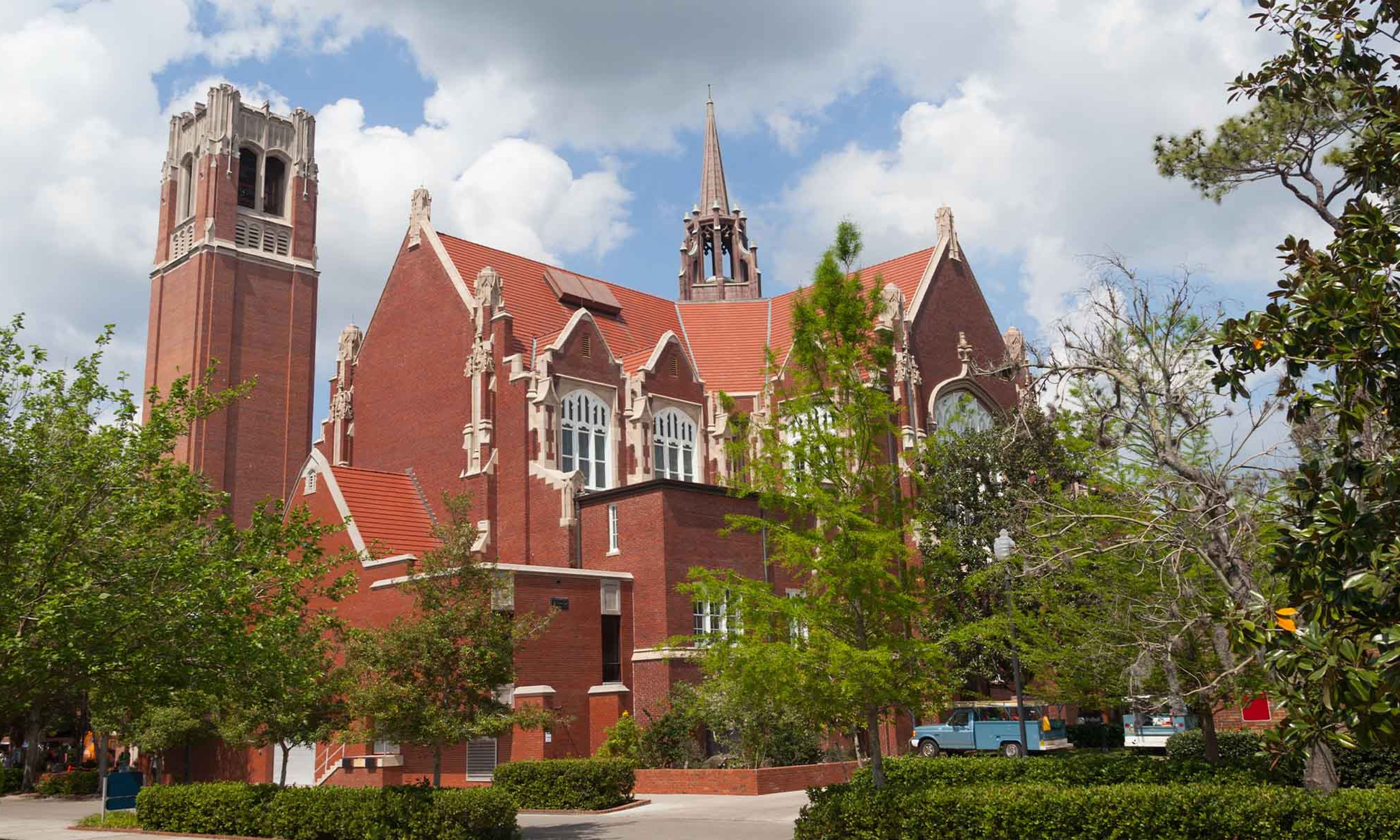
Former U.S. senator Ben Sasse recently announced that he would be stepping down from the presidency of the University of Florida to care for his wife, who is seriously ill. However, in the 18 months of Sasse’s leadership, UF has done the seemingly impossible: built a first-rate academic center that’s not in thrall to recent academic orthodoxies.
In May, the university announced the hiring of 21 new full-time faculty members. The kicker? Each wants to teach the Western tradition. They work in the fields of philosophy, history, literature, and political theory and will join eleven other new faculty members who had already been hired under Sasse. Such a large group of new hires in so short a time is rare in the modern university. These 32 faculty members will take up positions at the school’s Alexander Hamilton Center for Classical and Civic Education, founded in 2022.
William Inboden, the director of the Hamilton Center, spoke with National Review about this new chapter at UF. A military historian, he has spent his career in government as well as in university positions. In 2003 he received his Ph.D. in history from Yale, where he overlapped with Sasse, who received the same degree in 2004.
Not long after Sasse became the president of UF, Inboden received a phone call from his old friend and colleague — Sasse wanted to build a hub for top research and teaching in the Western tradition, and he needed a director. Inboden was then at the University of Texas at Austin, where, in 2013, he started the Clements Center for National Security. In short order, he relocated to Gainesville along with his wife and two sons and took charge of the Hamilton Center.
While Sasse and Inboden have been instrumental to its success, the center was instituted by the Florida legislature, with support from Governor Ron DeSantis, and established by the UF Board of Trustees shortly before either man arrived. The center’s mission is to “educate university students in core texts and great debates of Western civilization and the Great Books” and in “the principles, ideals, and institutions of the American political order.”
Sasse is rightly proud of the center’s recent growth. “The Hamilton Center is rapidly becoming another unit of excellence at the University of Florida, and scholars around the country are paying attention,” he tells me. Most of all, his goal has been to build “a team of incredible minds.” The center, he says, “is dedicated to both teaching and research at the highest level.”
Sasse has faced politicized allegations of financial mismanagement — spending by the president’s office rose from $5.6 million under former UF president Kent Fuchs to $17.3 million under Sasse — but the Hamilton Center’s explosive growth this past year is both the cause and the purpose of the increased presidential budget. Once he took office, Sasse helped negotiate a rise, from $3 million to $30 million, in annual state funding for the Hamilton Center, $10 million of which is recurring. By spending a large sum quickly and efficiently, Sasse was able to bring the center to life in a markedly short time.
Critics have also snubbed Sasse for bringing staffers from his Senate days to the university’s presidential office. However, the practice of a new administration hiring its own “cabinet” of trusted advisers is nothing strange. And the additional staff proved themselves necessary — the amount of work the Sasse administration accomplished in less than two years is remarkable.
Soon to be named “Hamilton College,” the center will offer several majors to Florida’ s undergraduates. The first two will be rolled out in August 2025: philosophy, politics, economics, and law; and great books and ideas. Two more will be added in August 2026: history, statecraft, and strategy; and American studies.
As an independent academic unit, the center has the ability to design its own curricula and manage its own tenure appointments. It receives funding directly from the state and private donors. This kind of institutional independence is key to building and maintaining an atmosphere of freethinking.
For academics laboring under the weight of ultra-left-wing bureaucratic regimes, the Hamilton Center offers an undreamed-of haven for scholarship and teaching. It received more than 1,100 applications for the 32 teaching spots. Inboden says, “We found that if you plant a flag and announce a pretty clear — and for many people, exciting — academic mission, scholars will come out of the woodwork and say, ‘Hey, count me in!’ ” Each of the Hamilton Center’s hires has an impressive pedigree. The faculty includes members who have served as diplomats, earned university-wide teaching awards, and written seminal texts in their fields.
James Hankins, currently a professor at Harvard and a renowned historian of the Renaissance, will serve as a visiting professor for the 2024–25 academic year. Adam Lebovitz, a political theorist who received his Ph.D. and J.D. from Harvard, taught at Stanford before accepting his assistant professorship at Hamilton. Darren Staloff, after teaching at City University of New York for decades, will begin teaching as a professor of humanities in the fall of 2024. He may be a familiar name to lovers of American history, having recorded several popular lecture series on the topic for the Teaching Company.
Most of the new hires have advanced degrees from the Ivy League and other elite institutions. Many simply want to work with top scholars, access the best resources, and teach bright students. Tolerating a woke administration is a price many such professors have been willing to pay to do so. But at the Hamilton Center, faculty can work with top scholars, access the best resources, and teach bright students without the baggage of an overly politicized administration that regulates their every move.
Detractors of the Hamilton Center have labeled the project a reactionary crusade. A reporter for the French newspaper Le Monde accused Sasse and DeSantis of instigating a “right-wing takeover of Florida’s universities.” Hamilton has indeed been radical, but not for the reasons its critics think. In the current academic climate, it is radical simply not to impose an ideological litmus test.
According to Inboden, scholarly rigor and a commitment to undergraduate teaching were the leading factors in the center’s hiring process. “We want to depoliticize academic hiring and teaching and research,” he says. “A lot of what we’re doing at Hamilton is pre-political. These are much deeper values and questions that we’re looking at.” The conversations that stem from studying the classics do not “necessarily lead to a specific predetermined outcome on whom you vote for or where you stand on a particular issue.” In particular, “we don’t regard being conservative as disqualifying.” The same cannot be said for most elite American universities today.
Inboden describes the contemporary playing field in academia: “It has been empirically shown over and over again — and I can certainly tell you dozens of anecdotes — that universities (humanities and social-science departments especially) are actively discriminating against conservatives. It’s horrendous, but it’s true.”
“The real corrosion of academic freedom,” he continues, “has been under way for a few decades now — led largely by the more militant, progressive Left — within the academy. So that has been the backdrop to the Hamilton Center’s founding.”
Hiring trends in the past decade, particularly at elite universities, have weighted DEI points above many other qualifications. As an example, consider schools in the University of California system. In May 2018, Scott Waugh, UCLA’s executive vice chancellor and provost, issued a memo to deans, the university librarian, department chairmen and chairwomen, and “equity advisers” announcing a new EDI (equity, diversity, and inclusion) “Statement Requirement for Regular Rank Faculty Searches.” Waugh wrote: “Starting in the 2018–19 academic year, all regular rank faculty searches must require candidates to submit an ‘EDI Statement’ that describes the candidate’s past, present, and future (planned) contributions to equity, diversity, and inclusion. . . . Also, please note that UCLA will implement a similar practice in the context of ladder rank faculty promotions beginning in the 2019–20 academic year.” (“Ladder-rank” faculty can be promoted until they reach the rank of full “professor.”)
UC Berkeley is no better. According to its “sample rubric for assessing candidate contributions to diversity, equity, inclusion, and belonging (DEIB),” candidates who are not DEIB activists will be scored much lower than those with a “track record” of activism. For example, the rubric awards only one to two points (out of five total) to an application if the candidate “explicitly states the intention to . . . ‘treat everyone the same,’ ” or “participated in only one or two DEIB activities. In order to win five points, the candidate must demonstrate a history of commitment to DEIB “activities.” For top marks, the rubric delineates certain activities required, such as having “organized or spoken at workshops or other events (depending on career stage) aimed at increasing others’ understanding of diversity, equity, inclusion, and belonging.” Candidates must also integrate DEIB into their scholarship and “clearly formulate new ideas for advancing equity and inclusion at Berkeley and within their field, through their research, teaching, and/or service.”
At UC Davis, the statement on “criteria for scoring understanding, knowledge, and awareness” assigns a score of two out of five, or “superficial,” if the candidate “seems to be unaware of or does not understand personal challenges that URMs [underrepresented minorities] (African-Americans, Latin(x)/Hispanics, and Native Americans) face at academic research institutions” or does not “feel any personal responsibility for helping to eliminate barriers.” Such candidates, the document warns, “may provide reasons for not considering diversity in hiring” or see such considerations as “antithetical to academic freedom or the university’s research mission.”
These DEI score sheets are advertised as part of a “holistic” review process, but in practice they lead to the systematic exclusion of academically qualified candidates. At Berkeley, the results have been staggering. The score sheets gave DEI administrators veto power over which candidates departmental hiring committees could even consider. “Of 893 nominally qualified candidates, 679 were eliminated solely due to insufficiently woke diversity, equity and inclusion statements,” Andrew Gillen, a research fellow in education at the Cato Institute, noted in 2020. “In other words, Berkeley used a political litmus test to eliminate over three-quarters of the applicant pool.” At such schools, it doesn’t matter whether a candidate studies molecular biology, ancient Greek, or astrophysics — he must string together reasons why his research contributes to the DEI mission. The pursuit of knowledge for its own sake is insufficient.
But not at the Hamilton Center.
Inboden hopes that the center will build a Ph.D. program in the next few years. One of his “ultimate indicators” of success, he says, is being able to encourage “really sharp, promising undergrads to get Ph.D.s again.” Relatedly, he hopes the center will “reset some of the demand signals of the academic job market.” In recent decades, “universities have been overproducing Ph.D.s, and there haven’t been enough academic jobs — especially tenure-track ones — for them.”
With more academic entities like the Hamilton Center emerging at state schools across the country — eight more, in five states, are in the works — top-notch humanities faculty will be in greater demand. Young scholars dedicated to their research and students rather than to wokeness will have new opportunities to establish themselves in nonhostile environments. And if more university centers continue to prioritize scholarly acumen, quality of teaching, and freedom of thought over ideological checklists when hiring faculty, then hope remains for an American academic reformation.











Comments