Dumb Money, a film about the wild meme-stock days of early 2021, when internet investors drove the price of the decrepit video-game chain GameStop to the moon, is an engaging little movie that feels confused about what kind of story it’s telling.
It’s really a story about online culture under the pressure of the pandemic, and the growing madness, the zeal for wild ideas and apocalyptic confrontations, that a certain kind of enforced virtualism imposes on human beings. That makes it the equivalent of a movie about a left-wing cancellation mob in the summer of George Floyd, or the deluded Trump enthusiasts who invaded the U.S. Capitol on January 6. It depicts zealots of finance rather than political fanatics, but the theme is the same: This is what too much Zoom-life does to people.
But by the time Dumb Money wraps up, you realize that what it wants to be is an essentially unironic story about underdogs taking on the system and winning a victory for truth, justice, and the American way. And that’s a delusion: one that doesn’t make the movie uninteresting or unenjoyable but does require you to take its conclusion and overt message with a substantial tablespoon of salt.
At the eye of the movie’s meme-stock hurricane is Keith Gill (Paul Dano), the suburban-Boston financial adviser whose GameStop posting, under the nom de Reddit “Roaring Kitty,” first persuaded a bunch of internet stock obsessives that the company was undervalued, driving its share price higher — and then persuaded a much larger group of investors to join what became a populist crusade aimed at keeping the price so absurdly high that the hedge funds that had been shorting the stock would be squeezed into financial ruin.
Dumb Money does a good job of evoking the bizarre environment in which this mania took shape, the late-pandemic period when the vaccines were just arriving but closures were still commonplace (especially in states like Massachusetts), public spaces were empty, and people went about observing irrational masking rituals (off for diners, on for waiters, etc.). And its class-warfare mood is reinforced by this peculiar environment: We see the big Wall Street guys — Seth Rogen as the CEO of the hedge fund exposed by the GameStop surge, Nick Offerman as the billionaire Ken Griffin — going about barefaced while the servant class hovers around them masked.
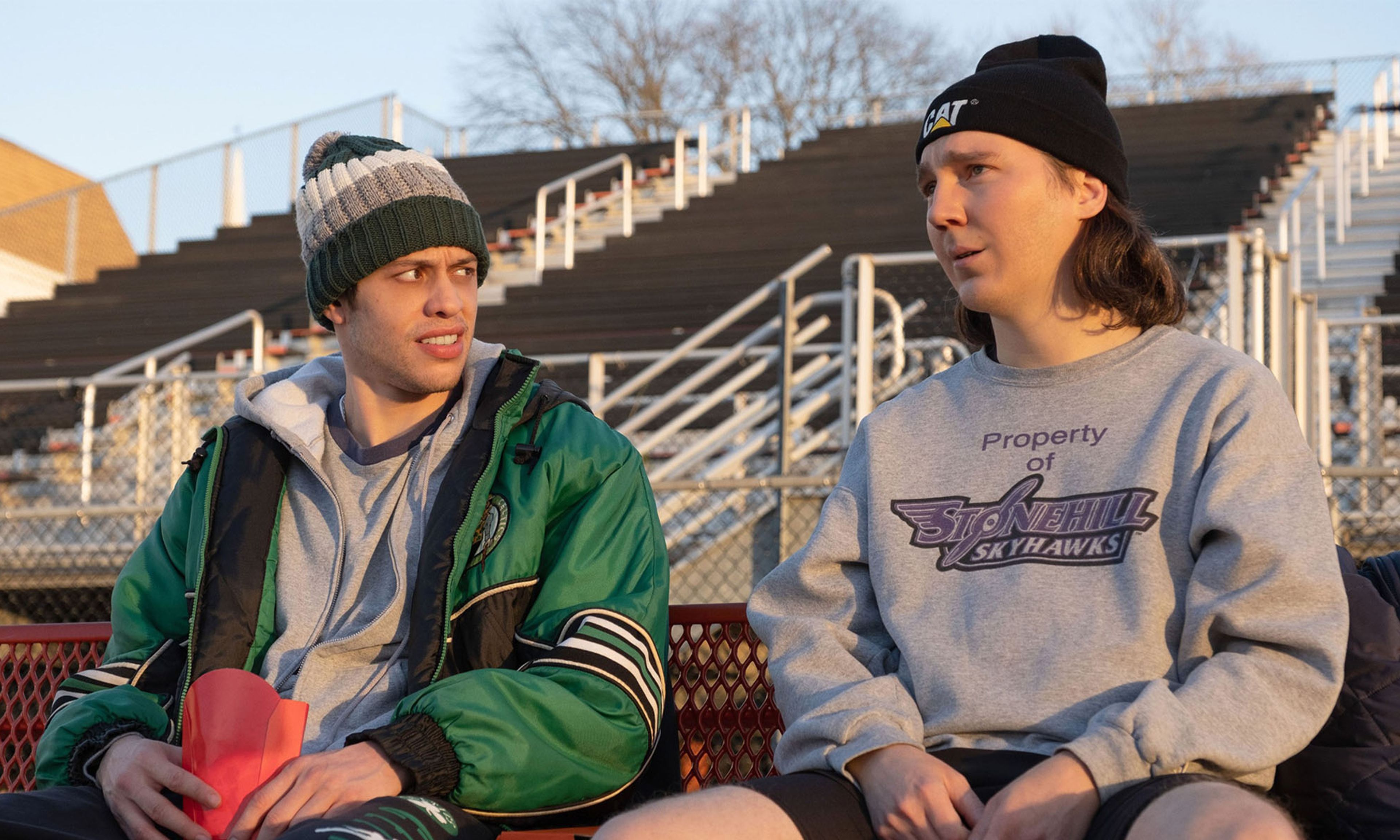
Caught in the conflict between Gill’s enthusiasm and the big money that he briefly panicked are Gill’s family — his aging parents, his implausibly patient wife (Shailene Woodley), his somewhat shiftless DoorDasher brother (Pete Davidson) — and the hosts of ordinary meme-stock buyers he inspired, here incarnated as a beleaguered nurse and divorced mom (America Ferrera), a GameStop employee (Anthony Ramos) put upon by his obnoxious boss (Dane DeHaan), and a pair of lesbian undergraduates (Talia Ryder and Myha’la Herrold) in Austin, Texas. Also looped into the story are the co-CEOs of Robin Hood (Sebastian Stan and Rushi Kota), the trading website where most of the meme-stock action happened, presented as a pair of pandemic-specific creatures in their own right — the paper billionaires with tons of users and no clear path to actual profits.
From a single-digit low, GameStop peaked around $81 a share; today, post-mania, it trades in the high teens. That’s not bad for a former meme stock — others look a whole lot worse — but it means that plenty of the ordinary buyers who joined the crusade were genuine “dumb money,” buying in during the ascent and then losing on the downside. Meanwhile, the people who made the initial surge happen were not exactly financial commoners: As the Atlantic’s Derek Thompson put it, the community of intense day traders represents “an extremely online evolution of Big Finance itself, a kind of decentralized hedge fund duking it out with other hedge funds.”
So I kept waiting for one of the ordinary-buyer characters to become a genuine cautionary tale, a fool who followed the smarter traders much too late and was parted from some money. But the movie tracks all its characters’ worth, and none of them ends up behind where they began; one basically comes out even while the others make bank. The rich guys aren’t completely crushed (being rich guys, after all), but they definitely don’t win, and there’s a final scroll touting all the ways the meme-stock moment changed how the big investment firms operate, a victory lap of sorts.
This mostly seems like rubbish. If the meme-stock mania was less damaging than some crazes, it’s because it wasn’t all that much of a mass phenomenon to begin with, and also because the Covid stimulus payments gave a lot of people what felt like Monopoly money to play around with. The hard-pressed everyman did not win much of anything from the GameStop wars, and as Thompson noted at the time, one of the biggest winners from the mania, because it owned a lot of GameStop, was the populist bête noire BlackRock.
Some sympathetic people made money and had fun in a pretty weird moment, and that’s enough for an entertaining story. But “the people” weren’t the winners — and the house, I’m afraid, didn’t really lose.












Comments