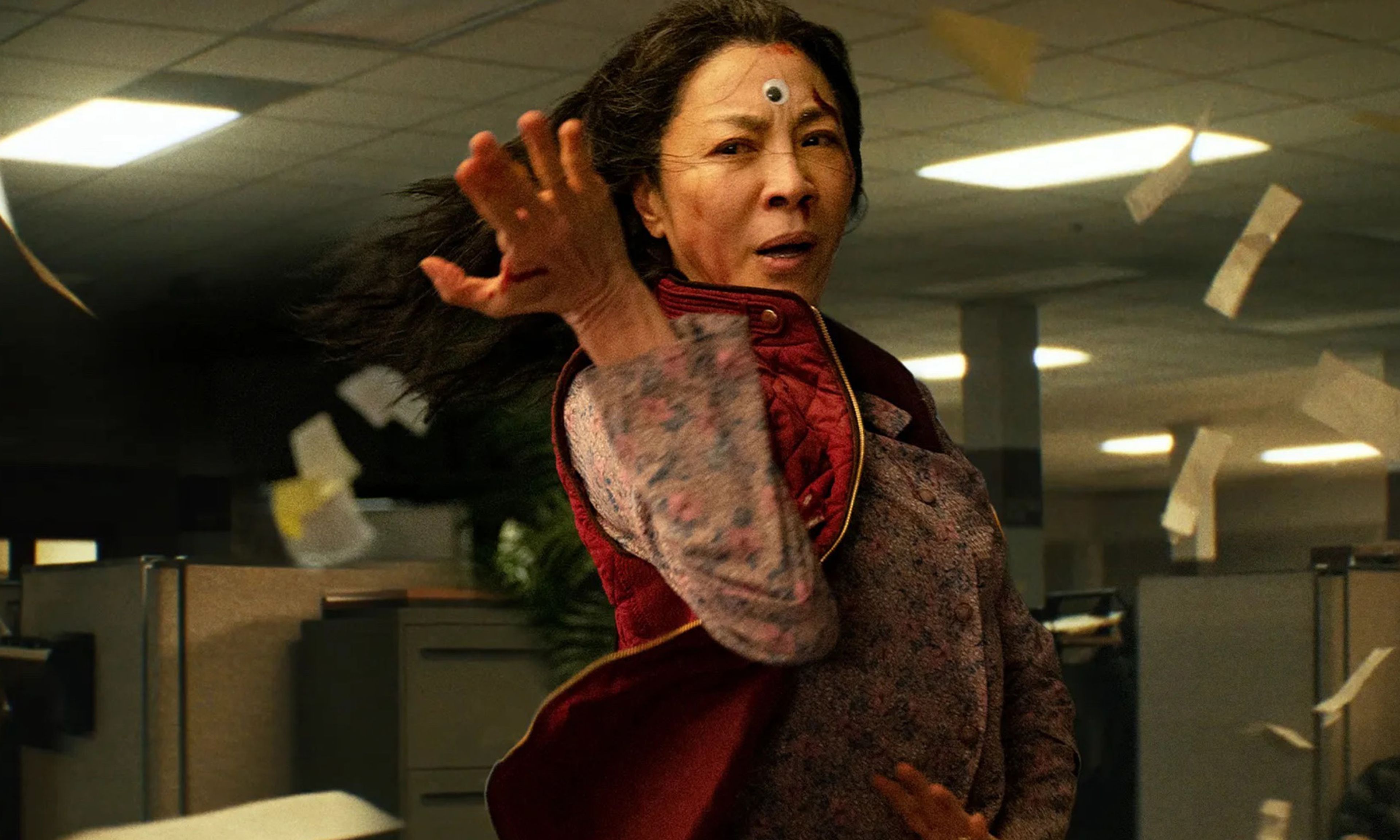
Just about everyone who sees it loves Everything Everywhere All at Once. It’s a rare recent movie to show some real word-of-mouth energy at the box office. Its critical score and audience score on RottenTomatoes.com are basically aligned, and both are over 90 percent. And it’s the kind of movie that has proselytizers, people eager to tell you just how great it is, fans who won’t rest until you’ve seen it.
I’m not one of them, but that’s probably my own problem. Sometimes critics get things wrong, and the passion this movie inspires, at a time when not that many big-screen entertainments inspire passion, is a strong indicator that when I watched it I ended up focused on the wrong thing. So in this review I’ll first tell you what other people see in it and love about it, and only then tack on what I particularly disliked.
Everything Everywhere starts out as a naturalistic drama, in which an immigrant businesswoman is having the worst day of her life. Her name is Evelyn Wang, and she’s played by the normally radiant Michelle Yeoh, but there’s nothing radiant about her situation. The laundromat she owns with her husband Waymond (Ke Huy Quan) is about to be forfeit to the IRS, thanks to a brutal audit conducted by a bureaucratic drone (Jamie Lee Curtis). Her judgmental father (James Hong) is staying with her, and her daughter Joy (Stephanie Hsu) is alienated from her, and the two problems intersect because Joy has a girlfriend and Evelyn can’t figure out how to tell that to her old-world dad. Finally Waymond, unbeknownst to her, is planning to file for divorce, overwhelmed by years of self-sacrifice and Evelyn’s failure to adequately love him back.
But all of that’s just in one universe, and a little ways into the story the multiverse — the infinite branching universes, every alternative reality that our untaken paths create — begins to break in to Evelyn’s overburdened world. It turns out that our universe’s version of Evelyn is perhaps the least successful version of herself, and that in other universes she has a vast array of talents — opera-singing, martial arts, amazing hibachi-chef skills, even the scientific talent to discover how to travel between universes.
Unfortunately the universe-hopping iteration of Evelyn, the “verse-jumping” discoverer, set in motion events that created a threat to every single universe — the supervillain Jobu Tupaki, who can travel effortlessly throughout the multiverse, and whose ability to experience, well, everything everywhere all at once has curdled into a nothing-matters nihilism, and a desire to obliterate everything there is.
The war that Jobu Tupaki touches off spills across the universes, and our universe’s Evelyn proves — precisely because of her own disappointments — to be crucial to the fight. In order to join in, though, she has to connect to the more talented versions of herself, enabling us, the audience, to hop between the universes, encountering both the sublime and the absurd (a universe where humans have hot dogs for fingers gets particular attention), while Evelyn basically downloads skills for her battles from her other selves, like Neo learning kung fu in The Matrix but with more variety and comedy.
The result is a story that blurs genres (family drama meets superhero movie meets wild slapstick farce), that jumps constantly from one startling image to the next, that gives us a series of micro-world-building exercises, and that finally circles back to a heartwarming narrative about the power of love. And while it’s Evelyn’s love that ultimately saves the multiverse, what saves Evelyn is the love of her husband — and the terrific work in that role of Ke Huy Quan, the child star in Indiana Jones and the Temple of Doom, is what really holds all the movie’s universes together.
So what was my problem? I’m afraid it was a philosophical objection (the worst sort, I know): The movie takes the concept of the multiverse to dark, despairing places, and I found that journey horribly persuasive, and the love-is-all-you-need message at the end not enough of a path back.
Fundamentally Everything Everywhere All at Once is a story about depression and the temptation of suicide, with Jobu Tupaki’s direct experience of the multiverse as a kind of “black pill,” a gateway to despair. Nothing matters because everything that can happen will happen no matter what you do, no choice you make leads anywhere significant because there are infinite versions of yourself, and that infinitude is a sign of the total insignificance of the individual human life.
In particular, the metaphysics here strongly imply that because everything happens “at once” there is no learning, no advancement. Even if you advance in understanding — as our universe’s Evelyn does, eventually — another version of yourself is presumably doing the reverse, which makes the multiverse much darker than other ways of thinking about living multiple lives. If you believe in reincarnation, for instance, you can hope that each version of yourself carries something forward from your prior self’s experience. But in the multiverse, where every version of yourself exists in perfect simultaneity, there can be no possibility of progression or ultimate escape.
Such were my thoughts, at least, while watching Michelle Yeoh steal sign-spinning skills from another universe’s variation on her character and use them to whack some bad guys upside the head — and the happy resolution of her story did not resolve those existential doubts.
But in another universe, perhaps, there’s a version of myself that wasn’t quite so metaphysically disturbed, and you should probably trust him: I’m sure he gave the movie an absolute rave.












Comments