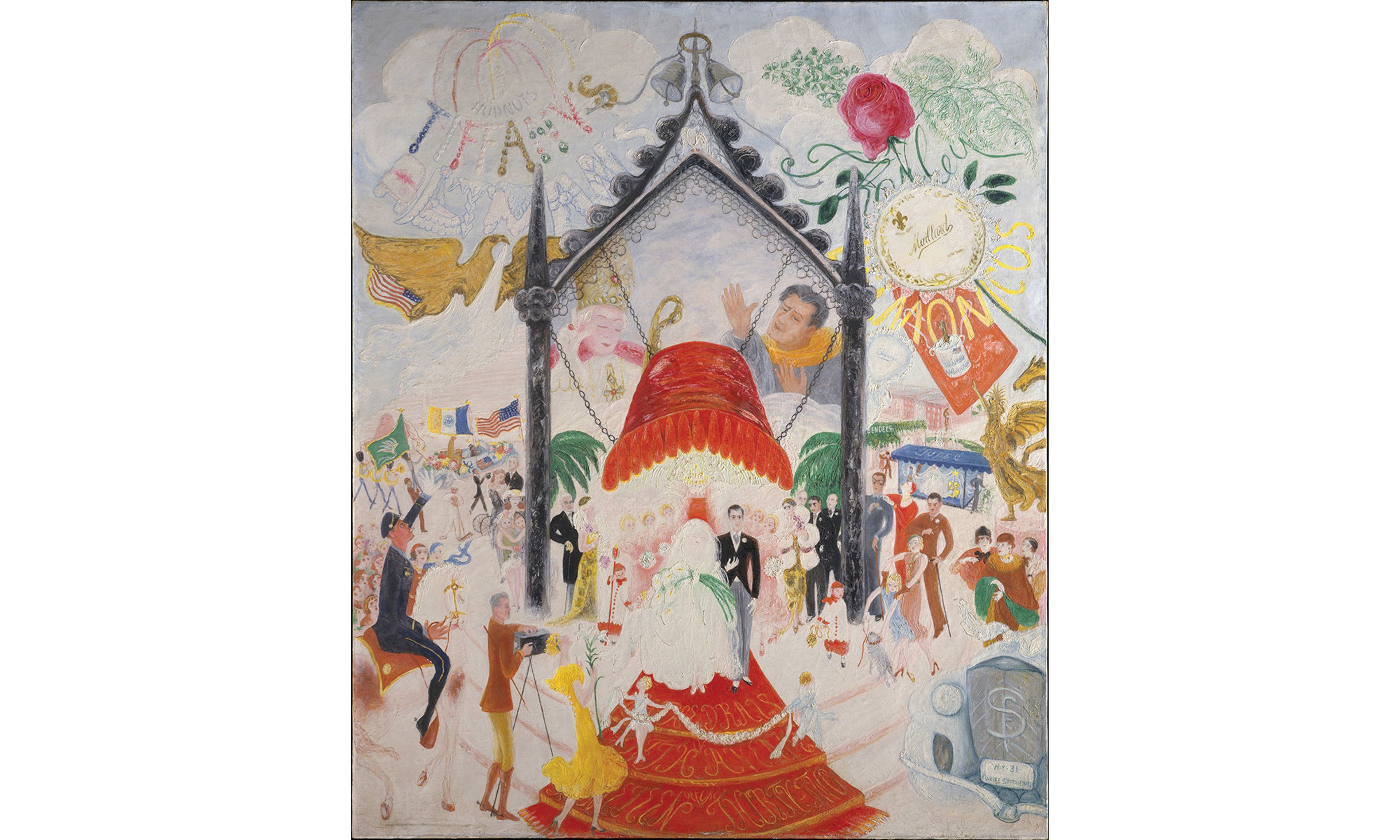
Barbara Bloemink’s new biography of the artist Florine Stettheimer (1871–1944) reveals an acquired taste, and a unique one. We learn that Stettheimer is a creature of the Jazz Age, which gives us some moorings, and that she’s what we’d call a feminist, though it’s better to say she had no need for men. Her paintings of everyday life among Manhattan’s intelligentsia from the Teens through the early 1940s are delightful and pungent.
Bloemink is a thorough, sensitive biographer. I recommend her biography. The book is beautifully designed, printed, and illustrated, too. This in itself is a tribute to Stettheimer, who was known by connoisseurs in her day for her paintings but was more broadly famous as the costume and set designer for Four Saints in Three Acts, America’s first avant-garde opera.
Who was she? Was she a cloistral, cranky old maid working in a style derided as “feminine”? No, though that’s the way the art world characterized her from the 1950s to at least the 1990s. Her pastel colors, unmuscled, even deboned figures, furbelow and flounce details, and lifestyles-of-the-rich-and-useless subject matter made her, well, irrelevant. Yes, Bloemink tells us, Stettheimer was rich. Yes, she was bitchy and snooty, too. Yes, her art sometimes has the look of puff pastry, but it’s so much more. Bloemink’s right to call it serious stuff. I’d call it “Silk Stocking Regionalism.”
Stettheimer’s paintings are distinctive. She started with dense, layered whites for a backdrop that glows. There’s usually no single narrative but, rather, independent vignettes of couples or a single figure, all looking like sticks who know the best couturiers. They’re supple, fine, fluid, and never weedy. Stettheimer loved the ballet, and was crazy especially about the Ballets Russes, which she first saw in Paris in 1909. There she found her sense of color and lithe figure style.
Stettheimer’s family was German-Jewish American, intellectual, and hermetic. They were among New York’s Jewish elite sometimes referred to as the “One Hundred.” Her parents had five children, two of whom married. In 1878, her father deserted them and moved to Australia, disappearing from the plot. Stettheimer and her two sisters, Ettie, who got a Ph.D. in philosophy, and Carrie, a socialite who made dollhouses, never married and lived with their mother, Rosetta, for the next 50 years.
After her husband disappeared, Rosetta moved with her children to Europe, living and traveling in luxury, based in Germany but visiting wherever was in season. Florine studied art in New York at the Art Students League in the early 1890s. She soon returned to Europe, and to her mother and sisters, remaining until 1914. Then, fear of the new war brought them back to New York. Bloemink examines the difficult dynamic among the four women.
Though Stettheimer had her own studio and, after her mother’s death in 1938, moved to her own place, until then the four did almost everything together. On Stettheimer’s death, Ettie edited her diaries and letters with a razor blade, removing what she called “personal matters.” Bloemink and posterity are left to wonder what was lost.
The Stettheimer sisters hosted a high-octane salon whose regulars were the art critic Henry McBride, Marcel Duchamp, Baron de Meyer, Gaston Lachaise, Sherwood Anderson, and Georgia O’Keeffe. What Ettie destroyed, many of Stettheimer’s friends and her contemporaries among the curators and critics supplied, at least in part, in their own accounts of this riveting personality. Many of her guests and friends also populate her paintings.
Stettheimer’s major works anchor the book. Illustrations are mostly full-pagers and feel juicy and real. Some of her work is very funny but not without a bite. Spring Sale at Bendel’s, from 1921, depicts what Bloemink calls “the ardor of acquisition.” It’s a mêlée. Red’s the main color, suggesting how much passion fuels a shopping spree on Fifth Avenue. One of my favorites is Beauty Contest: To the Memory of P. T. Barnum, from 1924, and at the Wadsworth Atheneum. It’s another kind of mêlée, one surrounding the then new Miss America pageant. In both, Stettheimer skewers the gross objectification of women, which women themselves aid and abet.
The artist’s big Cathedrals paintings are an amalgam of realism, fantasy, satire, and glitter and are very New York, or the New York that Stettheimer understood. They’re surprisingly egalitarian, too. The Cathedrals of Broadway, from 1929, isn’t about the latest avant-garde drama but about the Roxy Theater. Front and center is a painted black-and-white still of Mayor Jimmy Walker taken from a short about the first ball Hizzoner threw to start the baseball season. The Roxy’s ushers, by the way, were trained by an ex-Marine sergeant, one of many fun facts Bloemink delivers.
The Cathedrals of Fifth Avenue (1931) depicts a wedding, probably at St. Patrick’s. It’s so packed with everyday life that it seems like a Jazz Age Bruegel. It’s got the House of Tappé, General Sherman’s equestrian statue, a cop directing traffic, and a sign blaring the magic word “Tiffany.” There’s a choirboy using a scepter to lift the bride’s dress for a peek and for comic relief. A vignette of Charles Lindbergh’s ticker-tape parade reminds us New York is the celebrity capital of the world. And there are the three Stettheimer sisters, standing by their Rolls-Royce as they watch the spectacle. The bride’s faceless, and the groom looks like a mannequin. No one thought much of marriage in the Stettheimer home.
The Cathedrals of Wall Street (1939) is a paean to Roosevelt and the New Deal, of all things. Stettheimer believed the two together had tamed the animal spirits of the big conglomerates. The Cathedrals of Art (1942) isn’t about art history but about the Whitney and the Museum of Modern Art, two fledgling, struggling museums that powerful forces at the Metropolitan Museum of Art wanted to devour.
Stettheimer, Bloemink says, is a satirist and observer par excellence but a blinkered one. Her art sometimes needs deciphering since it’s filled with insider tidbits. The Great Depression comes and goes, too, leaving her unaffected. She has no interest in working-class people or the poor.
Among American Regionalists, Grant Wood has the rural Midwest, Norman Rockwell and Grandma Moses Vermont, and Marsden Hartley and John Marin the coast of Maine. Stettheimer’s world was bounded by 96th Street to the north and 42nd Street to the south, by her studio, the family apartment, and a set of Midtown theaters and galleries.
Bloemink’s chapter on Four Saints in Three Acts is a high point of the book. It was a high point for Stettheimer, too. She designed the costumes and sets for Gertrude Stein and Virgil Thomson’s opera, produced in 1934. It’s a centerpiece of American Modernism, a surprise since the subjects are Roman Catholic saints.
It’s zany but charming theater. It’s short enough that Stein’s Cubist wordplay libretto doesn’t irritate. Thomson’s music reflects old Baptist hymns and Gregorian chants, with a dissonance that’s modern but, again, not irritating. He chose a black cast because, not to put too fine a point on it, they had rhythm, or better diction and a feel for religious folklore. Both he and Stein wanted them to perform in whiteface since an obviously all-black cast would, in Thomson’s mind, distract the audience and, in Stein’s, sexualize the opera.
The book illustrates promotional photography of the performers on stage and Stettheimer’s handmade fabric figurines that were used as models. For an opera set on earth and in heaven and dealing with the mystic Saint Teresa of Avila and the evangelical Saint Ignatius of Loyola, scenery design and costumes had to be fantastic and ethereal and real. Stettheimer’s work on the opera doesn’t merely supplement Stein’s, Thomson’s, director John Houseman’s, choreographer Frederick Ashton’s, or the cast’s. It’s integral.
Stettheimer was a poet, too, and her poems, pithy and wry, give a flavorful book an extra pinch here and there. They sometimes rhyme but often don’t. Written on the spur of the moment on scraps of paper, they’re both light-hearted and acrid. “The world is full of strangers / They are very strange / I’m never going to know them / Which I find easy to arrange,” she wrote, referring to Germans, whom she loathed, traveling with her on a luxury cruise.
Stettheimer never sold a painting and gave away only three. Bloemink thinks she feared the rejection of the marketplace and, anyway, she didn’t need the money. Her work decorated her studio and was almost the entire décor of her family home. And an idiosyncratic look it must have been. On display was her life-size nude self-portrait, done in 1915, in the parlor where the Stettheimers hosted their lively salon. In the painting, the redheaded Florine, buck naked, holds a bunch of flowers. She seems more frank than invitational. She based it on Titian’s Venus of Urbino and Goya’s Nude Maja. American artists almost never painted nudes, much less nude self-portraits, and women artists were few and far between. Suffice to say, in 1915 Stettheimer was a most unusual pioneer.
Oddly enough, despite its unmistakable likeness to the artist, no one, not the artist, not her family, not her friends, ever acknowledged the title was anything but “A Model.” It wasn’t until 1995, Bloemink says, that the Museum of Modern Art made what everyone knew official.
Bloemink addresses Stettheimer’s place in art history at the end of her book, and she does it wisely and correctly. Stettheimer left her art to her sisters. No, Ettie didn’t take it to the Fishkill dump, as much as the sisters might have resented each other. In 1946, Duchamp organized a Stettheimer retrospective at MoMA, its first for a woman. In the late ’40s, the family’s lawyer distributed dozens of her paintings to museums in New York and New England. By the early ’50s, though, Stettheimer had disappeared from the art scene’s consciousness. People move on, but what happened here?
The American art world in the ’20s and ’30s was small but various. It accommodated the likes of Hopper, Sheeler, Demuth, Bellows, Thomas Hart Benton, the photographers Stieglitz and Steichen, O’Keeffe, Hartley, Stuart Davis, and Stettheimer. What an array. In the late ’40s, Abstract Expressionism came of age, an art of flexing muscles and red corpuscles. It overwhelmed and supplanted all else. Stettheimer’s work couldn’t be more at odds with it.
In the Pop Art era, though Warhol was smitten by her work, she seemed irrelevant as well. Pop Art drew from comics, advertising, and tabloids. Irony and detachment powered it. Stettheimer’s far too serious. The women’s movement launched her excavation, helped along by the more recent interest in women artists of the past.
She’s a niche of one. In the last few years, as Stettheimer has received more recognition and been the subject of more shows, I’ve heard “There’s nothing like Florine,” merging persona and painting. Bloemink’s book will accelerate and deepen the trend. It’s good to see Florine front and center again.












Comments