The shrewd, worldly Austrian statesman Prince Klemens von Metternich notoriously asserted in 1849 that Italy is only “a geographical expression” — that is, that it had never been a single nation and never would be one. (At the time, the Austrian empire occupied a large part of it.) Seventy-five years earlier, the great Samuel Johnson argued that a person “who has not been in Italy is always conscious of an inferiority, from his not having seen” what a person should see to be cultured. (Johnson never got there.) We might well say that centuries of foreign conquerors — and of domestic tyrants, high and petty — wanted too much to be in Italy, wanted to own and exploit it to the detriment of the vast majority of its residents, from Sicily to the Alps.
And the task of unifying Italy was not only the need to expel foreigners and put down competitive homegrown tyrants. It was also the need to unify the country politically, culturally, and economically, from Sicily and the south to the very different northern worlds of Rome to Florence to north of the Apennines. Within this arena of cultural, linguistic, and geographical variety (and great wealth and beauty), there was cultural and class division of the masses of people from the elites — aristocrats, merchants, professional men, writers, ecclesiastics — whose ornament, badge, and tool was Latin and the classical heritage to which it was the key.
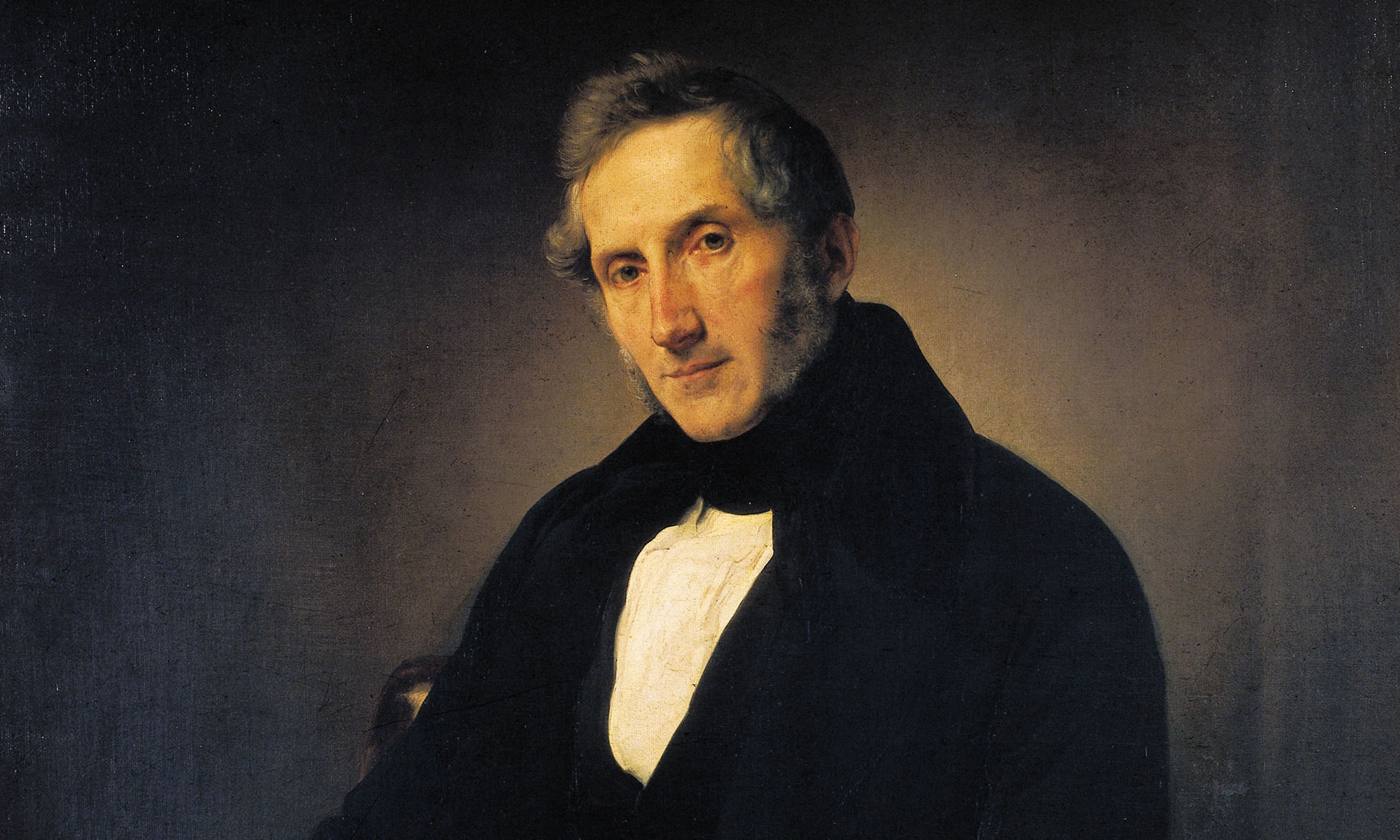
The man who truly unified Italy on several levels was neither a conqueror nor a king nor a politician, but a writer, Alessandro Manzoni; and he did a great deal more even than “make” Italy. He wrote one of the profoundest and most influential works of the literature of the world. Forty years ago, the English literary scholar Martin Seymour-Smith wrote that Manzoni’s vast novel The Betrothed (I promessi sposi) “is one of the greatest books ever to come from a human brain”; it is a true valuation.
I taught Manzoni’s novel to undergraduate students in the U.S. in the 1980s and ’90s and was astonished that many of them loved this forbiddingly vast work (720 pages in Bruce Penman’s 1972 Penguin translation). There is now a new English translation of The Betrothed, by Michael F. Moore (Modern Library), which I have not read. What I have read recently is a fine historical and literary-critical work by the Italian historian Roberto Bizzocchi, Romanzo Popolare: Come i Promessi sposi hanno fatto l’Italia (2022) — “Popular Novel: How The Betrothed Made Italy.” Bizzocchi’s clever title puns fruitfully: The novel is a romance in the sense of a love story; in Italian, the word for novel is also “romanzo.” The plural “the betrothed” — the novel’s two romantic partners and its three different editions — are here alleged to have “made Italy.”
Manzoni finished the first edition in September 1823; the others appeared in 1827 and 1842. Much more than his other writings, earlier and later, these three versions, on which he spent 20 years, both revealed and ultimately shaped Italy with a force, significance, and impact comparable only to Dante’s Divine Comedy. The only other works of literary imagination equal to The Betrothed in modern Western literature are the novels of Dickens, Dostoevsky, and Tolstoy. (A comparison to Shakespeare would not be strained or irrelevant.)
All four of these great 19th-century novelists were Christians who used a “Providential aesthetic.” They attempted to use language and literature as a means not only or mainly of self-expression, communication, or representation (art as mirror of reality) but of conveying and making credible, and lovable, the moral universe itself (art as lamp of metaphysical-moral truth).
Writing in 1781 of Milton’s epic Paradise Lost (1667), Samuel Johnson said: “His purpose was the most useful and the most arduous: ‘to vindicate the ways of God to man’; to show the reasonableness of religion, and . . . of obedience to the Divine Law.” After Milton’s own youthful visit to Italy in 1638–39, and partly inspired by it, in 1642 he articulated his hope for his great future literary project to be a work “doctrinal and exemplary to a nation,” which is what Paradise Lost became. The phrase also felicitously describes Manzoni’s achievement in a quite different genre a century and a half later.
The Betrothed is still the one modern literary work that all Italians to some extent know: A current, standard upper-high-school/college edition, edited by Corrado Bologna and Paola Rocchi, runs to over a thousand pages, with the famous original illustrations by Francesco Gonin. The novel goes far above and beyond the aims and achievements of Sir Walter Scott, whose once-famous historical novels were a major inspiration for Manzoni: Though Scott was a noble and gifted man, Manzoni is, as Seymour-Smith says, “an infinitely subtler and deeper novelist.”
The three editions of Manzoni’s novel all depict life in northern Italy — Milan and Lombardy — during the Spanish occupation and governance from 1628 to 1631, and they develop the same characters and plotlines, with important differences that Bizzocchi learnedly discusses. Writing 200 years later, under the Hapsburg Austrian dominance of the same area, Manzoni is scathing in his depiction of the gross and pervasive oppression and exploitation of the masses of Italian people by their foreign overlords, but also of the collaborating vanity, snobbery, lawlessness, and incompetence of the local Italian elites.
Despite its frequent comic interludes and touches, and especially by means of its magnificent recurring irony, The Betrothed paints a terrible picture of human nature and turpitude. The English-language reader will think of Dickens’s descriptions of exploitation and abuse in A Tale of Two Cities, Oliver Twist, and Hard Times, and Manzoni’s historical account has some of the dramatic pathos of another contemporary writer, the historian Thomas Carlyle, whose 1837 history of the French Revolution was the inspiration for A Tale of Two Cities. Victor Hugo’s Les Misérables (1862) is a work of comparable moral documentation and protest in the French-speaking world.
Manzoni’s personal history and development have in fact a great deal to do with the French-speaking world and the French Revolution and its aftermath. Born privileged in 1785 into the decadent Italian but Francophile and Francophone aristocracy of northern Italy, with an older, remote father who was almost certainly his father in name only, Manzoni was initially educated in austere classical-Catholic boarding schools in Lombardy, grew increasingly skeptical and libertine, and at age 20 went to Paris to join his mother, who had absconded there years before with her aristocratic Italian lover. He lived in postrevolutionary, Napoleonic Paris for five years, initially in the “freethinking,” libertine milieu of the left-wing aristocratic intelligentsia.
In Paris, Manzoni married an earnest young French-Swiss Protestant woman, Henriette Blondel, whom he deeply loved, and the two of them ended up converting to Catholicism. The story is surprising and complex, for Manzoni did not become either a tepid Catholic conformist or a “throne and altar” Catholic reactionary but instead proved to have resources of education, insight, character, and moral imagination that were developed into one of the commanding literary-ethical intelligences of the past 200 years.
Manzoni critiqued many of the most alluring intellectual, ideological, and political temptations of the modern period. Italians who read his novel in one or both of its last two editions realized — and still realize — that it was written in defense of the Christian idea of the equal worth of all persons, whatever their ethnicity, class, occupation, or sex. Bizzocchi argues that the heart of Manzoni’s vision is the principle of the equality of human beings, announced first by Saint Paul in the Epistle to the Galatians.
And Manzoni’s Italian patriotism had a universalist core: He insisted that the Christian gospel was transnational, in fact cosmopolitan. If the dominant Spaniards of The Betrothed are unjust, self-interested, and pompous, few of the Italians — including churchmen — are any better. If Christianity has a transcendental core rooted in and ultimately oriented to another world, that does not absolve us from persistent ethical striving in this one.
The mature Manzoni has a ballast and wisdom that none of his influential French predecessors, contemporaries, or successors manages, even opponents of the Jacobins and Napoleon such as Sismondi, Madame de Staël, or Benjamin Constant. Like explicitly social-political thinkers such as Burke and Tocqueville, he saw Rousseau, Robespierre, and the Jacobins as abstract fanatics committed to the pernicious utopian illusion of a rapid perfection of the conditions and moral status of humanity.
Yet as much as any Protestant, Manzoni was aware of and disgusted by the frequently corrupt and demoralizing history of the papacy. In a long life, he never visited Rome, despite being a chief intellectual architect of the new, unified Italian state that finally took Rome as its capital in 1871. On the occasion of his death in 1873, that of the greatest Catholic layman in Italy and the most important modern intellectual influence in the strengthening and deepening of the Catholic spirit of its people, the pontificate of Pope Pius IX had nothing to say.
It is gratifying and revealing to note the veneration in which prominent contemporaries and successors held Manzoni. In 1838 the great English Christian statesman William Ewart Gladstone sought out and met Manzoni near Milan, conversed with him in Italian, and subsequently corresponded with him (in Italian). Even before meeting Manzoni, the great operatic composer Giuseppe Verdi admired him and called The Betrothed “not only a book, but a consolation for humanity.” He composed his great Requiem for Manzoni’s soul. René Girard (1923–2015), the distinguished French literary critic, anthropologist, and member of the Académie Française, had Manzoni’s novel read to him as a youth in Avignon by his learned Catholic mother and never forgot it; his adult reconversion to Catholicism in the U.S. entailed a profound rejection of the French literature of libertine subjectivism, preening aestheticism, and neophilia whose earlier forms Manzoni had rejected and to which his work is such a contrast. The current pope, Francis, has often mentioned Manzoni’s novel as a formative influence and recommended it publicly.
But it is Manzoni’s concern with and advocacy of the Italian language and of the “common” masses of Italian people that are most noble and noteworthy. His life project was a vindication of the Italian vernacular and, one can argue, even of the medieval Christian piety of Saint Francis and Dante (and the rationalism of Saint Thomas Aquinas) against the classicizing elitism — cultural and political — that grew to characterize the incipiently pagan and aristocratic Renaissance and its domestic and European legacy of self-reflective aestheticism. Professor Bizzocchi shows conclusively that Manzoni heroically shed and attacked the deep, tragic snobbishness that saw in the common people of Italy and Europe mere workers, “hands,” or “base mechanicals.”
Assessing the stylistics and implications of the New Testament and Dante, the polymathic intellectual historian Joseph A. Mazzeo of Columbia University wrote nearly 50 years ago that the “Christian vision of reality opened the imagination to a new relation between the Supreme Reality and everyday reality, so that no social class or occupation or condition in life was without that eternal reference, whether for good or evil.”
To the extent that we are still civilized, we live in the light and ambiance of that vision, and we are nourished by its trajectory and residual momentum. Alessandro Manzoni’s book is one of its greatest products.












Comments