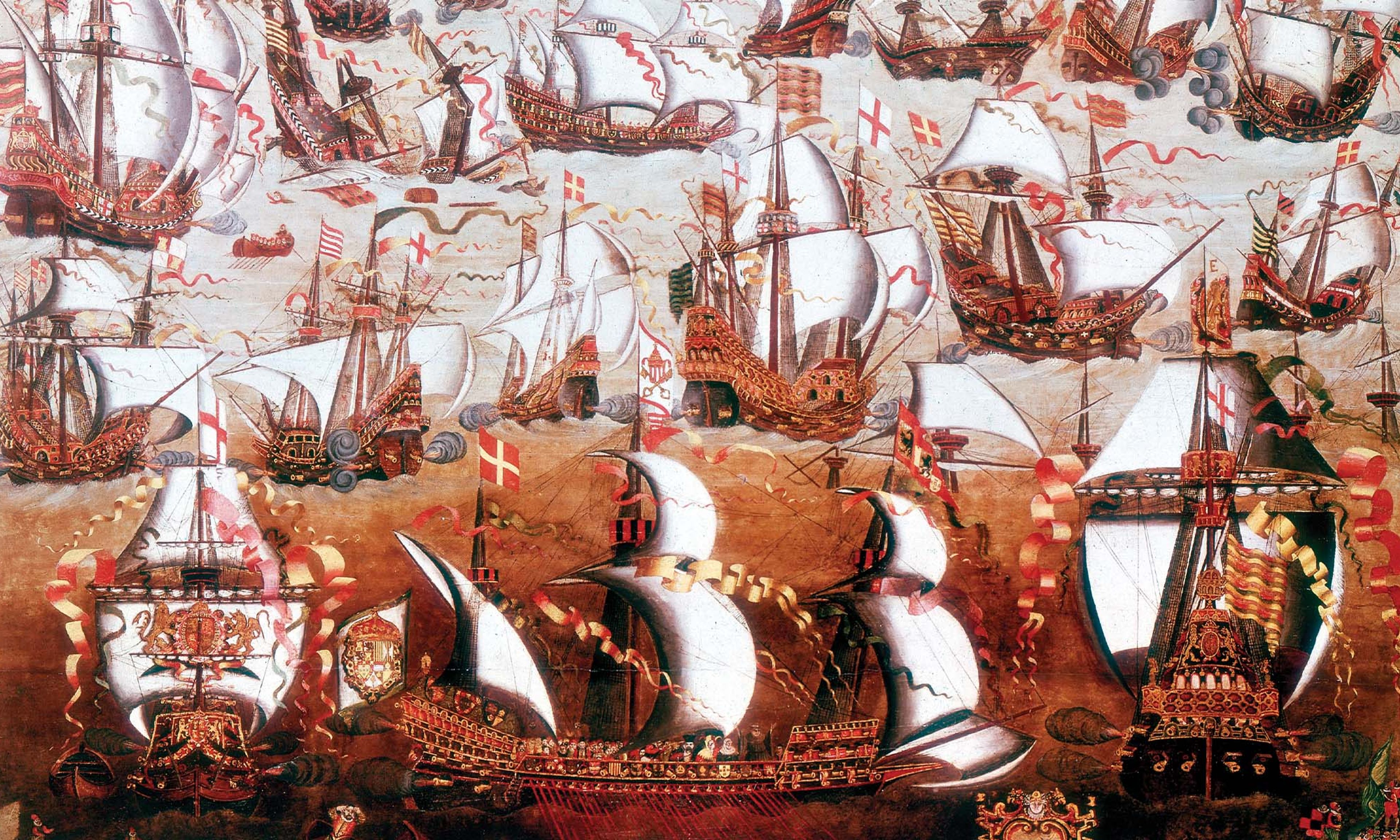
An audacious and high-stakes military operation that didn’t come off, the attempt by the Spanish Armada to take England was one of the most important events of the early modern period.
It deserves the treatment it gets in this volume. I’m no expert, but it’s hard to imagine a more exhaustive or authoritative work on this battle.
I like my books to be easily handled — ideally a paperback or advance galley suitable to getting stuffed in a pocket in a pinch — and Armada spectacularly fails by that standard. It weighs in at 4.27 pounds. It is 545 pages of text, and thick, high-quality, glossy pages at that.
Another warning: Unless you are the Mr. Dick of the Spanish Armada, there is undoubtedly more than you’ll want to know here, down to individual ships and how many times they fired their cannons. That said, you will also come away much better informed about a defining struggle in the history of the West, pitting Catholic Spain against Protestant England, Philip II against Elizabeth I, a great empire against a rising power.
I’ll show my cards. I think Elizabeth is one of the preeminent leaders in English, nay, Western history, and that it would have been a tragedy if England had been subjected to Spanish overlordship just as it was about to achieve the takeoff that gave us the modern world and seed our shores. Imagine if North America had the Spanish-inflected political culture of Latin America. Our country as we know it wouldn’t exist.
The 16th century is a fascinating period. It is recognizable in so many ways, yet involves a combination of intense personal and religious politics alien to our times.
Given that Tudor family values weren’t exactly warm and fuzzy, Elizabeth had seen some stuff, as they say (aside from the execution of her mother and one of her stepmothers, she was imprisoned twice and was lucky to escape her teenage years alive).
For his part, Philip, son of the legendary Charles V, was a man of faith who attended Mass daily and a hard worker obsessed with getting things right. Convinced that he had a mandate to advance and defend the Catholic faith, he believed in what Colin Martin and Geoffrey Parker call a “messianic imperialism.”
Philip had been married to Elizabeth’s half sister, Mary Tudor (“Bloody Mary”), who reimposed Catholicism on England. When she died, Philip offered to marry Elizabeth, although only with an eye to keeping England in the Catholic fold. “If it were not to serve God, I would never do this,” he told a confidant.
That match obviously didn’t happen. Elizabeth wasn’t the marrying sort and was a committed Protestant, which had enormous geopolitical consequences. The pope hoped to get her assassinated, and Elizabeth concluded that the locus of Catholic hopes and agitation, her cousin Mary Stuart, had to be executed. The act stoked international outrage and gave Philip a diplomatic stick to use against her.
In the 1580s, he was on a winning streak, taking Portugal and the Azores. A gold medal struck in 1583 was inscribed “Philip II, King of Spain and the New World,” with the legend, “The World Is Not Enough.”
The English feared the consequences of Spanish control of the Atlantic. They provided aid to the Protestant forces in the Netherlands resisting the Spanish; attacked Spanish shipping; and, most intolerably for the Spanish, conducted naval raids on Spain itself, including Francis Drake’s famous expedition “to singe the king of Spain’s beard.”
Spain had already engaged in plots against Elizabeth, but now it would finish the job. The plan was that a massive battle fleet would advance up the English Channel and connect with another force, led by the duke of Parma, in the Spanish Netherlands. They would proceed together to England, landing in Kent — the site of Roman, Saxon, and Viking invasions — where they would offload considerable troops and matériel. Then they’d march to London and capture or kill Elizabeth. England would be restored to the Catholic faith. Problem solved.
Think an amphibious, 16th-century version of the Russian decapitation scheme at the outset of the Ukraine war.
It was an extraordinary undertaking. For the Armada, Philip mobilized 140 ships and 18,000 troops, and another 27,000 troops with 300 craft were in Flanders. Merely maintaining these forces was highly expensive. Keeping together the Armada cost 30,000 ducats a day, and Parma’s army, 15,000 ducats.
The English needed to keep the Spanish from staging a landing because their land forces weren’t suited to resisting anyone. In mid March 1588, the government had issued orders to mobilize 10,000 citizens to defend London, but there wasn’t enough equipment for them. As Martin and Parker note, “Many received bows and arrows, but no training in their use.”
The navy was different. Elizabeth’s father, Henry VIII, had set up a permanent defense establishment to protect against Catholic invasion after his break with Rome, and the Tudor state invested amply in the navy. British ships got faster, more stable, and better armed.
After dispiriting problems supplying the Armada and getting it under way, its commander, Medina Sidonia, got the fleet to sea from Lisbon, a notable achievement in and of itself. Harried by the English, he managed to sail all the way to Calais, a mere 30 miles from the army of Flanders.
Then, the glitch in the plan. How to keep in touch with Parma in a timely manner? Medina Sidonia duly sent messages, but it could take days for them to arrive, and the location of his fleet was always changing.
No one had thought through how this was going to work. “The joint commanders of the greatest amphibious operation in the Atlantic to that date had no effective contact with each other,” Martin and Parker write. On August 6, for instance, Medina Sidonia got a message from Parma that had been dispatched August 3, replying to a missive Medina Sidonia had sent on July 25.
The initial British approach had been to isolate and attack individual Spanish ships. With the Armada anchored off Calais, the English turned to attacking with fire ships. “Although no Armada ship caught fire,” Martin and Parker write, “the fleet degenerated overnight from a disciplined and still formidable fighting force into a scattering gaggle of panic-stricken ships. The Armada had lost its cohesion, on which its effectiveness and future security depended.”
The rout was on.
The English blasted away. On the run, the fleet decided to return to Spain after sailing north around Britain. Disaster ensued. It wasn’t just a naval catastrophe, but a massacre. Ship after ship wrecked on the coast of Ireland, with sailors drowning and the survivors getting butchered onshore. A few stragglers and lucky prisoners might make it back to Spain eventually. The royal governor of the Irish province of Connacht estimated that as many as 7,000 men from the roughly 15 ships that ran aground died there and that, of those casualties, at least 700 had been executed.
While there’s no doubt that launching the Armada was a foolhardy venture, the Spanish had succeeded in a prior complex amphibious operation that took Lisbon and then all of Portugal. But the English simply outclassed them. Their ships sailed faster. They had better, more experienced seamen. They had superior tactics, firing cannon at close range, while the Spanish still wanted to board and fight hand to hand. The English had more big guns, and more gunners, and a better truck carriage. They were more proficient at reloading and fired more often.
With the triumph, Elizabeth’s legend was complete. Against the wishes of her privy council, she had traveled to Tilbury to review the troops. There, she gave her iconic Shakespearean speech: “I know I have the body but of a weak and feeble woman, but I have the heart and stomach of a king, and a king of England too, and think foul scorn that Parma, or Spain, or any prince of Europe should dare to invade the borders of my realm.”
Even in victory, injury and disease took an astonishing toll on the English sailors. “Perhaps only half the men who fought for England in 1588,” Martin and Parker write, “lived to celebrate the following Christmas.”
Britain and Spain remained embroiled in conflict for years. It didn’t come to an end until Elizabeth died and James, her successor, and Philip’s son, who had taken over after his father’s death a few years earlier, struck a deal. But Philip III got nothing that the Armada campaign had sought, and Spanish power would decline.
Britain went on to rule the waves.












Comments