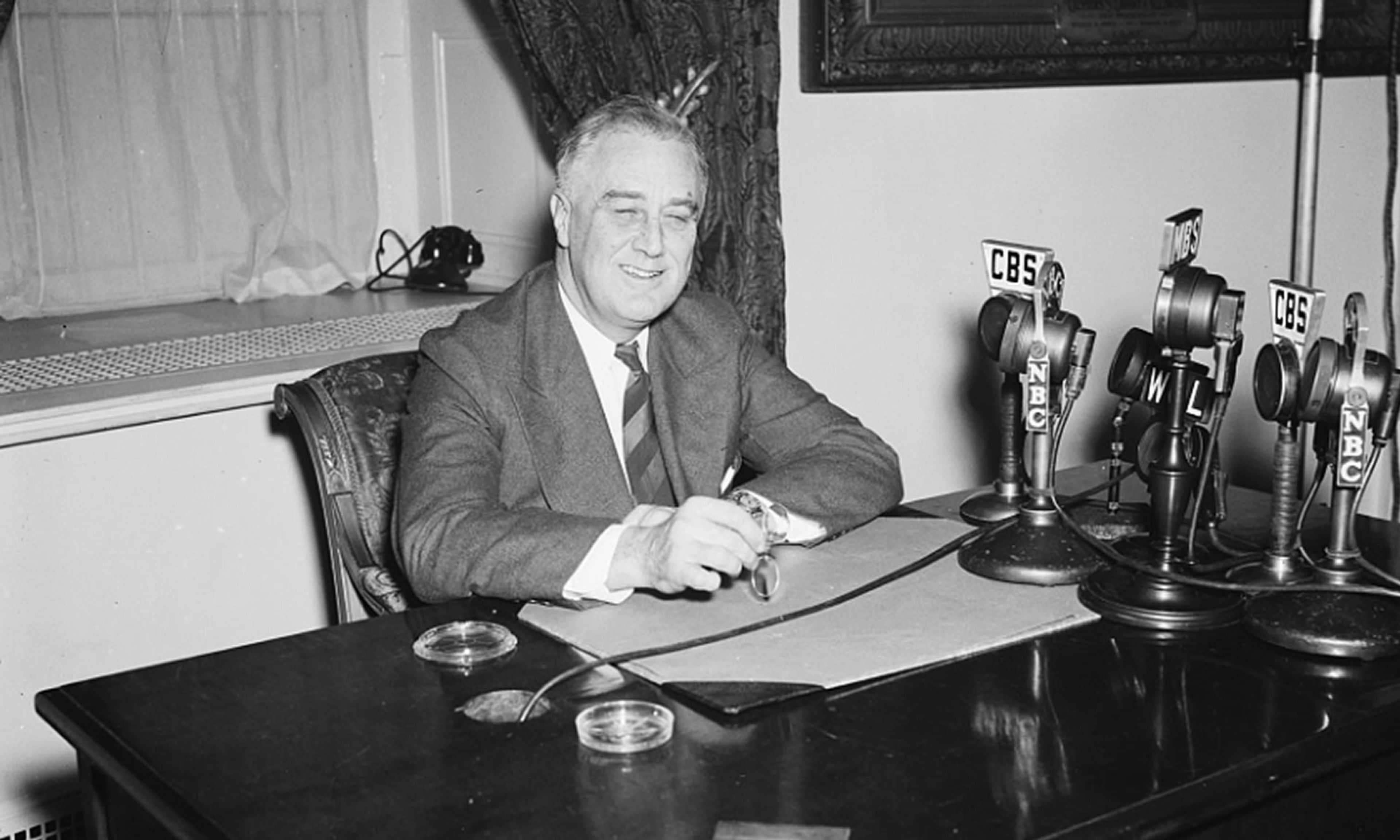
In a 1936 New Yorker cartoon, Peter Arno depicts a quartet of upper-crust characters stopping before a well-heeled house where fellow toffs in evening dress are dining. “Come along,” one of the quartet says. “We’re going to the Trans-Lux to hiss Roosevelt.”
The 32nd president was not in good odor with the WASP gentry of the Thirties, but he has, if anything, been even more loathed by the modern Right. Yet a conservative today who goes beyond the ahistorical abstractions in which so much of the debate about FDR is carried on and looks at the actual circumstances in which he acted will find much to ponder; the question of his statesmanship is more interesting than it has been made to seem. Nearly a century after the advent of the New Deal, there are good reasons for conservatives not to go down to the Trans-Lux to hiss Roosevelt.
Burke teaches us to suspect abstractions, to look at the reality on the ground: “Circumstances are what render every civil and political scheme beneficial or noxious.” The circumstances Roosevelt confronted in 1933, complex in themselves, were further complicated by the ignorance of all the chief actors. Neither Roosevelt nor his predecessor, Herbert Hoover, enjoyed the luxury of being able to take Milton Friedman and Anna Jacobson Schwartz’s A Monetary History of the United States (1963) from the shelf and read, as we can today, how the Federal Reserve, in the face of a shrinking money supply, tightened money and in a series of blunders converted a downturn into a depression. Ben Bernanke, a Fed governor who would later serve as chairman, offered in 2002 what amounted to an official apology. “Regarding the Great Depression,” he said, the Fed “did it. We’re very sorry. . . . We won’t do it again.”
What should a leader do when neither he nor any of his contemporaries knows the right answer to the question? For the conservative, prudence will often dictate doing nothing at all, or very little; reckless policy gambles might well make the problem worse or create different, unforeseen problems. It was precisely this sort of prudence, Amity Shlaes pointed out in a 2007 article, that Hoover’s Treasury secretary, Andrew Mellon, counseled as the Depression deepened: “Mellon — unlike the Roosevelt administration — understood that American growth would return if you left the economy alone to right itself.” And it is true that free people, left to their own devices, have a way of surprising politicians and intellectuals by coming up with solutions that no mandarin in a government office ever foresaw. Nothing, Macaulay said, does so much to create capital and make a nation prosperous as the “exertions of private citizens,” the “constant effort of every man to better himself.”
“What are those things that look like little cages?” So Edmund Wilson, standing in the crowd on the day Roosevelt was inaugurated as president in 1933, heard one of the onlookers ask. “Machine guns,” a woman giggled in reply. The Army had set up machine-gun nests on the tops of buildings. A homegrown Jacobinism was stirring; to Roosevelt’s left were characters like Huey Long, who would soon put forward his “Share Our Wealth” plan. Across the ocean, utopian efforts in Russia, Germany, and Italy to remake society along various illiberal lines seemed to much of the world to be promising, and at any rate had not yet been thoroughly discredited.
Many poor and out-of-work Americans were attracted to the policies being pursued abroad; a 1937 Gallup survey found that 21 percent of those interviewed supported the formation of a Farmer-Labor Party — a radical alternative to the “bourgeois” politics of the Republicans and the Democrats. At the same time, an influential portion of the country’s educated elites, its opinion-shaping clerisy, felt the pull of revolution. Wilson, of Princeton and The New Republic, would later recall how in the 1930s he believed that “a fundamental ‘breakthrough’ had occurred” in Soviet Russia, and “that nothing in our human history would ever be the same again.” Stalinism, the New York intellectual Diana Trilling remembered, was coming to dominate the higher culture of the Thirties: “In art, journalism, editing and publishing, in the theater and the entertainment industries, in the legal profession, in the schools and universities, among church and civic leaders, everywhere in our cultural life the Soviet Union exercised a control which was all but absolute,” in part because the party line became “the fashionable trend in what was presumed to be enlightened thought.” From the top of American society to the bottom, “a sharp increase in protest and anticapitalist sentiment,” as Seymour Martin Lipset and Gary Marks write, “threatened to undermine the existing political system,” to topple a free constitutional state that, for all its shortcomings, had done much good, and might do more in the future.
Here is the dilemma of the conservative. How to distinguish between ordinary time, when aggressive state action may impede that useful thing, individual liberty of action, and extraordinary time, when the course most likely to conserve what is valuable in the laws and customs of a polity — not least, individual liberty of action — lies in active statesmanship rather than the passive virtues? Burke’s Reflections on the Revolution in France was itself, in part, a conservative defense of emergency measures undertaken at an extraordinary moment in time, the Glorious Revolution of 1688. Washington and Lincoln, firmly installed in the conservative pantheon, acted boldly when their crises came, though drawing the sword on one’s own territory invariably, if temporarily, restricts in countless ways the liberty of action each man championed.
A case can be made that Roosevelt was largely faithful to the example of Burke, Washington, and Lincoln when he concluded that, in the particular circumstances in which he found himself, inaction of the kind Mellon advocated would jeopardize the very constitutional freedoms to which he and Mellon were pledged. “The country,” he declared in 1932, “needs and, unless I mistake its temper, the country demands bold, persistent experimentation.”
It is easy for scholars writing in quiet libraries decades later to argue that Roosevelt misread the temper of the country, that the threat of revolution was exaggerated, that the crowd, frustrated by inaction, would not, in fact, have strung up Mellon from a lamppost, much as a French secretary of the treasury, Joseph Foullon de Doué, was dragged à la lanterne in 1789. But if Roosevelt, the man who for twelve years navigated some of the trickiest crosscurrents ever confronted by an American leader without coming to grief, believed that the “millions who are in want will not stand by silently forever,” the scholar in the library ought to exercise a certain amount of modesty before that judgment.
The judgment was, moreover, Herbert Hoover’s own. Mellon, with his counsels of patience, was not, as his boss was, in the hot seat. Hoover’s antennae were not nearly so acute as his successor’s, but he saw that a leave-it-alone policy was politically impossible and morally unwise. The New Deal, indeed, began as an extension of Hoover’s own harried experiments. “We didn’t want to admit it at the time,” Rexford Tugwell, the Roosevelt Brain Truster, later said, “but practically the whole New Deal was extrapolated from programs that Hoover started.”
When the right policy was as yet an unknown variable, an uncharted Planet X in economic theory, Roosevelt gambled that action, even mistaken action, was the best way to conserve the American idea in a period of extraordinary crisis, and the best way to defang those who, as Lipset and Marks said, wanted to replace America with something different.
Though made by a liberal, the gamble was, in many ways, a conservative one.
Beyond the question of virtuous policy, there was the merely human catastrophe. Roosevelt felt it, and acted on the feeling. The suffering of the Depression was on a scale America had not known since the Civil War, and was more widespread. Yet the impression one gets, in reading much conservative writing about Roosevelt, is that he used the suffering as an excuse to indulge a secret self, an inner Man of the Left freed by circumstance to remake America in accordance with a Manichean vision of public-sector virtue triumphing over private-sector vice.
The notion is in keeping with our current politics, in which liberals suspect that every Republican president is a crypto-Hitler and conservatives suspect that every Democratic president is a crypto-Stalin. In fact Franklin Roosevelt was too intellectually lazy to be a crypto-anything. When forced to define his philosophy, he could say only that he was a Democrat and a Christian. In questions of political economy he was as illiterate as the hapless Federal Reserve mandarins, and his ideas concerning policy ran the gamut from individual self-reliance and balanced-budget austerity to Matthew 19:21: “Go and sell that thou hast, and give to the poor, and thou shalt have treasure in heaven.”
In understanding Roosevelt’s motives, what is more useful than his crazy-quilt policies is his background. He grew up in a peculiar corner of WASPdom, one that ended up, mostly because of him, exerting an outsized influence on the 20th century. He was a year old when his parents, James and Sara Roosevelt, encountering their old friend James Lawrence on Campobello Island, the preppy retreat off the coast of Maine where they all summered, learned that the Lawrence family had recently donated land in Groton, Mass., for a new school that Lawrence’s relative, Endicott Peabody, was soon to open. The school was filling up fast, and James and Sara put down little Franklin’s name.
“As long as I live,” Roosevelt would write, “the influence of Dr. and Mrs. Peabody means and will mean more to me than that of any other people next to my father and mother.” Peabody was the kind of man who made an impression, especially on the young. His close friend Theodore Roosevelt thought him the “most powerful personality he had ever encountered.” A lazy scholarship has made much of Peabody’s adherence to the “muscular Christianity” movement, a combination of hygienic athleticism and Christian uplift derived from the upper-crust Rugbys and Harrows of Victorian Britain, where Peabody himself, the scion of New England merchant bankers who had transitioned to industrial capital, was educated. Yet the most significant thing about Groton was not the amount of Christian muscle it toned but the part it played in a broader late-19th-century movement in which children of industrial capital, guilty over their privilege, sought to soften capitalism’s rougher edges.
In England, France, Germany, and Scandinavia, the well-meaning rich longed to abase themselves in the hovels of the poor. Before she became the Fabian socialist Mrs. Sidney Webb, Beatrice Potter, the daughter of an English venture capitalist, was stung by conscience and went as a sort of princess in disguise to live among mill workers in Lancashire. Nowhere, perhaps, was the desire to atone more acute than in the eastern extremity of Christendom, in the Russian Empire, where young idealists known as “Narodniki” were going “to the people” in an effort, Orlando Figes has written, to “redeem their own sin: that of being born into privilege.”
A similar impulse produced, in America, such WASP reformers as Henry Stimson, Learned Hand, and John Jay Chapman, who wanted not to scrap the country’s commercial civilization but (in Theodore Roosevelt’s words) to save it from the “dull, purblind folly of the very rich men” whose Gilded Age excesses were an invitation to revolution. Endicott Peabody wanted his little seminary in Massachusetts to play a part in this WASP effort at reform, a renovation that by doing something for the little people would ultimately render liberty and property more secure. At Groton, he urged his boys to live lives inspired by the Christian idea of agape, the “vigorous and active” love that, as the philosopher Alexander Boyce Gibson argued, lies at the heart of Dostoevsky’s The Brothers Karamazov, which culminates in Alyosha’s urging the schoolboys he has mentored to embrace ideals of service and sacrifice.
Peabody’s preaching had its effect on FDR. As his biographer Frank Freidel recounts, Roosevelt told Frances Perkins, his secretary of labor and the first woman to sit in a presidential cabinet, that when he was struck down by the virus that changed his life, he was “in deep despair, feeling God had abandoned him.” But he came to believe that he had “been shattered and spared for a purpose beyond his knowledge.” He interpreted the suffering that illness imposed on him as a form of what Peabody (who borrowed the idea from John 17:19) understood as sanctification, a sacrifice that enables one to serve others.
A man formed by such influences does not fit easily into progressive narratives that both the Left and the Right have inflicted on Roosevelt. The squire of Hyde Park, whose inherited capital enabled him to live in an over-the-top manorial style, was a more archaic figure than either his admirers or his detractors have understood. The radical ideologue of partisan fancy was in fact the child of a Victorian quaintness that sought to balance a Manchester School market economy with premodern ideals of charitable obligation. The tradition in which Roosevelt was formed was remote from Marx but rather close to Disraeli’s Young England, that conservative romance in which “generous young men of high birth” took up, in the historian Robert Blake’s words, the old Tory idea that rich people “have duties as well as privileges.”
As much as Disraeli, WASPs like Franklin Roosevelt wanted not a left-of-center revolution that would replace private enterprise but capitalism with a smiley face: a vision of well-to-do agape that had its last whimper in the two George Bushes, with their “kinder, gentler” brand of “compassionate” conservatism.
‘It is common sense to take a method and try it,” Roosevelt said in 1932. “If it fails, admit it frankly and try another. But above all, try something.” Roosevelt’s let-a-hundred-government-programs-bloom approach did, in fact, produce much failure. The centerpiece of the early New Deal, the National Industrial Recovery Act of 1933, was a mistake. It created the National Recovery Administration (NRA), a system of wage and price controls that, the Columbia historian Alan Brinkley writes, “utterly failed to stabilize industrial prices and production; its administrative structure dissolved in chaos; its legal authority was struck down by the Supreme Court.” NRA codes that put poultry merchants in jail for getting chickens to hungry people carried bureaucratic dirigisme into a cloud-cuckoo-land of dystopian absurdity. That the NRA parades and eagle emblems made for good newsreel footage only heightened their ominous similarities to Stalin’s and Hitler’s spectacles.
But although Roosevelt would remain in power until his death in 1945, the New Deal crested in 1935, when the Social Security Act (the foundation of the American welfare state) and the Wagner Act (which gave unions new bargaining leverage) became law. The rhetoric peaked a year later, in 1936, when Roosevelt, worried that his left flank was vulnerable in what some believed would be a close race against Kansas Republican governor Alf Landon, denounced “economic royalists,” the “privileged princes” of capital.
But the mood of the nation as a whole was changing, and Roosevelt, ever sensitive to the temper of the country, moved right, cutting spending and inadvertently inducing the recession of 1937–38. It was, Brinkley said, the “end of reform.” As the domestic emergency faded, Roosevelt, spurning the radicals he once courted, turned his attention to the conflict that became a world war.
Every tax, every regulation, is in some degree a restriction of liberty, one that is noxious or beneficial depending on the circumstances. New Deal taxes on wealth and success discouraged investment and blighted the growth that might have helped others succeed. But it is notable how much liberty of action Roosevelt left alone. In 1937–38 there were just 89 GOP lawmakers in the House and 18 in the Senate, yet even so the dreams of the more visionary New Dealers who wanted to “make America over,” to nationalize the banks and corporations, to regiment the economy along the lines of the Soviet Gosplan (the state planning committee), went unrealized. Freedom of speech and of the press were not abridged in the Thirties, and if Roosevelt had J. Edgar Hoover tap the telephone lines for his benefit, his America was not a police state. Free elections were held, with no anticipatory hedges about abiding by the result. This would hardly be worth boasting about today, but in a decade in thrall to the belief that the “constitution of liberty,” as Hayek called it, had been rendered obsolete by strongman leaders and a coercively planned state, it was an achievement that conservatives, however grudgingly, should respect.
The most enduring innovation of the New Deal, the adoption in America of European-style safety nets, is one that most conservatives today accept. Their quarrel is not with the idea but with the sloppy implementation: the bureaucratic creep, the public-sector bloat, the programs that do little to help people succeed in their own right. In this they have, could they see it, an ally in Roosevelt, who wanted to counteract what he called, in 1935, the “narcotic” effect of the dole, “a subtle destroyer of the human spirit.”
In March 2020 the $2.2 trillion Coronavirus Aid, Relief, and Economic Security (CARES) Act was passed by a unanimous Senate and a nearly unanimous House. When it comes to acting in the emergency, we are all Rooseveltians now. The techniques, to be sure, have been refined: Instead of establishing cumbersome bureaucracies, we simply have the Treasury mail us checks.
The problem has shifted to defining the limits of emergency. In distinguishing between ordinary and extraordinary time, Roosevelt, the Tory pragmatist with an uncanny sense of the temper of the country, may be closer to today’s conservatives than to today’s liberals. He did not believe in the democratic equivalent of Trotsky’s permanent revolution, the never-ending emergency. In 1935, in the apogee of the New Deal, he went so far as to say that the “Federal Government must and shall quit this business of relief” because able-bodied people would do better with a job than a dole. This was consistent with his belief that in ordinary time private enterprise is the default principle of American life: “The government,” he said in 1932, “should assume the function of economic regulation only as a last resort, to be tried only when private initiative, inspired by high responsibility, with such assistance and balance as government can give, has finally failed.”
The man whose presidency was cast in the emergency would regret that his example has become, for many liberals, the pattern of presidential success even when there is no emergency. He would shake his head at the way his protégé Lyndon Johnson tried to give the country another New Deal in an altered climate and in doing so prepared the way for the landslides of Richard Nixon and Ronald Reagan. On the other hand, he would understand why John Kennedy, who favored progress through incremental steps, rejected Arthur Schlesinger’s counsel that he pursue an ambitious domestic program. Schlesinger, Kennedy said, “couldn’t get it through his head” that this was “1963, not 1933.” Bill Clinton learned it the hard way, and after his own attempt to be a mini-FDR led to his 1994 midterm drubbing, he took into account the state of public feeling and ended up with a successful presidency.
The drawback of Roosevelt’s “temper of the country” test is that it often leaves little place for principle in politics. But principle, in a democracy, is ultimately at the mercy of voters. FDR is somewhere hoping that Joe Biden — with a portrait of Franklin hanging over his Oval Office fireplace but with far more tenuous congressional majorities than his hero had — takes note.











Comments