Dayton, Ohio — When it comes to the birth of aviation, North Carolina may have provided the wind and beach, but Ohio brought the engine, wood, cloth, camera, and, most important, the brains that sent man soaring into the heavens.
* * *
It started with a phone call to the mayor of Riverside, the town with the world’s largest military-aviation museum and one of the United States’ major Air Force bases. As a Dayton native, I knew that the city’s history was deeply entwined with the foundations of aviation, but I did not realize that, while the Wright brothers achieved powered flight at Kitty Hawk, the bulk of their flight training was done in Dayton, in a cow pasture called Huffman Prairie. What’s more, invaluable aviation research is conducted to this day on the same spot, at the Air Force base situated next to that prairie. Mayor Pete Williams passionately stressed this fact, pointing out that for more than 120 years, some of the best minds in the world have come together to create the tools that have made our Air Force No. 1 in the world — and they’ve come together on the same field over which Wilbur and Orville Wright first turned a plane in the air.
Growing up in Dayton, I was well familiar with the incredible resource that is the National Museum of the Air Force, almost in my backyard — but it wasn’t until recently that I decided to fully explore the area’s aviation history. It couldn’t be that hard, could it? But unbeknownst to me, I was up against a vast, detailed trail full of innovation, personalities, and planes and was blissfully unaware that the task would require more than a few months.
* * *
On a fine Wednesday morning in August, armed with notebook and pen, I set off, ecstatic over the fact that I, National Review’s Sarah Schutte, was going to step onto Wright Patterson Air Force Base (WPAFB) and see some C-17s up close.
During my training for my private pilot’s license in 2022–23, I landed at numerous airports and airfields around the Greater Dayton area. One runway I could not land on, alas, is 05L/23R — property of the United States Air Force and off-limits to us civilian pilots. I have heard rumors that if you ask nicely and the airspace isn’t busy, the base tower will let you overfly the field, but I had never tested this theory. Instead, I was visiting the deputy commander of the 445th Airlift Wing, Colonel Matthew Muha, who was delighted at the chance to discuss Dayton’s history of Honor Flights and to “walk the flight line” — see some of the planes in a hangar and also some out on the tarmac.
The colonel told me that the idea of the Honor Flights — flying American war veterans to D.C. to visit the memorials in our nation’s capital — was born in Dayton. This year was expected to be the last Honor Flight Dayton, and Muha wanted to mark the occasion by drawing special attention to it, even pairing it with the base’s well-known Air Force Marathon. Most notably, this was the first time an Honor Flight would take place with military aircraft, one of which was renamed Spirit of Hanoi Taxi in honor of the occasion.
This experience gave me a new appreciation for the size of both the C-17, which is a highly advanced military airlift plane, and WPAFB. And while it was wildly cool to sit up in the flight deck of the former, it was mildly terrifying to drive around the latter, regardless of all official papers in my possession.
* * *
The base, which is enormous, consists of Area A and Area B. The whole area is known as “Wright-Patterson AFB,” with the “Wright” part named after the Wright brothers, and the Patterson after Frank Stuart Patterson, a test pilot who died in a crash there. Wright Field (Area B) is home to the museum and is (mostly) open to the public. Patterson (Area A) encompasses the “nerve center and brainpower of the Air Force,” as Mayor Williams puts it.
This Wright-Patt setup is the result of savvy Dayton businessmen and some internal restructurings by the Air Force. The development of Wright-Patt was “not necessarily linear,” according to Kevin Rusnak, chief historian of the Air Force Life Cycle Management Center History Office. Rusnak explained that the Army Air Corps (the Air Force’s predecessor) ran two airfields in Dayton from 1917 to 1927, one named Wilbur Wright Field (WWF) and used for training, the other a bit later, at McCook Field, a now-shuttered airfield north of downtown Dayton that was used for R&D.
After World War I, flight training at WWF ended, but the base still worked as a logistics (supply) facility and as an adjunct test site for McCook Field. Then, in the early 1920s, the Army Air Corps considered moving operations out of the area, a plan that upset commercial interests in Dayton. “We were at this center of acquisition research and development,” Rusnak said, and local businessmen didn’t want to lose that. So they came up with an offer the government couldn’t refuse. “In October of 1922, they got together to do some fundraising to buy land to donate to the government — to the engineering-division functions that had been in McCook Field, to keep those in town. So within just a few days, they had raised $400,000 in donations to buy the land that is now Wright-Patterson Air Force Base.” Over time, all operations moved from McCook to the new area, which in 1931 split into Wright Field (the area continuing the R&D work from McCook) and Patterson Field (the logistics section). After World War II, the two sections were rejoined and named Wright-Patterson Air Force Base.
* * *
After I finally got a grip on the center of this historical constellation, it was now time to explore its satellites — scattered pockets of flight innovation up and down the I-75 corridor. And this is how, to my immense delight, I found myself winging across a September sky in an open-cockpit biplane.
Before I leapt into said plane, though, I found myself in two different models — a Rearwin and a Piper Saratoga — each of them taking off into a sweltering sky from Grimes Airfield in Urbana, Ohio. Grimes is home to not one, not two, but three aviation museums and is the birthplace of aviation lighting. So I zipped along country back roads, making my way toward the promise of a “fly-in,” where people from all over fly into an airport on the same day and hang out together; a car show; and a hot-air-balloon display all in one. After arriving at this lovely airfield, I was introduced to local after local who’d lived in and flown out of the area over decades. Their small-town pride in the place is apparent, and I spent so much time meeting people, looking at planes, and soaring around in the Rearwin and the Piper that I managed to miss all the museums.
Unperturbed, I told myself I’d be back — a vow that made the Aviation Trail gods chuckle. Whether or not such deities exist remains to be seen, but Aviation Trail, Inc., is very much a real entity, a nonprofit that, working with the National Park Service, promotes aviation heritage in the Dayton region. Its general guidelines and maps set the course of my trek.
As I studied the Aviation Trail map, planning which locations I’d be able to visit, it dawned on me that, in a way, I already had visited many of them. Bird-watching had taken me to Huffman Prairie; I’d visited the Wrights’ graves at Woodlawn Cemetery; at Dayton-Wright Brothers Field, I’d practiced many a short-field landing, and I’d done night-landing practice at Neil Armstrong Airport in Wapakoneta; not long after receiving my pilot’s license, I’d completed a wobbly solo landing at Grimes.
But it’s impossible to complete the trail in under a year. Rather than visit every spot on the map, I realized that I would have to be content with merely marveling at it. I decided to wrap up my monthslong adventure with two final stops.
* * *
Tucked on top of a hill, just southeast of the prairie and the main WPAFB campus, is the Huffman Prairie Flying Field Interpretive Center, an unassuming but a highly informative museum. The small space is well ordered, leading history buffs along the Wrights’ path to flight. The best part? An interactive display detailing when and where the Wrights launched their plane. One section is labeled Wings & a Prairie. Perfect.
Outside the museum stands the Wright Brothers Memorial, a squat monolith set in the center of a paved round, dedicated in 1940. Continuing north past the monument, you’ll come to a wall, and if you look to your right, across a busy road and next to the huge modern runway, you’ll see the very spot on which the Wright brothers refined their trade. With blue sky and sunshine all around me, I needed only a C-17 landing at the base to make the moment perfect.
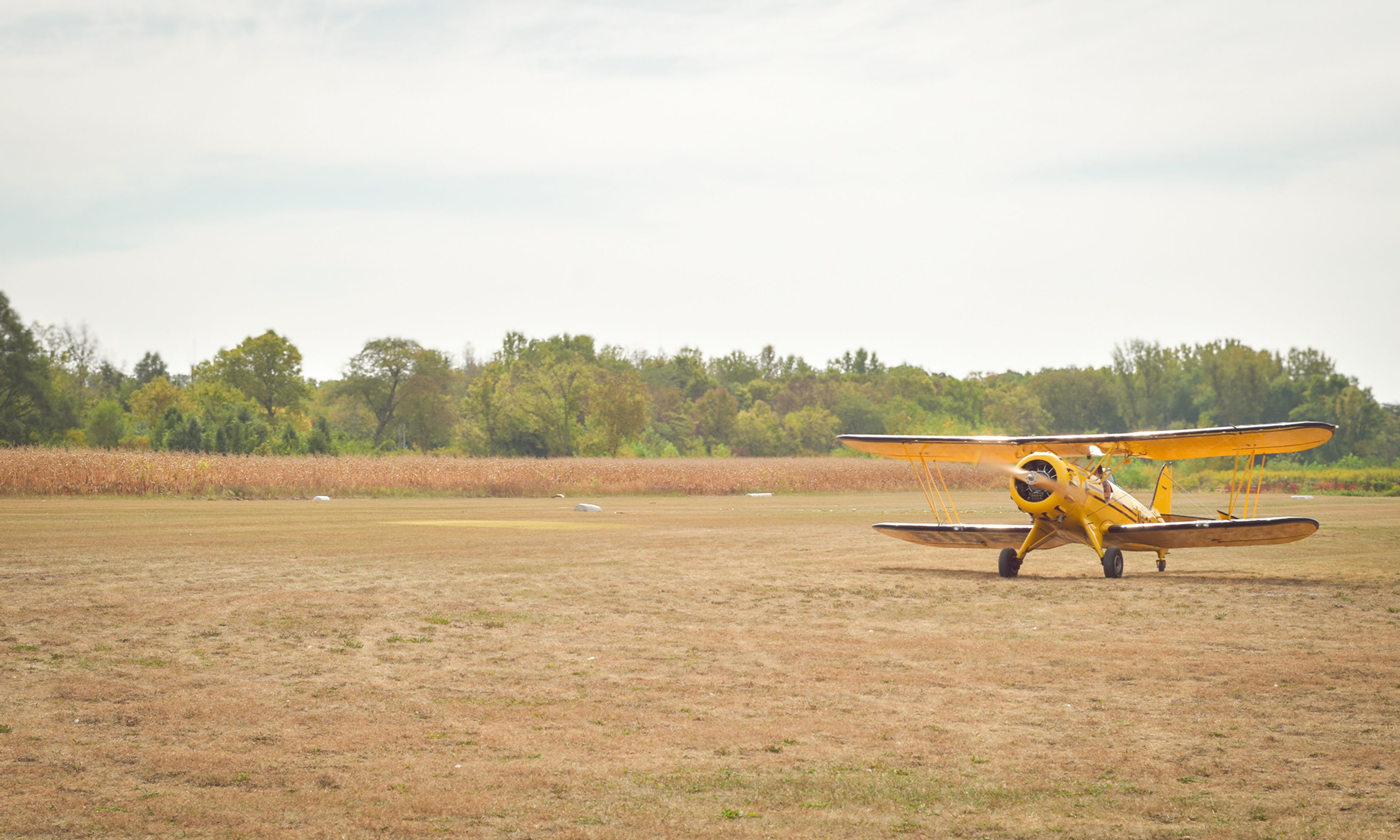
To cap off this far-flung tour, I headed to historic WACO Airfield in Troy, Ohio, for its annual fly-in. This grass strip is one of the few fields in the Greater Dayton area that I hadn’t graced with my nervous landings, but this adventure promised to half-rectify that situation. Why? Well, top of my WACO agenda was taking an open-cockpit biplane ride. Reader, I did it, and I can honestly report that open-cockpit biplanes are the place to be. Loud, breezy, and bright, “Sunny,” as this model is known, is a 2004 biplane manufactured at the WACO plant in Battle Creek, Mich. Chauffeuring my ecstatic self across the sky was former naval aviator Jason, who awed me with his declaration — after my prompting — that he’d landed on aircraft carriers on the ocean more than 600 times. His was, undoubtedly, the best landing I’ve yet to experience.
Before I stepped into the plane, as I signed forms and chatted with the cheerful women running the booth, the lady serving me said that when she’d taken a ride in a Sunny, she hadn’t wanted it to end. After 30 short minutes enjoying the cool wind whipping around my face, listening to the headset crackling in my ear, and gazing out over a sun-dappled bit of Ohio, I couldn’t agree with her more. Jason talked to me over the headset throughout the journey, pointing out local aviation landmarks and natural highlights, and answering my questions about his time in the Navy and life lived all over the world. According to him, though, despite his experience in far-flung places, Troy, Ohio, “is fantastic,” and it’s where he and his family have chosen to make their permanent home.
Just as at Grimes, the denizens of WACO were friendly, pleased to have visitors, and proud of the airfield and local community. I spoke with everyone from WACO’s Learning Center director, Nancy Royer, to two members of the Troy Historical Society, to a sweet elderly woman named Mary Ann who, as I stepped away from Sunny, asked how I’d enjoyed it. And that’s how I discovered that someone else — Mary Ann — loves the sensation of takeoff as much as I do. Mary Ann’s husband died eight years ago, and she was attending the fly-in to celebrate his birthday. I can’t think of a better tribute or a grander way to spend a September Saturday.
WACO, Grimes, Huffman Prairie, Wapakoneta — these are just a few shimmering parts of a many-pointed constellation, all of which owe their existence to the tenacity of two brothers and the insightfulness of a group of businessmen clearing the way for the advancement of human flight. And it all started here, on an unremarkable little prairie.












Comments