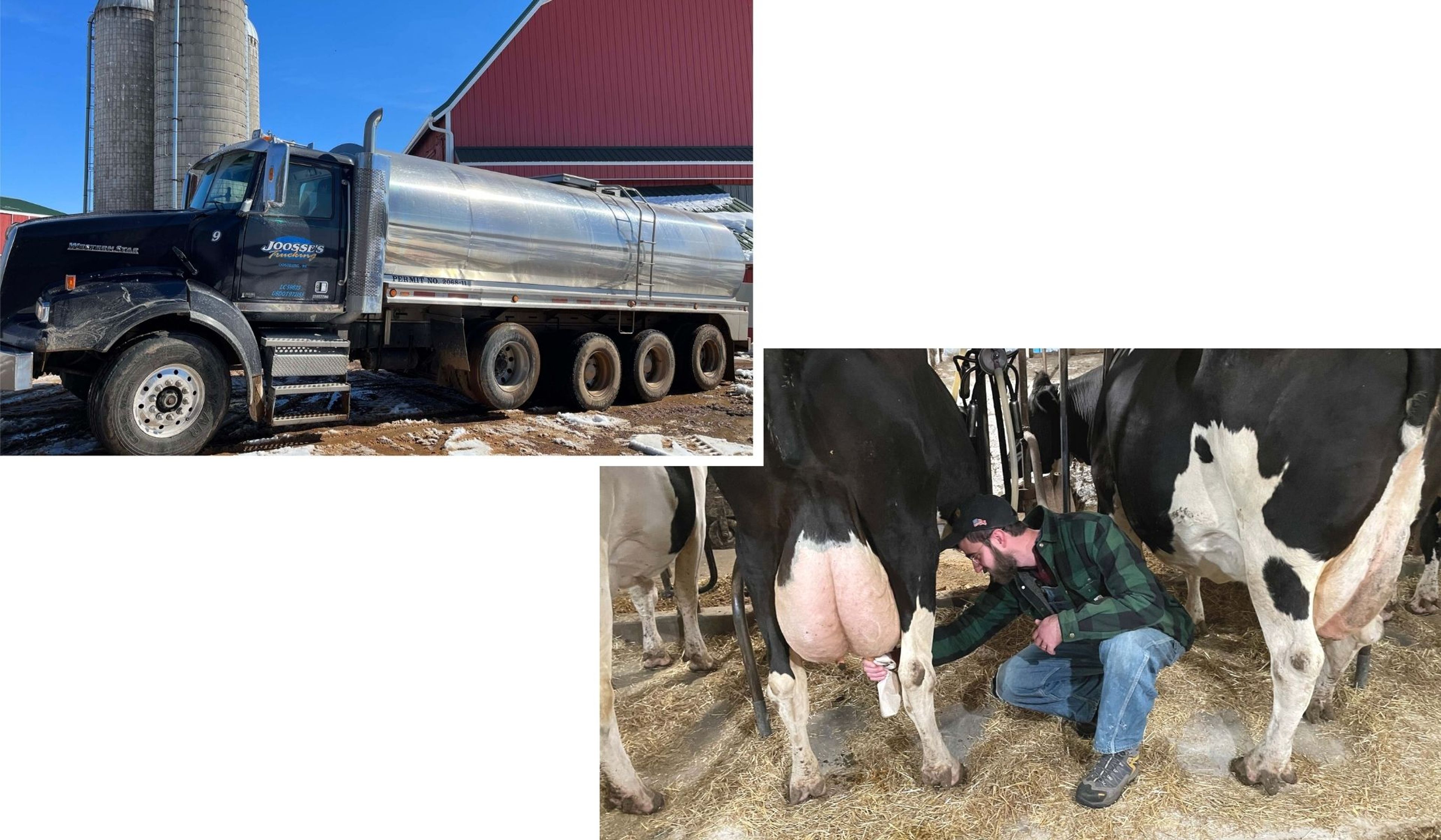
At 3:45 a.m., Folgers coffee poured, I headed south from Sheboygan, Wis., to Joosse’s Trucking in Oostburg. There I was confronted by two rows of scowling milk trucks — their double-walled cylinders certain to inspire a Pavlovian response in Diet Coke drinkers. I met Scott, a retired Kohler engineer now pulling 16-hour shifts as a driver. He’d later explain, “God made me to work,” and work he did. The cows don’t take days off, so neither do the drivers — in rain, in snow, or on Packer game days.
Our truck was a Western Star, a quad-axle straight truck — meaning the trailer was permanently attached. Scott explained that reversing his rig is “like backing up the family minivan but without a rear window. ” While the Western Star was older than some of the Peterbilts and Kenworths on the lot, Scott thought the ride smoother and the cabin more spacious, boxy like a Volvo station wagon. A picture of his granddaughter hung from the defunct CB radio, her smile pirouetting in the defroster draft.
With 502K miles on the odometer, the original Detroit diesel motor was soon grumbling good-naturedly. After taking a hammer to the tires to check for duds and then verifying that all mechanical connections and levels were tip-top, Scott rowed the Western Star’s paired nonsynchronous transmission lever, double-clutching out of the lot in fifth gear and working up to 18th on the interstate heading north.
With a few hours of driving to enjoy until we arrived at the first farm, Scott delineated the regulatory constraints of his work. The fully fueled 31,000-pound milk truck can carry up to 48,500 pounds. of milk (79,500 pounds gross) but is restricted to 74,000 pounds gross by state law. (A semi can haul a full 80,000 pounds) He expected to have 35,000 pounds (66,000 pounds gross) by the end of the day, making the currently tight suspension rolling and ponderous. The time required for a loaded truck to go from a stop to 60 mph is reckoned in eons.
Wondering about the choice of milk-measurement unit — pounds instead of gallons — I was informed that pounds are simpler and more accurate, and that milk has been measured this way for centuries.
We turned west, away from Lake Michigan, and the sun soon rose enough for us to spot fellow milk trucks. Like Jeep owners and country-dwellers, the milk-haulers have a fraternal wave, consisting of a full hand raise, reserved for others of their kind.
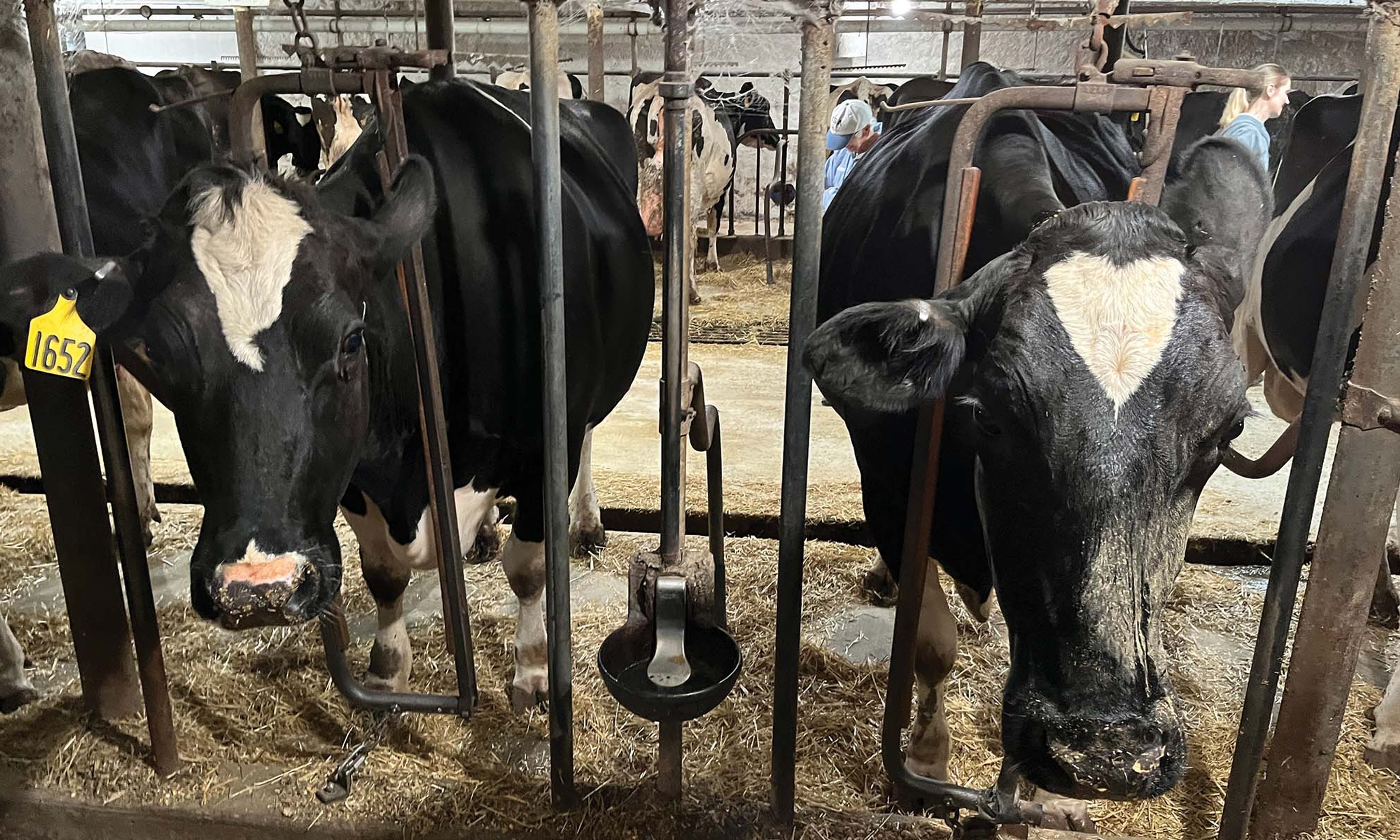
In the countryside surrounding Abbotsford, we pulled into the first of ten stops we’d make, all organic family farms, before dropping off our get at the cheese factory. An operation whose owner had retired to his house on the farm, the dairy was now being worked, and would eventually be owned, by John, a 25-year-old liberal Mennonite with a phone and a TV. Originally from Ohio, John was affable and took my questions as we stood in the low-ceilinged cow pen. There among the splattering sounds of bovine relief, he explained that he would earn the farm through his labor — what John didn’t have in capital, he had in work ethic.
I asked about his dating prospects on the farm, and he said that through the church — his being the oldest Mennonite church in Wisconsin — he would eventually find a bride. The proximity of other Mennonites and their communitarian support structure also meant that he could rely on others for technical expertise, for instance at “a welding shop or a farm store.” As the state inspector was rumored to be in the neighborhood, we thanked John and left him to continue cleaning his spotless pump house.
The second farm looked different despite having the same components: several dozen cows, farmers, and a pump house. Every farm is a legacy product, so its organization, coloration, and structures are unique. Tim and Heather — who wouldn’t look or sound out of place in a Madison coffee shop — own and operate the organic farm that was originally run by Tim’s parents. Having met online while attending college, the handsome young couple settled on dairy farming as their life’s work and would love for their kids to continue it. The pump house was large and warm, and the air, rich in the nostril, smelled of cleanliness and cream.
Wanting the best for their cows and the environment, Tim and Heather came to organic from standard milking through a five-year conversion process. They were proud of the milk their farm produced and the conditions provided to their 1,600-pound ladies. Decrying the steady addition of regulations, such as herd-conversion rules that fail to improve organic quality while raising costs and being subject to manipulation by larger outfits, Heather asked, “Is it our intent to just have all these stricter regulations for the sake of these regulations? Or are we trying to remember that the point of these regulations is for this animal-care need or for this health component?” After passing along news of the state inspector’s proximity, we headed into Mennonite country.
The next four stops were with the Hoover cousins, families fluent in Pennsylvania Dutch. Traditional in dress and using machinery for commercial applications only, the Hoovers each had specializations outside of dairy farming. Melvin runs a health-food store from his homestead. Levi, the youngest, talking to me with his son perched in his arms, outlined Mennonite self-insurance. A producer of maple syrup and peanuts, he said that he wished he could sell his raw milk directly to consumers — noting that actually destructive items such as alcohol and cigarettes are widely available at grocery stores — and that anything approaching a farm subsidy brings with it the danger of government ownership.
Martin Hoover impressed upon me the need for children to bear the weight and responsibility of work from an early age. He runs a bicycle shop and described the intra-church debate about e-bikes. They don’t require physical output, making them frowned upon in general, but they are a permitted accommodation for those who can no longer pedal a conventional bike.
“You can’t dodge a cow,” pronounced Harvey Hoover: Cows, unlike bulls, allegedly keep their eyes open while charging. Levi had beaten us to Harvey’s place (whether by bicycle or horse I know not) and gifted me a pint of his family’s maple syrup. Harvey purchased his farm 16 years ago and has used young bulls — less than two years old — to maintain his Jersey, Brown Swiss, and Normandy heifers at 60 head. The herd is slightly larger than ideal for his 100 acres — he and Levi reckoned that two acres per cow is about the perfect ratio for an organic dairy farmer. I wondered about the danger of bulls, but Harvey reassured me that those under two and not overfed on grain are just fine — farmers have been debating “AI” for far longer than our potentates and prognosticators, though artificial insemination may not be what Washington is talking about. Tough to tell sometimes . . .
I asked about the larger conventional operations. Harvey gave a measured response: “I have nothing against the big farms. But ask anyone working there if he likes working there and then ask a man working on his family farm if he likes working there, and you’re going to get two different answers.”
Back among the “English” (non-Mennonites), I spoke with Brent while his Jersey cows nuzzled my hand and he bottle-fed a calf that wore a burlap sweater. Brent had moved up from Kentucky. When he received word that his bid in Wisconsin had been accepted, he arranged with a trucker to load up his chocolate-brown cows after that evening’s milking. Brent and the perhaps chemically energized trucker then took the double-cab semi screaming north — over 100 mph at some points — to get the cows to Wisconsin in time for the morning milking.
Getting older and with hands the size and toughness of a 1910 catcher’s mitt, Brent figured it wouldn’t be long before he needed to sell the place, though he intended to keep farming as long as the knees and the shoulder would allow. When the day to sell comes, he said, it will likely conclude not with an auction or a listing but a buggy arriving in the driveway with an offer for the whole kit and caboodle.
With 22K pounds of milk now aboard, one could feel the slosh through the cab at stops and while turning. We dropped the tag axle (rear), with the pusher axle (front) in reserve to take on even more weight. We ate our lunches on the drive out: a brown bag for Scott and a Playmate cooler for me.
“Get the f*** out of Ag,” came the response from Toby, owner of the last farm on our route, when I asked what the government could do for farming. Toby, who looks 24 and is 49, was none too pleased to have some writer hanging around his milk house — bad press from a city twit could make his already difficult work even harder. Toby’s first job away from home was working on the farm he now owns, which is also where his wife was born. He said there used to be enough dairy families that a milk truck’s run could be accomplished just on his stretch of road. Now a truck has to come four hours across the state from Oostburg. “When the cows leave, they don’t come back,” he explained — when a farm goes under and sells its herd, no one is likely to make it a dairy again. “The farm is everything,” Toby went on. “It demands all the time and attention a man can give, and more.”
Listening to Toby, one understands the heart of a family farmer. The labor is as much a regulatory struggle as a physical one. Fertilizer-runoff reports have to be written while the cows are on the loose. (Indeed, one of Toby’s calves mischievously circumnavigated the truck as we arrived.) The simple jobs that should be the work of a farmhand are left unfinished in a tight job market, the value of milk is depressed as larger outfits increase their herds, and the family farmer can’t stop for an hour, let alone a day. But Toby wants to be on the farm because that’s where he knows how best to raise his kids, control his affairs, and take pride in his work.
Finished with collection by midafternoon, we now had to offload at a cheese plant outside Fond Du Lac. After a stop at the scales, we pulled into the three-bay offloading area, a palace of hairnets and chrome. All three trucks in the bay were driven by “retirees,” each of whom continues to work at least three days a week. One gentleman drives out to Iowa City daily to deliver regular milk before returning five and a half hours later with organic milk. As a long-haul trucker, he used to transport oversize loads to the East and West Coasts and up to Canada. Now he chews on a mint stick and enjoys his “short trips.”
Our day, which started at four in the morning, ended at eight that night. Five hundred miles driven. Nine Humvees’ weight in milk collected and delivered.
What I hadn’t done was milk a cow. So I called upon my grandpa, who was raised on a farm in Dale, to see whether he knew some dairy farmers who’d entrust their cows’ uddersides to me. Sure enough, he did. It came to pass that my grandpa photographed me wearing my great-grandfather’s OshKosh B’gosh overalls on a scarlet October evening, milking Valentine, an aging cow soon to go to slaughter, on a farm that within two years will cease dairy operations.
As my grandpa entertained us there among the cow warmth with recollections of running the pneumatic milking equipment off a vacuum pulled from the spark-plug port on a running Allis-Chalmers WC tractor, I couldn’t help but inwardly lament the economic, familial, and regulatory pressures that end these farms. What’s the Wisconsin countryside without cows mooing and sashaying in the fields? I never want to know. One can only be grateful that the organic family farms have found a model that keeps the lights on and the pastures stocked so those who drive by can exclaim, “Hey, look! Cows!”











Comments