‘Ideas have consequences,” thundered Richard Weaver in 1948, in a book sporting that title. Weaver was an intellectual historian who believed that the metaphysical errors of the late Middle Ages had spawned a whole slew of evils, from moral relativism to jazz. His declinist mode of thinking has become second nature to many conservatives, who still use Weaver’s phrase to draw causal connections between malign social developments and intellectual positions that they themselves oppose. Critical race theory is the misbegotten offspring of Karl Marx and Friedrich Engels. Lockean individualism leached away Americans’ piety and respect for tradition. Feminism ransacked the family.
It’s interesting to observe that these “consequences” are noted and tracked only when they are malevolent. Good ideas, it would seem, are fertile and dynamic. They open new possibilities for coming generations to explore. Bad ideas are more like Godzilla. They rampage around destroying everything in their path.
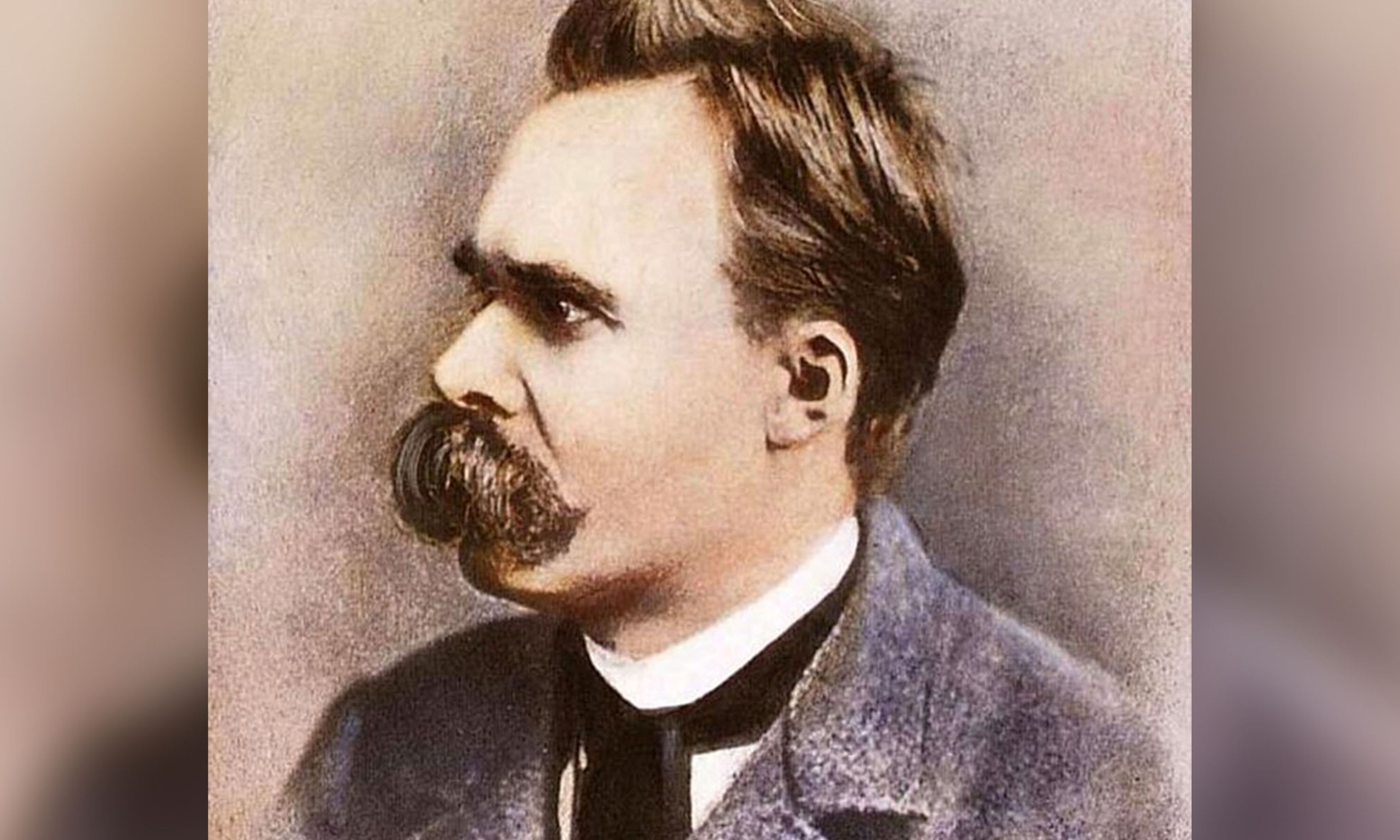
Philipp Felsch, a professor of cultural history in Berlin, has written a book exploring the relationship between ideas and their consequences. How Nietzsche Came In from the Cold is provocatively billed as a “Tale of a Redemption,” and it does indeed tell the story of Friedrich Nietzsche’s reclamation from the dustbin of Nazism. Felsch’s narrative is far less triumphalist, though, than the title would suggest. The book’s cover is rather more revealing, depicting Nietzsche’s profile in an ill-defined, blotchy black shape reminiscent of a Rorschach test. Nietzsche has been subjected to a dizzying array of interpretations, with thinkers of many persuasions scrambling to claim him as their own. In the end, the real hero of this book is not Nietzsche but rather an Italian philologist named Mazzino Montinari, who co-edited the critical edition of Nietzsche’s collected works in the 1960s and ’70s. It’s an unlikely setup for an epic tale, but Montinari really does come through as a kind of scholarly hero. In a politically inflamed world where “consequences” tend to draw attention away from real ideas, he undertook the noble task of faithfully transcribing and translating Nietzsche.
Did he succeed in this quest? It’s a difficult question, which raises yet another: Is it good to preserve and disseminate the ideas of a thinker like Nietzsche? If there is such a thing as a philosophical supervillain, Nietzsche is surely a strong contender for the title. He is beloved of Nazis, nihilists, and postmodernists. Hitler once sent Mussolini a beautifully bound copy of the philosopher’s complete works as a birthday gift. Nietzsche had a profound impact on such generous, fruitful, and humane thinkers as Samuel Francis and Bronze Age Pervert, and even to this day, alienated young men are thrilling to Zarathustra, savoring the sweet daydream that they might one day push their antisocial impulses to a glorious, liberating pinnacle, becoming the Übermenschen of the next age.
Perhaps the world would have been better off without him. And Felsch’s book raises a startling possibility: But for Montinari’s efforts, Nietzsche really might have been, if not utterly forgotten, then at least marginalized into obscurity. A sizeable portion of his work could easily have been discredited or destroyed in the period following World War II. It makes for an interesting thought experiment at a moment when Americans are fiercely debating the ethics of censorship. Given the chance, would we want to cancel Nietzsche?
Book-burning is often a futile endeavor, but in Nietzsche’s case it might have worked. As of the late 1950s, it was widely known that the available texts were both incomplete and deeply unreliable. Born in 1844, Nietzsche was incapacitated in 1889 by a major mental breakdown from which he never recovered. His widowed sister, Elisabeth Förster-Nietzsche, took charge of her invalid brother and his manuscripts at a time when his reputation in Europe was starting to grow. She seems to have been quite energetic about tracking down the complete collection. She was also aggressively antisemitic and an avid supporter of the Völkisch German Right. Förster-Nietzsche freely cherry-picked, embellished, or simply rewrote her brother’s work, transforming him into a Nazi icon and an engine of Völkisch propaganda.
In the years after the war, scholars recognized to some extent that the available texts were distorted, but rectifying the problem seemed both unworkable and unappealing. Somewhere behind the Iron Curtain, the 10,000 pages collected by Förster-Nietzsche were still sitting in an archive, but it seemed unlikely that the Communists would facilitate a revitalization of a thinker so greatly loved by their enemy. Martin Heidegger, a former Nazi, had helped prepare the already-available edition of The Will to Power, and he used such influence as he had to discourage a new project. Then there was a further issue: Nietzsche had terrible handwriting. Even given the chance, Western scholars understandably showed little enthusiasm for moving to Weimar to spend their days poring over the “all too human” chicken scratches.
Nevertheless, Montinari did precisely that. Visiting East Germany in 1961, he was amazed to find that Nietzsche’s manuscripts were voluminous, well preserved, and meticulously catalogued. Nietzsche’s sister, for all her faults, had excellent secretarial skills. Montinari was ideally situated to explore this treasure trove: As an Italian with communist sympathies, he raised few hackles with local government. He kept his research a secret and successfully persuaded his Stasi minder that his philological project would serve only to discredit the fascists and their legacy. What began as a two-week reconnaissance mission soon turned into a life’s work. Montinari moved to Weimar and worked relentlessly on the manuscripts, eventually marrying a local woman and starting a family with her. New translations of Nietzsche’s works began appearing in Italian in 1964, with French and German editions following three years later. Translation of the editions that Montinari produced with his friend and mentor Giorgio Colli continues to this day; the 17th volume of Stanford University Press’s English edition is forthcoming in January 2025.
Montinari’s effort could not have succeeded without Colli, who co-edited the volumes and managed the project from Italy. It was Colli who, as his high-school philosophy teacher, first introduced Montinari to Nietzsche in Tuscany in 1942. Colli was charismatic and burned with a mystical, Dionysian spirit. He cultivated an intimate circle of specially talented students who gathered together to read Platonic dialogues, listen to Beethoven, and obsess over Nietzsche. Undoubtedly, those euphoric youthful experiences laid the foundation for Montinari’s later work. In the end, though, the younger man possessed the determination, meticulous patience, and intellectual humility that were needed to recover Nietzsche. His feat is even more impressive when one considers Nietzsche’s strong tendency to inflame the passions of egoists. It would take a rare man to marinate in those texts for months and years without developing some megalomaniacal fever dreams of his own. Evidently, Montinari was that man. That first encounter with an original manuscript was, for him, the come-to-Nietzsche moment that activated the devout impulses of a Benedictine scribe.
Not everyone appreciated his efforts, of course. Montinari alienated some intellectuals by declaring that The Will to Power, possibly Nietzsche’s most famous work to that point, was not really a work at all in the sense that Nietzsche never intended for those writings to be published in that way or under that title. In his later years, he was widely respected as a Nietzsche expert but also criticized by virtually every existing scholarly camp. To Michel Foucault and the postmodernists, who loved Nietzsche’s freewheeling style, Montinari was a dogged conservative clinging to the literal text. Other scholars believed that Montinari’s anti-fascist views and aims had led him to downplay Nietzsche’s darker prejudices, opening the way to a chaotic explosion of interpretations. In this reader’s eyes, Montinari’s ability to offend every camp (even as they returned to him for source material) stands as strong evidence of the success of his quest.
This brings us back to an earlier question. What are the real consequences of Nietzsche’s dangerous ideas? Was Montinari’s quest a righteous one? Would the Soviets have done the world a favor by destroying the Nietzsche archive before it could be rediscovered?
Studying the Rorschach-test cover, I found it hard to wish Nietzsche down the memory hole. No doubt he has done real harm, though the extent is impossible to quantify, particularly when he shifts so fluidly between diagnosis of the modern condition, prescription, and prediction. Sometimes his ideas seem to push people to dark places, but is he planting a bad harvest or just describing the growing weeds? Among conservatives, Nietzsche tends to be valued not as a fellow traveler but as a worthy interlocutor who saw and articulated the real implications of entering a post-Christian world. If one malevolent and destructive group of people had enshrined Nietzsche as its prophet, that might seem like strong grounds for condemning him. When many groups want to claim him, that does seem to exonerate him somewhat. Whatever Nietzsche himself is contributing to each, it doesn’t appear to be the central creed. His fans are too diverse for that.
Perhaps, then, Nietzsche functions as a kind of mystical mirror of modernity. People peer into his texts and see themselves, with particular features sharpened. For egoists and tyrants, this is not curative. But more virtuous people may benefit from the experience, drawing on his trenchant insights to deepen their understanding of the modern condition. Where Nietzsche seems broken or depraved, he may just be reflecting the brokenness and depravity of modern life. He encourages decadent men like Foucault in their decadence but helps disciplined, rational men like Montinari to apply their gifts more fruitfully.
Bad ideas can be harmful, but there is only one weapon that can consistently slay them. That weapon is the truth. Instead of lamenting historical errors, or decrying dangerous thinkers, perhaps we should try harder to articulate true answers to the questions being asked in our own age.











Comments