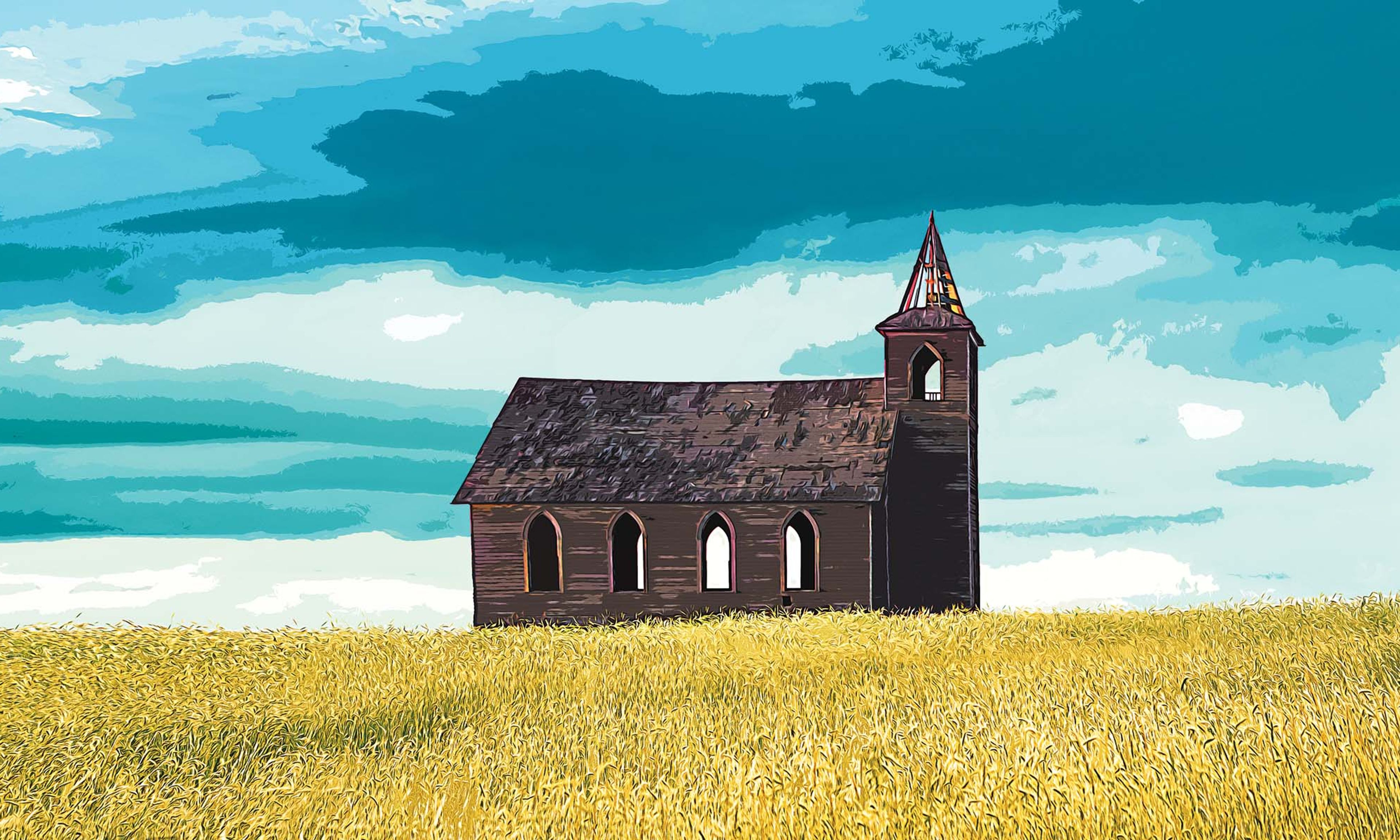
There’s a church in upstate New York — in the town of Utica, as it happens: Grace Episcopal. Built in 1860, it’s what you might expect of a small-city Episcopal building of its time — an era in which the American form of Anglican Protestantism represented both confidence and taste. This was the church of both old Yankee blue-blood money and the brash nouveau riche bankers striving to join them: a graceful, gray stone building with a traditional red door, brown wood supports, a decorated chancel, and a whitewashed, understated nave. Pews to hold a few hundred. A good organ and choir space. And this was America, the very center of the culture, for over 200 years.
Or maybe the place to look for the essence of the nation is Los Angeles’s First Baptist Church, down on Westmoreland Avenue. It’s a 1927 building of Spanish Gothic design, to match California’s missionary aesthetic, but with decoration stripped down to match the more puritanical sensibilities of American Protestantism. The church was influenced by the Azusa Street revivals of Los Angeles around that time — which gave birth to the uniquely American sects of what would come to form Pentecostalism — but retained its Baptist orientation, with fewer high-tone congregants than would put on their Sunday best for services at, say, St. John’s Episcopal Cathedral, a 1925 Romanesque church just off the intersection of Adams and Figueroa Streets. But First Baptist, too, was the physical locus of the spirit of the nation. It was the kind of place you’d go to look for America itself.
Or maybe the 1909 red-brick Congregational Church in Fort Pierre, S.D., with its spireless tower and pews curved to fit its square space. Or the wooden 1876 Methodist church in Pokagon, Mich. (where the popular hymn “The Old Rugged Cross” was first sung), remodeled from a hop barn. Or the 1858 First Presbyterian Church in Macon, Ga., with its dark-brown pews and plain white walls.
Take any of these or thousands of others. This was America, once upon a time: a land of churches one after another down the leafy streets of small towns. Or the run of churches up 16th Street NW, in Washington, D.C., from the White House to the Maryland border. Or the many spires that slip by along the Main Line railroad (the original reference in the phrase “Mainline Protestantism”) that connects Philadelphia to its wealthy northwest suburbs.
In 1965, churches affiliated with these Mainline denominations claimed around 50 percent of the American population. Today (according to the religious statistician Ryan Burge, working his way through reams of 2020 numbers, the most recent complete data available), the old Mainline has fallen to 9 percent. Seven denominations that once formed the core of American Protestantism have numbers that are nearly invisible in national totals: the northern Baptists, the Disciples of Christ, the Congregationalists (later merging with a set of German Reformed churches to create the United Church of Christ), the Episcopalians, the Lutherans, the Methodists, and the Presbyterians.
This is one of the largest sociological changes in American history, and it has happened to institutions that seemed central to the nation itself. For evidence of these churches’ significance, we could look to Will Herberg’s once-famous 1955 book Protestant — Catholic — Jew: An Essay in American Religious Sociology, or even President Eisenhower’s traveling up from Washington in 1958 to lay the cornerstone of the National Council of Churches’ official building on Riverside Drive in New York.
But long before the 1950s, as Alexis de Tocqueville observed after touring the nation in 1831, there was general agreement about personal morality: “The sects that exist in the United States are innumerable. They all differ in respect to the worship which is due to the Creator; but they all agree in respect to the duties which are due from man to man.” As the Civil War would show, the agreement was sometimes merely an establishment of manners: “The clergy of all the different sects hold the same language,” he added. “Their opinions are in agreement with the laws, and the human mind flows onward, so to speak, in one undivided current.”
Morals and manners are not everything, but they are nonetheless something. Beyond all their differences, the central Protestant churches gave a form and tone to the culture. Their unity-in-difference offered the United States a peculiar gift: America had the advantages of social agreement that come with a state church, without the disadvantages of government control of religion.
We tend to think of the Mainline as what emerged from the unifying of denominations that took place from the 1910s through the 1950s. But in fact even the splintered sects that Tocqueville saw in the 1830s are what we might loosely call the “Mainline.” And though the undivided current of that old Protestantism never reached ecclesial unity, it did achieve a national vocabulary: a way to understand ourselves outside political struggles and economic exchanges.
And this is what we have lacked in recent decades — with the unsurprising result that our political and economic divisions have become nation-threatening, imbued with the spiritual anxiety that the churches once corralled and directed into concern about personal salvation.
The American experiment might be understood as a three-legged stool, each leg counterbalancing the others. Democracy grants participation in national governance and fills the desire of some citizens to take part in history, but it leans toward vulgarity and shortsightedness. Capitalism gives us other freedoms and outlets for ambition, but it threatens to topple over, eroding the virtues it needed for its own flourishing. Meanwhile, religion provides meaning and narrative, a channel for the spiritual hunger of human beings, but it tilts, in turn, toward hegemony and conformity.
Through most of American history, these three legs of democracy, capitalism, and religion accommodated one another and, at the same time, pushed hard against one another. In many ways, America’s Protestant Christianity was a highly accommodating religion, but again and again the churches managed to withstand the politics and the economics of the age. The great fight to abolish slavery, or to gain women’s suffrage, or the temperance struggle against the Demon Rum, or the civil-rights movement: Every so often there would explode from the churches a moral and prophetic demand on the nation. And to that demand, politics and economics had to bend.
Looking back, however, we can discern that these grand campaigns were a secondary effect of religion’s influence on America. To see the unreported and generally ignored statements on every transient political event that issue these days from the central offices of the old Mainline is to understand that these churches mattered more when they wanted to matter less. The old denominations were often engaged in sectarian debates: infant baptism, the consequences of the Fall, the theological significance of good works, the real presence of the Eucharist, the role of bishops. And yet, the more their concerns were narrow, the more their effects were broad, giving a characteristic shape to the nation: the centrality of families, the pattern of marriages and funerals, the vague but widespread patriotism, the strong localism, and the ongoing sense of some providential purpose at work in the existence of the United States.
We could suggest any number of causes for the decline of Mainline churches. The rise of television, for example. The disdain for narrow doctrine in the prestigious mission boards. The Social Gospel movement, which diminished the need for church in the name of a higher social morality. And much more: It was a ratchet that turned in only one direction, with each new sociological change weakening Mainline Protestantism.
The result is undeniable, however. We are living in an age of spiritual anxiety — the social factor that once interested major sociologists from Émile Durkheim and Max Weber to Peter L. Berger. Some Mainline Protestants left for Evangelical churches and others for Catholicism (the two largest Christian groups outside the old Mainline). But much of that decline from 50 to 9 percent over the past decades came from the people who simply felt that their politics gave them the moral satisfaction they needed.
And now their children are in the street — without any satisfaction at all. Spiritually anxious, they react to each short-lived bit of political hoopla as though it were the trumpet of Armageddon. Desperate for meaning, they latch on to anything that gives them the frisson of seeming revolutionary, no matter how little they understand it or perform actions that meaningfully affect it. Shouting slogans, they ache for the unity of a congregation singing hymns. What Protestantism once gave, they have no more: a nation-defining pattern of marriage and children, a feeling of belonging, a belief in Providence, a sense of patriotism.
The danger in all this comes from the fact that the apocalypse is self-fulfilling. If everything in public life is elevated to world-threatening danger, if there is no meaningful private life to which to retreat, then all manners and even personal morals must be set aside in the name of higher causes — and opponents quickly come to feel they must respond with similarly cataclysmic rhetoric and action.
The collapse of the central denominations in American religious life is not the cause of our current social and political divisions. But it is a significant cause of the rancor, lack of fellow feeling, and apocalyptic threat in those divisions. Utica’s Grace Episcopal, Los Angeles’s First Baptist, Macon’s First Presbyterian — what do these churches have to do with America? Once everything. Now nothing, may God have mercy on us.












Comments