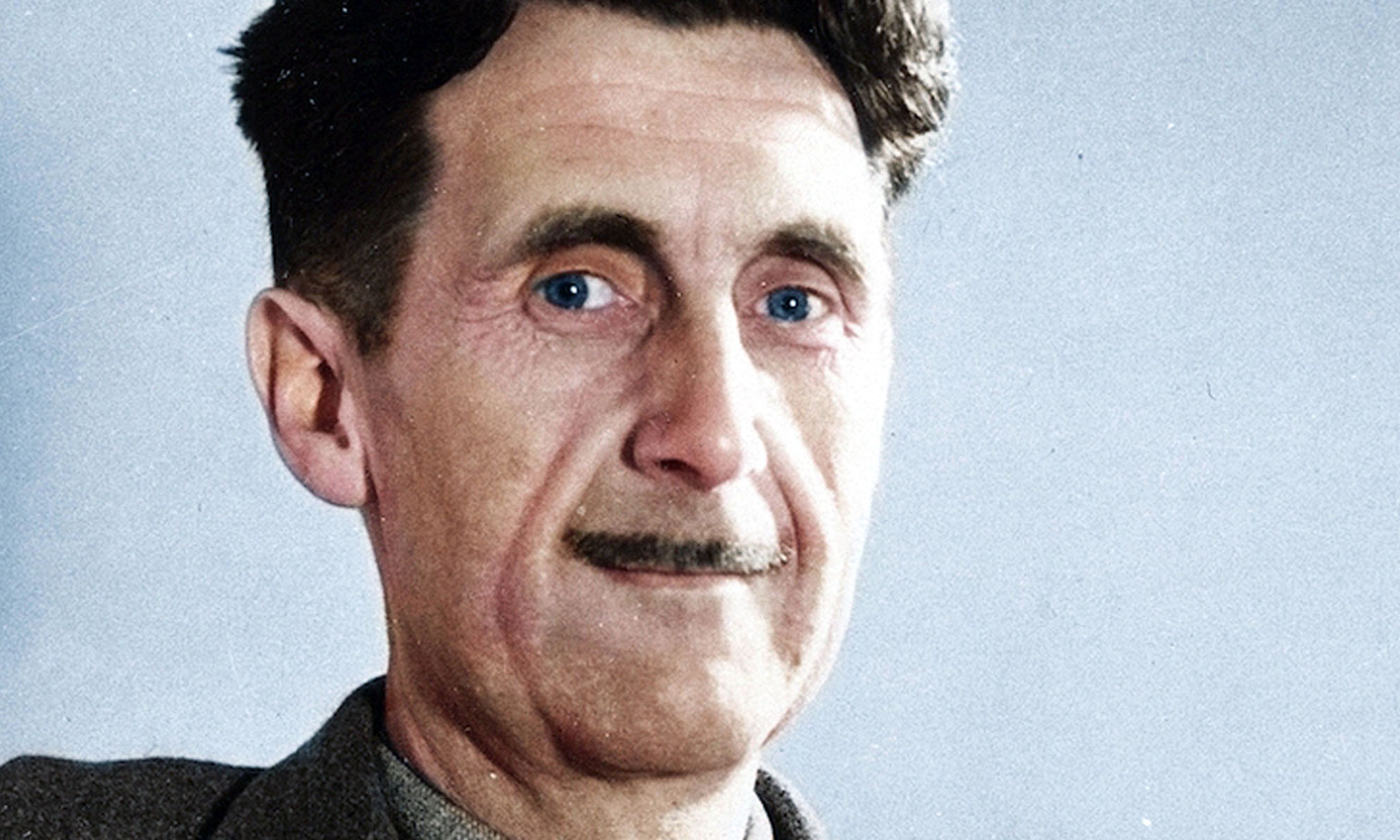
It was a dark cold morning in January, and the clocks had just struck eight when Richard Blair learned that his father had died. The news came from a battery-powered radio in the kitchen of a house without electricity on the remote Scottish island of Jura. “We always tuned in a little before eight o’clock to hear the weather report, and then came the news broadcast,” recalls Blair. “At the end of it, the announcer said he was dead.”
Five-year-old Richard was the son of Eric Blair, whose pen name was “George Orwell.” The younger Blair was living with his aunt — Orwell’s sister, Avril — in the house where his father had written 1984, which had been published the previous June as its author suffered from tuberculosis and other maladies. At his death on January 21, 1950, Orwell was 46 years old and bedridden at a hospital in London. Today, the 80-year-old Blair is one of just a few surviving people who knew Orwell. The others include a pair of his cousins and a handful of old-timers on Jura.
The son of the man who may be the 20th century’s most notable novelist lives near the English town of Banbury, famous for the nursery rhyme: “Ride a cock-horse to Banbury Cross / To see a fine lady upon a white horse.” Blair has spent his life far removed from the books and essays that occupied his father, though in his retirement he has become a leading guardian of Orwell’s legacy. Behind it all is a remarkable story of an ambitious writer, a child who needed a home, and an adoption.
Around 11 a.m. on May 14, 1944, a boy was born in London to a mother in a jam. She was married, but the baby’s father was not her husband, who was absent because of his service in World War II. The woman’s doctor was Gwen O’Shaughnessy, the sister-in-law of Eileen Blair, who was the wife of Orwell. George and Eileen were a childless couple who had expressed an interest in starting a family. Gwen made it happen. At the age of three weeks, Richard Blair — named after Orwell’s father — acquired his adoptive parents.
At the time, Orwell had yet to write the works for which he is best remembered. Instead, he was a struggling journalist who was churning out newspaper columns and book reviews and had just finished drafting the manuscript that would become Animal Farm. “I am smothered under work,” he wrote a month after the adoption. “Also I’ve been bombed out and we have a very young baby, all of which adds to one’s work.” That comment is classic Orwell: a dry-as-dust reference to the momentous event of fatherhood and the fact that a V-1 rocket had wrecked his flat.
He and Eileen weren’t home when the bomb hit, so it left them unscathed, but tragedy struck the next spring. During preparations for what should have been a routine surgery, Eileen died, at the age of 39. Orwell was left a widower, with a son who was less than a year old. “It was a dreadful shock and a very cruel thing to happen,” wrote Orwell days later. “She had become so devoted to Richard and was looking forward to living a normal life in the country again as soon as the war was over.” He added that Richard “is becoming so charming.”
Orwell apparently never considered giving up Richard, either by foisting him on relatives or forcing him into a second adoption. Instead, he hired a nurse and continued to write. He was about to become busier than ever before: The publication of Animal Farm in the summer of 1945 caused a sensation. Its anti-Stalinist allegory was timed perfectly, with World War II ending, the Cold War starting, and the Soviet Union shifting from friend to foe. Meanwhile, Orwell dealt with the cheerful chaos of a rambunctious toddler. “Richard has been trying to help me with the typing of this letter,” he wrote to a friend, in a line that any work-from-home parent can appreciate. As Richard approached his second birthday, Orwell provided another update: “He is a splendid child and fortunately very healthy, and is a great pleasure to me.”
Yet Orwell was troubled. He wanted to remarry, partly for the sake of Richard. He managed a few awkward proposals to acquaintances, all rejected. He also wanted to get away from the city and its distractions — and with a rented house on Jura, he found an isolated retreat and began to conceive the nightmare world of Big Brother and the Thought Police.
“Time starts to dim one’s memory,” admits Blair in our interview, but he has vivid recollections of Jura. “Living there was wonderful. I was always so interested in what was going on outside.” Often that meant visiting Bill Dunn, a war veteran who had lost a part of his leg in Sicily and now worked on a neighboring farm. “Bill would be mucking with machinery, and I would get in the way.” Bill may have tolerated the meddling because he was courting Avril, who lived on the island with her brother and looked after her nephew. Blair says he wore thick boots everywhere, on orders of his father, who worried about snakes. He recalls another rule of the house, too: “When you heard the clacking of the typewriter, that was when you were supposed to leave him alone.”
Blair suffered from the usual mishaps of childhood. His father described one incident in the spring of 1947: “Richard had a very bad accident a few days ago — he fell off a chair on to a jug which broke under him and cut his forehead very badly.” A doctor closed the wound with two stitches. “I don’t think there will be a very bad scar,” wrote Orwell. During my conversation with Blair via Zoom, I asked whether he still has the scar. “Oh yes,” he replied, leaning toward his camera and pointing to a spot on his forehead. “I think you should be able to see it.” And there it was, above his right eye, faint but visible.
After the gash came what could have been a much worse disaster. Orwell often took Richard fishing for lobster and mackerel, and in August they went out for a jaunt in a dinghy with two others. Off the northern tip of Jura is the Gulf of Corryvreckan and the location of what is sometimes said to be the third-largest whirlpool on the planet. It’s in a strait that is normally navigable but potentially deadly when a flood tide pours through. The boaters arrived on the scene at the wrong moment, probably because Orwell had misread the tide tables. Orwell provided an abbreviated account in his diary: “On return journey today ran into the whirlpool & were all nearly drowned. Engine sucked off by the sea & went to the bottom.” The vortex whipped them around, but they managed to escape by rowing to safety on a rocky islet. As they were coming ashore, however, their boat flipped and the current swept away their oars. They also nearly lost Richard, who “loved every minute of it except when he went into the water.” Fishermen picked them up a few hours later. The calamity left no physical scars, but Orwell wondered about mental ones. The next spring, when his sister reported that Richard was “frightened of boats,” Orwell theorized that “his present fear may be a delayed reaction.”
Orwell’s letters from this period are full of amused descriptions of Richard, who is “unbelievably destructive,” “terrifyingly energetic,” and “offensively well.” Orwell remarks that Richard doesn’t speak much, guessing that it is because the boy is rarely around other children. Richard may have been what pediatricians today would call a “late talker,” a condition that can vex parents but usually is harmless. Orwell also imagined the boy’s future: “I do not think he will ever be what they call ‘one for book learning.’” And he made a striking observation in 1949, as Richard approached his fifth birthday: “He is very self-reliant and is good with machinery and seems interested in farming. If he decides later that he wants to be a farmer when he is grown up, I’d be delighted.”
Orwell never got to see the grown-up Richard, of course. He had battled bad health for most of his life. Toward the end, he was often convalescing in hospitals — and Richard was under Avril’s full-time care. Three months before his death, Orwell married Sonia Brownell. He hoped for a recovery and intended for Richard to live with him and his new wife. Orwell also knew that his prognosis was poor. The plan in the event of his death was for Avril to raise his son.
And that’s what happened. Avril married Bill, and they took in Richard permanently. They left Jura and rented a farm on the Scottish mainland, where they herded cattle and sheep and grew grass for hay. Richard learned about his adoption from his aunt when he was seven or eight years old. “Avril suddenly came out with the statement in the car one morning,” he says. “She just slipped it in. I took this piece of information at face value. I don’t recall having a long conversation about it.” He eventually went away to a boarding school, where he studied until he was 16. “I was not terribly academic,” he says. He returned home and resolved to become a farmer, like his aunt and uncle. He worked on farms and attended a couple of agricultural colleges. In Aberdeen, he met Eleanor Moir, whom he married in 1964. This summer marks their 60th wedding anniversary. They have two sons and five grandchildren.
After meeting Eleanor, says Blair, “I decided to bail out of college.” They moved south to England, for a job on a farm in Herefordshire. “I was an assistant milker,” he says, but he also plowed fields with tractors and harvested wheat and barley with combines. Among the farm’s products were hops — an ingredient of beer whose picking is the subject of a 1931 essay by Orwell. “That was coincidental,” says Blair. Later, he moved to a farm in Warwickshire. In 1975, he took a job with Massey Ferguson, a maker of agricultural equipment. He demonstrated large machinery, in a role that mixed sales and training. It also proved his father prophetic: Blair indeed spent much of his life in farming and mechanics.
When Sonia Orwell died in 1980, the literary estate transferred to Blair — and when Massey Ferguson laid him off in 1986, he had the means to purchase a group of vacation cottages in Scotland, near the farm where Avril and Bill had raised him. He employed a manager to work on site, while he handled the bookings and advertising from England. In 2008, he sold the property and began the final phase of his career, which is to promote the understanding of his father’s life and work.
The first time Blair read the work of his father was in prep school, when a teacher assigned Animal Farm. Later, he read more, and today he says he prefers the essays, especially two about Orwell’s time as a colonial policeman in Burma: “A Hanging” and “Shooting an Elephant.” Despite his father’s model, Blair felt no impulse to write. “Nobody could ever emulate him and I never wanted to try,” he says. “That’s one benefit of not sharing his DNA.” He has looked up the people with whom he does share DNA — the progeny of his biological mother — but he never has met them.
Today, Blair is involved with the Orwell Foundation and the Orwell Society. The first oversees prizes for political writing. The second is a membership group that publishes a journal, sponsors trips and events, and helped erect a statue of Orwell that now stands outside the headquarters of the BBC. “I’m a figurehead,” says Blair. He shows up at functions and gives occasional interviews to biographers and journalists. He avoids playing a favorite game of pundits who want to declare what Orwell would say about current controversies: “I get all sorts of smart-arse intellectuals who think they know more than I do, which is not very much considering he has been dead for more than 70 years. I suppose one can conjecture, but it’s dangerous.” Blair doesn’t talk much about politics at all, but he admits that he usually votes Conservative — unlike Orwell, a lifelong socialist who voted Labour.
I did coax Blair into one speculation about Orwell, asking what he thinks his father would make of the man his son had become: “So long as I’d done what I did with honesty and hard work, he would have been happy with that.”












Comments