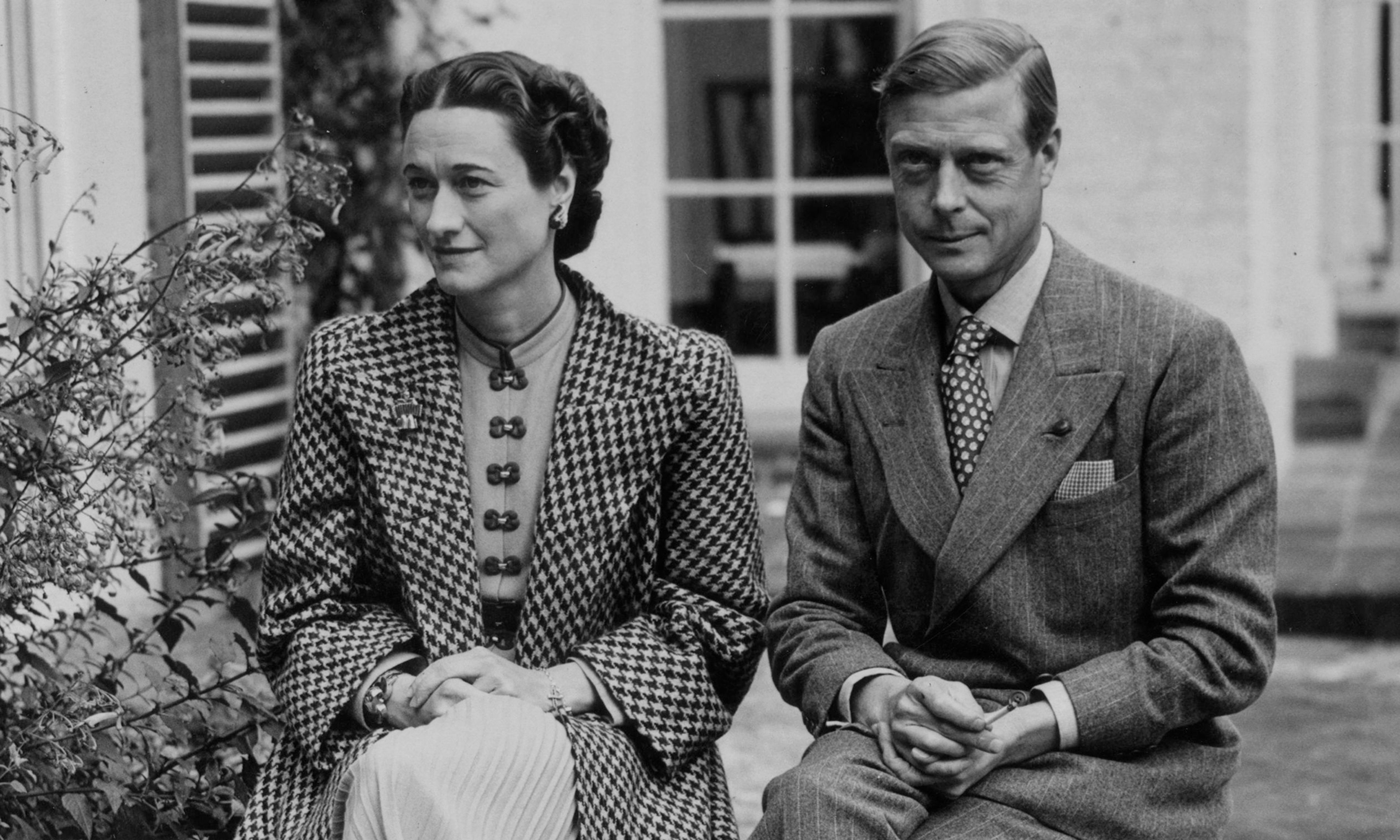
Heir to the British throne, good-looking and rather racy, the duke of Windsor in his youth seemed set to be one of the select personalities of his day. But his father, an old-style monarch, must have perceived some character flaw, because he predicted, “After I am dead the boy will ruin himself in twelve months.” Sure enough, in January 1936 he began his reign as Edward VIII and abdicated at the end of that year to become duke of Windsor, a title invented for him.
In the past, ambitious men had fought on the battlefield to settle rival claims to the British throne. Abdication was in itself as good as a slap in the face of the citizen, an unspoken admission that the throne wasn’t worth having. Frances Donaldson’s biography Edward VIII, published in 1974 shortly after the duke’s death, takes the view that the duke’s serial misjudgments did serious damage to the nation and the royal family. Andrew Lownie is a well-known journalist and biographer, and his Traitor King is a more succinct and deadly polemic that lays out everything the duke has to answer for.
What the duke wanted above all else, he confessed to the nation, was to marry Wallis Simpson, “the woman I love.” An American from Baltimore, Wallis had been married twice before and otherwise was an unknown quantity. A slightly ribald calypso expressed a general consensus about her: “Mrs. Simpson, she no fool, she make her aim the big crown jewel.” A somewhat prejudiced and traditionalist debate in Parliament and in the country established that she could never be queen. Stanley Baldwin, the prime minister, proposed that the king live openly with Wallis as his acknowledged mistress, the way kings had always done. Baldwin was baffled that the king quit with no sign of moral struggle, no idea that duty might demand the sacrifice of personal wishes.
The duke and Wallis both put their names to autobiographies written by ghosts with the promotional purpose of making the best of everything that had happened in their lives, and they repeated themselves in a number of interviews. Some commentators have taken them at face value and believed that the Windsors were a devoted couple in a happy marriage of 35 years. Lownie thinks it doubtful that Wallis was ever in love with the duke, or that she fully considered the implications of their relationship. “The life they led,” he writes, bearing down hard on both of them, “was born out of disappointment, frustration and unfulfilled expectations.”
Fourteen of the duke’s 16 great-great-grandparents were born into German royal families, and his parents, though king and queen, spoke English with a German accent, while the duke’s German was impeccable. “Every drop of blood in my veins is German,” was the sentimental image he had of himself. Hitler was rearming Germany with the ideological intention of destroying the Soviet Union, and the duke held that it was only right to support him.
In the idiom of that time, the duke was a Nazi fellow-traveler. His mind-set has to be inferred from the diaries and correspondence of whoever might have recorded conversations they had just had with him. Robert Bruce Lockhart, for instance, a diplomat and a secret agent who had been posted in the Soviet Union, noted in his diary that after Hitler came to power the prince of Wales (as the duke still was) was suggesting a role for himself. He was “quite pro-Hitler and said it was no business of ours to interfere in Germany’s internal affairs either re Jews or re anything else and added that dictators are very popular these days and that we might want one in England before now.” Valentine Lawford, third secretary in the Paris embassy, said in a letter to his mother that he had just dined with the duke and found him “very Nazi in his ideas,” adding that he seemed “to have a horror of Bolshevism.” Chips Channon, a member of Parliament and himself an appeaser who applied the word “genius” to Hitler, also kept a diary and said of the duke, “I shouldn’t be surprised if he aimed at making himself a mild dictator, a difficult enough task for an English king.” Hitler, he went on, “is changing the face of Europe, democracy is dying or dead.” Moral objections to Nazism were neither here nor there.
Private citizens though they were, the visit of the Windsors to Germany in October 1937 was much like an official royal tour to mark approval of Hitler and Nazism. Hitler received them in Berlin and the Berghof. The mutual admiration was evident. There is no record of what they talked about, but presumably each wished to impress the other. Hitler regretted the abdication, and in his wartime conversation he observed that with the duke in power “we could have achieved permanent cordial relations with England.” Goebbels was still more effusive. “The duke is wonderful,” he wrote in his diary. “It’s a shame he’s no longer king.”
The Windsors lived in a rented house in Paris, where they employed 16 servants, and might have idled there for the rest of their lives. In the months after the outbreak of war, the duke fatally compromised himself. Frances Donaldson said in her book that in the atmosphere of the French Resistance his behavior would have earned “fierce reprisals.”
The polemical Lownie sees outright treason. Appointed a liaison officer to the British Military Mission in France, the duke was stationed at Vincennes. His aide-de-camp was an old friend, Edward Metcalfe (son-in-law of Lord Curzon and always known as “Fruity”). The first hint of what was to come was a report from the German ambassador in The Hague, writing to the state secretary in Berlin that he might have the opportunity “to establish certain lines leading to the Duke of Windsor.” Another report in German hands conveyed information obtained from the duke about the poor disposition of the French army. One morning shortly after the Wehrmacht invasion, Fruity discovered that the duke had fled in the night without telling him. “Utterly I despise him. . . . He’s deserted his country,” Fruity wrote to his wife. “It is the end.” There could hardly be a worse display of bad character than leaving his ADC to fend for himself with the Germans at his heels while he and Wallis drove to safety in Spain and then Portugal.
Hitler had every reason to assume that the Wehrmacht’s blitzkriegs in Poland and France would force Britain to come to terms. Churchill had been prime minister for hardly more than a month. The story the British tell of themselves is that he led the nation to continue fighting on its own a war it was unlikely to win. This was its Finest Hour, very much in capital letters. In reality, there were men and women in all stations of life determined to make peace with Hitler at any price, and it was treasonable but not altogether fanciful that the duke sought to discover whether his Nazi friends might help him regain the throne.
Ribbentrop, Hitler’s foreign minister, the German ambassadors in Madrid and Lisbon, and the Gestapo hoped that the duke would hold himself ready to fall in with whatever Hitler might ask of him. As a sign of goodwill, a maid was allowed to go to the house in Paris and pack up items the Windsors wanted — the duke must have known this was trafficking with the enemy. The German ambassador in Lisbon heard from Spanish informers that “the Duke believes with certainty that continued heavy bombing will make England ready for peace.” As one secret telegram put it, Germany was determined to force England to make peace and was prepared to “accommodate any desire expressed by the Duke, especially with a view to the assumption of the English throne by the Duke and Duchess.” The Spanish foreign minister, Juan Beigbeder, forwarded to General Franco the report of a conversation one of his secretaries had had with the duke: “He throws all the blame on the Jews and the Reds and [Anthony] Eden with his people in the Foreign Office and other politicians, all of whom he would have liked to put up against a wall. . . . If [the Germans] bombed England effectively this could bring peace.” Here the duke was recommending bombing even more heavily people who year after year had been subsidizing his lifestyle and its pleasures.
Churchill had almost ruined his career by taking the duke’s side in the abdication crisis. Informed by official and unofficial sources of the way the duke was positioning himself, Churchill appointed him governor of the Bahamas, too far away for more scheming. When the duke showed signs of refusing to take up the job, Churchill threatened to have him court-martialed. Some evidence exists that the duke had agreed with German agents on a code word to bring him back to Europe when the time came to reinstall him on the British throne. After the war, Prime Minister Attlee and his predecessor, Churchill, combined to suppress publication of documents captured from the German archives that might do the royal family “the greatest possible harm.” Retiring to France, the Windsors spent the rest of their lives having to remember why they were best forgotten.












Comments