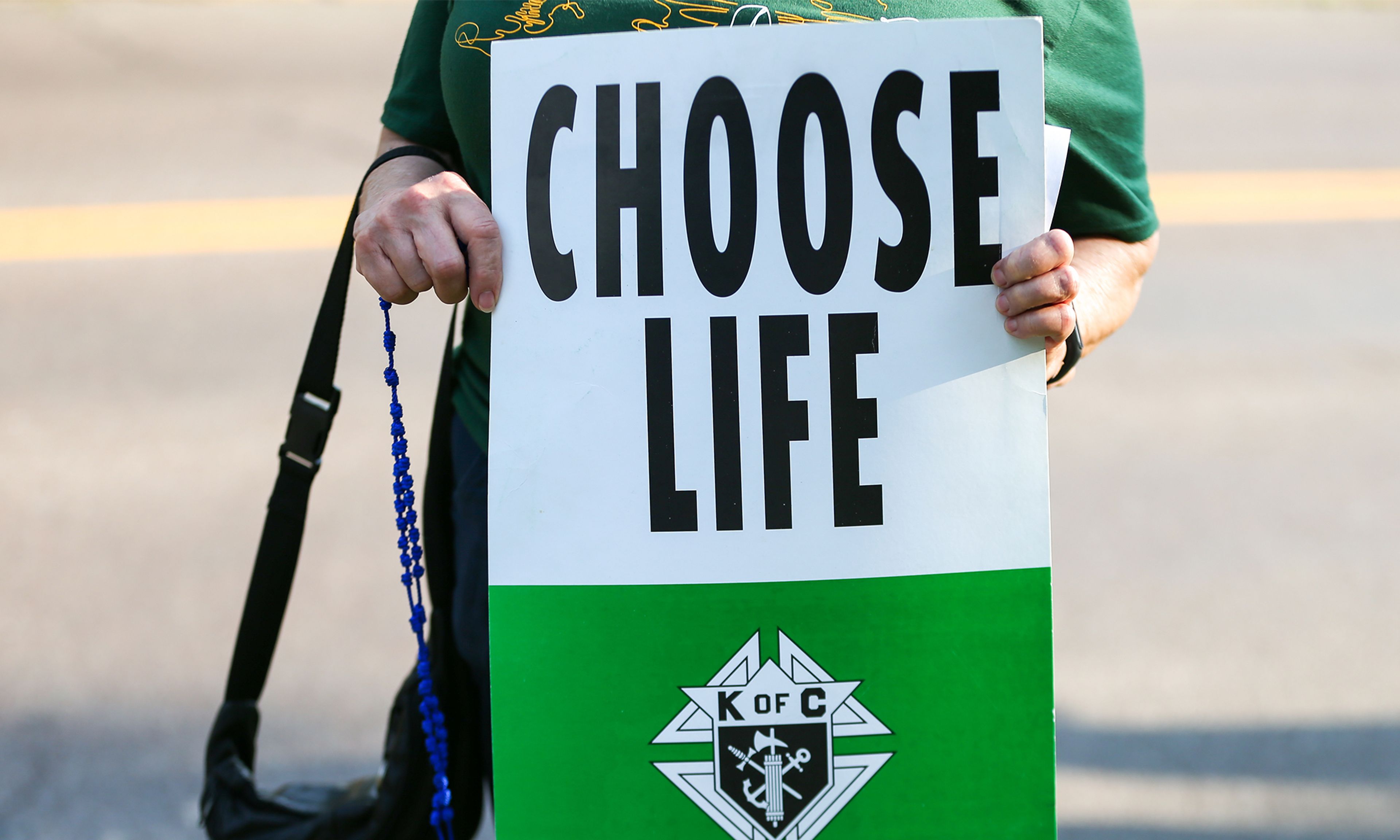
‘Good morning!” I said as an abortion activist addressed me by name one morning last fall. She was protesting the monthly Witness for Life prayer vigil across the street from the flagship Planned Parenthood in Manhattan, formerly named after PP’s founder, the eugenicist Margaret Sanger. “It is a good morning!” she replied. “No one is forcing me to give birth today!”
I’m pretty sure no one forced her to give birth the day before and no one did the day after. The abortion cause is largely fueled by anger and hurt and a dissociation from facts.
Then another of the protesters screamed: “Kathryn Jean Lopez, what are you going to blame on abortion today in the National Review?” And I smiled, even as they were forcing me into a corner so I couldn’t take photos of their efforts to obstruct sidewalk counseling outside the abortuary and to harass the people praying the Rosary across the street. They read us! I thought. Maybe they will be converts yet!
Conversions to the pro-life movement are powerful. Most famously, Bernard Nathanson went from founding the National Abortion Rights Action League and serving as director of the largest abortion clinic in the United States, which performed 60,000 abortions (5,000 of which he executed himself; he even ended the life of his own child), to being a leading pro-life activist, one who knew intimately what abortion is and does. More recently, Abby Johnson ran a Planned Parenthood clinic in Texas, only to have the good intentions that had brought her there collapse before her eyes as she was called in to help with an ultrasound-guided abortion. Once you see, you cannot look away, if you are open to the truth.
Tearing Us Apart: How Abortion Harms Everything and Solves Nothing, by Ryan T. Anderson and Alexandra DeSanctis, is going to lead to conversions. At least, that is my prayer. If someone you know is on the fence on abortion and is open to learning, give her a copy. If someone is pro-choice because he believes abortion is a necessary evil, do make sure he reads the book. Abortion, indeed, is a poison in our bloodstream that touches everything. And nothing will be better until we acknowledge as much.
The Supreme Court’s decision in the Mississippi abortion case this June finally liberates us to admit that Roe v. Wade was always bad law, bad history, bad science, bad for women — and not in the Constitution; the decision is a foundational step in the right direction. The timing of Tearing Us Apart could not be better. Abortion is as prevalent as it is in America — at least 62 million abortions were performed in the 49 years of Roe — because we have gotten used to it. Many of the people who supported Roe and its companion cases don’t know what they did — that they threw out laws that were already in place in some states that protected the unborn; that they insisted on legal abortion in all three trimesters of pregnancy. The lack of knowledge of these basic facts is a huge opportunity.
As Tearing Us Apart explains:
Abortion harms every single one of us by perpetuating deeply rooted falsehoods about what it means to be human. Abortion attacks the humanity and value of the child in the womb. Abortion strikes at the bond between mother and child, turning it into a conflict between adversaries and a justification for violence, a relationship not of love but of antagonism and mutual destruction. Abortion corrupts the relationships between man and woman and rejects the responsibilities that mothers and fathers have to their children and to one another. Abortion cuts at the fabric of marriage and of entire families, harming mothers, fathers, siblings, and grandparents.
Now is clearly the time to tell the truth about abortion. And Anderson and DeSanctis do — focusing on the harms to the unborn child, women and family, equality and choice, law, politics and the democratic process, and media and popular culture. They walk us through how abortion “distorts science and corrupts medicine.” It also “perverts what it means to live in a justly ordered political community with laws that protect us all — and in a society where our laws say that some human beings don’t deserve to live, we are all at risk.” It means we seek to eradicate those with disabilities. “It undermines solidarity with the poor, the weak, the marginalized, . . . and anyone on the periphery of life.” They quote Ruth Bader Ginsburg explaining that abortion allows people to reduce “populations that we don’t want to have too many of.” There’s that Margaret Sanger thinking, reiterated by an icon of our time. “Abortion,” the book makes clear, “is a disaster.”
Tearing Us Apart is in many ways a guidebook for where we find ourselves right now. It answers the question How do you talk about abortion in a country that has been deluded and lied to about what Roe has meant for women? “In a post-Roe United States,” Anderson and DeSanctis write, “pro-lifers will need to convince our neighbors that unborn children deserve protection under the law.” That requires “cultural power, the ability to speak the truth in the public square without being silenced.” It “will require fighting the side of corruption evident in so many of our cultural institutions, which have put their weight behind abortion, lying about what abortion is and spreading fear about what a world without abortion might look like.”
Anderson and DeSanctis quote from Frederica Mathewes-Green writing in National Review Online, in a 2016 piece that is as timely as it ever was:
The pro-life cause is perennially unpopular, and pro-lifers get used to being misrepresented and wrongly accused. There are only a limited number of people who are going to be brave enough to stand up on the side of an unpopular cause. But sometimes a cause is so urgent, is so dramatically clear, that it’s worth it. What cause could be more outrageous than violence — fatal violence — against the most helpless members of our human community? If that doesn’t move us, how hard are our hearts? If that doesn’t move us, what will ever move us?
Anderson could be a comfortable tenured professor at an Ivy League university. Instead, as president of the Ethics and Public Policy Center, he has chosen to be a clear, sober, rigorous, and compassionate voice on some of the most contentious issues of the day. He perseveres in telling the truth with love. I joke that the day Alexandra DeSanctis joined the staff of NR six years ago, I was able to retire from ever having to read Planned Parenthood annual reports. She has a seemingly insatiable drive to call out violent injustice against the unborn and women. There is no better duo to help encourage renewed leadership among those who consider themselves pro-life and, with reasoned argument, to reach those who don’t.
Tearing Us Apart may be a means for people of goodwill to find common ground in the face of the barbaric unnecessity of abortion in America. Don’t be distracted by the rare cases the media highlights. They are not the vast majority of abortions. Do we want to continue to kill babies as a form of backup birth control? That’s the question. Don’t we want to do better for our young people than that? Tearing Us Apart prompts the examination of conscience on abortion that we need and equips us to bear witness to the hope that is inherent in life when it is embraced as the gift that it is.
We all have our roles to play as we move forward in a nation where states are no longer subject to Roe’s toxic regime. Tearing Us Apart highlights solutions to the culture of death, including organizations such as Mary’s Shelter in Fredericksburg, Va. Its founders didn’t intend to open a maternity home when they first began to work with women in crisis pregnancies, but once you start approaching and listening to such women, how can you not work to meet their needs? It is crucial for pro-life people in this historic post-Roe era to ask big questions of themselves — especially those with financial means. (You can’t take it with you when your time on earth is ended, and you can save lives here and now.)
“We will need pro-life doctors and journalists, lawmakers and ultrasound technicians, lawyers and engineers, parents and preachers and priests,” Anderson and DeSanctis write. “Some of us might personally support a mother in need or welcome our own child in difficult circumstances.” Consider opening your home to a child in the foster-care system — especially a teenager. Countless couples who struggle with infertility will welcome an adopted baby. You don’t have to have that suffering to think about foster care and adoption, though. Now is the time to inundate the culture with radical hospitality.
Now is the time for Christians to show they hear the Sermon on the Mount and are compelled by God’s grace to live it. Many of us have prayed and worked for this post-Roe moment. Tearing Us Apart will help us with new urgency to make sure the alternatives to abortion are so widely known and well-resourced that abortion can become unthinkable to most pregnant women because they will be so embraced by love and support.
We’re a culture in need of healing. Tearing Us Apart shows us why and how.











Comments