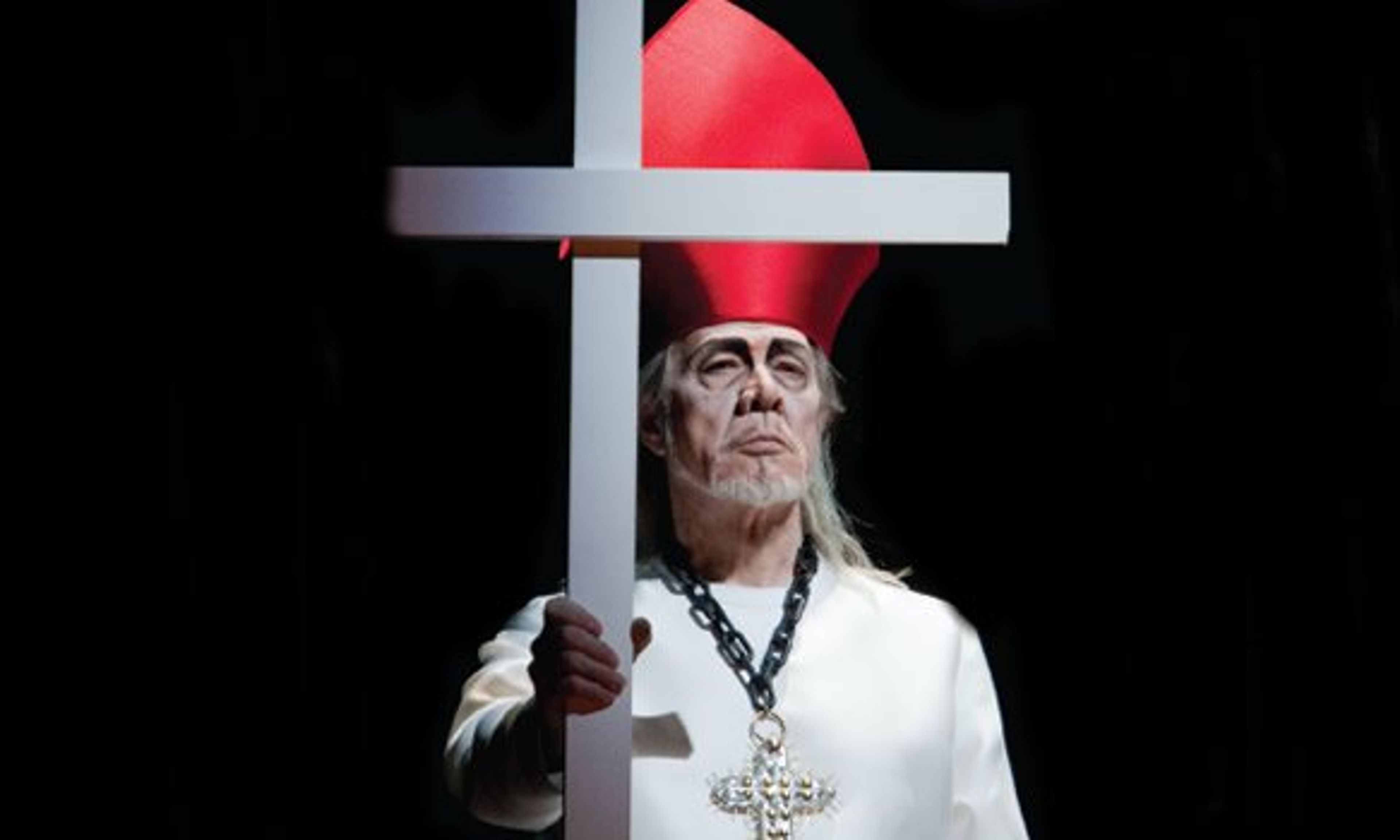
New York has offered some interesting musical evenings of late, as it usually does. In fact, that is one of its jobs. The Metropolitan Opera staged two little-known works by very well-known composers. Carnegie Hall had a concert featuring a new chamber piece by an amazing, iconoclastic Scotsman. Shall we go to the opera first?
For the first time, the Met staged The Nose, an opera by Shostakovich. The composer wrote it in 1928, when he was 22. His source is the short story by Gogol, written in the 1830s. A minor official, Kovalyov, wakes up one morning to find his nose missing. Then he encounters that nose all around town — St. Petersburg — before getting it back. This is the kind of story, and opera, known as “absurdist.”
The music is tart, brash, sarcastic, nuts — you perhaps know Shostakovich in that mood. There is some lyricism, some relief, in this score, but very little. What comes at you, unrelentingly, is musical talking — “sung speech,” to use a familiar phrase.
In my view, the opera soon becomes tedious and monotonous — and I say this as a deep admirer of the composer. Think of a joke or a point that goes on too long. “I got it, I got it,” you want to say. The Nose is one of the shortest operas in the repertory, at an hour and 45 minutes. To me, it felt as long as Les Troyens. And did Shostakovich intend this quirky, absurdist jaunt to be performed in a grand house such as the Met?
What cannot be faulted is the performance — not the one I caught, early in the show’s run. It was led by Valery Gergiev, the famed Russian conductor. He has introduced the West to a great variety of operas from his home country. Before the collapse of the Soviet Union, we got Tchaikovsky’s Eugene Onegin and Queen of Spades, and Mussorgsky’s Boris Godunov and maybe Khovanshchina — but not much else. Gergiev is the type to give you Tchaikovsky’s Mazeppa or Mussorgsky’s Fair at Sorochyntsi. Or The Nose. And he brought to Shostakovich’s opera the energy and smarts we expect from him.
In the leading role of Kovalyov was the baritone Paulo Szot, a Brazilian of Polish parentage. He is best known for what he has been doing next door to the Met, at the Lincoln Center Theater: singing Emile de Becque in South Pacific. In 2008, he won a Tony award for it. Of course, there is a long tradition of opera singers in this role, as those who remember Pinza and Tozzi will attest. Kovalyov is a starkly different role, and Szot measured up in that one, too.
Perhaps the star of the Met’s Nose is the production, fashioned by William Kentridge, a South African artist. It is busy and farcical, filled with video clips, cartoons, poster art, and other devices. The production matches the score and the libretto to a T — which should be the aim of a production, though that is a very old-school notion.
Soviet authorities did not care for The Nose, and they were critics with bite: After its unveiling, the opera was not staged again in the Soviet Union until 1974, a year before Shostakovich’s death. He wrote just one more opera, Lady Macbeth of the Mtsensk District (1932). That one almost cost him his life. It is hard for us, slurping our lattes, to imagine the pressures under which such as Shostakovich worked.
He was our last great composer — which is to say, our most recent composer to be great, our most recent composer to enter the pantheon. But he will not be our last, right? There will surely be another, and many others . . . right?
James MacMillan may not be a great composer, in the pantheonic sense, but he is unquestionably a composer worth knowing, and it was his String Quartet No. 3 that had a hearing in Carnegie Hall. Actually, that hearing was in Zankel Hall, which is the venue downstairs in the building known as “Carnegie Hall.” There is an upstairs venue too, the Weill Recital Hall. The space we ordinarily think of as “Carnegie Hall” is, technically, the Isaac Stern Auditorium. The very stage has a name, too: the Ronald O. Perelman Stage. Pretty soon, they’ll be naming each urinal. Whatever it takes to keep music afloat.
MacMillan — not to be confused with the late Canadian composer, Sir Ernest MacMillan — comes from Ayrshire. He was born in 1959. Probably his two most popular works are The Confession of Isobel Gowdie and Veni, Veni, Emmanuel. The former is an orchestral “requiem” for a Scotswoman burned as a witch in the 17th century; the latter is a percussion concerto (not many of those). MacMillan is a religious person, a Catholic, and many of his compositions have religious or spiritual themes. His second string quartet is called Why Is This Night Different? and concerns the Passover rite. Two years ago, he wrote a St. John passion, commissioned for the 80th birthday of Sir Colin Davis, the conductor.
This is a subject for another day, but it is simply true that many of the best composers now working are religious, writing religious music. I think, just for starters, of the Estonian Arvo Pärt.
MacMillan is what is known as “controversial” and “outspoken.” At the 1999 Edinburgh Festival, he gave a speech called “Scotland’s Shame” in which he said that anti-Catholic bigotry was rife in his country, and covered up by the media and the rest of the establishment. More recently, he issued a long, magnificent blast against the grip that dogmatic modernists — Pierre Boulez and his crowd — have long had on the world of composition. It was published in Standpoint magazine, the conservative journal in Britain edited by Daniel Johnson, son of the historian Paul.
MacMillan inveighed against secularists, Marxists, ideologues, anti-Americans, and other menaces and nuisances. Here is one sample statement: “The liberal elites who control the commanding heights of culture and criticism have an instinctive anxiety about religion.” Here is another one: “The modernist hierarchy is still so powerful in places such as German radio stations and German and French New Music festivals that it acts like a politburo.” MacMillan’s essay was a plea for open-mindedness, tolerance, and genuine art.
I know from experience that many composers and other musicians whisper opinions such as MacMillan’s in the shadows. For a guy to shout them for all the world to hear is wonderfully shocking. MacMillan has given heart to many who are more circumspect.
Fortunately for those who admire his views and outspokenness, MacMillan is a good composer, too. Consider his String Quartet No. 3. (It carries no title, unlike the second one.) The work is in three movements, and these have unusual markings: “Molto rubato,” “Largo,” and “Patiently and painfully slow.” The music is spare, searching, intense. An agitation is ongoing, occasionally relieved by some whimsy: for example, a take on a Viennese waltz. MacMillan has his players do some strange things, such as tap on their instruments (making these players percussionists, temporarily). A lot of composers go in for tapping and the like. These moves usually sound like gimmicks; not in this quartet, however.
There is a huge amount of passion — anger, outstandingly — packed into the work. The composer grabs your attention at the outset, and holds it. Along the way, he may well unnerve you. At the end, the music dissolves spookily into nothingness.
We hear in this quartet a composer who obviously takes his craft very seriously — a disciple of music, you might say — and who has important ideas to express. You can tell real music from the fake sort, the contrived sort: This belongs to the real. I give MacMillan’s quartet practically my highest accolade for a new work: I’d like to hear it again.
It was well played by the Takács Quartet, but they insisted on giving a lecture about the piece before they performed it. This will deflate the atmosphere in a hurry. Talking, lecturing, from the stage is epidemic in the music world. Performers and administrators seem to think that new music in particular needs special pleading and hand holding. When will composers rise up against this? When will audiences?
Return now to the Met — no lecturing! — and the other little-known work by a great composer: Attila by Verdi. The Met had never staged this one, either. Verdi composed Attila in 1846, when he was 32. In Verdi’s operatic catalogue, this work comes just after Alzira (even more of a rarity than Attila) and just before Macbeth (a hit). Verdi, lucky guy, would be given many more years — he lived to 87 — and go on to write such ditties as Otello.
Attila may be early Verdi, with a foot in the old bel canto world, but it is very much Verdian: Most of the composer’s stylistic traits are in place. The story involves Attila’s invasion of Italy in the 5th century. We see a kinder, gentler Hun: Attila is the Scourge of God, sure, but he is a fairly reasonable scourge. And he is dangerously clement toward his enemies. I dare say that Attila and his barbarians come off as more sympathetic than the Italians, who should be the victims.
Making his Met debut along with the opera was the conductor in the pit, Riccardo Muti. The Italian Stallion is almost 70 now; this was a late debut. When he was a relative kid (colt?), presiding over the Philadelphia Orchestra, one criticism of him was, “He makes everything sound like Verdi.” There is no gainsaying his Verdi: He has long been a superb champion of this composer, and his conducting of Attila was masterly in every respect.
The title role was taken by the Russian bass Ildar Abdrazakov, who is always an imposing presence, certainly in the physical sense. He is married to Olga Borodina, the mezzo-soprano who is one of the greatest singers of our time. Abdrazakov is all right himself. There have been more potent Attilas, vocally — Samuel Ramey, for example — but Abdrazakov conveyed the necessary. His love interest was Violeta Urmana, the Lithuanian soprano who used to be a mezzo: Sometimes they make the switch upward. The night I attended, she was suffering from a cold, but she still acquitted herself well. She has the kind of technique that can be relied on. I recall something Marilyn Horne once told students in a master class: “If you get your technique, the world’s your oyster.”
Scheduled for the role of Foresto, an Italian knight, was Ramón Vargas, the well-known Mexican tenor. Indisposed, he was replaced by Russell Thomas, a young American. I first heard him several seasons ago as the First Prisoner in Fidelio. The prisoner has just a few lines, but they are sublime ones, and Thomas made the most of them, using what I called a “melting trumpet.” He was impressive as Foresto, too: not endowed with true Verdian heft, but lyrical, ringing, and pleasing.
The Attila of old, Ramey, made an appearance as Leone, the Roman bishop (otherwise known as Pope Leo the Great). The kid from Colby, Kansas, is just one year younger than his friend Muti: but he can still sing with tremendous authority. The voice may have gone wobbly, but the thinking and the overall artistry stay true.
And the production? The Met engaged Pierre Audi, the Beirut-born director who has been with the Netherlands Opera for more than two decades. I will yield the floor to my fellow critic Sam Ramey — who, amazingly, posted a comment on a website:
It is unfortunate that for the Met’s first production of Attila they could not do a more “conventional” production. The sets and the costumes had nothing to do with the period of the opera or the characters. I know from having been at rehearsals that the director gave the singers nothing and the set prevented them from doing anything dramatically. The production is a fiasco!
That’s tellin’ ’em. I am softer on the production than Ramey is, seeing some merit in the “fiasco,” but his denunciation is more than valid. Very rare is the singer who will speak out against a production. They grouse in private, constantly (believe me) — but they do not risk professional repercussions. They grin and bear idiocy after idiocy. A famous bass at the end of his career is a free man indeed.
Here is a question: If Attila were not by a great composer, would we see and hear it? I think the answer is yes, definitely. Attila may not be Otello, Traviata, or Falstaff, but it is a substantial and compelling work. How about The Nose? Would we see and hear that? Probably, although the question is debatable. As for MacMillan, may he have at least as many years as Verdi and compose bravely and well.












Comments