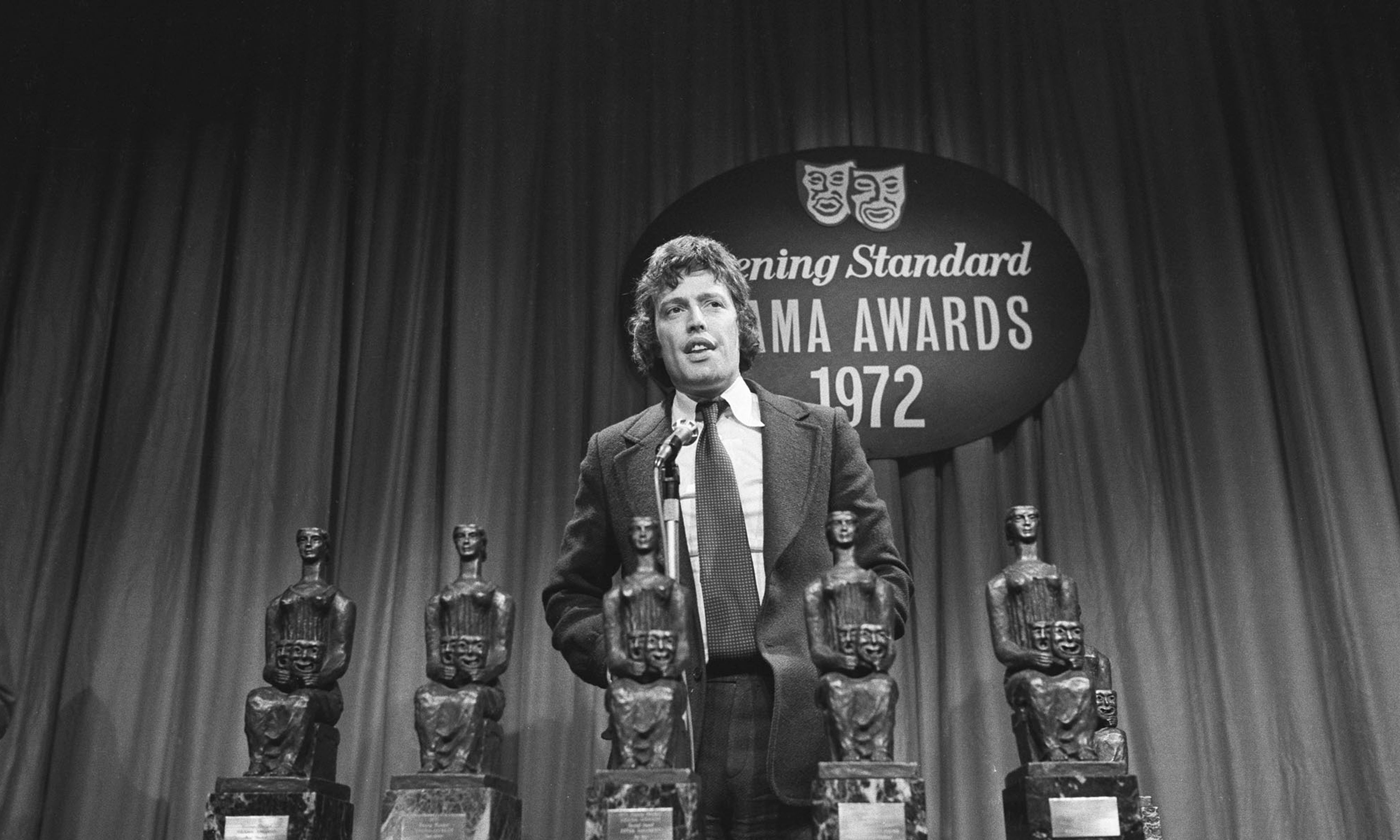
Tom Stoppard is often, justly, called the greatest living English-language playwright. Now Sir Tom, OM, CBE, FRSL, he’s been famous since 1967, when Rosencrantz and Guildenstern Are Dead premiered at London’s Old Vic — making him, at 29, the youngest person ever to have a play performed by the Royal National Theatre.
Though not without critics, he has won every major writing award for the stage, the screen, and radio. His work has dramatized questions of philosophy (the nature of identity, morality, history, consciousness, art) and politics (revolution, freedom of the press, Soviet and Nazi persecutions) within love stories, shaggy-dog stories, thrillers, parody, and farce (and combinations thereof). He writes, he says, two kinds of plays — comedies and serious plays with jokes — and is dismayed when they are called “difficult,” because he believes that the writing of plays is a practical art: One’s first obligation is to keep the audience from decamping at intermission. But his contract with the audience runs both ways. The audience must collaborate — as one must, for example, in order to get a joke. We enjoy a joke not by having the connections among its incongruous elements explained but by supplying those connections ourselves. He told the cast of Coast of Utopia that, while his characters think fast, “we mustn’t deny audiences the compliment, indeed the satisfaction, of having to keep up.”
Hermione Lee’s intelligent and gracefully written biography presents Stoppard as, it will be no surprise to learn, a complicated man. She asked those she interviewed to sum him up with three words, and the most common by far were “loyal,” “kind,” “considerate,” “glamorous,” and “intelligent”; no one said “cruel,” “proud,” “selfish,” or “inattentive.” But “solitary” and “private” were also common and, on things that matter to him, “a core of steel.” Some who have known Stoppard for many years claim to be unsure whether they really know him at all. An old friend of his told her, “Beware of the charm.”
Stoppard himself likes to say that he is “good at performing niceness” but is “not as nice as people think.” Yet it seems unlikely that mere performance would have sustained so many long-term friendships with so remarkably wide a range of people, both famous and obscure, e.g.: the pugnaciously right-wing historian Paul Johnson; the pugnaciously left-wing playwright Harold Pinter; Val Lorraine, a former landlady with whom he kept in touch for nearly 50 years, until her death; his glamorous exes.
Stoppard has often questioned the very idea of biography. It is, says a character in The Invention of Love, “the mesh through which our real life escapes.” In Arcadia an unscrupulous academic jury-rigs half-glimpsed fragments of history into a tall tale about the life of Byron. Memory is hardly a guarantor of truth. The memory play Travesties takes place, Stoppard says, in the mind of “a fantasizing amnesiac.” In interviews and speeches Stoppard has said that biographical fictions can illuminate truths better than bare facts can.
He once told a journalist that he wanted any biography of him to be “as inaccurate as possible.” Stoppard nonetheless asked Lee, a celebrated author of literary biographies, to take him on. He has been, she says, “patient, accessible, and generous. . . . But his line to me is: ‘I’m not supposed to be helping you. You’re on your own.’”
The outlines of Stoppard’s life are by now well known. In 1937 he was born Tomáš Straussler in Zlín, Czechoslovakia. His family fled to Singapore from the Nazis and then to India from the Japanese invasion (which killed his father). He was educated until age eight at American schools in India and became Tom Stoppard, and an English schoolboy, when his mother married a British soldier. He left school at 17 and was a provincial journalist before the breakout success of Rosencrantz and Guildenstern. In 1999 he published “On Turning Out to Be Jewish,” having learned family history that his mother had not wished to reveal — that all his grandparents were Jewish, that they and three of his mother’s five siblings had died either in Auschwitz or in the Riga ghetto.
We read the life of an artist not only for the gossip — telling ourselves, if needing an excuse, that it’s Higher Gossip — but because the art matters and the life may shed light on it. It is conventional to partition Stoppard’s career into phases (subjected, by his detractors, to conventional criticisms): his debut as a young, dandyish “university wit” (frivolous, coldhearted, show-off); a turn toward political engagement (reactionary, anti-Soviet tendencies); and another turn, in middle age, to writing more directly from the heart (though subjects like middle-class infidelity seemed rather bourgeois). But Lee makes clear a fundamental unity in Stoppard’s work: It shows a steadfast concern with the integrity of language and the morality of its use and misuse, and, while not autobiographical, it is personal — often deeply so.
The personal elements tend to be buried. His second big success, Jumpers, is a three-ring circus combining farce, acrobatics, and a murder mystery with high-flown philosophical comedy about the nature of the Good and the existence of God. The central character is a philosopher struggling to show that the difference between right and wrong is not a social convention but a metaphysical fact. That his wife is coming apart at the seams is something to which he, an otherwise sympathetic character, seems oblivious. Beneath the exuberant comedy, says Lee, the play “carries the sadness, and the guilt, of living in a malfunctioning marriage with a wife who is having a breakdown.” Lee describes a painful scene toward the end of Stoppard’s first marriage: The woman who would become his second wife dresses down a penitent Stoppard for dutifully attending to the demands of children, housekeeping, and career but not the downward spiral of his first wife from depression and drink. Jumpers opened two days after the divorce.
Perhaps the biographical fact most important to Stoppard’s art is that he might easily have lived a very different life. He has no memory of speaking a language other than English and grew up with no special feeling for the country of his birth: “I was proud to be British before I was British.” But it was purest chance that washed him ashore in England. What if his family had returned to Czechoslovakia after the war? Would he have found his vocation as a playwright? Had he become a writer, how would he have behaved under the Soviet-imposed dictatorship? Could he have shown the courage of Václav Havel, the great Czech playwright who later became his friend?
Stoppard’s awareness of this life-that-might-have-been appears in different guises throughout his work. One is a recurring theme of dividedness and double lives. Rosencrantz and Guildenstern are two halves of a single character, though they are not quite certain which half is which. A. E. Housman, the central figure in The Invention of Love, leads separate lives as a poet and as a scholar; he also has two lives as a gay man, one of them wholly unrealized because permanently suspended by an unrequited love. And he becomes divided in time, holding conversations in the afterlife with his younger self. Rock ’n’ Roll centers on a Czech exile who does return.
This might-have-been is at the root of Stoppard’s small-“c” conservatism, which originates in a sense of gratitude. He is grateful for his lucky life, for the freedoms he has enjoyed, and for being, Lee says, “an outsider who finds himself accepted as being inside.”
Amnesty International asked Stoppard to write a TV play for a “Prisoners of Conscience Year” planned for 1977. He had been shocked by Victor Fainberg’s horrifying account of his years in a Soviet psychiatric prison — his “mental illness” being a protest against the Soviet Union’s 1968 invasion of Czechoslovakia. Stoppard was able to meet Fainberg and his wife, Marina, in exile. He visited the Soviet Union and met Marina’s son (the same age as one of Stoppard’s), whom the regime was holding as a pawn, and took risks to smuggle out messages from dissidents. Two proximate results: a TV play, Professional Foul, about a well-meaning English academic who goes to a conference in Prague and is forced to recognize what a dictatorship does to ordinary people, and Every Good Boy Deserves Favour, a darkly comic stage play set in a psychiatric prison. He became active in support of Soviet and Czech dissidents and continues to speak and write in behalf of personal and artistic freedoms in tyrannized societies, lately in defense of the Belarus Free Theatre.
To his grateful and romantic attachment to England was thus added an explicitly political corollary: The “Free West” was, in a profound way, morally superior to the Soviet empire. Western governments were, he wrote, “all too often disfigured by corruption and injustice, but the abuses represented, and were acknowledged to represent, a failure of the model. In the East, though, the abuses represented the model in full working order.” This belief put him at odds with the monocultural leftism of the British theater world. In some circles, Lee writes, “the animosity against him was vituperative.”
Lee does have one unsettling tic: a preemptive cringe from anything that might tickle the antennae of the PC police. Stoppard’s movie reviews as a young journalist contained “breeziness about women on screen” that was, she primly notes, “very much of its time,” such as “blithe references to curvaceous starlets” (her words) or admitting boredom with Brigitte Bardot in (his words) “all her mammalian glory.” He once paid the bills by writing TV episodes for the Arabic Service of the BBC, to be translated from English into Arabic. The series was a fish-out-of-water story about a Jordanian medical student in London. To his friends, Stoppard called it “Ali in Wonderland,” another joke scolded for being “very much of its time.”
At age 83, Stoppard naturally thinks about his legacy. Unlike a novel, which is available to anyone who can read, a play fully exists only when being performed. It is, he likes to say, an event, not a text. He does hope that some of his plays will continue to be produced. The latest in this extraordinary body of work, its London production now suspended by the pandemic, is Leopoldstadt, which won the 2020 Olivier Award for Best New Play. It’s his most nearly autobiographical — about the effect of the Anschluss and its aftermath on three generations of a family of Viennese Jews. There’s a smallish role for a somewhat callow young man who washed ashore in England as a child and is later brought face to face with the story of the family he never knew.
Lee concludes by saying that she has, of course, written a life, not the life, of Stoppard, but it’s as nearly definitive as we’re likely to get. In his well-researched 2002 biography, Ira Nadel paints a picture not dramatically different from Lee’s, but he lacked her access to Stoppard’s letters and journals, and to Stoppard himself. I offer her book the best compliment I can think of: When I finished it, I took Stoppard’s plays from my shelves and reread the lot.












Comments