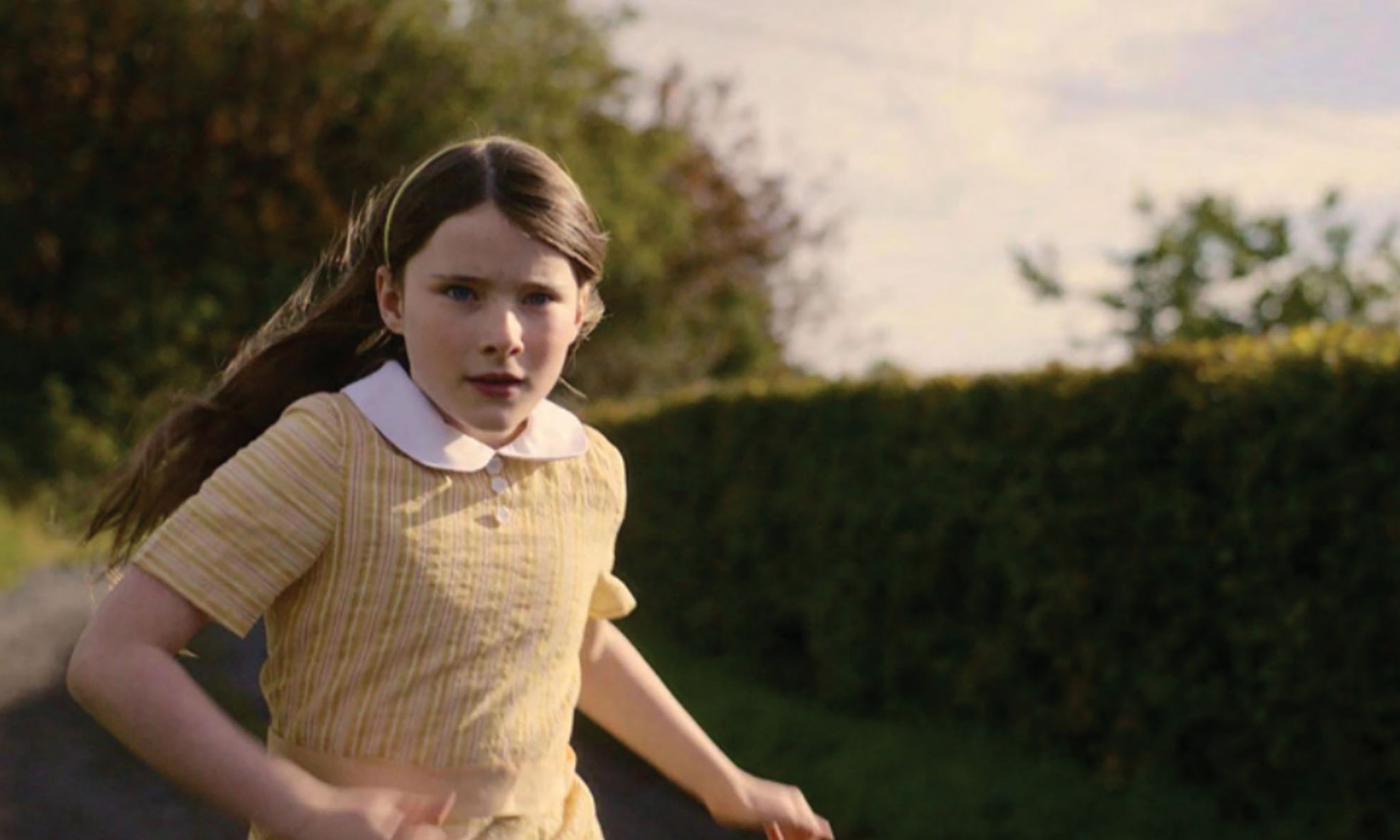
Knowing little about the movie The Quiet Girl except its title and its Irish setting, you might be inclined to imagine it as a long-delayed sequel to or spin-off of John Ford’s Gaelic-fisticuffs epic The Quiet Man — one in which the granddaughter of John Wayne’s Irish-American boxer returns to rural Ireland to face down, I dunno, somebody. To be followed, presumably, by Son of the Quiet Man, Quiet Man 2: The Shushing, and Quiet Man: Donegal Drift, in the ever-expanding Gaelic extended universe.
This flight of fancy isn’t completely detached from reality. It’s not an extended universe in the Marvel Studios sense of the term, but there is a reliable genre of Extremely Irish movies that runs down from Ford’s era to the present, and most of them have a little bit of The Quiet Man in their DNA, whether they’re wallowing in blarney or self-consciously refusing to have anything to do wi’ it — sorry, with it.
Each of the last two Oscar seasons featured examples of the genre among their Best Picture nominees. In 2022 it was Kenneth Branagh’s Belfast, its scenes of tight-knit Irish neighborhoods heavy with nostalgia, notwithstanding the shadow of the Troubles. This year it was Martin McDonagh’s The Banshees of Inisherin, a movie so determined to bury the sentimental interpretation of rural Ireland that it ended up offering a kind of grimdark blarney of its own.
The Quiet Girl was also represented at the Oscars this year, but in the category of Best International Feature Film, because it has the distinction of being filmed in Irish Gaelic (with a bit of English woven in). The list of movies made in that language is extremely short, and this one exists only because of a recent initiative to fund and promote Gaelic cinema — a project more than justified by this production, which in a slight story and brief running time manages to encompass the various themes of the Extremely Irish genre with unusual subtlety and grace.
The plot comes from a celebrated 2010 short story called “Foster,” by the novelist Claire Keegan. Here Keegan’s nameless narrator becomes an Irish girl named Cáit, played by the first-time actress Catherine Clinch with a watchful intensity. Cáit leads a neglected life as one of the older children in a beleaguered rural family — with a drunk for a father, a harassed and unhappy mother, a miserable, bedwetting, and keep-out-of-sight existence for herself.
Then her mother’s latest pregnancy changes her fate: Cáit is sent away for the summer, down to a different kind of rural landscape, the coast of County Wexford, where her Aunt Eibhlín and Uncle Seán (Carrie Crowley and Andrew Bennett) keep a dairy farm. The familiar plot of the child exiled unwillingly to some cruel or difficult relation is here reversed: The new home is well tended, peaceful, stable, everything that Cáit’s own home is not. Eibhlín is kind from the start, physically generous in the way she washes and cleans and cooks. Seán is distant and harder to read, keeping his own counsel while he works and watches television. But his own kindness slowly blossoms — and so does Cáit, her taut pre-adult anxiety giving way to the genuine freedom of youth, inside the home and outside in the countryside.
There is a secret to be uncovered in the aunt and uncle’s past, tragic but not particularly surprising, easily guessed by the moviegoer but hidden for a time from Cáit. But mostly the movie moves the way an ideal childhood summer does, free from the demands of plot and time alike. The camera’s eye is like a child’s gaze, fastening on objects, movements, well water, a tree-lined lane, the sea.
And the story sketches lightly all the different elements of Irishness that in a different movie would be layered on thickly, or overemphasized at another element’s expense. So here, in a few scenes, are the darker things, the stuff of the long-running elite rebellion against rural Catholic Ireland: the scourge of alcohol, the large family trapped in squalor, the gossip and the small-island claustrophobia.
But there, in the better life that Cáit discovers, are the good things, the stuff of Irish life that’s justifiably romanticized: the cheer of neighborly fellowship, the purity and simplicity of a certain kind of agrarian existence, the beauty of the green isle in sunlight and in shadow, the music of the accent turned into the music of an entire tongue.
It’s a duality that holds to the very end, an ambiguous final line and shot. Which Ireland? Which family? Which father? Which fate?












Comments