I was at my desk, in the middle of explaining for you, dear reader, the real danger posed by the nexus between political violence and lawfare’s corruption of our legal system. Celebrating the Supreme Court’s recent concrete steps to curb, though not extinguish, the banana-republic practice of deploying a governing regime’s prosecutorial powers against political rivals and other dissidents, I turned to the ever-pressing question, What is to be done?
Then Donald Trump was nearly murdered, coming within centimeters of losing his life when a would-be assassin fired shots at him as he was speaking at a rally. In strafing the podium, the shooter killed Corey Comperatore, who was attending the event, as he shielded his daughter from gunfire, and wounded two other Trump supporters.
That doesn’t turn this rumination on lawfare into a just-so story. As I write, it is too early to tell what motivated the shooter, who was killed by responsive fire from security officials.
Still, that he was motivated to slaughter not only Trump but any Trump supporters who got in the way seems beyond doubt. Besides spraying bullets at the Republican candidate and his enthusiastic crowd, the assassin reportedly had explosives in the car he’d parked near the rally location and in his home.
Lawfare is the noxious practice by which the incumbent government exploits its prosecutorial power to brand its political opponents not merely as misguided or cynical partisans but as dangerous criminals who pose an existential threat to the body politic. Though not as obviously so, violence is as foreseeable a consequence of lawfare as it is of the rabid rhetoric declaimed by terrorists from their pulpits, and echoed by their sympathizers, in order to dehumanize their targets.
In a stable republic, where it is expected that policy disputes, even deeply divisive ones, will be resolved peacefully through democratic processes, we can argue passionately without losing sight of the greater things that unite us as a people. In unstable societies, the ruling faction’s exploitation of police power against its rivals is meant to intimidate and abominate them, to portray them as a treasonous threat to the nation. And the rulers’ inevitably two-tiered justice system can catalyze forcible attacks because it also turns a blind eye to friendlies who advance favored causes or smite perceived enemies. Not every lawfare prosecution will breed violent attacks, but a society that normalizes lawfare — that makes a mockery of the rule of law and equal protection under it — consigns itself to the omnipresent threat of violence and the occasional assassination of regime adversaries.
America is not a lawfare society. There is yet time to reverse an alarming drift in that direction. If we’re going to do that, however, it’s important to understand how we got here.
It is trendy to speak of cycles of lawfare, as if it were a tit-for-tat phenomenon. It cannot be gainsaid, moreover, that Donald Trump has promised, if elected, to be the “retribution” president after running a gauntlet in which Democratic prosecutors and activist left-wing lawyers sued him civilly — to the point, in the case brought by New York attorney general Letitia James, of trying to destroy his business empire — and indicted him four times, with more than enough statutory penal exposure to land the 78-year-old former president in prison for the rest of his life. Nevertheless, Trump was not the retribution president his first time around. This is probably best explained by the presence of strong advisers, such as Bill Barr, Trump’s second attorney general, who vigorously opposed two-tiered justice. Yet, despite his occasional mercurial demand for the indictments of former FBI director James Comey and members of the Biden clan — rants that Barr wisely ignored — Trump’s more considered position was to eschew a prosecution of Hillary Clinton over the emails scandal, even as Clinton was driving the Trump–Russia “collusion” smear.
In the United States, lawfare is predominantly the practice of progressive Democrats. That is not an accident. Nor is it furtively done; to the contrary, progressive prosecutors tend to be unabashed in this pursuit.
By and large, the states feature elective legal systems. Voters elect attorneys general, district attorneys, and even many judges and county sheriffs. It’s a marked contrast with the federal system, in which top prosecutors and judges are appointed by the president and must be confirmed by the Senate. It is thus still common for federal appointees, even when Democrats are in power, to commit publicly to nonpartisan enforcement of the laws.
That turns out to be the tribute vice pays to virtue: The Biden Justice Department has prosecuted Trump and his allies, and it has scorched the earth to arrest not only lawbreakers but mere loiterers implicated in the Capitol riot (even as it largely ignored “racial justice” and pro-Hamas rioters) in service of the partisan narrative that these people are white-supremacist domestic terrorists who pose a mortal threat to the nation. It has used that same slander pretextually to investigate Trumpy Republicans along with nonviolent pro-life activists, religious conservatives, and parents who dared object to woke indoctrination in the schools. The Obama Justice Department, whose veterans now staff the Biden DOJ’s upper echelon, blazed much of this trail — demagoguing racially fraught police incidents, attempting to manufacture gun crimes (recall the Fast and Furious scandal), and helping the Internal Revenue Service tough out congressional probes of its harassment of conservative political groups opposed to Obama’s 2012 reelection campaign.
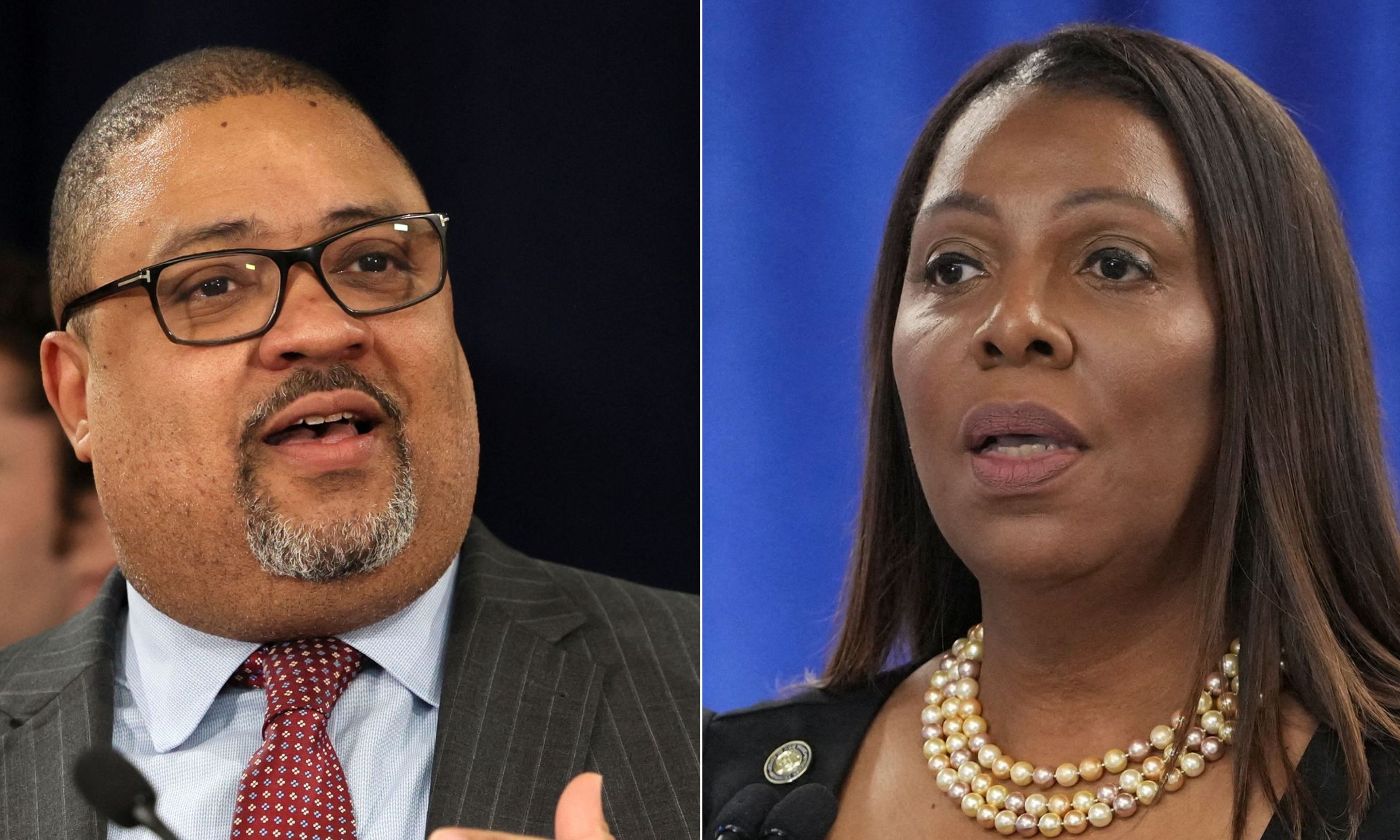
Still, with Congress watching, the Justice Department grasps that it must deny, however risibly, that it practices lawfare. In blue cities and states, by contrast, candidates for law-enforcement posts now commonly vow that, if elected, they will use the powers of their offices to harass political opponents, debilitate police, and pursue the Left’s ideological pieties. When running for office, Letitia James promised New Yorkers that she would use the AG’s authority to enforce civil law to make Trump’s existence a living hell; in his campaign, Manhattan district attorney Alvin Bragg signaled that Trump would similarly face criminal prosecution. Such radical commitments would have been seen as disqualifying just 15 years ago. Today, progressive prosecutors like James and Bragg are comfortably elected — and when they achieve power, they deliver on their promises.
On lawfare, conservatives and progressives are ships passing in the night. On the right, commentators cry foul as progressive prosecutors make “social justice” rather than equal justice their compass. In essence, progressive prosecutors and their apologists respond, “Damn right we do!”
We need to comprehend this. Over the past half century, the law schools, like undergraduate colleges, have inculcated in students the conceit that the law is a tool for achieving “progress” — it is no longer seen as the vital undergirding of a free and prosperous society. The schools produce culture warriors who regard lawfare as a key part of the “hope and change” arsenal. Conservatives speak as if this were a clandestine project, but progressives wear lawfare like a badge of honor.
Fighting back against lawfare — fighting on behalf of our constitutional commitment to due process and evenhanded law enforcement — is thus a cultural challenge at least as much as a legal one. But there is cause for optimism, if only a glimmer, on the legal front.
There is much to debate regarding the Supreme Court’s ruling that Trump, as a former president, has presumptive immunity for all “official” acts (and absolute immunity for “core” executive acts). Given that presidential immunity is not explicit in the Constitution’s text, the derivation of it from separation-of-powers principles opens the Court to accusations of activism, or at least of providing too wide a berth for abuses of power. To my mind, these criticisms are overwrought, but that’s an argument for another day. For present purposes, the significant development is the majority justices’ conclusion that motive is not a basis for bringing criminal charges against presidents — or, presumably, other government officials — who take actions that are within the ambit of their legitimate constitutional or statutory authority.
Such motive-based prosecutions are not the entirety of lawfare, but they account for a high percentage of it. Of course, if officials commit crimes that are unrelated to their governmental duties, those are private wrongs for which there is no credible immunity claim. If they abuse their power, they are still subject to impeachment and, if they are lesser officials, to other forms of administrative discipline. To be immune from criminal prosecution is not to be unaccountable or above the law. Still, many a lawfare prosecution involves imputing corrupt motives, fairly or unfairly, to ostensibly legitimate exercises of government power simply because the new administration objects to the policy or the policy-maker involved. To nullify post hoc critiques of political motive as grist for prosecution strikes a real blow against lawfare.
It is not, however, a decisive blow. The most egregious aspect of lawfare is the exploitation of legal process as a penalty: prosecutions in which the result is less important to the state than are the punitive and in terrorem effects of putting political enemies through the wringer — with all the stigma, anxiety, and expense that that implies. There is no indication that this type of lawfare is on the wane.
It won’t be unless and until there is a serious political price to be paid for such malfeasance. Again, the challenge is more a cultural than a legal one.












Comments