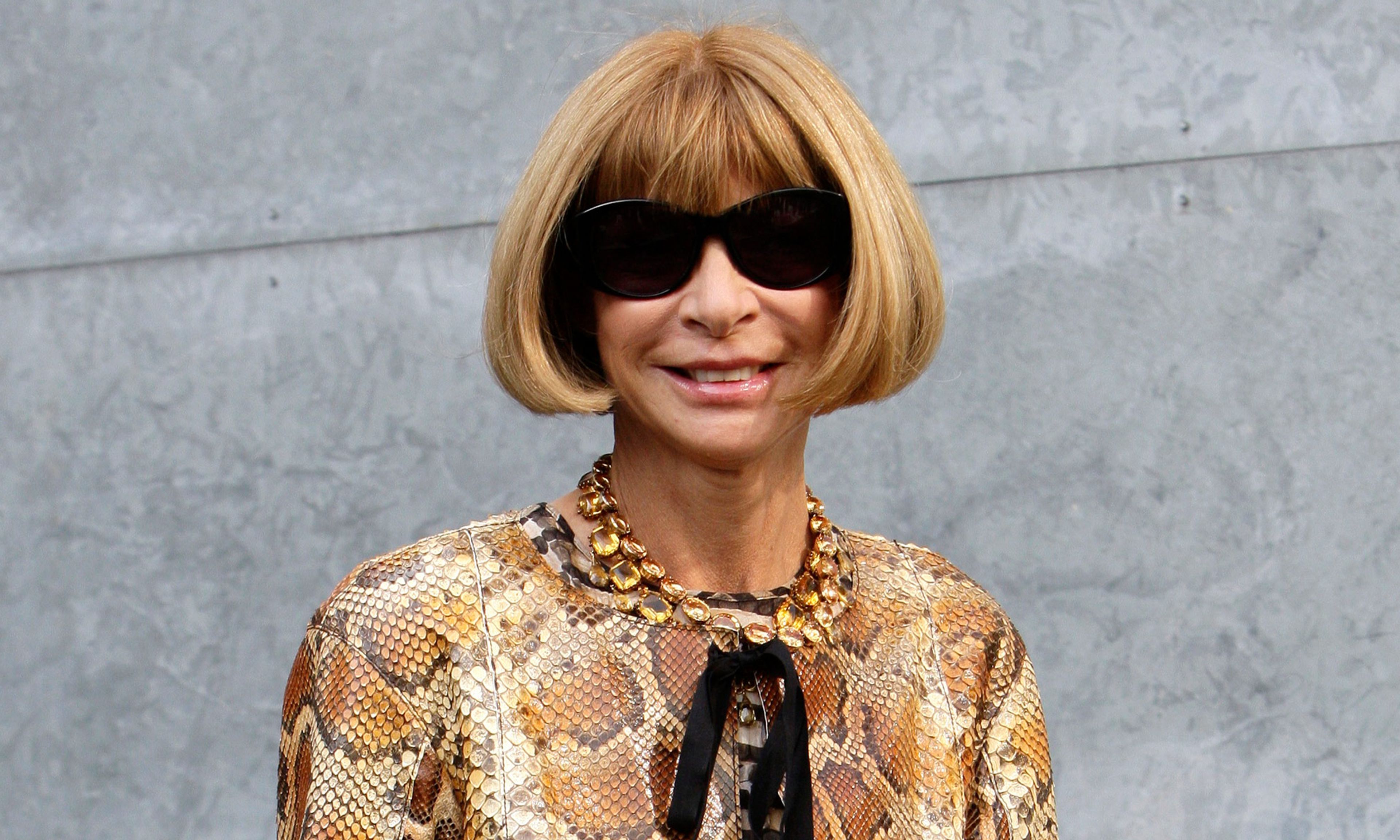
Two movies about Anna Wintour and Vogue have graced theaters in the last four years. First there was The Devil Wears Prada, based on a roman à clef by a former Voguette, in which Wintour was thinly disguised as Miranda Priestly, editrix of the fictional Runway, and played by Meryl Streep. Now there is The September Issue, R. J. Cutler’s documentary about the production of Vogue’s thickest issue ever — from September 2007, the last gilded autumn before the 2008 crash. And this time, Wintour gets the chance to play herself.
It’s fascinating to compare the two performances. Streep’s version of Wintour was an entirely secure character in an insecure film. Her Miranda Priestly was serene, imperious, and untroubled by any doubts about the ultimate value of her life’s work. But the movie she inhabited couldn’t decide whether it agreed with her. One moment, The Devil Wears Prada was celebrating the cultural and artistic significance of a magazine like Runway/Vogue; the next, it was deploring fashion’s decadence, superficiality, and pointlessness. The narrative set out to prick the pretensions of its aspiring-journalist heroine, played by Anne Hathaway, who thought of herself as too intellectually and morally serious to work for a fashion magazine. But its conclusion, in which the heroine fled back into the supposedly more high-minded world of newspapers, suggested that she had been right to look down on fashion all along.
The September Issue, by contrast, is a straightforward valentine to Vogue and the larger fashion world that Wintour’s magazine bestrides. There’s no moralizing about ephemerality and superficiality in Cutler’s documentary, and no suggestion that any of its characters would be better off enrolling in the Columbia School of Journalism. But the rail-thin Empress of Fashion at the center of the story seems oddly insecure about the importance of her work.
Not when she’s in action, of course — gliding through the halls of Condé Nast or the salons of European capitals and tersely dismissing outfits, photo spreads, hairstyles, and anything else that doesn’t measure up to her exacting standards. Whether she’s dampening a subordinate’s enthusiasms or raising an eyebrow at a hapless designer, Wintour-the-editor is exactly as advertised: icy, inscrutable, and entirely self-assured.
But facing the camera, shorn of her famous sunglasses, she becomes unexpectedly defensive. Instead of ignoring her industry’s critics, she spends the movie’s opening frames trying to explain why people feel the need to make fun of fashion. (“Because it scares them or makes them nervous, they put it down.”) It’s a startling moment: Imagine if John Madden, interviewed for a football documentary, felt the need to begin by defending his sport against people who think that it’s just a pointless scrum for musclebound freaks.
There’s a similar sense of insecurity visible in the way that Wintour talks about her siblings, a collection of reasonably impressive British do-gooders whose approval she seems to crave, and lack. (“I think they’re very amused by what I do,” she ruefully remarks.) Even her daughter doesn’t give Wintour any respect: Asked if she wants to follow in her mother’s footsteps, the ungrateful child dismisses the business as “a really weird industry” and complains that Vogue editors “act like fashion is life.” (She’s considering law school, naturally.) Faced with such philistinism, Streep’s Miranda Priestly would have delivered a ten-minute lecture on the cultural significance of couture. But her mother only sighs and murmurs, “Well, it’s early days.”
It shouldn’t be a surprise, perhaps, that a woman famous for traumatizing her employees, crushing her rivals, and hiding her bird-of-prey good looks behind enormous sunglasses would have a few insecurities about the whole “being Anna Wintour” business. But The September Issue suggests, albeit obliquely, that Wintour’s insecurities about her line of work have less to do with the fashion world itself than with her place in it.
The heart of the documentary, in this sense, is the contrast between the chilly, sphinx-like editor and her passionate, earthy creative director, Grace Coddington, a former model turned wild-haired composer of gorgeous photo shoots.
Both women are British, both are just past menopause, and both are geniuses. But Coddington’s genius is artistic, whereas Wintour’s is critical and curatorial. Coddington produces reel upon reel of stunning, arresting, glowing images. Wintour culls them, edits them, and decides — often to her creative director’s despair — which to use and which to drop. Coddington pines after the perfect image; Wintour aims, with clinical precision, at the perfect layout for a mega-selling magazine. And the audience’s sympathies, naturally, alight on Coddington’s quest for beauty and truth, rather than on her editor’s quest to build a better magazine.
Without great editors, of course — and great critics, and great connoisseurs — great art would never reach the audience that it deserves. High fashion needs Anna Wintour, chilly and discriminating, as much as it needs romantics like Grace Coddington. But the editor’s fame is still a secondhand sort of thing, even when the editor in question drapes herself in Lagerfeld and occupies the front row at every runway show.
And this, I suspect, is the root of Wintour’s insecurity — that however hard she works, however much of herself she pours into its pages, her Vogue remains a museum for the works of others. In which case, all of her famous, self-dramatizing tics — from her sunglasses to her silences — may be just a way of compensating for the fact that the art she offers us is not her own.











Comments