The digital billboard looming over the exit out of the McAllen International Airport flicks between a red, white, and blue Thank You Governor Abbott campaign ad, one for Miller Lite, and another, also paid for by the Abbott campaign, displaying the cover from Beto O’Rourke’s 2019 Vanity Fair profile, which features his now infamous quote: “I want to be in it. Man, I’m just born to be in it.” Plastered over the quote in bright-red letters is the phrase Not So Much. Off the freeway, a huge roadside sign shows the smiling face of Mayra Flores, the Mexican-born Republican who won a special congressional election in June, with the Flores campaign slogan: “God. Family. Country.” And in Spanish: “Dios. Familia. Patria.”
According to the 2020 census, the city of McAllen, population 142,000, is more than 86 percent Latino. Located on the border with Mexico, it’s the largest city in Hidalgo County, which is just shy of 92 percent Latino and is in turn the largest county in the Rio Grande Valley, also about 92 percent Latino. (The three other counties in the RGV, Starr, Willacy, and Cameron, are about 96, 88, and 90 percent Latino, respectively.) The Tejanos here look like any other stereotypical Texans — the cowboy hats, pickup trucks, chewing tobacco, and boots-on-the-table, what-are-you-gonna-do-about-it-buddy swagger à la John Wayne. About 78 percent of the 1.3 million people in the region speak Spanish at home. Like most areas where Latino communities have formed, it was traditionally a Democratic stronghold; today, it’s one of the most contested political battlegrounds in America. Five of the nation’s six largest county-level swings toward Donald Trump from 2016 to 2020 occurred right here in South Texas.
For decades, the growing Hispanic share of the U.S. electorate was seen as the harbinger of a new, more progressive America. John B. Judis and Ruy Teixeira’s The Emerging Democratic Majority (2002) famously pointed to the trend as a cornerstone of the Democratic Party’s coming political dominance in the style of the New Deal coalition. Texas was to be the crown jewel of this theorized coalition: “Hispanics,” the left-wing polling group Latino Decisions predicted in the run-up to the 2020 election, “will turn Texas blue if given a chance.”
But that future has yet to materialize. Trump carried the Lone Star State by five and a half points in 2020, and Republicans carried the statewide vote in congressional races by more than nine points — an improvement of more than five points over their performance in the 2018 midterms. The GOP retained its majority in the Texas house, giving Republicans unified control of the 2020 legislative redistricting process. In the RGV, all four counties shifted toward Trump by at least ten points and as much as 55 — an ominous sign for one of the pillars of Democrats’ Texas strategy. “If Hispanic voting trends continue to move steadily against the Democrats, the pro-Democratic effect of nonwhite population growth will be blunted, if not canceled out entirely, and that very influential Democratic theory of the case falls apart,” Teixeira noted in December 2021. “That could — or should — provoke quite a sea change in Democratic thinking.”
Republicans in the Rio Grande Valley seem to be vividly aware of their status as an insurgent — until recently irrelevant — political minority. “When I told people I was running for Congress as a Republican, the local fat cats literally told me that no Republican will ever get elected here so long as they were in charge,” Monica De La Cruz, a Latina running on the Republican ticket in the 15th congressional district, which covers large parts of McAllen, told a crowd at a local Young Republicans conference. The homepage of the Hidalgo County GOP website declares, as if the reminder is needed: We Are Republicans. (And again in Spanish: Somos Republicanos.)
Hidalgo, like the rest of the RGV, is still blue, but considerably less so than just a few years ago: The 861,000 -person county swung toward Trump by more than 23 points in 2020. The next year, McAllen made national headlines when it elected Javier Villalobos, its first Republican mayor in decades. Villalobos wasn’t raised Republican. Speaking with me at his McAllen law firm, he tells me he’s from the small town of Crystal City: “It was . . . 99 percent Hispanic, very low income, very, very low education. Everybody was pretty much a Democrat.” In fact, he jokes, “I always say I was Republican when being Republican wasn’t cool.” But he thinks the GOP’s gains with communities like his will hold — less because of a shift in either of the major parties, and more because of a shift among Hispanics themselves. “The Hispanic community is more educated than before,” he says, pointing to the good reputation of the University of Texas Rio Grande Valley (UTRGV). The rate of Hispanic homeownership is steadily climbing, and “business ownership is very high for the Hispanic community.” As he sees it, better education and knowledge of fiscal issues make people “more in line with the conservative party.”
Of course, there’s an argument that higher college -attendance rates could harm the GOP in the long term, given that Republicans tend to perform better among voters without four-year degrees. Several GOP operatives I talked to in South Texas are worried that younger Hispanics, whose political worldviews are formed on left-wing campuses, will shift back to the Democratic Party. (A 2012 Pew poll found that 19 percent of second-generation Hispanics were likely to identify as or lean Republican, compared with 16 percent of first-generation Hispanics, an increase of three points; but among those who identify as or lean Democrat, the second-generation percentage went up by eight points, from 63 to 71 percent.) That’s a cultural divide, above all else. But Villalobos isn’t a culture-war guy: “I steer away from social issues,” he says. “I think those are just meant to divide . . . people and help you raise money.” For the people he talks to down here who are moving toward the GOP, he says, it’s mostly about the essentials: “Taxes, economy, jobs.”
The No. 1 preoccupation, however, is the border. “A lot of times people think that the Hispanic community is always for immigration,” Villalobos says. But faced with the high numbers of illegal crossings, “people are tired of it.” Trump’s hard-line stance on immigration was widely cast as a liability with Hispanics, but in South Texas, at least, it may have actually helped him. “I think a lot of people here felt like, hey, we finally have somebody that will say what other people won’t,” Villalobos says.
The immigration issue colors every aspect of life in South Texas. At a McAllen Republican watch party for the Texas gubernatorial debate — held just down the road at UTRGV — the loudest jeers come when Beto O’Rourke declares that “no one cares more about the security and safety of the border” than he does. (O’Rourke, clearly aware of the salience of the issue, occasionally attempts to attack Abbott from the right, slamming the governor’s “clearly failed” approach to border enforcement.) Cartels leave a heavy footprint in this region: De La Cruz tells me of the gruesome phenomenon known as “rape trees” on local ranches: “Cartels have put [them up] as a trophy for how they have treated the women and children that they’re bringing over. . . . These trees have women’s bras and underwear” on them. “Nobody,” says De La Cruz, “wants that in our district.”
The border’s political potency is also owing to the significant role the Border Patrol plays in the region’s economy. Law enforcement is the second-largest industry in South Texas. That, too, is an advantage for Republicans: As the Democratic Party has galloped to the left on immigration, the National Border Patrol Council (NBPC), the labor union representing some 18,000 agents, has become far more outspoken in its support for the GOP. In 2016, in its first-ever endorsement of a presidential candidate, the union backed Trump — and it did the same in 2020.
Among Tejanos I talked to, views of the border didn’t always map cleanly along partisan divides. In a liquor store a couple of blocks from my hotel, a Hispanic kid tells me that strict enforcement has just made the border-crossing process more deadly: “A wall won’t work,” he says, shaking his head grimly. “If somebody told you your dream was across that wall — you’re gonna get across it.” But Border Patrol agents here, and the communities they’re a part of, feel- -understandably — that they are regarded with disdain by national Democrats. Any pretense of political neutrality that may have existed in the pre-Trump years has disappeared; agents attend, and often speak at, Republican campaign events in full uniform. When I passed through a Customs and Border Protection checkpoint on my way to a GOP rally, a friendly young Latino agent asked me where the rally was being held. I told him it was a Republican rally in the parking lot of the local NBPC union. He grinned and nodded — “All right, I gotchu, bro” — and waved me through.
Mayra Flores and Monica De La Cruz are two-thirds of las tres chingonas (roughly, “three badass women”), a term used affectionately by local Republicans to describe the trio of Hispanic women running for Congress on the GOP ticket in South Texas this cycle. The third, Cassy Garcia — who, like Flores, is married to a Border Patrol agent — is running in District 28, which covers hundreds of miles of the Mexico border. The trio of candidates is something of a test case for whether Republican gains in the region can stick. Flores and Garcia are making their pitches to blue electorates: According to the Cook Political Report, Flores’s 34th district leans Democrat by nine percentage points, and the 28th by three. De La Cruz’s 15th district — an open seat that the Texas Tribune called the state’s “most competitive congressional race” — leans Republican by one point.
While it may not have to win all of these races outright, the GOP is acutely aware that its ability to keep making inroads here will determine its political future in Texas. The Republican National Committee opened four new Hispanic community centers in the Lone Star State last year, in Laredo, San Antonio, McAllen, and Houston. The effort seems to be bearing fruit: Republican primary turnout in the RGV is blowing 2018 numbers out of the water — up 84 percent in Hidalgo County, 87 percent in Webb County, and a whopping 137 percent in Cameron County.
At a Laredo bus-stop rally for Garcia, I watched as Representative Chip Roy and Senator Ted Cruz revved up a largely Hispanic crowd. (They were preceded by Pastor Rafael Cruz, father of Ted, who delivered an impassioned bilingual speech.) Later, sitting in the campaign bus stationed behind the rally with Garcia and the vice president of the Border Patrol union, Cruz strikes an optimistic tone: “The Hispanic community in Texas has always been conservative,” he tells me — traditionally, “almost all conservative Democrats.” But “what has happened is today’s Democratic Party has been radicalized — and it’s radicalized such that conservative Democrats are no longer welcome in the party.”
The question, of course, is whether that instinctive conservatism can prove more powerful than long-standing partisan loyalties. In an impoverished community where large numbers of voters speak Spanish as a first language, the GOP’s message could still struggle to break through. “The thing is that the people that usually vote — they don’t get involved in politics,” Cindy Vazquez, a Latina single mother who’s running for a seat on a Laredo school board, tells me at the rally. “They’re too busy paying their bills.” Contrary to what Mayor Villalobos argues, a lot of local Republicans I talked to think that cultural issues could sway heavily religious communities like these — but only if they were exposed to them. The paradox is that, by virtue of the region’s insularity and conservative mores, it’s mostly untouched by the Left’s cultural liberalism, let alone radicalism. “We don’t see a lot of Antifa or anything like that — that is not our problem,” Vazquez says. Osvaldo De Leon, an earnest young volunteer at the rally, adds: “Nobody from Austin comes to Laredo. Ever since Texas became Republican, Laredo lost its interest in Washington, D.C., and Austin. People don’t pay attention to what is happening outside of Laredo.”
Republicans have been predicting that they’re on the cusp of winning Hispanics since the demographic category first appeared in the U.S. Census in 1970. Richard Nixon courted the “Spanish Speaking community” (as one of his memos has it) by appointing a number of prominent Hispanics to his cabinet and funneling tens of millions of dollars to Latino-owned businesses, operating on the theory that Republicans could break the Democrats’ multiracial New Deal coalition. Ronald Reagan campaigned on anti -communism in Miami and attended Cinco de Mayo festivities in San Antonio. George W. Bush delivered stump speeches in serviceable Spanish and made use of his half-Mexican nephew, George P. Bush, as a surrogate, while distancing himself from the immigration-hardliner wing of his party.
The results, however, have been middling. Nixon received an estimated 40 percent of the Latino vote in 1972, a high-water mark for the GOP. In 2004, widely varying exit polls showed Bush carrying between 33 and 44 percent of Latinos, possibly besting the Nixon record. On average, Hispanic support for Republican presidential candidates has hovered at around a third of the voting bloc. While Trump’s gains were far larger in regions such as South Texas and Florida — Miami-Dade County, which is 68 percent Hispanic, swung toward the former president by 22 points — his overall share of the Latino vote in 2020, though up ten from 2016, sat at about 38 percent.
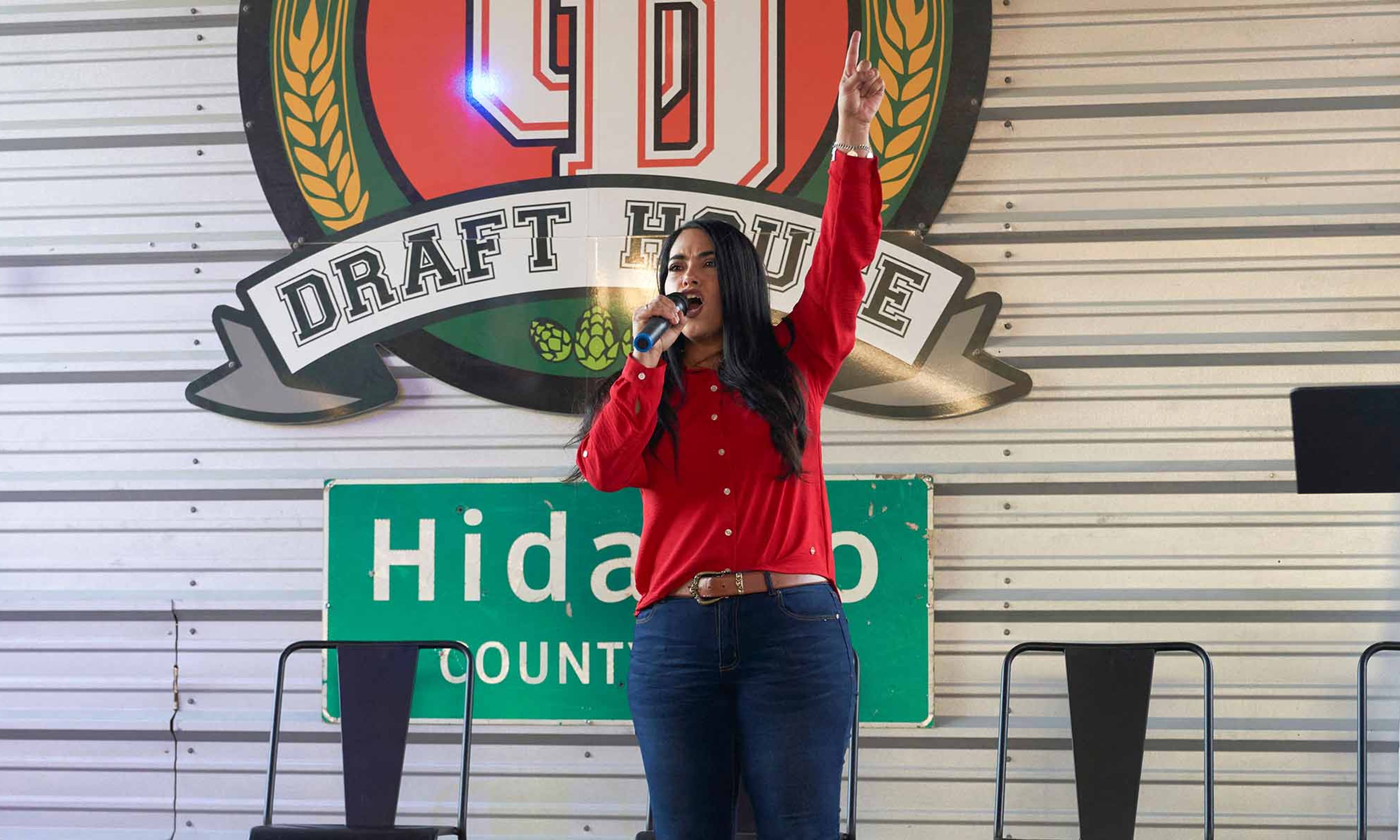
But in regions such as South Texas, there are signs that the party has momentum, as in Flores’s surprise victory in the state’s 34th district, which covers McAllen and the eastern edge of the RGV. She won by nearly eight points, in a district the outgoing Democratic congressman had won by over 13 points less than two years earlier. Flores is running for reelection in a redrawn district made more favorable to Democrats, but South Texas Republicans are determined to shock the nation with another upset. “I know we can win through hard work and dedication,” Flores tells the crowd at a Tejana Women of Faith prayer breakfast. “Because we’re conservative by nature — it is who we are. And I’ll say this: The Republican Party does not have a future without the Hispanic community.”
It’s a bold statement, given that more than 80 percent of the 2020 Trump vote was non-Hispanic white. But Flores is a persuasive orator: Despite a rasp in her voice owing to a cold, within minutes she has the entire audience in the palm of her hand. Delivering a message that is half stump speech, half Sunday-morning sermon, replete with biblical analogies and calls to prayer, she tells her audience: “We get caught up so much in work, in politics — but are we praying? Are we making enough time for Him?” People in the room are on their feet. “Do not allow this government to shame you for your Christian values. This nation is a Christian country!” One woman is so overcome, she begins sobbing. “I decided to run because of the love that I have for this country and for everything that this country has given me — but most importantly? For God.” She cites the “people before us [who] fought for us,” saying, “it is time that you also fight for the future of this country.” It’s a call-and-response now, the crowd shouting its approval in that distinctly South Texas accent, part Spanish, part Texas drawl, and entirely American.












Comments