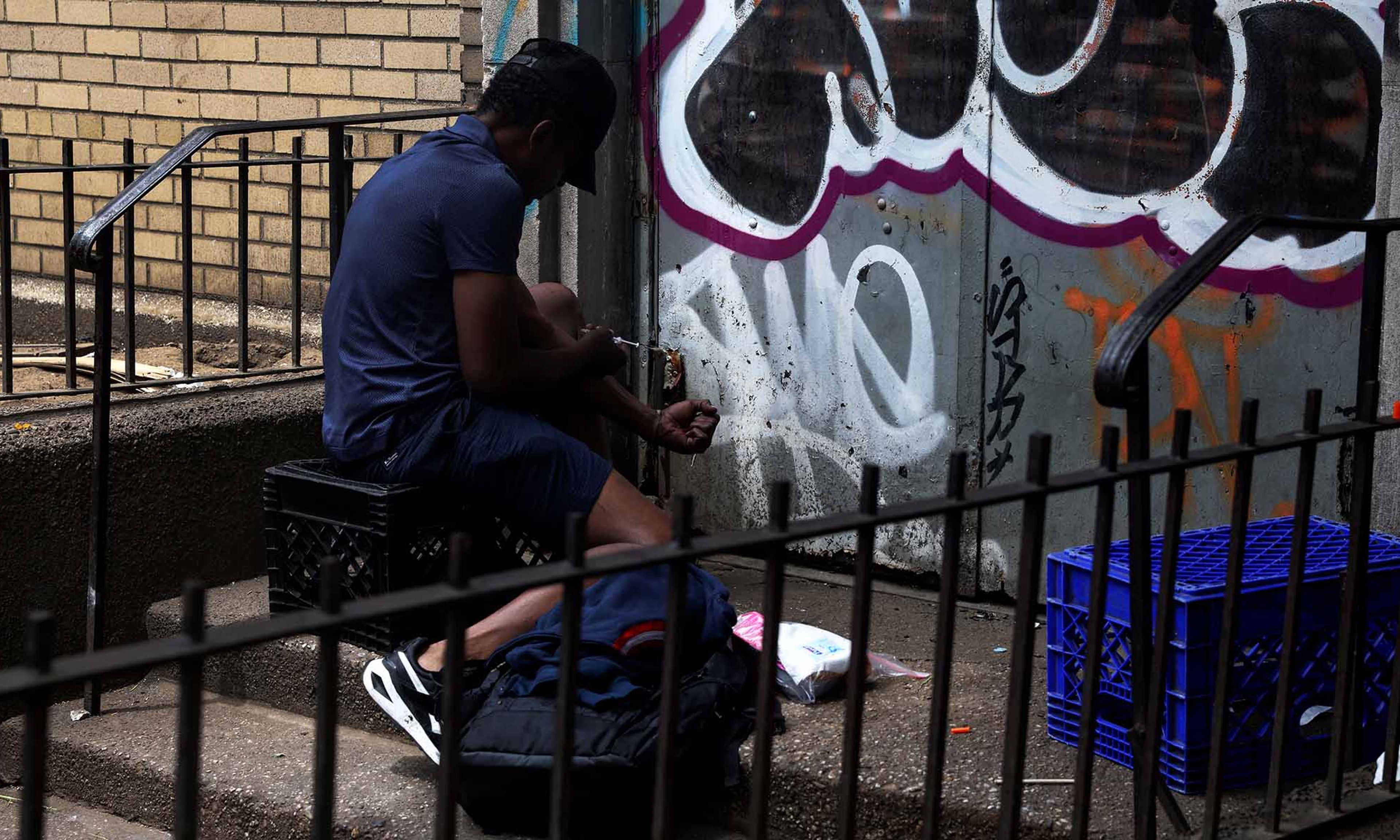
Richard Nixon is said to have begun America’s war on drugs on June 17, 1971. In a press conference, he declared drug abuse “public enemy No. 1” and asked Congress to provide the funding for an international “offensive” effort to stop the supply of drugs into America and to give treatment and rehabilitation to those suffering from the ill effects of illicit drugs.
If you look up the video of Nixon’s press conference on YouTube, posted by the Richard Nixon Foundation, you’ll see that one of the first comments is “I would like to congratulate drugs for winning the war on drugs.” The other comments repeat criticisms that have become conventional wisdom over the past several decades. “It was never a war on drugs, it was a war on us.” Or “How many lives were lost and destroyed in his politically and racially motivated war on drugs?”
These same sentiments have, for decades, increasingly guided pop culture, think-tankers, and policy intellectuals. Although the percentage of Americans using drugs fell by almost half during the 1980s and into the 1990s, use surged again at the turn of the century. For a very long time, movies and television series have portrayed the drug war as both futile and corrupting. “Our laws against illegal drugs function as a price support system for the criminal drug industry,” film critic Roger Ebert wrote, opening his review of Traffic in 2001. “They do not stop drugs,” he continued. “Despite billions of dollars spent and a toll of death, addiction, crime, corruption and lives wasted in prison, it is possible today for anyone who wants drugs to get them.” In a recent report calling on Biden to end the drug war once and for all, the Brookings Institution concluded that the war on drugs had been a failure with “one crowning achievement: systematically harming minority communities in America with intent and malice.”
The message from pop culture and policy circles alike is that the drug war is no better than prohibition of alcohol, in that attempts to enforce the law paradoxically benefit the drug-dealing that the law tries to criminalize. In this telling, drug enforcement leads to the over-policing of racial minorities and mass incarceration.
And the conventional wisdom has been trending toward a suite of alternative policies, some of which are already being pursued in various states and nations. These include decriminalizing the sale of softer drugs such as cannabis, and possibly even the possession and use of harder drugs such as heroin. Money currently given to drug-enforcement agencies could be rededicated, according to the Brookings Institution, to mental-health and addiction services, prison reform, and community reinvestment.
Ultimately the case for ending the war on drugs is that the demand for them is close to constant and cannot be significantly changed by policy, that many drug producers and dealers are criminal only because the law makes them so, and that enforcement causes only harm. It is based on the idea that we can sufficiently regulate and ameliorate the harms of drug abuse in the same way we do with alcohol, by making a robust market for selling well-regulated versions of the product. For those who still abuse drugs, we will have publicly and privately funded institutions and initiatives to help addicts recover, and we will morally stigmatize abuse among the potential pool of problem users.
Unfortunately, the case for ending the war on drugs is wrong in every jot and tittle. It is wrong at the level of theory, it has proved impractical wherever it has been tried, and ultimately it aims at an intolerable settlement built on a moral inversion: Toleration is given to those who profit from selling life-destroying drugs, at the expense of justice for those whose lives are destroyed by them. The case for surrender has been wrong for decades, and the rise of synthetic drugs only makes it more obviously destructive to pursue; the war on drugs is a just war and necessary.
That the war on drugs is just does not mean every policy pursued in its name has been just or wise. Far from it. Some sentencing guidelines for repeat offenders have been needlessly punitive. During the Cold War, some strategies for disrupting the drug trade in South America were compromised by other foreign-policy priorities. Similar conflicts plagued our involvement in Afghanistan. Some enforcement actions tend to increase violence between drug gangs without stemming the flow of drugs.
We should admit that the glib internet commenters are probably correct to say that drugs are currently winning the war on drugs. The United States has the casualty figures to prove it. In 2021, the number of Americans who died from preventable drug overdoses was 98,268. That’s an increase of 781 percent since 1999. Our new normal is that more Americans die of drug overdoses annually than died in the entirety of the Korean War and Vietnam War combined (36,574, and 58,220, respectively).
That brings us to the first fallacy in the case for surrender. Our inability to prosecute the war on drugs perfectly is not an argument for ending the war on drugs. If we had grouped a number of crimes together and called our enforcement effort a “war on violence,” we would not respond to the persistence or increase of violence in our society by giving up or decriminalizing less grave forms of violence in the hopes that they would satiate the demand for murders. Instead, our desire for justice would impel us to build on our past successes and to look for new tactics and opportunities to improve enforcement.
Here we must deal with the analogy of the war on drugs to the prohibition of alcohol in the United States from 1920 to 1933. It is true that temporary criminalization of alcohol did not end demand for the product and that it did empower criminals to take over the business. Unregulated alcohol was far more dangerous to its consumers. And government attempts to enforce prohibition did make the government complicit in needless deaths, as when the government began increasing the toxicity of industrial alcohol to discourage its use in illegal personal consumption. We currently accept approximately 140,000 alcohol-related deaths a year, though the vast majority of them are from medical conditions — cancers and liver and heart disease — in which excessive alcohol consumption over decades interacts with other unhealthy lifestyle choices.
But the analogy quickly breaks down. While prisoners and a handful of outlaw romantics still make illegal and unregulated forms of alcohol, legal alcohol drives the demand for illegal or more dangerous alcohol to practically zero. The legalization or decriminalization of drugs does not similarly contain drug users to safer forms of use.
The legalization of cannabis in Colorado over a decade ago paradoxically led to a dramatic expansion in the number of people in that state being charged with serious marijuana-related felonies. “We thought that the black market would disappear,” John Hickenlooper, the governor at the time, told Rocky Mountain PBS in 2018. “The thing that nobody predicted was that normalization, commercialization, would be a magnet for international black-market activity,” Colorado’s former U.S. attorney Bob Troyer would later tell reporters. There is also now a growing body of evidence, identified by the Colorado School of Public Health at the University of Colorado Anschutz Medical Campus, that legal cannabis is associated with a rise in psychosis and other mental-health disorders in the state.
But was it so unpredictable? The law still has a deterrent effect on behavior, and decriminalization would naturally invite some share of the non-drug-using population to try legal, casual drug use. Some percentage of these new users would of course become problem users and constitute a new market for those selling harder drugs. Further, the opioid epidemic showed how even a legal prescription drug could habituate new populations to the stupefaction and numbness of drug abuse and open them up to harder, illegal alternatives.
Legal cannabis had no discernible impact on the rate of drug-overdose deaths in the state; Colorado suffers from the same opioid and fentanyl crisis that ravages the entire country, sitting right in the middle of overdose deaths per capita. It is here that the analogy to Prohibition returns in a cruel twist. Colorado progressives, seeing the damage of the drug crisis, are proposing to create state-funded and staffed “safe-injection sites” where drug users can take their illicit hard drugs in the presence of those who could intervene in the event of an overdose. Once again, the state would become complicit in overdose deaths that do result, this time from drugs taken at the state’s invitation and under the banner of safety. Similar failures already mark legalization efforts in Oregon. Overdose deaths in Portland surged 46 percent this year.
There are other problems with treating the war on drugs like the misbegotten attempt at alcohol prohibition.
The culture of legal alcohol use relies on society’s placing the moral burden for alcohol’s ills on the alcohol users themselves. We treat alcohol producers and vendors as normal businesses providing a service with real social utility, because we still believe that the old philosophers were right that a moderate level of drinking can produce joy and conviviality. We stigmatize alcoholism as excess and a moral fault. And even when we’ve relieved that burden by talking about it as a disease, the onus for recovery ultimately falls on retraining the will and restraining the appetites of the problem user himself.
The same moral culture cannot exist for hard drugs. A bartender can know with confidence what a safe dose of alcohol is. Similarly, labels on alcohol can urge consumers toward safe consumption. There are people who once fantasized that the same could be done for drugs such as heroin and cocaine. This was not a sound theory, because habitual users of hard drugs have always sought out stronger and stronger doses as their addictions and drug tolerance devoured them. Those stories ended either with the addicts hitting rock bottom and then trying to live a reformed life or with their finally finding out the fatal dose.
In the current age of synthetic opioids such as fentanyl, the idea of regulated, safe drug use is simply preposterous. The drug problem in 2023 is not just one of rising numbers of users or of the behaviors that spill out from addiction; the problem is the dramatically increased lethality of the drugs themselves.
Drug-dealers who peddle fentanyl in consumable tablets, or other drugs spiked with fentanyl in order to give an extra kick, know that their product is likely to kill a large percentage of their customers, and they are selling it anyway. A huge number of the people dying from fentanyl cannot be justly described by their loved ones as “addicts” or “problem users” of drugs. Every day in every city, there are stories of teenagers like Melanie Ramos, a 15-year-old girl who died inside the bathroom of her Los Angeles high school after taking what she thought was a Percocet but was in fact a counterfeit laced with fentanyl.
Surrender in the drug war would require a culture to treat the person who sold her lethal fentanyl as, at worst, a hustler meeting insatiable demand, while writing off young people like Melanie Ramos as addicts or biowaste. This is impossible; it offends our obvious and ineradicable sense of justice. The people who knowingly profit from killing those like Melanie Ramos are moral monsters, and their deeds must be treated as criminal. Punishing them is just.
And behind those dealers are even worse criminals, deserving of worse punishment. The drug cartels — principally Sinaloa Cartel and Cártel Jalisco Nueva Generación — traffic not just in drugs but in humans. They are increasingly working with Chinese partners who produce the drugs or precursors in China, and who even perform moneylaundering for the cartels. As we’ve seen in decriminalization efforts locally, these networks cannot be tamed by legitimizing and regulating their business. There is no safe way to trade recreational fentanyl, anyway. They can be put out of business only by the rule of law, by force rooted in justice.
America has roughly 20 times the rate of overdose deaths as the global average. Robert VerBruggen has noted that if “you randomly picked 100,000 Americans at the beginning of 2020, about 30 of them would have overdosed by the end of the year.” While our geography and culture present higher obstacles to stopping drug-trafficking and abuse than exist in Singapore, for example, justice demands that we act to save our citizens from this predation, which is fueling disastrous corruption, civil-war-like conditions, and potential state breakdown in our neighbor and along our borders. The Philippines and other democratic nations that fall to the predation of drug cartels turn to extreme and highly ugly measures, like those employed by Rodrigo Duterte, to rescue themselves. Already in the United States, some political actors such as presidential candidate Ron DeSantis have floated the idea of conducting drone warfare against the cartels in Mexico without the cooperation of the Mexican government. Such policies are a sign of failure to address the problem before it becomes an all-consuming crisis.
Amelioration efforts must be updated for the synthetic-drug era, to help emergency responders and possibly other institutional officers to have anti-overdose drugs on hand and ready to deploy. We should also examine whether drug-war measures we’ve abandoned can be revived for the present day. The decline in the percentage of Americans using illicit drugs in the United States coincided with massive public-awareness campaigns in the 1980s and 1990s about the dangers of drugs, including the much-parodied “This is your brain on drugs” commercials, and the government interventions in situation comedies, as when Nancy Reagan showed up on Diff’rent Strokes to “just say ‘No!’”
A modernized drug war in the age of fentanyl would pour money into more enforcement at the border and in the sea-lanes used by traffickers. It would require stiff enforcement of immigration laws and automatic deportation for illegal residents involved in the drug trade, to break up distribution networks. It would require better intelligence operations in Mexico and China. It would almost certainly require better surveillance technology used on vehicles traveling through the border. We should work with the Mexican government as much as possible to freeze the assets of cartels and bar them from the international banking system. Currently, the Drug Enforcement Administration seizes, on a monthly basis, enough fentanyl to kill every single American and then some.
This is not a fight to give up.












Comments