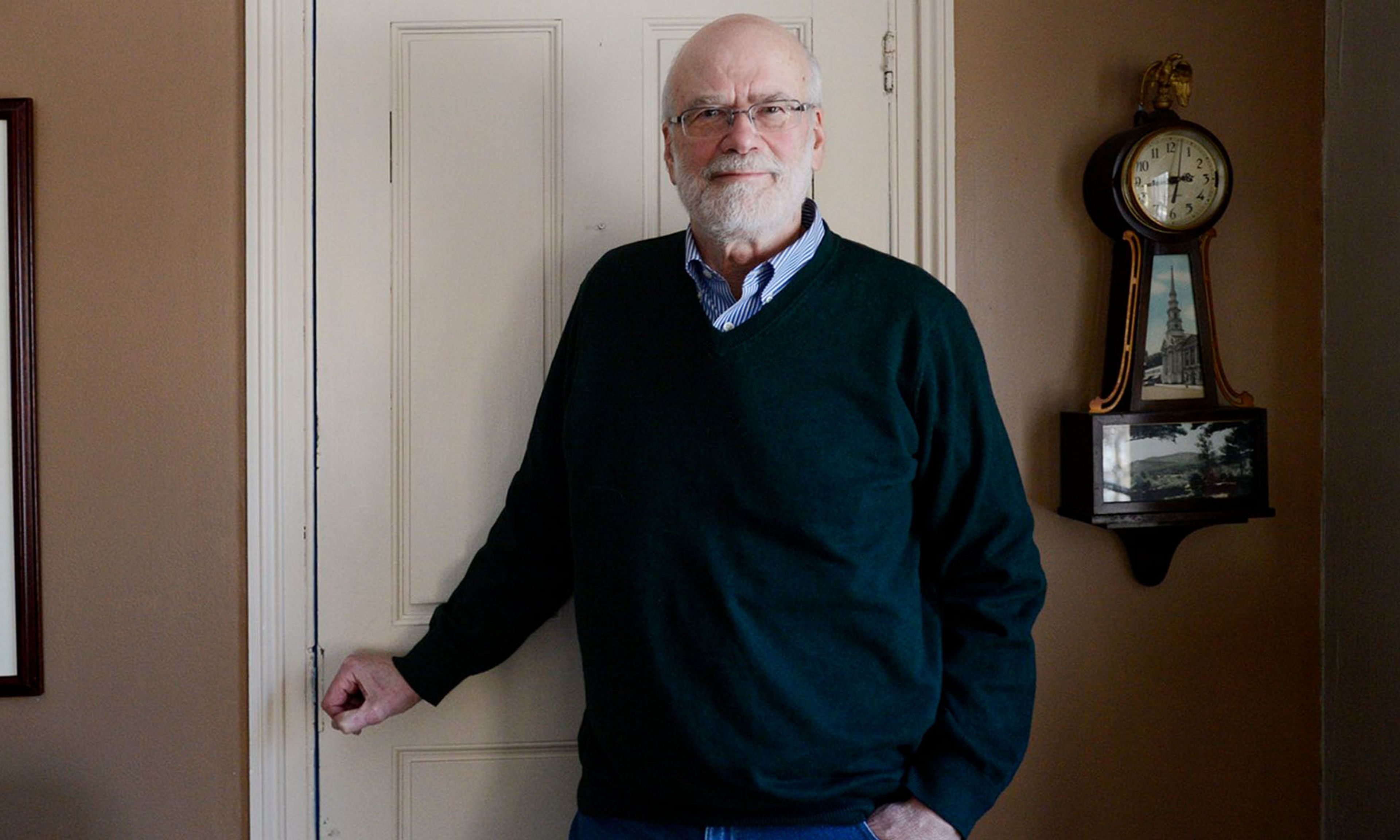
Literary lives are full of circumstantial encounters. For poets, these moments are often merely fodder for verse — but sometimes they are fortuitous.
In 1975, Wesley McNair was teaching English at Colby-Sawyer College in New London, N.H., ten miles from his farmhouse in North Sutton. He’d managed to escape, in his telling, a “crushing workload as a high-school teacher and make more room for poetry.” McNair learned that the poet Donald Hall had quit his tenured position at the University of Michigan and moved into Eagle Pond Farm, Hall’s family farm in nearby Wilmot, N.H.
Educated at Harvard, Stanford, and Oxford, Hall — already an accomplished poet and critic — was about to publish his first volume of selected poems. McNair, in contrast, was finishing his second master’s degree at Middlebury College’s Bread Loaf School of English. He was ambitious but knew that the door to writing poetry as a career was a narrow one.
At the end of McNair’s first visit to Eagle Pond, he put his manuscript of poems on the kitchen table. Hall, a generous reader with good taste, loved it. They exchanged letters and poems until Hall died in 2018. McNair likely would have found a route to success one way or another (he went on to become poet laureate of Maine, among other honors), but Hall’s friendship and support were invaluable. As McNair describes it in the preface to Late Wonders, a collection of his new and selected poems, Hall “procured a publisher” for all but one of McNair’s eventual books.
Hall also professionally benefited from the relationship, including by participating in poetry readings at McNair’s college, but there is something unusually pleasant about their kindness toward each other. Poets are more often known for their rivalries. (Hall once recalled a 71-year-old Robert Frost, who, during a faculty-and-student softball game at Bread Loaf, cracked a double off a “fat pitch,” served up slow and low for the iconic poet. Frost “had to win at everything,” Hall said. “Including poetry.”) Hall’s advice for McNair was full of folksy wisdom. When McNair lamented that he struggled to find confidence, Hall responded: “Go ahead and be consumed with self-doubt. . . . Confidence is probably not even a useful quality among poets.”
Late Wonders includes work composed during that season of doubt — poems that would make up McNair’s 1983 debut collection, The Faces of Americans of 1853 — and later pieces, in which his use of persona poetry had evolved into its present skilled and sharply rendered form. His work is melodic without being singsong; it is both sanguine and realistic.
McNair’s first collection contained melancholy, nearly elegiac poems such as “Small Towns Are Passing.” Like much of his best work, they are columnar in shape: smooth sentences deftly broken into short lines. Think Ted Kooser and early Jim Harrison. Like Harrison, McNair melds the prosaic with the surreal — and in doing so, he captures a paint-peeling nostalgia particular to New England. The former small-town world is passing away:
Just like that
whole families picnicking
on their lawns tilt
over the hill,
and kids on bikes
ride toward us
off the horizon,
leaving no trace
of where they have gone.
The poem ends: “Signs turn back and start / after them. Packs of mailboxes, / like dogs, chase them / around corner after corner.” It’s a clever conclusion — almost a recognition that perhaps his elegy is more the product of perception than reality — and leads nicely into other pieces such as “Where I Live.” McNair’s New Hampshire is a rooted place for locals but a mysterious place for passers-through — a vision of the pastoral as quaint but unknowable. “You will come into an antique town,” McNair writes, “whose homes move apart / as if you’d interrupted / a private discussion.” Past “landscaped streets,” somewhere “unsolved by zoning,” eager travelers will find “old farmhouses and trees / with car-tire swings” among signs that announce “hairdressing / and nightcrawlers.” Finally, the “timothy grass will run beside you / all the way to where I live.” These are perceptive lines that manage to be both poetic and refreshingly free of artifice.
McNair, who founded the American-studies program at Colby-Sawyer, said a “poem is a process of mulling” and that his work mixes “real life with the sort of lying that leads to a deeper truth.” He arrives at a notable number of these truths, as in “This Life,” originally from his collection My Brother Running. The poem is surprisingly profound; surprising, in part, because the lines are airy in their pacing.
There is a moment
when the arms,
sent behind you
to locate the sleeves
of your coat, become lost
in the possibility
of the garment lifting
above them.
Those lost hands, reaching, long for “a seamless place / that opens / to another life.”
By the time of that collection’s publication in 1993, McNair had left his native New Hampshire for Mercer, Maine. Gestures toward memory abound in later collections, such as Talking in the Dark, which includes “Waving Goodbye”: “Waving goodbye, of course, is what happens / when the space gets too large / for words — a gesture so innocent / and lonely, it could make a person weep / for days.” He ponders our mundane grasping toward meaning and connection:
how
extraordinary it is that we make this small flag
with our hands to show the closeness we wish for
in spite of what pulls us apart again
and again: the porch light snapping off,
the car picking its way down the road through the dark.
A trio of poems spread across two collections captures McNair’s muted spirituality: One finds measured affirmations of God’s existence in his lines, but just enough to seam his worldview. In “Mistakes about Heaven,” a sequential poem from The Ghosts of You and Me, the narrator affirms: “Heaven is not up / or down but a place outside / of programs. Those most / ready for it have spent / their lives unable / to make up their minds.” “Praise Song,” from The Unfastening, depicts a resurrected old pear tree in the narrator’s backyard. It has fallen to the ground, left to lie beside another tree, “its mate”; come spring, it sprouts “new shoots and flowers.” Much like the fallen tree, the narrator wishes “to lie down / in the long grass with one arm by my side / lifting me up as I reach out to her with all the others / and she reaches back” — surrounded by the “humming and fumbling of bees.”
“Benediction,” one of McNair’s finest poems, compels the reader to “Consider the lilies of the field, / how they grow / beyond their flowering, no longer / beautiful to our eyes.” We hear something of Gerard Manley Hopkins’s “Pied Beauty” in the poem’s lines, with McNair’s narrator reminding us to look at “the dream / of the bloomers and of the wind- / torn blackberry bushes / holding out their stick fingers / that the birds have picked clean.” Taken together, McNair’s poems are just sharp enough to open our eyes anew — and just smooth enough for us to think such wisdom arrived by grace alone.












Comments