Tesla’s annual “Impact Report,” released in May, surveyed thousands of its “key stakeholders.” Most were in China. Tesla’s largest plant and export hub is in Shanghai. It has just opened a research-and-development center there as well. Founded in America, dependent on American innovation, nurtured by American subsidies, the world’s most valuable car company might best be described as Chinese. When its executives promise “stakeholder engagement,” they mean kowtowing.
Faced with such results, policy-makers and their economists are belatedly discovering that globalization is not a “no-brainer,” an easy “win-win,” or even a particularly good idea. Researchers have shown that free trade with China cost America millions of jobs, with consequences ranging from declining family formation to increasing substance abuse and suicide — the so-called deaths of despair. The Covid-19 pandemic’s disruptions have exposed the strategic disaster of dependence on China, the costs of moving supply chains overseas, and the ways that the single-minded pursuit of efficiency can make a nation less resilient.
The economic-policy tools that conservatives most comfortably wield — tax reform, deregulation, expanding trade, and so forth — were chosen long ago in response to different challenges. They offer little help here. So policy-makers have begun rummaging through the garage to make a bigger toolbox. In the semiconductor industry, for instance, Taiwan and South Korea supplanted U.S. leadership through an aggressive industrial policy of direct public investments and subsidies for their own chip manufacturers. China is now attempting the same. In America, the recently passed CHIPS and Science Act represents the beginning of a response, with funds aimed at supporting both construction of chip-fabrication plants here and research that could produce future breakthroughs.
But conservatives rightly prize America’s market economy and worry that subsidies will fuel cronyism and mis-allocate capital. Subsidies for particular firms and projects are a double-edged sword: Their narrow targeting might seem to minimize market intervention, but they also leave room for mischief. The CHIPS Act is better than the alternative of simply abandoning technological leadership to Asia, but the conservative toolbox has more to offer. Much blunter instruments can often get more done and, counterintuitively, they can do much less damage to markets in the process.
The best illustration comes from our own shores, during the presidency of Ronald Reagan. When he took office, the domestic auto industry was in a tailspin. Facing a flood of Japanese imports, the “Big Three” automakers — GM, Ford, and Chrysler — had just suffered their first losses in more than two decades and collectively laid off a tenth of their factory workers. While some in his cabinet advised doing nothing, Reagan negotiated an import quota with Japan, sharply constricting the flow of vehicles into the United States. This was not a subtle or fine-tuned policy; it simply prohibited imports from rising above the 1979 level.
And it worked. Detroit turned around, and the Japanese firms invested tens of billions of dollars in a massive new manufacturing base in the South that created hundreds of thousands of American jobs — the single, exceptional example of significant foreign manufacturing capacity relocating to America instead of the other way around. Anyone hoping for more of the same today should take note.
After four decades of aggressive public support from its Ministry of International Trade and Industry (MITI) — direct subsidies, tax breaks, cheap loans, and information-sharing — Japan had built an automotive juggernaut by the 1970s. Economics textbooks predicted that such policies would yield sclerosis and cronyism, but in this case, the results were the world’s most efficient production processes and its highest-quality cars. Japan’s top automaker, Toyota, had perfected its management of material to the point where its inventory costs were only a tenth of General Motors’. American automotive engineers awarded many more product-quality honors to Japanese automakers than to American ones. Over the decade, the Japanese industry raised its productivity by 4.3 percent annually — three times the American rate of progress.
From 1970 to 1976, Japanese cars tripled their sales volume in the United States, to more than 1 million units and 8 percent market share. Then came the decade’s second oil crisis. In the wake of the Iranian Revolution in the spring of 1979, as oil prices more than doubled, American consumers lost their taste for American-made “gas guzzlers” and switched en masse to smaller, more fuel-efficient cars. In 1980, nearly two out of every three new automobiles sold were small or compact cars, up from fewer than half in 1978.
Such cars were a Japanese specialty, and the American automakers, unable to quickly retool, quickly lost ground. Japanese automakers reached 21 percent market share in 1980, at which point they were exporting nearly 2 million cars annually to the U.S. — more than they were selling in their home market. That year, the Big Three suffered a $6.2 billion loss, as compared with an average of $4.4 billion in annual profits during the previous decade. In the span of two years, Big Three sales had plummeted 30 percent, to their lowest level since 1961. Chrysler was on the verge of bankruptcy. Over 100,000 auto-factory workers had been laid off, and the United Auto Workers (UAW) had lost 40 percent of its membership.
It was far from a fair fight. Whereas American firms competed in a free and open market, Japan had insulated its automakers from foreign competition. On top of the aggressive government support it provided to its own producers, high tariffs kept imports uncompetitive, while onerous standards made it virtually impossible for foreign firms to build operations in Japan. American tolerance for such an imbalanced arrangement was a feature of Cold War–era trade policy and had long been a source of frustration for American auto executives. “In America’s determination to establish and hold ties to Japan and maintain it as a Far East buffer against Communism,” Chrysler CEO Lee Iacocca complained, “the United States set trade agreements without thought to reciprocity.” The UAW urged Japanese automakers to build assembly plants in the United States and hire American workers, but the requests were flatly denied.
Nor was there any light at the end of the tunnel. According to a later analysis by the U.S. International Trade Commission (ITC), the Big Three’s downward trajectory was showing no signs of slowing. Industry analysts argued that American automakers required “breathing room” and an estimated $80 billion to retool their factories and regain their competitive footing in the Japanese-dominated market for cheap, fuel-efficient compacts. But when Ford and the UAW filed for import relief from the ITC, their petitions were rejected by a 3–2 vote. While acknowledging that imports had been “a significant thorn in the industry’s side,” the ITC concluded that recession was the leading cause of its woes and speculated that import relief might “generate a perverse influence on the ability of the United States to attract foreign producers to establish new domestic facilities.”
The Carter White House was similarly unmoved. Foreshadowing the free-trade consensus that would define the 1990s and 2000s, President Carter opposed import restrictions of any kind. He accepted the industry’s decline and suggested a program of palliative care, aimed at ameliorating plant closures through government aid to surrounding communities. To address unemployment, he proposed retraining laid-off workers. If only the software industry had been better developed, he could have suggested they “learn to code.”
Ronald Reagan knew better. Government, in his view, was partly to blame — not for doing too much, but for failing to do enough. “Government has a role that it has shirked so far,” he remarked during a campaign visit to a Chrysler plant in September 1980. “The deluge” of Japanese imports, he insisted, “must be slowed while our industry gets back on its feet.” Reagan not only promised import relief but threatened retaliation: “If Japan keeps on doing everything that it’s doing, obviously there’s going to be what you call ‘protectionism.’”
It was an unorthodox stance for a disciple of the free market. Then again, the auto industry’s predicament betrayed free-market orthodoxy. Markets were supposed to create the incentives and competitive pressures that would spur productivity and innovation. Interfering in markets was supposed to backfire. The Japanese auto industry, insulated from foreign competition and subsidized by the state, should have been a catastrophic failure; America’s open market should have fostered firms that were more resilient and responsive to consumer demand and competition. What was to be done when the opposite occurred?
Economic reality’s defiance of economic theory stoked a debate among policy-makers seeking remedies. Newly inaugurated, President Reagan formed a cabinet-level task force to address the crisis. It soon divided along ideological lines. A free-market faction, led by the treasury secretary, former Merrill Lynch executive Donald Regan, opposed any action beyond broad supply-side reforms. Import restrictions, as another top Reagan official speculated, might “take the heat off the domestic industry to do other things it should, to take corrective steps.” Opposing them was a “pragmatist” faction, composed of seasoned businessmen such as Commerce Secretary Malcolm Baldrige and Labor Secretary Raymond Donovan, who came from the manufacturing and construction industries, respectively. They pushed for import restraints, fearing that the proposed supply-side reforms were inadequate to address the auto industry’s challenges. A task-force memo to the president warned, “Even a successful recovery program may not generate sufficient capital to enable the industry to meet changing customer demands, increasingly stringent government regulations, and competition from abroad.”
As it debated whether to fulfill the president’s campaign promise, the divided task force came under additional pressure from Congress. Senate majority leader Howard Baker (R., Tenn.) feared that “the situation’s out of hand,” and Senators John C. Danforth (R., Mo.) and Lloyd Bentsen (D., Texas) introduced legislation to impose a three-year import quota on Japanese automobiles. It was a threat — both to the Japanese and to the free-market faction in the White House. A Treasury Department memo admitted, “Congress may take the question out of our hands if we fail to act.”
President Reagan chose a diplomatic solution. In addition to seeking supply-side reforms that reduced fuel-economy standards and eased antitrust enforcement, he would restrict Japanese auto imports for three years. Armed with the threat of an outright import quota, his administration negotiated a “voluntary export restraint” (VER) with the Japanese MITI, which preferred to restrain its own industry rather than face restraints imposed by Congress. MITI limited the number of cars that Japan exported to the United States each year to 1.68 million, the level in 1979.
The predictions of the two factions on the task force would be put to the test: Would such a blunt obstruction of trade insulate Detroit from competition and thereby allow it to decay further, leaving consumers with costlier and lower-quality vehicles, or would the Big Three learn their lesson and become leaner and meaner? Would workers lose out in the long run or, contra the ITC’s prediction, would the Japanese invest to make cars in America?
The quota immediately stabilized the American market. According to the ITC’s later analysis, American-made cars had been on pace to hold just 68 percent of the market by 1983. Instead, the share recovered to its 1979 level of 77 percent by 1984.
American automakers took advantage of the breathing room to boost their capabilities and compete in the newly fuel-conscious consumer market. Car size and weight declined, while fuel efficiency increased. Improved operations raised quality while cutting costs. Ford reported that defects fell by 78 percent over the decade; J.D. Power found a decline of defects across all domestic automakers of 40 percent. By 1989, American automakers could make cars with 25 percent less labor than in 1979, which equated to robust 3 percent annual productivity growth.
As important, VER reshaped the American manufacturing landscape by bringing Japanese production onshore. The quota set no limit on the number of vehicles Japanese automakers could sell in America, only on how many they could import into the country; cars built in the U.S. were exempt. As a result, the firms had great incentives to build cars here and hire American workers.
In 1980, there were no Japanese auto-assembly plants in the U.S. Within a decade of Reagan’s action, every major Japanese automaker — Toyota, Honda, Nissan, Mazda, Mitsubishi, Isuzu, and Subaru — began assembling cars in America.
And assembly plants were only the beginning of the story. As assembly moved onshore, economic forces pulled suppliers along, too. By 1991, Japanese automakers had built not only eight auto-assembly plants, but also more than 300 other production facilities that employed over 100,000 American workers and represented over $25 billion in capital investment (in 2022 dollars). For a sense of scale: Total foreign direct investment in new domestic capacity, across the entire economy, has averaged $10 billion per year since 2015.
VER’s lasting legacy is the millions of “Japanese” cars on American roads that are in fact American cars — Toyotas and Hondas are not only assembled in America but also have consistently ranked among the cars with the highest share of American-made parts. Japanese automakers continued to gain market share, but while that competition forced the Big Three to sharpen their performance, it did not threaten American workers as Japanese imports once did. The share of American-made cars held steady.
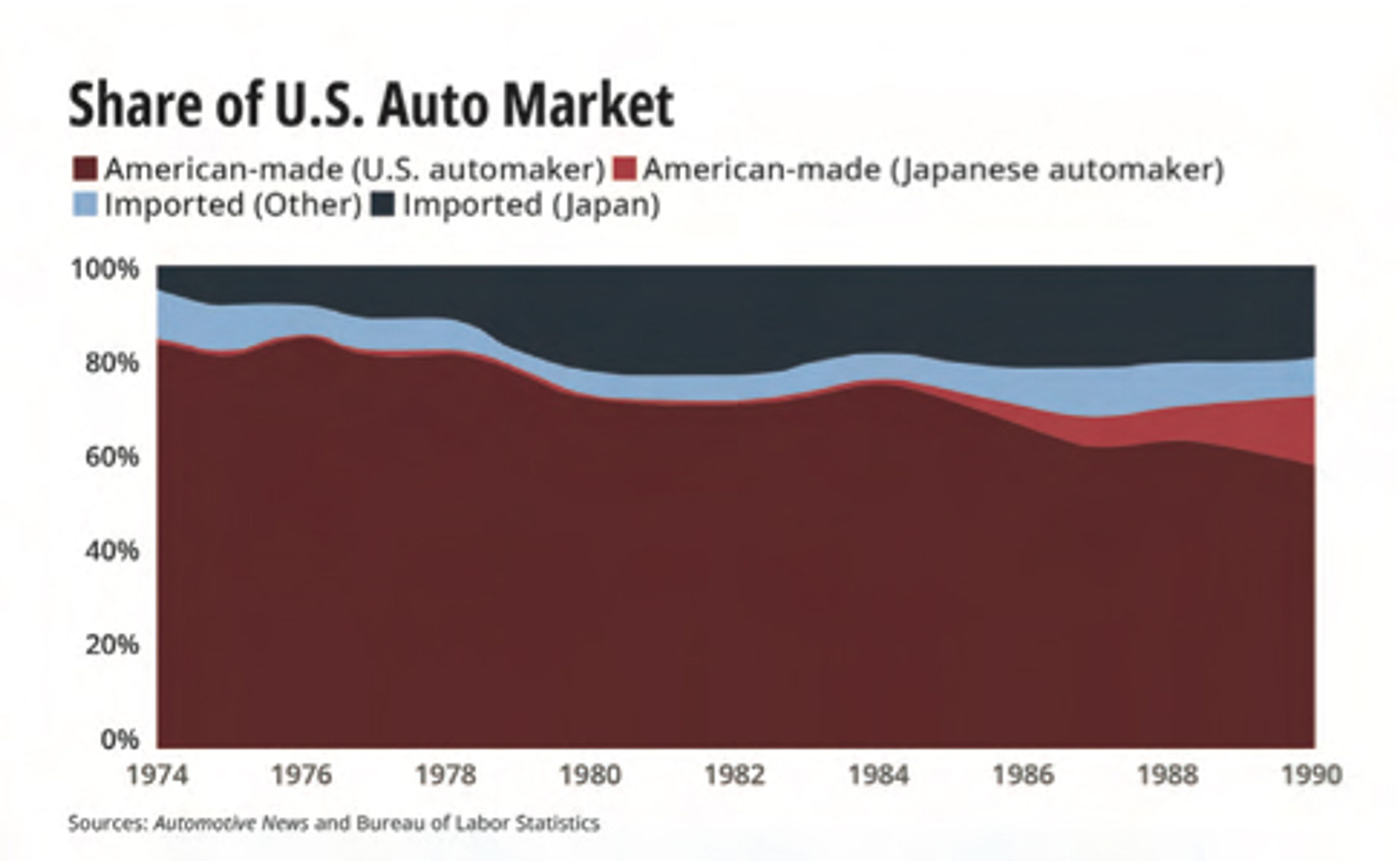
Economists were proven right, in a narrow sense, about the costs of restricting trade. According to government estimates, VER raised prices on Japanese cars by about 8 percent, which translated into an additional $5.1 billion for American consumers between 1981 and 1984. But within the decade, the policy had also prompted nearly three times that much foreign direct investment. The cost per new job in the Japanese supply chain was only about $50,000, and that does not even include the jobs saved at American automakers and suppliers. From one perspective, the exchange may seem unfair — a diffuse cost to millions of consumers for the benefit of a smaller number of workers. But Americans had a different perspective: In a 1980 New York Times poll, 71 percent favored “protecting jobs at the cost of higher prices on foreign products.”
And while the intervention was temporary, the benefits were permanent. VER had been lifted by 1985, and Japanese automakers have not faced any quotas since. But once their American investments had begun, maintaining and expanding them took on an economic logic of its own. No one today suggests that American consumers face higher prices because their Camrys come from Kentucky instead of Tsutsumi; the best place to locate production in a free market is not some immutable truth, but rather a function of previous policies and investments.
President Reagan’s approach was not an indictment of free markets or international trade. Both were necessary, after all, to the establishment and growth of the transplanted Japanese industry. Rather, the quota offers a simple lesson in political economy: Blunt constraints that set market boundaries, while encouraging competition within them, can help ensure that capitalism serves the national interest. Neither tax cuts nor deregulation would have given Detroit the chance it needed or incentivized Japanese investment.
What was a fairly unique challenge for the auto industry in 1980 has become a commonplace across the American economy four decades later. The United States ran a $59 billion trade surplus in advanced technology products in the early 1990s; by 2020, that surplus had collapsed to a $189 billion trade deficit (both figures in 2020 dollars). From semiconductors and communications equipment to solar panels and electric-vehicle batteries to pharmaceuticals and personal-protective equipment, the United States has witnessed a systematic hollowing out of its industrial leadership — and with it, of jobs, investment, and innovation — met largely with a shrug by economists and policy-makers who saw it as inevitable or perhaps even beneficial. As we finally awake from that stupor, conservatives inclined to ask what Ronald Reagan would do should remember what he did.
Proposals already on offer illustrate the wide variety of tools available. For example, President Trump’s U.S. trade representative, Robert Lighthizer, has proposed an across-the-board 10 percent tariff that would increase steadily so long as America continued to run a trade deficit. As with an import quota, the tariff’s effect would be to redirect market forces to domestic production and then let them rip. Another approach, proposed by Senator Josh Hawley (R., Mo.) and Representative Claudia Tenney (R., N.Y.), would be a “local-content requirement” for critical goods, requiring that 50 percent of the value in their supply chains be produced domestically. The market would decide which parts of the supply chain made most sense onshore, but it would have to choose something.
As longtime Intel CEO Andy Grove warned just as his successors were sacrificing the firm’s manufacturing edge, simple production goes first, but more-complex processes and entire supply chains follow, and then research and innovation go, too. He predicted the same would happen in the advanced-battery industry, and he has already been proven right. Happily, though, this process flows in both directions: Where production returns to American shores, broader supply chains and greater innovation will, too. Just as Tesla released its report of predominantly Chinese stakeholders, Toyota announced a new series of research projects at one of its five American R&D centers, to be conducted in partnership with six American universities.
Wells King is the research director at American Compass, where Dan Vaughn Jr. is an analyst. This essay is adapted from a case study originally published at American Compass.












Comments