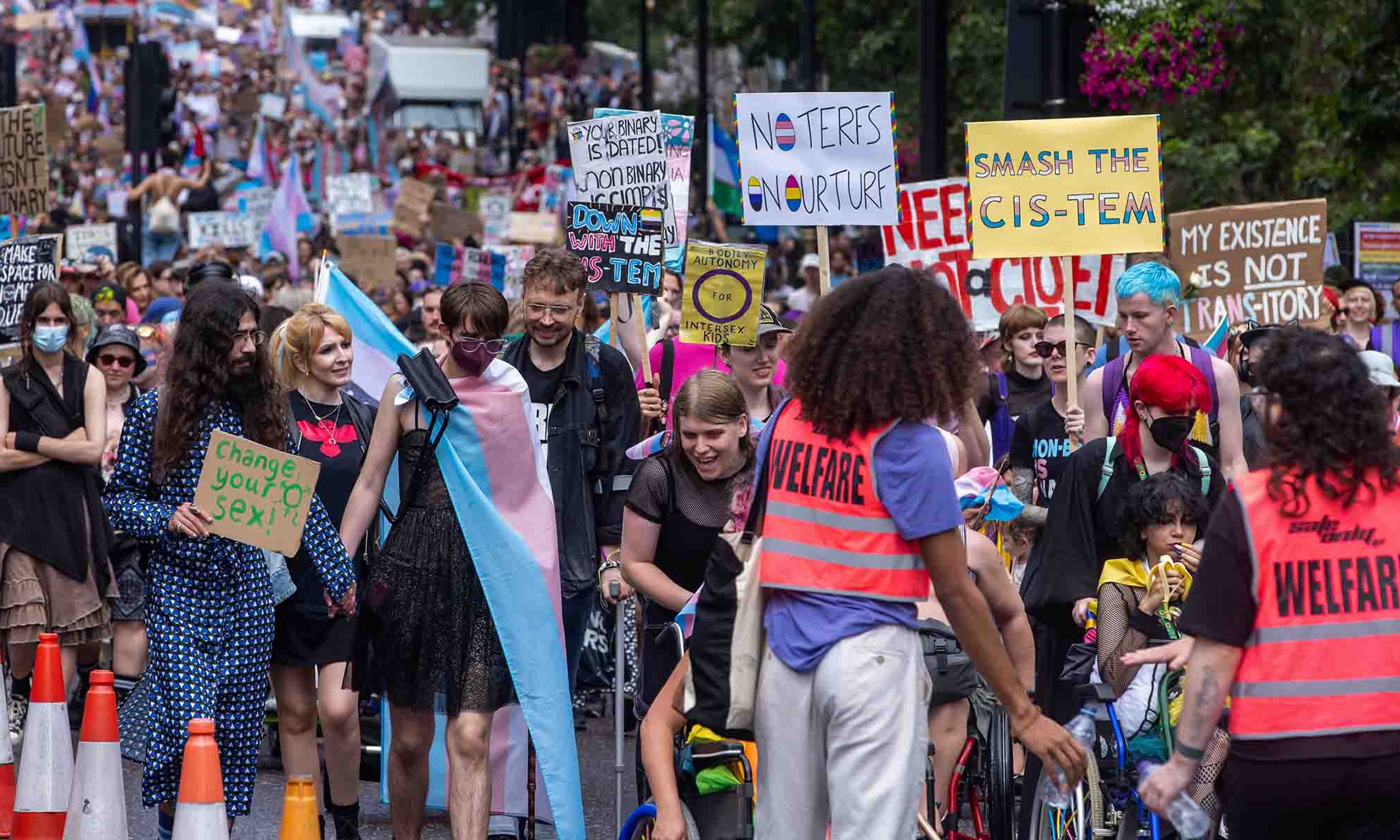
For years, American conservatives have regarded Great Britain as increasingly illiberal politically and unserious morally. American progressives, meanwhile, have looked to Britain, with longing, as an enlightened secular society.
In a matter of decades, particularly in the past ten years, Britain has in fact undergone what the British Social Attitudes report has called a “profound” shift in public views. New research published by the National Centre for Social Research shows that, since the 1980s, the share of Britons who believe that children should be born within wedlock has plummeted, while the share who view pre-marital sex as “not wrong at all” has greatly increased. More than ever before, Britons support cohabitation, single parenthood, abortion, and same-sex relationships.
Yet there is one exception: transgenderism. The notion that people can be “born in the wrong body” is now losing support. In 2019, 53 percent of Britons believed that a trans-identifying person should be allowed to change the sex recorded on his or her birth certificate. By 2022, that had fallen to 30 percent. More telling still, 64 percent characterize themselves as “not at all prejudiced” against transgender people, down from 82 percent.
Why has a society that has embraced social progressivism seemingly turned its back on the new frontier? How did the U.K. — bastion of right-on thinking — become “TERF island”? (The acronym, for “trans-exclusionary radical feminist,” is used to refer to women, feminist or not, who oppose transgender ideology and its implications: men in women’s sports and spaces, medically altering the secondary sexual characteristics of children, etc.)
One explanation is that transgenderism inspires a broad coalition of resistance because of the ways in which it conflicts with the rights of women, the interests of children, and, often, fundamental liberties such as freedom of speech. While there was no guarantee that these opponents to transgenderism would prevail in a standoff, they have won the battle and, for now at least, appear to be winning the war. A small number of trans-skeptical individuals in positions of influence across journalism, politics, medicine, law, and activism have made critical contributions that have affected the direction of the country.
Helen Joyce, the author of Trans: When Ideology Meets Reality (2021), has since last year been the director of advocacy at Sex Matters, just one of the new activist groups in the U.K. to have sprung up in determined opposition to transgender activists’ efforts to subordinate sex to the concept of gender identity. Over tea in London, Joyce told me that Sex Matters deliberately avoids culture-war politics. “We don’t take a position on anything if it isn’t about what sex means in your life,” she says. “We don’t call ourselves a feminist organization because we’re for everybody, feminist or nonfeminist. Everybody has a sex,” including those who identify as trans.
In her book, Joyce gives a number of reasons why transgenderism has failed to take hold in the U.K. as tenaciously as it has in the U.S.: Britons’ moderate temperament and aversion to extremism; the centralization of the political and health-care systems; the role of trade unions, with left-wing women tending to be “very organized and very persistent”; the role of Mumsnet, an internet forum where trans skepticism first got off the ground; the legal framework, specifically the 2010 Equality Act and child safeguarding; gay-rights organizations’ being slower than American groups to adopt the trans cause; the country’s less religious and less polarized character, resulting in less tribalism and division; and “very importantly,” Britain’s having “a different kind of feminism,” one that is less bound up in identity politics.
But “the thing I didn’t emphasize enough in my book,” Joyce says, “because it hadn’t really become clear, was the impact of a few key figures.” She names two women in particular, her colleague Maya Forstater and the Harry Potter author, J. K. Rowling. According to Joyce, Forstater was “the perfect claimant” in what became the landmark legal case protecting trans-skeptical views and is now a “strategic genius” in her role as executive director of Sex Matters. The influence of Rowling in speaking out in defense of Forstater and against transgender ideology cannot be overstated.
In 2019, Forstater was working as a tax consultant and, in a personal capacity, tweeted her views about proposed changes to Britain’s Gender Recognition Act of 2004. As it stands, the law allows people to change their legal gender after two years of transgender identification and upon provision of medical diagnosis of gender dysphoria. Transgender activists sought to relax the law, however, to allow self-identification alone. Forstater tweeted that “radically expanding the legal definition of ‘women’” to include males would render it “a meaningless concept” and “undermine” women’s rights and protections. When her employer responded by declining to renew her contract, she sued for unfair dismissal.
In 2019, a judge ruled that Forstater’s views were, according to the relevant standard, “not worthy of respect in a democratic society.” It was then that Rowling wrote her infamous tweet: “Dress however you please. Call yourself whatever you like. Sleep with any consenting adult who’ll have you. Live your best life in peace and security. But force women out of their jobs for stating that sex is real? #IStandWithMaya #ThisIsNotADrill.”
Forstater’s case was won on appeal in 2021. The High Court judge wrote that the belief that sex is binary and immutable “must be tolerated in a pluralist society” and that it is protected under the U.K. Equality Act, which prohibits discrimination based on age, disability, gender reassignment, marital status, pregnancy, race, sex, sexual orientation, or, as in this case, religion or belief. In recent years, trans ideologues have been successful in establishing the legal interpretation that having a gender-recognition certificate (GRC) — the document allowing an individual to amend his legally recorded sex under the 2004 Gender Recognition Act — changes one’s sex for the purposes of the Equality Act. But thanks to the tireless work of sex-based-rights activists as well as their sympathizers in positions of influence, that is poised to change.
In February, Kemi Badenoch, the Conservative government’s equalities minister, asked Lady Kishwer Falkner, who chairs the U.K.’s leading human-rights watchdog, the Equality and Human Rights Commission (EHRC), to clarify the definition of sex for the purposes of the Equality Act. Falkner did so in April, recommending that the act be amended to explicitly define sex as anatomical and outline the contexts in which this matters. “Once you secure those limited areas for women you can be entirely relaxed about expanding transitioning and gender recognition certificates for people who want them, the ability of people who want to just be trans or any other of those identities,” Falkner later explained.
Next, under Falkner’s leadership, the EHRC corrected its schools guidance from 2014, which had previously suggested it would be discriminatory for a school to refuse to refer to a boy as a girl or vice versa. The EHRC clarified that schools are in fact legally obliged to provide separate sex-based facilities for boys and girls.
On September 2, Transgender Trend, another trans-skeptical campaign group, wrote an open letter to Prime Minister Rishi Sunak, arguing that the government had “been complicit” in creating gender-distressed children “by allowing gender identity ideology into schools and failing to provide schools with clear guidance on the law concerning sex and transgender identity.” The letter called for “strong, unequivocal guidance to schools making clear that they cannot lawfully accommodate ‘social transition’ by children.” Signatories included whistleblowers from the National Health Service gender youth clinic.
The clinic had come under heightened scrutiny after journalists at the Times of London began to question a huge uptick in demand, especially from an unprecedented number of adolescent females. Then, in 2020, Keira Bell, who had begun taking puberty-blockers when she was 16 before later detransitioning, sued the clinic for inadequate care. She won at the High Court, whose judges doubted whether anyone under 16 could be competent to give informed consent to puberty-blocking drugs and suggested that, in future cases, clinicians of patients under 18 would need to obtain court authorization. In response, the clinic suspended prescriptions of puberty-blockers. The decision was reversed at the Court of Appeals in 2021, the court finding that it “was for clinicians rather than the court to decide on competence” with regard to consent.
Despite this eventual defeat, the Bell case combined with whistleblower testimony was instrumental in prompting an independent review of the clinic; that review was led by Hilary Cass, former president of the Royal College of Pediatricians and Child Health. Her 2022 interim report, which noted “gaps in evidence” and concerns over safety, concluded that the clinic was “unsustainable.” At her recommendation, the NHS will permanently close the clinic’s doors in March 2024. In June 2023, NHS England announced that puberty-blockers would be used only in clinical research.
Changes are also afoot in the area of speech-policing. In the British legal system, “hate crime” legislation has undermined speech rights in the transgender debate and elsewhere, creating a culture of intimidation and self-censorship. But this has begun to be challenged. Harry Miller, a former police officer, founded the group Fair Cop after officers showed up at his workplace in response to allegedly “transphobic” tweets. Miller was informed that, though he had not committed a crime, his actions would be recorded as a “hate incident.” His legal challenge against the College of Policing was ultimately successful.
The campaign for sex-based rights has been helped by the overreach of its adversaries. Take, for instance, Mermaids, a group promoting social, medical, and surgical “transitions” for minors. For a time, Mermaids enjoyed outsized influence: It received $600,000 in public funding and a Starbucks sponsorship, helped draft treatment plans with the NHS, and was a consultant on a TV series. But in 2019, the Times exposed that the charity had inadvertently made users’ personal and medical information publicly available through its website. In 2022, the Daily Telegraph revealed that Mermaids had been offering “chest binders” and inaccurate medical advice to children as young as 13 behind their parents’ backs. The group’s CEO resigned.
British sports, which also came under scrutiny, have started to roll back policies allowing males to compete in the female category, specifically by making the male category an “open” one (i.e., one for people of any sex or gender identity). Meanwhile, high-profile cases such as that of the trans-identifying rapist Karen White, who sexually assaulted women he was incarcerated with, made the public aware of dangers to female prisoners. The activist group Fair Play for Women reported in 2017 that “60 of the 125 transgender prisoners known to be in prison in England and Wales are convicted sex offenders.”
In Scotland, public outrage followed by political intervention ensued when a convicted rapist, Isla (formerly Adam) Bryson, who began identifying as a female after being charged, was remanded to a women’s prison to await sentencing. The episode marked one of many political crises for the Scottish National Party, whose devolved parliament passed the Gender Reform Bill, loosening requirements for individuals as young as 16 to legally change their gender. In an unprecedented move, the British government intervened on the side of Scottish public opinion to veto the law, citing its incompatibility with the U.K.-wide Equality Act.
It was this episode that prompted Labour leader Keir Starmer, who said he had “reflected on what happened in Scotland,” to conclude that he does not consider self-identification the right way forward.
Joyce told me that such developments are promising but mark only “the end of the beginning.” A lot could still go wrong. The current U.K. government might not survive long enough to enshrine its promised protections. Activists could yet have legal victories of their own. Still, it has been a remarkable first chapter. On TERF island, a small number of people in positions of influence have, together, made all the difference.












Comments