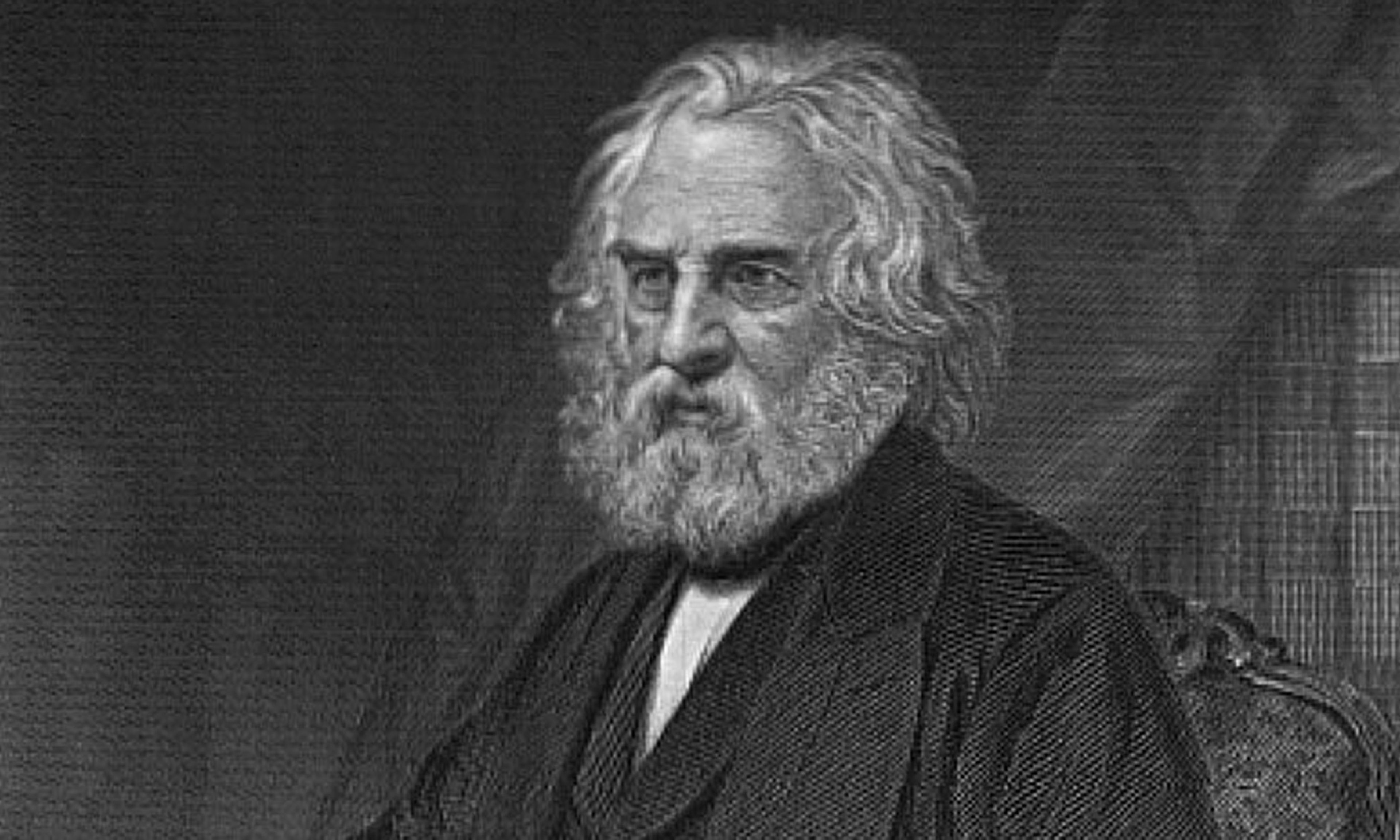
‘Listen, my children, and you shall hear / Of the midnight ride of Paul Revere, / On the eighteenth of April, in Seventy-Five: / Hardly a man is now alive,” clippety-clops “Paul Revere’s Ride,” Henry Wadsworth Longfellow’s poem about a take-charge common man and his horse, off to change the world. Longfellow published it in January 1861, on the eve of the Civil War. He reached back in time to present one man’s strike for liberty, as a prelude to the epic fight to save the Union, which Revere had helped to forge. It’s a patriotic, thrilling, and eminently scrutable story and a triumph of realism-as-poetry.
How Longfellow’s life and loves fashioned his writing is the theme of Nicholas Basbanes’s Cross of Snow, a new, deeply researched, and readable biography. Evangeline, The Courtship of Miles Standish, The Song of Hiawatha, and Longfellow’s account of Revere’s transformative ride were once memorized by everyone. They were part of America’s cultural vernacular. Few can recite the poems now, but Basbanes tells us that Longfellow is still, in our century, a gift that keeps giving.
Basbanes does four new things, and he does them with clarity and verve. First, he establishes Longfellow as a crucial medium between Old and New Worlds. Longfellow and his friend Washington Irving were America’s first writers with an international perspective. Irving’s interest in other cultures was mostly confined to Spain’s. Longfellow in his curiosity about the abroad was voracious and omnivorous.
Basbanes evokes the exhilaration that the young, well-born Maine savant felt in studying in Germany’s oldest university, traveling in Italy, romancing a young woman in Spain, and in hot pursuit of his first and second wives on colorful Grand Tour–like trips. On that level, Cross of Snow is a story of an innocent abroad, enriched intellectually and sensually, and then living a life of deep sophistication.
Fluent in eight languages, Longfellow taught French, German, Italian, and Spanish at Harvard. It was pioneer work. Longfellow delivered many of America’s future, Harvard-trained movers and shakers from a provincial womb and inspired them to appreciate the big, wide world. His English translation of the works of Dante in 1867 was a must-own and must-read for Americans who considered themselves cultured.
Second, Basbanes tells the story of Longfellow’s two marriages, each a remarkable romance. His first, to Mary Storer Potter, a young woman he knew from childhood, ended after four short years, with her death in 1835. His second was to the extraordinary Frances Appleton. Fanny, as she was called, was the daughter of Boston’s richest man. Basbanes presents her as Longfellow’s intellectual equal and partner. Romantically and aesthetically, the two moved in sync. Courting her was a long haul, though. It took Longfellow seven years to get her to the altar. Basbanes finds the nuance and equivocation in Fanny’s feelings and Longfellow’s own determination and, often, anguish when thwarted.
Basbanes uses Fanny’s freshly transcribed letters, diaries, notebooks, and journals to develop his account of what he calls “a love of uncommon power.” This material has never been plumbed, in part because Longfellow’s descendants believed that their close study was intrusive, even salacious. Hers is a Boston Brahmin paper trail, voluminous, yes, but cryptic and reticent. Basbanes is a great biographer. He has the detective, forensic, semantic, and soothsayer skills to tease new meaning from the material.
Third, Basbanes, through his life of Longfellow and Fanny, presents the social world of Boston’s ruling class and, by extension, big chunks of the nation’s. Longfellow was a celebrity not only as an esteemed writer but as a bon vivant and a social whirl. Well into middle age, he enjoyed movie-star-level fame for his good looks and charm as well as for his writing.
Everyone adored him. He and Fanny, both natural networkers, matchmakers, and collectors of the best and brightest, hosted hundreds of dinner parties. That Longfellow’s last dinner party honored Oscar Wilde shows the breadth of his friendships. Wilde greatly admired Longfellow for creating a distinctly American poetic language. Queen Victoria, Edwin Booth, Charles Dickens, and Sarah Bernhardt were among his fans. Dickens considered Longfellow his peer and close friend. When Longfellow met Bernhardt, she threw her arms around him and gave him a sloppy kiss on his forehead.
Longfellow’s fame, natural sociability, and marriage to a rich wife connected him to a host of America’s political and literary elites. Henry David Thoreau, Ralph Waldo Emerson, Nathaniel Hawthorne, Washington Irving, Louisa May Alcott, and Oliver Wendell Holmes were intimates. Charles Sumner, a Massachusetts U.S. senator, was his best friend, and this linked Longfellow to Washington. He was once apolitical but soon became an abolitionist and ardent Union man.
This leads us to the fourth reason to read the book. It’s not a literary history. Basbanes surprises us in noting that Longfellow, rare among 19th-century writers, is academically relevant, but that’s for specialists. Cross of Snow is a life story. Life’s dramas, its woes and delights, inform the work, but Basbanes doesn’t dive into literary analysis.
He does, though, treat what he considers Longfellow’s middling poetic aesthetic. His poetic style itself is catholic and egalitarian. His poems are melodious, with a nice beat, easy to remember, fun to recite, and, depending on the subject, soothing and refreshing to hear. He never hesitates, and he’s not opaque. His poems are more narrative than psychological. He wrote in iambic hexameter, the go-to style in English poetry, but also in free verse. He wrote ballads and sonnets as well.
Longfellow’s accessibility was criticized in his lifetime. So was his use of lots of well-known English, Italian, German, and Scandinavian literature as inspiration. Longfellow was the first to admit he wasn’t bleeding-edge original. An envious Edgar Allan Poe accused him of plagiarism. Walt Whitman thought he was banal. Emerson believed that his focus, in later life, on translating Dante and editing anthologies of other writers’ work was a waste of his talent. Poe was especially nasty, but this didn’t stop Longfellow, forever compassionate and forgiving, from sending Poe’s impoverished mother-in-law money after Poe died.
Basbanes knows how to build a drama. The chapter “Hour of Darkness” begins with the tense, gloomy months after Lincoln’s election in 1860. Longfellow says the time “was like the chorus of a Greek tragedy, prophesying Woe, woe.” Life, once rich and good, seemed eerie as the summer brought record, scorching heat to Cambridge. “If one could only foresee one’s fate,” Longfellow wrote in his diary, referring to the massing of Union and Confederate soldiers for a fight to the death.
Hellfire’s on the horizon in more ways than one. At home one day in July, Basbanes tells us, Fanny is quietly placing luxuriant, golden locks of her children’s hair in fancy envelopes, sealed with wax. It was a Victorian tradition and the ultimate memento of a loved one. Longfellow’s in his study, writing.
Three of the four envelopes were filled, sealed, and recorded with the child’s name in Fanny’s precise script. They’re still at the Longfellow house, along with a fourth, unsealed envelope. As Fanny melted its wax, drips, or maybe a spark from the candle, ignited her light muslin hooped skirt. Flames instantly consumed her. A human inferno, she ran to Longfellow, who frantically tried to put out the blaze. Covered with burns, Fanny died the next day.
Her death was gruesome, senseless, and sudden, but not unique. Billowy dresses with combustible crinoline stiffening the hoop form killed hundreds of women a year in freak fires. Miss Havisham in Great Expectations dies this way. The details of Fanny’s death are well known, but Basbanes tells them with a novelist’s touch.
Fanny’s always with him. The book’s title comes from Longfellow’s poem, written in 1879, on the 18th anniversary of the horrible fire that killed her. “In the long, sleepless watches of the night, / A gentle face — the face of one long dead — / Looks at me from the wall, where round its head / The night-lamp casts a halo of pale light,” he wrote. He imagined a faraway mountain with a sun-defying, deep ravine. There, a cross of snow lies forever, and “such is the cross I wear upon my breast.”
When Longfellow traveled to Europe in 1868, he found he was more famous and more loved than Tennyson or Browning. By the end of his life, all of his major work was translated into a dozen languages, including Latin. Longfellow was a rarity in many respects, among them his good business sense. He was keenly aware of intellectual-property law. He adeptly stewarded his own fame and was a star property in Boston’s publishing industry, aside from London’s then the best in the English-speaking world.
Cross of Snow is enlightening, perceptive, and moving. I hope it moves its readers to visit Longfellow’s poems, either anew or for the first time. They’re beautifully written, with characters and settings we can visualize, as we can those in Basbanes’s book. They’re magically transportive, too, and couldn’t we use a dose of magic today?












Comments