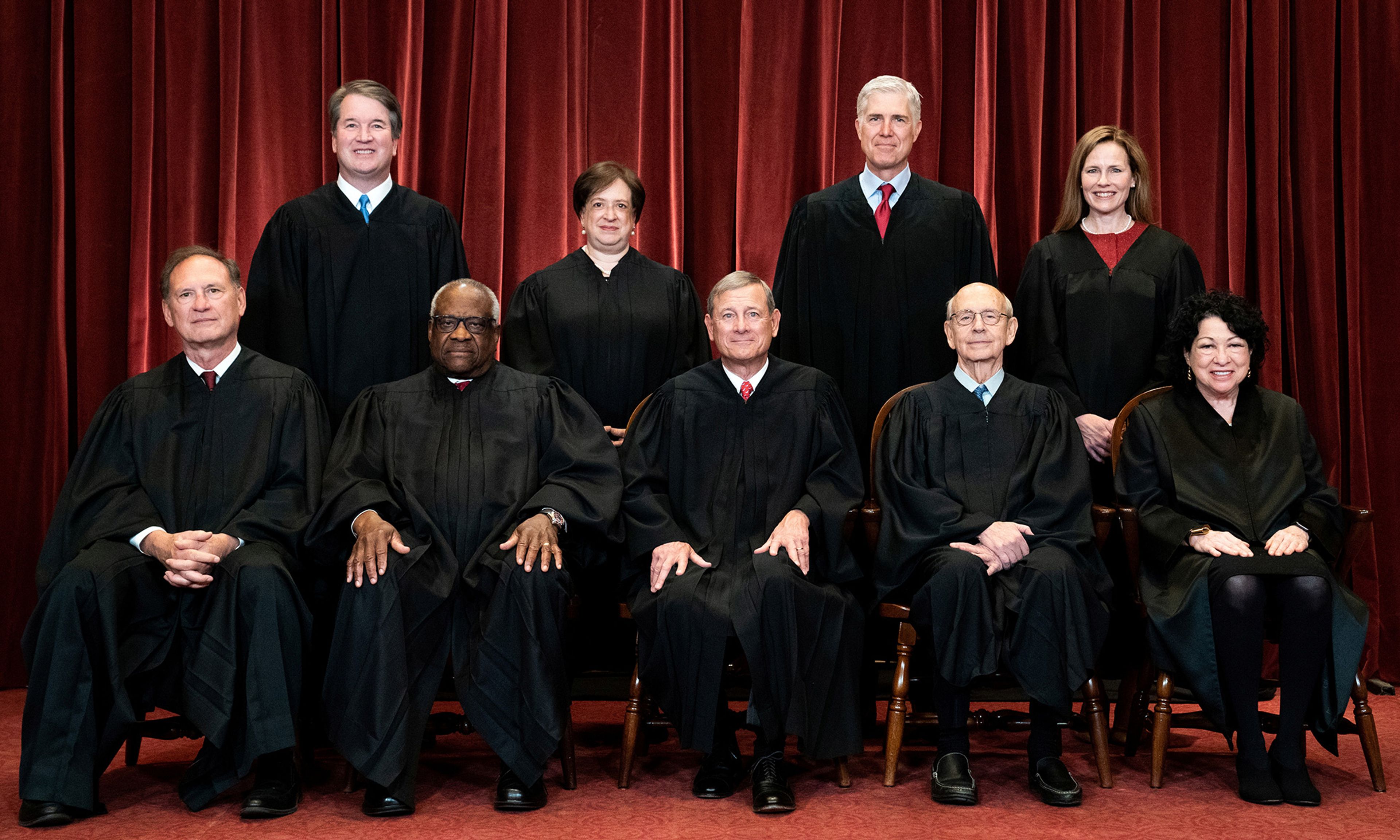
This past June, the Supreme Court issued Terry v. United States, in which Justice Clarence Thomas, writing for the majority, used the adjective black. In her partial concurrence, Justice Sonia Sotomayor capitalized it: Black. She was the first justice — apart from a 1971 anomaly in an opinion by Justice William O. Douglas — to use the capitalized Black as a racial designation. Until April of this year, her opinions uniformly put the term in lowercase.
The shift doubtless reflects the changing standards of style guides, many of which in 2020 started recommending Black over black. Mind you, the debate on this point goes back much further, but not until 2020 did a great many stylistic influencers, such as the Columbia Journalism Review and the Associated Press, endorse capitalization. Last year saw a very public shift to Black. If you’re reading attentively in newspapers today, you’re likely to notice references to “the Black and white populations” of a given locale — capitalizing one but not the other.
It’s the editorial expression of the need for social justice. The shift may be traceable to the ghastly murder of George Floyd. At first this may seem less than plausible; on reflection, it seems almost inevitable. There’s a community in our midst that needs compassion, respect, and support from people in power.
On the Court, the Black/black issue is the culmination, for the time being, of a long stylistic evolution in how it refers to the descendants of American slaves. We’re sure to see more discrepancies in coming years — not just in Supreme Court opinions but in everyday reading.
Let’s look at the history.
In the first half of the 19th century, white writers generally used the term colored in reference to enslaved or free people of African origin. Then, after the Civil War, the lowercase negro became predominant, even though contemporary style manuals suggested that colored was still usual. The rise of negro coincided with its promotion by several prominent advocates, including Booker T. Washington (1856–1915) and W. E. B. Du Bois (1868–1963).
Supreme Court usage was a little different. For most of the 1800s, the Court typically used negro (always lowercase) as both noun and adjective. It used colored less often early in the century but gravitated toward the word as it declined in general usage. After the Civil War, the Court began using black in some references — always in lowercase.
At the beginning of the 20th century, writers in general began mostly capitalizing Negro. By the 1920s, that form had become dominant, and by mid century it was almost uniformly written that way. In 1926, the Government Printing Office Style Manual had this to say: “Capitalize [Negro] only when used as a synonym for entire race, or in juxtaposition with other races, as Caucasian, Chinese, Malayan, etc. Lower-case when used as a common noun or adjective, as a negro, negro dialect, negro dentist, etc.” The term colored wasn’t mentioned at all. By 1937, the manual was updated to recommend always capitalizing Negro.
Despite all these changes in general usage, the justices at the time didn’t change their style. They continued to use colored until 1928 and the lowercase negro for much longer. Between 1940 and 1946 — a particularly contentious time on the Court — the justices disagreed on whether to use negro or Negro. The last holdout was Justice William O. Douglas, who insisted on lowercase negro for a long while after his colleagues had adopted the capital.
Within the African-American community, opinion polls showed that the preferred label had shifted rapidly in the 1960s from Negro to black. Even so, during the 1960s the Court used Negro three times as often as black. In opinions of the 1970s, the two terms were about equally frequent. The last occurrence of Negro in straight print (as opposed to a quotation or a party name) occurred in 1984.
In 1970, Justice John Marshall Harlan II was the first to use Afro-American. That term appeared in justices’ writing in 21 cases from 1974 to 1991. Justice Thurgood Marshall, who had come onto the Court in 1967, would adopt it as his preferred term. At the 1991 news conference when he announced his retirement, he was asked whether the state of “black people” had improved during his 24-year tenure. He bristled in answering: “I am not a black people. I am an Afro-American. Now, do you want to talk about Afro-Americans?”
Even if Afro-American was abandoned by the Court after Marshall’s departure, the late 1980s saw a major societal shift to African-American. In 1988, Jesse Jackson and other leaders announced that this term was to be preferred. It first appeared in a Supreme Court opinion in 1991 but was used less often than black throughout the 1990s. In this century, stylistic divergences on the Court have persisted. African-American now appears more often than black, but often both appear in a single opinion.
You may wonder how the phrase people of color fits into the picture. It has come to be a hypernym, meaning it’s a broader term, literally: It conventionally includes not just African Americans but also other racial minorities, such as Asians and Latinos. The Court has used the phrase only six times since 1989 — most recently this year, in an opinion by Justice Sotomayor. It may surprise you to learn that the phrase appeared in eleven decisions from 1813 to 1896, including the infamous opinions in Dred Scott (1857) and Plessy v. Ferguson (1896). These 19th-century references were exclusively to black people — and often in disadvantageous judicial decisions.
Are these questions of nomenclature trivialities? Decidedly not. It’s not trivial what you call a person or a whole group of people — especially a group that the law considers a protected class. Yet though I’ve laid before you all the mainstream choices, and something of their histories, I imagine you’re not entirely clear about your own way forward. I’ll bet the Court isn’t, either.












Comments