Petoskey, Mich. — When Ernest Hemingway drove to northern Michigan in 1947, he had not seen his boyhood haunts for more than a generation — not since leaving them behind in 1921 and moving on to Paris and fame. He also never saw them again. His visit lasted about a day, an out-of-the-way stop on a road trip between Florida and Idaho. Its purpose is unclear even among Hemingway buffs — and the larger question of why the author of The Sun Also Rises, A Farewell to Arms, and For Whom the Bell Tolls avoided the place he had grown up loving is a small mystery.
“I’m trying to figure it out,” says Christopher Struble. We’re meeting for dinner on a snowy night in Petoskey, where Struble owns a jewelry store and serves as president of the Michigan Hemingway Society. “I love Michigan, and I love that Hemingway loved Michigan,” he says. “We have more authentic locales associated with Hemingway than anywhere in the world. I can put you within five feet of where he fished.” He makes the claim as we drink pints of Two Hearted IPA, a beer whose name refers to the fishing story that may be Hemingway’s first masterpiece: “Big Two-Hearted River,” a 1925 tale about a character’s recovery from trauma. It takes place in the wilderness of Michigan’s Upper Peninsula; the beer is brewed downstate, in Kalamazoo.
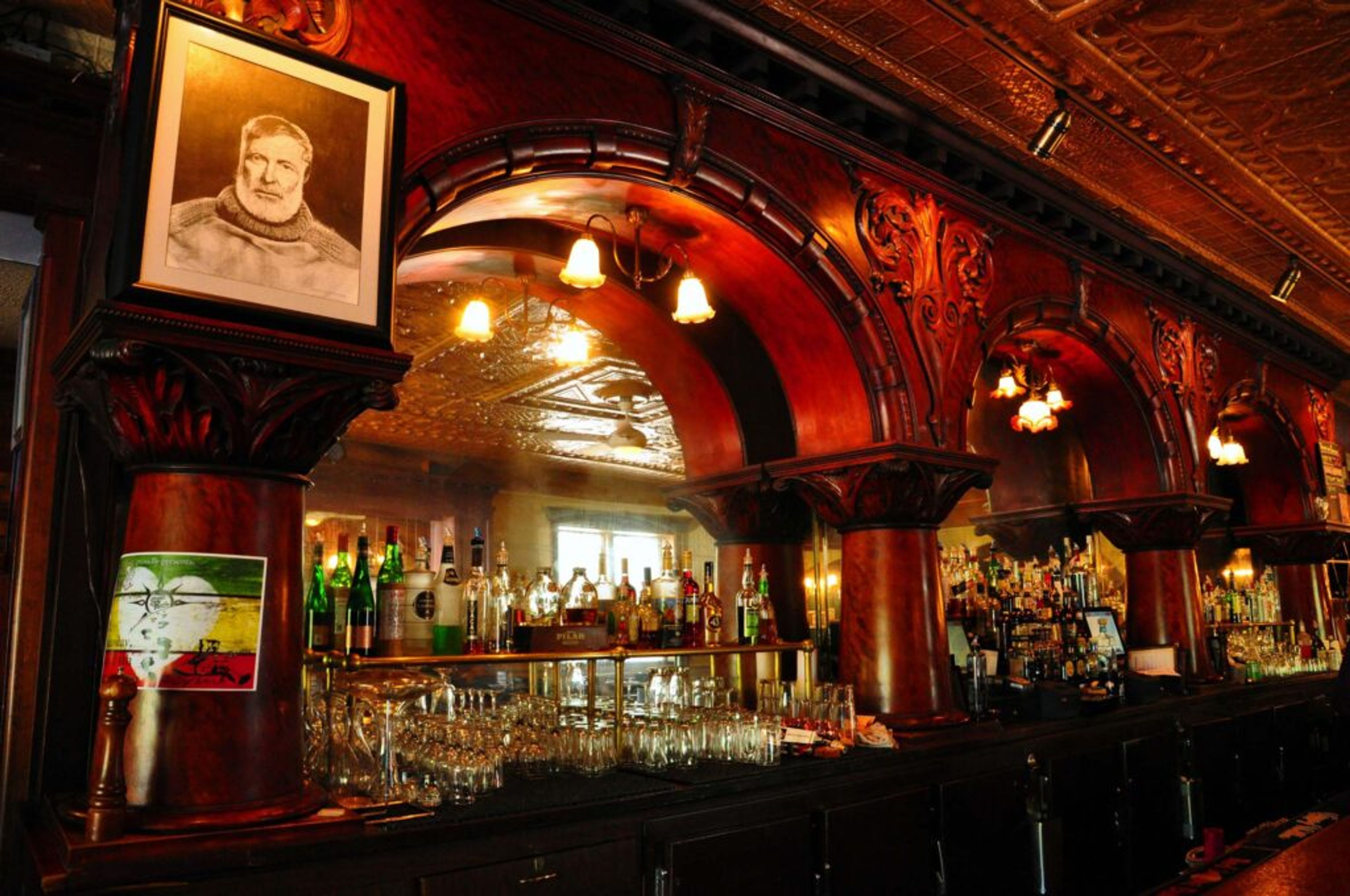
Our dinner is at City Park Grill, an old restaurant that displays a photo of Hemingway above its bar, close to where he supposedly sat when he returned from World War I as a wounded ambulance driver. The claim that he imbibed at the bar may be more legend than fact, as Prohibition was in effect, but Hemingway almost certainly knew the building. It probably inspired the saloon he described in one of his later stories, “A Man of the World,” written in 1957. That’s according to a shield-shaped plaque on the restaurant’s exterior, one of 17 in the region posted by the Michigan Hemingway Society. “We’re trying to make it easy for tourists,” says Struble, who has promised to show me around the next day. I’ve already seen many of the area’s Hemingway sites, but in a do-it-yourself fashion, clutching a map printed from the internet. I’m eager to explore them with Struble, who may know more than anybody about Hemingway’s time in Michigan.
Elsewhere in the United States, Hemingway is associated with his birthplace museum in Oak Park, Ill., a compound in Key West, Fla., and a grave near Sun Valley, Idaho, where he killed himself in 1961. There are also the international spots: the bookshops and cafés of Paris, Harry’s Bar in Venice, and Finca Vigía, his pre-Castro home near Havana. Then there’s Michigan, often overlooked, where he spent every summer of his youth. His father built a cottage on Walloon Lake and his mother named it “Windemere,” in tribute to her ancestors from England’s Lake District. Hemingway’s relatives continue to live in it.
In the popular imagination, Hemingway is more than a writer who scribbled at a desk: He’s a celebrated outdoorsman who fished for marlin in the Gulf Stream and hunted cape buffalo on safaris in Africa. His passion for such pastimes was born much earlier, as he plucked trout from Michigan’s streams and shot birds and squirrels in its forests. Yet in the final 40 years of his life, his only return to the place that had formed him was that jaunt in 1947.
I also spent large chunks of my boyhood “Up North,” as Michiganders call it, at a lakeside house my grandparents built before I was born. It’s in the less affluent northeastern part of Michigan’s Lower Peninsula, but it’s close enough to Petoskey and Walloon Lake for me to have felt a distant kinship with the man who, except for the Motown musicians of the 1960s, may represent my native state’s greatest contribution to art and culture. Unlike Hemingway, though, I couldn’t give up northern Michigan. Year after year, I have kept going back to the family place.
My personal interest in Hemingway started with high-school homework. Reading The Old Man and the Sea turned me on to him, and my attraction grew as I discovered our mutual connection to Michigan. At Hillsdale College, I once taught a course about his Michigan stories. As a journalist, I’ve written about his ties to Michigan for the New Criterion and the Wall Street Journal. I’ve also gotten to know the sites. One attraction is Petoskey’s Carnegie Library, where Hemingway as a young veteran talked to the Ladies’ Aid Society about his war service. Another is the Little Traverse History Museum, whose artifacts include an oil lamp and two chairs from Windemere, a helmet and a canteen that Hemingway brought back from the Italian front, and a copy of A Farewell to Arms with a handwritten inscription to his friend Dutch Pailthorp, “to whom I told this story in the winter of 1919–20 in Petoskey, Michigan.”
Among my usual stops in Petoskey is McLean & Eakin Booksellers, a two-story shop in the Gaslight District. Almost the first thing customers see when they enter the front door is a bookcase packed with Hemingway titles. “Every single day someone comes in for a book by or about Hemingway,” says Zach Matelski, the general manager. At my request, Matelski consults the store’s records. The most popular book by Hemingway is The Nick Adams Stories, a volume of tales set mostly in Michigan about a character who is often regarded as Hemingway’s alter ego. Over the past 20 years, McLean & Eakin has sold more than 2,400 copies.
I once had a chance to visit Windemere — a rare opportunity because it’s a private home. Most of the locals refuse to give directions. They don’t want sightseers overrunning the residential areas of Walloon Lake, and, perhaps more important, they try to protect their neighbors from gawkers. My excursion was in 2012, during a conference of Hemingway scholars in Petoskey. For a $50 donation to the local historical society, we could spend an hour or so at the cottage. On the frame of a door that led to the lake, I saw century-old pencil scratches that marked the growth of “Ernie” and his siblings. And although Windemere at some point acquired indoor plumbing, an outhouse still stood, with a sign on its door: “Ernest Hemingway sat here.”
On this trip, I’m staying where Hemingway once slept, at Petoskey’s Perry Hotel, which was built in 1899, the year of his birth. The author spent a night at the hotel in 1916, on his way to Windemere from Chicago. The clerk at the registration desk smiles when I ask which room Hemingway occupied: “I get that all the time.” He adds that the records are long gone and that even if they existed it wouldn’t matter. “The hotel has gone through so many renovations that it’s impossible to know anything,” he says. “His head was probably in what’s now room 206 and his feet in room 207.” As it happens, I’m in room 324.
Struble lives a few blocks away, above a store that used to be Braun’s Restaurant, which Hemingway changed to “Brown’s Beanery” in The Torrents of Spring, a short 1926 novel set in Petoskey. Hemingway wrote it quickly to escape from a book contract. Although McLean & Eakin has sold nearly 500 copies over the past two decades, few readers recommend it, including Struble. “I have another theory about Braun’s,” he says. He thinks Hemingway used it for the main setting in “The Killers,” one of the writer’s best-known stories. The plot involves a couple of mob hit men and their target, a washed-up boxer who is resigned to his fate. (In a 1964 movie adaptation, Ronald Reagan played one of the gangsters in what was to be his final role before he ran for governor of California.) The tale, published in 1927, takes place in Summit, Ill., but an early typescript, now archived with the Hemingway papers at the John F. Kennedy Presidential Library in Boston, names the setting of “The Killers” as Petoskey.
In Hemingway’s time, Petoskey was a resort town. It’s still one today, with boutiques and art galleries on its main drag. McCarthy’s Barbershop, where Hemingway once went for shaves and cuts, is now Ruff Life Pet Outfitters. Across the street was Jesperson’s Restaurant, supposedly a hangout spot for Hemingway and his friends. I once had lunch there, but it closed in 2017 and today is High Five Spirits, an upscale distillery. “He’d be okay with that,” jokes Struble.
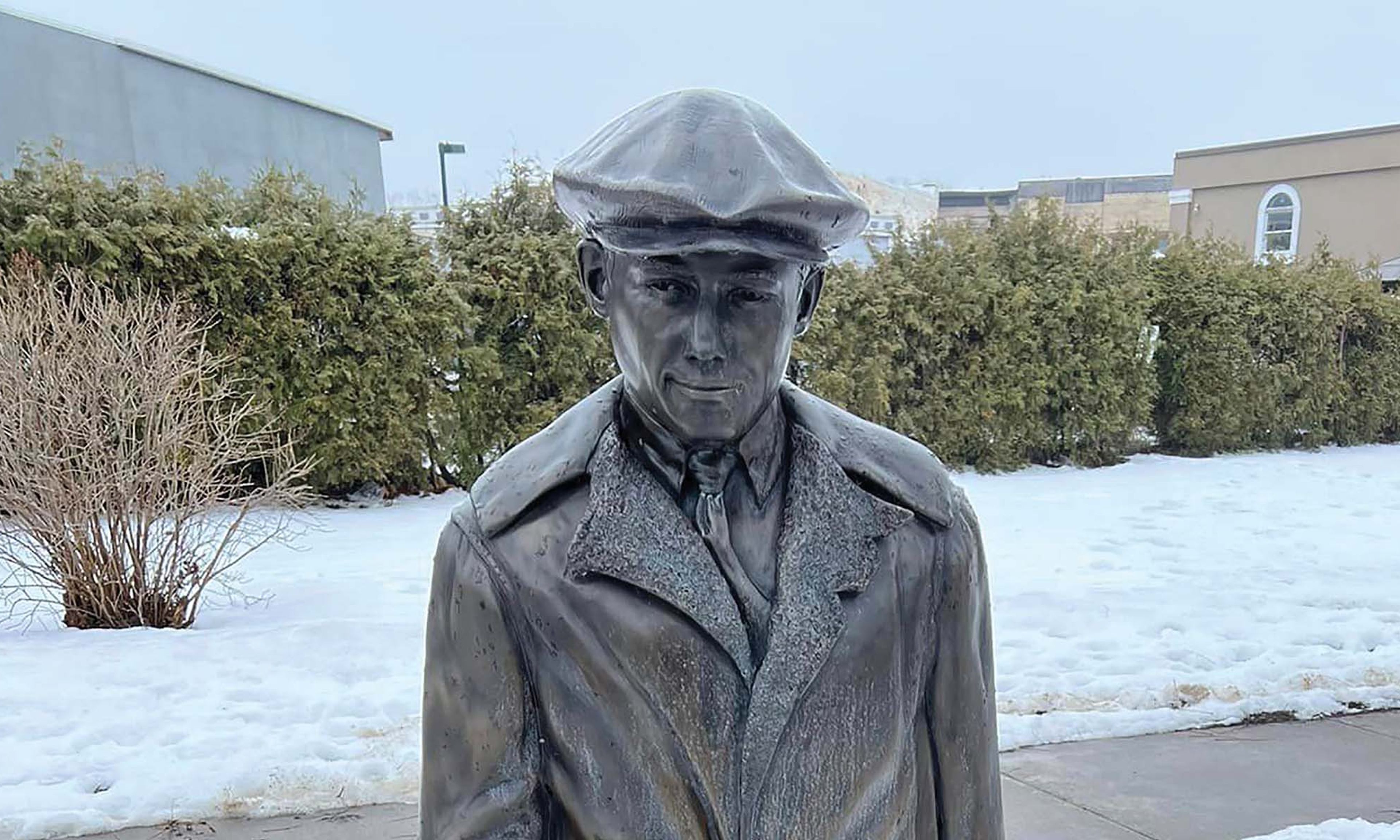
Our tour goes by the train station that Hemingway’s family often used and a nearby bronze statue of the young author. Based on a photograph, it shows him holding a suitcase as he gets ready to board an outbound passenger car. A highlight of our circuit is the former Potter’s Rooming House, where Hemingway lived in the fall of 1919. In a letter to his father that October, Hemingway described acquiring a typewriter and working on his fiction. His efforts from this period were mostly failures, but they were also the start of something that within a few years would lead to the likes of “The End of Something,” a breakup story set in nearby Horton Bay, which is where Struble soon drives us in his black Jeep Wrangler.
Horton Bay is a speck of a town on Lake Charlevoix. Hemingway often walked to it from Windemere and met friends. “If Hemingway were to come back today, he’d recognize it,” says Struble. “It’s lost in time — and that’s not true of the other places.” As we approach the lake, Struble parks his Jeep beside a marshy area. He points to a small spring, pulls out his copy of The Nick Adams Stories, and reads from “Summer People,” written in 1924 but not published until after Hemingway’s death. It still describes the scene in 2024: “The water came up in a tile sunk beside the road, lipping over the cracked edge of the tile and flowing away through the close-growing mint into the swamp.” When we get to the beach, we are at the setting of “Up in Michigan,” a story of seduction and rape whose title is a double entendre. Across the water — now frozen because this is January — we see “the point” from “The End of Something.”
One of Hemingway’s friends in Horton Bay was Katy Smith. She later married John Dos Passos, the novelist who in his later years wrote for National Review. Through her, Hemingway met Hadley Richardson, his first wife. They were married at a Methodist church in Horton Bay in 1921. After honeymooning at Windemere, they left — and Hemingway never came back to northern Michigan, except for that one time.
Struble speculates that Hemingway returned in 1947 to settle some unfinished business involving the ownership of Windemere. The idea sounds plausible but lacks evidence. Struble spent several weeks in February and March working with a researcher to look for documents in Emmet County’s courthouse and elsewhere. They turned up nothing. “We’re still on the case,” he tells me by phone when I check back in. Perhaps they’ll yet make a discovery.
If they do, it might reveal why Hemingway came back to northern Michigan, but it won’t explain why he stayed away. Hemingway possibly buried a clue in a 1923 letter, written less than two years after his departure. He was living in Paris, and his stories about Michigan were starting to click. “We can’t ever go back to the old things or try to get ‘the old kick’ out of something or find things the way we remember them,” wrote Hemingway. “We have them as we remember them and they are fine and wonderful and we have to go on and have other things because the old things are nowhere except in our minds now.”
Hemingway was more specific with Irene Gordon, an old flame who was working at a department store in Petoskey. In 1994, when she was in her 90s, she told a newspaper reporter what Hemingway had said in 1947 when she quizzed him about his long absence: “Every time I came back to somewhere, I was disappointed, and I loved Michigan so much I didn’t want to be disappointed.”
It was embedded in his memory, where he could return to it again and again, in the way readers might open an old book and enjoy a familiar story.












Comments