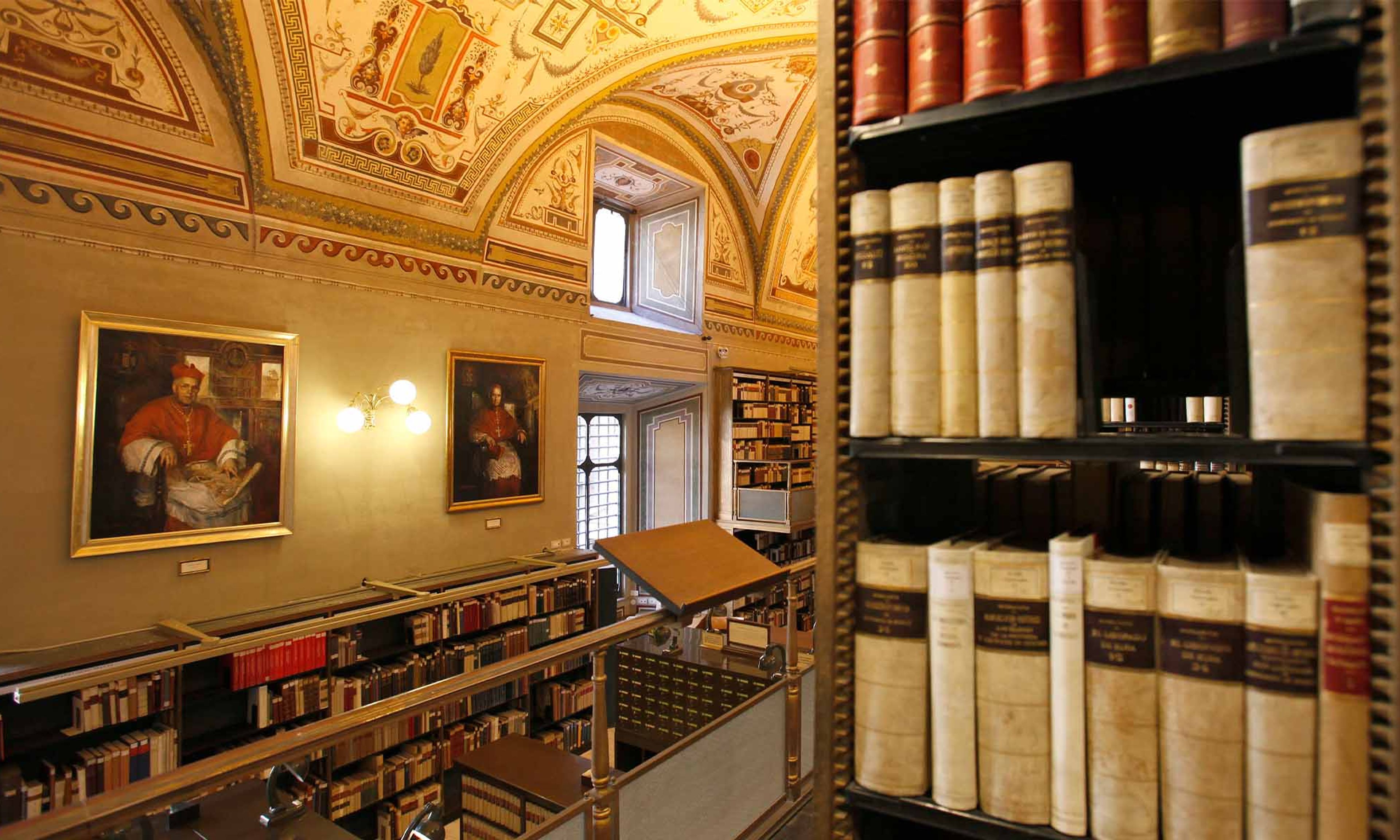
In the Kádár regime of communist Hungary, a relatively liberal culture minister devised a formula for classifying publications: Tiltott, Tűrt, Támogatott (forbidden, tolerated, supported). This bears a striking similarity to the net outcome of the Catholic Church’s ultimately doomed attempt to keep the artistic and scholarly works of which it disapproved out of the hands and minds of the faithful. The story is described in painstaking detail in Robin Vose’s stimulating and entertaining new book.
The sections on “scandalous images” and “scandalous music” occur toward the end, from which the exemplary plum of the pious work of Daniele da Volterra (also known as “Il Braghettone,” or “breeches-maker”) might be plucked. His job was to cover the nudity of figures on Michelangelo’s ceiling of the Sistine Chapel with tasteful drapery or foliage. The figures of Saint Blaise and Saint Catherine of Alexandria required remodeling, as the former appeared to be gazing wistfully at the latter’s shapely nude bottom.
More often the censors’ objections were liturgical or iconic; the Venetian Inquisitors’ examination of Veronese’s Last Supper (1573), commissioned for the Basilica dei Santi Giovanni e Paolo, the Dominicans’ principal church in the city, is such a case. They objected to figures of those not mentioned in the Gospel account, such as a servant with a nosebleed and one of those utterly charming dogs that were a feature of contemporary Venetian paintings. Veronese might have responded by pointing out that Saint Dominic himself is sometimes represented together with a dog, since his mother is said to have dreamt that a dog with a flaming torch in its mouth jumped from her barren womb before his birth — and, besides, the Dominicans were known as “Domini canes” (hounds of God) on account of their counter-reformatory zeal. Even so, the Inquisitors demanded that the offending canine be painted over with an image of Mary Magdalene, co-patroness of the order. Veronese would have none of it and simply renamed the painting “The Feast in the House of Levi.” “We painters take the same liberties as poets and madmen,” he said coolly.
Vose’s book is primarily concerned with the printed word, formerly available to only a small circle of highly educated people. Communism too was most afraid of the logos, more insidious and more difficult to control than the image. In both cases, totalitarian communism and Counter-Reformation Catholicism, the main objective of banning objectionable books was to shore up authority and power dependent on obedience, if not always acceptance. The church’s overriding concern was that believers not imperil their immortal souls through exposure to matter deviating from the orthodox teaching of Mother Church. Like harsh measures taken against the rebellious schoolboy, her strictures were imposed as much to protect the vulnerable as to punish them.
There is a marked difference in the ways that the defenses of the Christian and the Marxist religion were carried out. From Arianism to Protestantism, Christians were a disputatious lot, and learned prelates argued at great length as to whether specific works were heretical. The classic case is that of Erasmus of Rotterdam (circa 1466–1536), about whose writings the clerics and scholars disputed for the entire history of the Index. Vose identifies the most enduring issues that caused the censors’ headaches — the De Auxiliis conundrum, concerning free will; Copernican heliocentrism, Galileo’s nemesis; and Protestant Bibles in the vernacular. The Vulgate remained the gold standard for the Roman church — only in 1757 did Benedict XIV authorize an Italian version with the Latin in parallel columns, resulting in a 23-volume publication completed in 1781 and not exactly handy for the layman.
The Enlightenment provided a new set of problems, embracing as it did unwonted and unwanted notions such as tolerance, religious skepticism, and a secular reliance on an empirical scientific method that might lead in a heretical direction. Thus the philosophical and sociopolitical ideas growing out of the 17th century — from John Locke, for example — were the counterpart of a threat that included serious and scholarly challenges to theological rectitude. These included Deism, which rejected revelation as the foundation of truth, and Jansenism, which flirted with ideas similar to the Protestant notion of predestination.
It would be wrong to treat the church’s efforts as not only futile but ridiculous. To his credit, Vose does not. What he does do is demonstrate the ebb and flow of censorship, partly conditioned by the respective liberalism of individual popes and partly by the political and secular constraints that the papacy might be facing at any given time. This explains, for example, how De Monarchia, a tract by the pious Dante, was placed on the Index in 1585 — some 270 years after it was written. That was entirely because he favored the emperor’s side in the 14th-century struggle in Italy between Guelphs and Ghibellines, supporters of the secular powers of, respectively, pope and emperor.
Books on political theory were de facto potentially dangerous and subject to much scrutiny and debate by the Inquisition. Robert Bellarmine (1542–1621), a cardinal, inquisitor, Jesuit, and sophisticated scholar, nevertheless was one of those who voted that the intellectual genius Giordano Bruno (a heretical Dominican) should be burned at the stake in 1600, and it was he who issued to Galileo an instruction to desist from maintaining the truth of the Copernican heliocentric theory. Yet, says Vose, Bellarmine felt that Machiavelli’s The Prince, notwithstanding its intolerably immoral defects, was too valuable to be consigned to the flames.
The halfway house in such cases was often expurgation, which has almost as long a history as censorship itself. Today we are revisiting a phenomenon we thought long defunct: the bowdlerization of texts (particularly of children’s books and fiction generally) by “sensitivity readers.” Officially such readers are expurgating books in behalf of those who might be “harmed” or “triggered” by them; in reality, an ideology (“wokeism”) is being imposed just as indefatigably as the learned members of the Congregation of the Index instituted by Pius V in 1571 tried to uphold orthodoxy.
In the case of Catholic expurgation, Vose remarks that it sometimes resulted in long lists of corrections, which were published separately in the Index Expurgatorius — to Protestant scholars, a document of value almost as great as that of the Index itself. Thomas James, the first head of the Bodleian Library at Oxford, remarked in 1627 that the Index, since it represented the very best in Protestant thought, was “an invaluable reference work to be used by the curators of the Bodleian Library when listing those works particularly worthy of collecting.” An unauthorized edition of a Spanish expurgatory Index that appeared in 1601 irreverently included an introduction pointing out the numerous harmless or trivial passages the censors had suppressed in a wide range of books. Ridicule was arguably a greater danger for the censors than indignation — and so, perhaps, it has always been.
In 1571, at the Vatican, the Sacred Congregation of the Index took over (officially, at least) the ferret work of the Inquisition and reflected the somewhat erratic censorship favored by individual popes. It based itself on the ten Tridentine rules for control or suppression of publication and stuck to principles rather than specifics, though it did say that all books condemned by popes or church councils before 1515 were ipso facto banned. The Roman Index, however, was a comparatively late arrival on the scene; Indexes had already been in operation in the Netherlands (1529), Venice (1543), Paris (1544), Spain, and Portugal. Not all the Indexes agreed with one another, so an author considered heretical or simply undesirable in one country might be freely read in another. There was sometimes stout resistance, particularly in Venice, which had not only its revered and obstinate painters but also a very successful and illustrious printing industry.
Now and then Vose gives us some insights into the personality and character of the censoring mind, which is not always what you might expect. Benedict XIV (1675–1758), for example, added his own 3,300-book library to that of the Vatican, corresponded with the philosophes, and removed the long-standing ban on books dealing with heliocentrism (a move that led to the rehabilitation of Galileo). Yet he was also a stern Thomist, Aquinas being the fixed star of Catholic theology. As a canon lawyer, he was convinced of the necessity and value of appropriate censorship. That he read Protestant books and added to the Vatican’s oriental-manuscript collection may remind us that the communist nomenklatura possessed copies of Orwell’s books and others that were prohibited.
If you scroll down the list of authors who appeared on the Index in its later years, it reads, says Vose, “like a veritable who’s who of modern authors” — including Stendhal, Flaubert, Zola, and Anatole France. They were “mostly, but not all, European and Catholic (as had been the case since Trent, Protestant authors were not generally listed since they were already banned ipso facto).” Saint-Simon, Comte, and Proudhon were indexed but not Engels or Marx or even Darwin (though books explicating his theory were). This must indeed have been a relief to compilers, since the Spanish Index in its heyday had exceeded 1,000 pages. Such inconsistency produced the amusing situation that writers such as D. H. Lawrence and Henry Miller or James Joyce, a lapsed Catholic, were censored by the secular authorities but not by the church. Graham Greene, a struggling Catholic convert, was considered an Index candidate for his depiction of an alcoholic priest in The Power and the Glory (1940), but the church settled for a private admonition, on the grounds that the Holy Office (the Congregation of the Index had been dissolved in 1917) feared unfavorable publicity from banning such a high-profile catch. Greene promised to do better.
By then the Index was dying, partly from 19th-century overreach and partly from popular disdain and mass literacy. It was finally abolished in 1966 by Pope Paul VI. In his conclusion, Vose makes a sharp point when he reminds us that academics in the past were co-opted as reporters for the Index: “University professors sometimes became victims of Church censorship and had their own writings placed on the Index; but more often, they were in fact censors. And this was especially true when it came to silencing the unpopular opinions of their own peers.” My modest proposal is that these two sentences be attached to every contract of employment of those embarking on an academic career today, together with an additional sentence stating that any evidence of attempted censorship, no-platforming, or other activist impediment to free speech undertaken by teaching staff will be treated as grounds for nonrenewal of contract, or non-preferment to tenure, or removal of the same, as appropriate.











Comments