To borrow a phrase from the great Abba Eban, progressives “never miss an opportunity to miss an opportunity.” Eban said this of Arabs for their pattern of foolishly rejecting deals with Israel. Since then, many Arab countries have gotten smart, making peace with Israel. Progressives remain stupid.
Progressives, from the center-left to the far left, both inside and outside government, view moral issues through an absolutist lens and reject any incrementalism or pragmatic compromise in U.S. policy. For some reason, they have decided that LGBT liberation takes precedence over the acquisition of basic political rights. By elevating LGBT rights and making them synonymous with liberal democracy, they have been wasting precious time in advocating freedom around the world, even making liberal democracy look repulsive to culturally conservative and orthodox nations still hostile to LGBT rights.
A reporter recently asked National Security Council chief communications officer John Kirby about a bill in Uganda, which was awaiting the president’s signature, that would condemn homosexuals to lifelong imprisonment. Unsurprisingly, Kirby denounced the bill. But then, he went on to cite President Joe Biden’s “foundational belief in human rights,” adding, “And LGBTQ+ rights are human rights. And we . . . are never going [to] shy away or be bashful about speaking up for those rights and for . . . individuals to live as they deem fit, as they want to live. And that’s something that’s a core part of our foreign policy, and it will remain so.” It’s noble to argue that individuals should live as they deem fit, but it is troubling that, when the administration wants to showcase its human-rights credentials, it too often elevates LGBT rights over more basic freedoms that are owed to the entire population, LGBT or not.
The bill passed by the Ugandan legislature is horrendous and deserves denunciation, and the administration should prevent its enactment if it can. But if we are to judge anti-freedom political decisions in Uganda by the magnitude of their effects, persecution of LGBT persons is nowhere near the top.
Freedom House gives Uganda a 35/100 rating and labels it “Not Free.” The government orchestrates sham elections, restricts freedom of the press and expression, and imprisons and tortures dissidents. President Yoweri Museveni has held office for nearly four decades, and it will not surprise you that his son is gearing up to succeed him. Approximately 3 percent of the population is LGBT, so the persecution of LGBT Ugandans affects a relatively small number of people. In contrast, the universal application of unjust policies in Uganda affects 100 percent of Ugandans. Yet those oppressive policies have not impelled Democratic administrations to exert pressure on the Ugandan government.
The LGBT persecution has, though. In 2014, the administration of President Barack Obama briefly withheld aid from the East African country when its government enacted a law condemning people to life in prison for homosexual acts. After the government annulled the law, the aid resumed, and relations went back to normal. But “normal” meant overlooking the violation of the entire citizenry’s basic rights and holding sham elections. A day after his first statement, Kirby said the current administration is considering withholding aid, as the Obama administration had done.
This tells us two things: The administration, for good reasons, believes it can influence the Ugandan government’s domestic conduct, and it considers using its clout for the relief only of LGBT Ugandans rather than to advocate more basic and universal rights for the entire country. This narrow — and misguided — focus on LGBT rights should not surprise us. One of the first steps Secretary of State Antony Blinken took after assuming office was down this path.
During Mike Pompeo’s tenure, the Department of State’s Office of Policy Planning published a report defining its vision of a good human-rights policy. Much to the objection of the American Left, Pompeo’s State Department did not include advancing LGBT rights abroad as central to its mission, explaining that such policies remain contentious in the United States, let alone in more socially conservative foreign societies. In March 2021, Blinken announced an end to the Pompeo-era policy, saying, “I promised that the Biden-Harris administration would repudiate those unbalanced views. We do so decisively today.”
This was a result of the nonsensical backlash against the report from human-rights activists and members of the cultural elite, whose vision for human rights is unreasonable. One letter with 200 signatories took issue with the report’s “disturbing distinction” between “unalienable rights” and what it describes as the “social and political controversies” of “abortion, affirmative action, [and] same-sex marriage,” dubiously claiming that “the weight of both domestic and international human rights law . . . clearly establishes and recognizes the protection of LGBTQI+ rights and sexual and reproductive rights, including abortion, as human rights imperatives.” In this view, LGBT rights should be a core factor in U.S. human-rights policy.
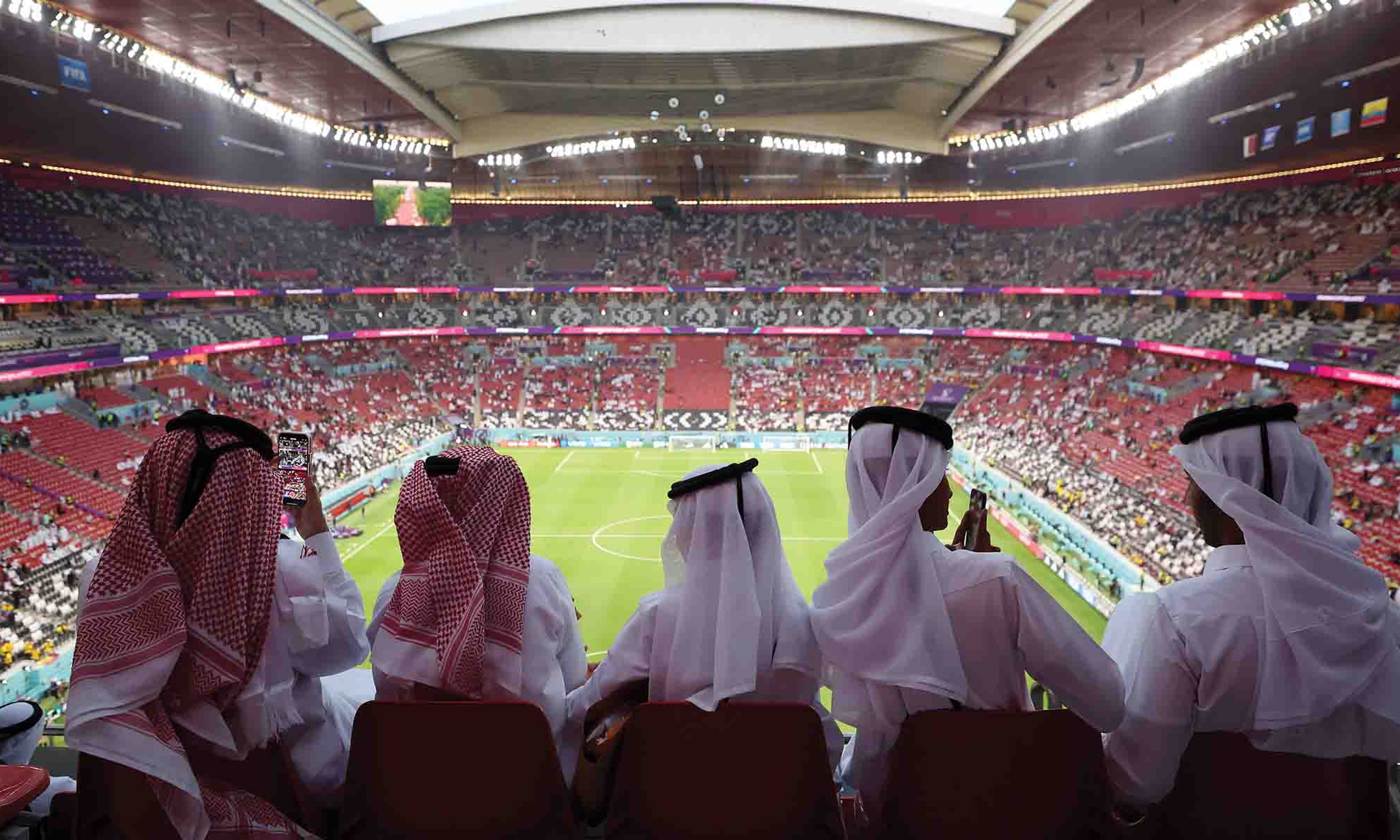
This vision is not limited to politics. It led to a circus in Qatar during the World Cup soccer tournament.
FIFA’s awarding of the World Cup games to Qatar was a scandal, given that Qatar is a state sponsor of terrorism with a terrible record on human rights. To add insult to injury, the decision was the result of a series of bribes from Qataris to FIFA officials, who forgot about their organization’s own “Say No to Racism” campaign when awarding host privileges to a regime that is actively Jew-hating. No wonder the Qataris were neither deterred from subjecting the country’s migrant workers to inhumane treatment nor bothered by the fact that thousands of them died while constructing Qatar’s World Cup facilities.
The treatment of migrant workers was noted in coverage of the World Cup, but it wasn’t what really offended the sensibilities of the cultural elite in North America and Western Europe. In addition to sponsoring terrorism, Qatar is a fundamentalist Islamist state with no freedom of religion, speech, assembly, or, well, anything. You might have thought this lack of freedom would spark outrage among the media elite, celebrities, and North American and European national teams that traveled to Qatar to compete in the World Cup. Except that it did not. They did not join forces to support the right of Qatari citizens to be allowed to criticize their government, worship as they please, form political parties, and have a representative government accountable to them. Instead, they obsessed over LGBT rights.
This choice ended up turning much of the World Cup into a silly culture-war sideshow that served few but the elites who engaged in it. During the match between Wales and the United States, Welsh fans attempted to enter the venue wearing rainbow-colored hats, but Qatari authorities forced the women — not the men! — to remove the hats before allowing them to attend to game. The U.S. national team considered wearing rainbow jerseys to signal its players’ devotion to LGBT rights. Journalists put on rainbow shirts and then jubilantly tweeted about how they were denied entry, proving their moral purity and “alliance.” Some teams considered wearing rainbow armbands, a plan they dropped only after FIFA issued threats against them.
Applying the 3 percent rule, around 10,000 Qatari citizens are not “cisgender” and straight. Granted, those 10,000 are the most persecuted of all Qataris, but what was the point of all the pro-LGBT virtue-signaling when such displays were highly unlikely to change the mind of a single Qatari citizen? Wearing a rainbow T-shirt isn’t the same as risking one’s life to protest state oppression of minorities, a fact that American and European journalists and elites surely know. This is why their “protests” were more about making themselves feel and look virtuous than about advancing freedom for Qataris.
We should all hope for a Qatar — and a Uganda, and a world — where no one is persecuted for his or her sexual orientation. But this is a long journey. In the United States, rainbow rights and protections have morphed into the civil persecution of some other citizens, where parents concerned about bathroom policies at their daughters’ schools are demonized and people with traditional views on sexuality are shunned publicly. America has become so accepting of gays that people will lie about being gay because they believe it will help them get elected to Congress. But it’s worth recalling that it was only 45 years ago that gay-rights activist Harvey Milk was assassinated, and only 20 years ago that laws criminalizing sodomy were on the books in many states. And the United States in the 1970s was still far more liberal than countries like Qatar are today.
Qatar lacks a liberalizing political or cultural tradition. The state ideology of Qatar is Salafism, which holds that liberalization caused the decline of Islamic civilization and that, to return to the Islamic glories of the medieval era, Muslims should return to medieval practices. Unlike in Iran, where citizens regularly protest such strictures, we have no reason to believe that Salafism is despised and resisted by Qatar’s 330,000 citizens. Doha, Qatar’s largest and most cosmopolitan city, is still quite orthodox. One cannot go out without seeing women who cover their faces — not because it’s mandatory but because they are religiously observant, or because their husbands or fathers insist they be observant. It is difficult to imagine that the Qatari population is eager to welcome public expressions of homosexuality.
The message sent by North American and Western European elites and activists to the Qataris during the World Cup was “human rights are equal to LGBT liberation,” which many Qataris, given their embrace of Salafism, translated as “liberal democracy means degeneracy.” There are no reliable public-opinion surveys to accurately assess Qataris’ reaction, but we can safely assume that this message did not create many new converts to liberal democracy in Qatar. Much more likely is that the singular focus on LGBT rights was off-putting for many Qataris who might otherwise be open to the free world’s message of liberty and opportunity.
It is imprudent — in fact, foolish — to demand the recognition of LGBT rights from the citizens of a nation that still imprisons people for blasphemy, drinking, and out-of-wedlock heterosexual sex. Protecting the LGBT from violence is the very end of a liberal project — and one that this author supports — but this is a project that Qatar hasn’t even begun to undertake.
Things are not too different in Uganda. The most recent Pew Research Center survey of Ugandan attitudes toward LGBT rights is a decade old. At the time, 96 percent of the respondents said a society should not accept homosexuality. It is fair to assume that Ugandans have a more accepting view ten years later and that a large number, while disapproving, do not agree that homosexual conduct should merit lifetime imprisonment. But what does it tell Ugandans about our country that the United States is willing to flex its muscles for a community that most believe to be immoral and even degenerate but not for dissidents who speak out for liberalized politics?
The rights of minorities are guaranteed only if a society believes they should be. Socially orthodox and conservative societies will guarantee LGBT rights only if they step out of their negative views about them. Thy can change these views in one of two ways: either through government tyranny and propaganda, akin to that of North Korea, or by having the right to question their traditions.
Freedoms of expression, religion, and assembly, as well as free and fair elections — the basic rights and practices that apply to all citizens universally — should be our objectives. Then, and only then, can societies begin to rethink their old orthodoxies among themselves and move past them. We should try to minimize the persecution of LGBT persons in the meantime, not at the cost of the greater mission, but rather as a side mission. We should be aware that if promoting human rights and democracy becomes synonymous with LGBT rights, then we must bid farewell to human rights and democracy in autocratic countries, and this includes LGBT rights.
With regard to socially orthodox and conservative societies, we should ask ourselves: Why do we have a human-rights and democracy policy — to make ourselves feel good, or to make those societies better? Promoting American values is a terribly difficult and delicate enterprise. Or to quote a Reagan-era memorandum that argued for those values and resulted in the most successful period in U.S. promotion of freedom: “A human rights policy means trouble.” The lack of self-discipline among left-wing liberals — and illiberals — is making it more difficult. Four months after the World Cup concluded, Qatar is nowhere closer to — perhaps farther from — becoming a liberal democracy, and LGBT rights have not advanced either. In Uganda, too, the United States wasted a decade only to return to square one now. We have only ourselves to blame for these missed opportunities.











Comments