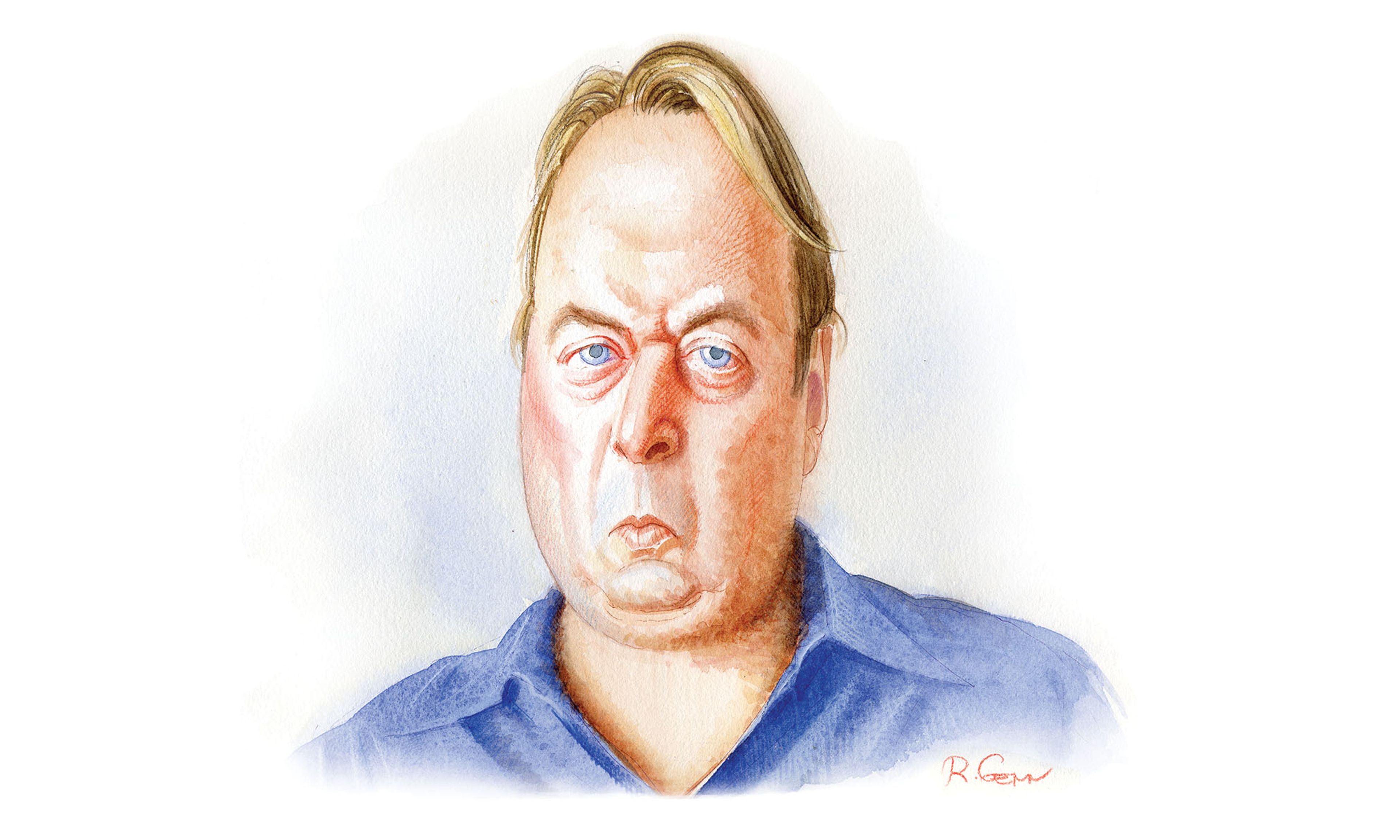
I met Christopher Hitchens in Washington sometime in the 1980s and, almost immediately, fell in love. As a television producer, that is. I was putting out a couple of hundred chat shows each year and, mired as I was in the boilerplate capital of the world, where the fanny-covering language of choice was bureaucratese, I could never find enough good chatters.
There was fun-loving old John McCain, of course, who was reliably keen to possibilities for self-promotion. So keen, in fact, that he would agree to appear on a show and then, on the way to the studio, call from his car to inquire as to what topic he might be asked to address. When it came to national television exposure, Senator McCain required no foreplay. There was young Anthony Fauci of the National Institutes of Health, eager to become the public face of the fight against AIDS. For a legendarily overscheduled professional, the good doctor seemed to be remarkably available for television hits. (In the world of broadcast journalism, the single most important ability is availability.)
There were other talking heads, Reliables both New and Old, who could be stayed by neither sleet nor snow from their appointed media rounds. (When ambitious young Beltway creatures would ask if I could make them famous, I could usually deflect them by saying that I would be happy to do so but they would have to wait for one of the 300 people who appear on television to die.) But none was more refulgent than Christopher Hitchens, who would soon establish himself as the gold-standard guest for talk-show television.
Hitchens was a glib Brit. He had not excelled in the classroom at Oxford, but he had spent some time there, made well-connected friends, picked up a degree (a Third, he once admitted), and then found a place for himself in the bright set of modish London. After that, it was off to America and the main chance.
Hitchens’s accent was unmistakably English but not offputtingly regional, which added at least 20 points to his IQ in the ears of Anglophiliac listeners. Almost always, it seemed, he had just returned from Damascus or Pyongyang or some godforsaken place and could thus be presented more or less plausibly as a “reporter,” as the man, that is, who had been there and seen it with his own eyes and, not incidentally, had secured an explosive one-on-one interview with The Man Himself — not atypically, some dusty tribal chieftain or despotic head case. Hitchens could vouchsafe to our audience, ran the subtext of our segments with him, the secrets of a dark society closed to all but the most resourceful journalists.
Best of all, from my point of view, Hitchens was prepared to discourse on almost any subject and on indecently short notice. He did so crisply, memorably, and apparently knowledgeably. I slid in that “apparently” only because Hitchens’s assertions seemed to grow in confidence as discussion ranged beyond the known world to impenetrably obscure corners of the globe. My professional views in such situations tended to be latitudinarian. If a writer has taken the trouble to airmail himself to Mogadishu, I empathized, he is entitled to present himself as an authority in all things Mogadishuan. (Not with Hitchens, but with certain others who shall be nameless, we felt obliged by experience to extend this courtesy for no more than 60 days.)
Important also to his television appeal — and this is never to be underestimated — Hitchens never bothered to conceal his contempt for most of America’s economic arrangements and for all of her foreign-policy preferences. His own politics were dogmatically and revolutionarily Left — “Trot,” as he and his coterie would say, referring to their deep and deeply implausible attachment to Leon Trotsky, the “good Communist” of the Bolshevik Revolution. (It is a romantic trope of the hard Left that the loser in a power struggle, almost any loser, would have been much the superior leader of the revolution, almost any revolution, than the historical winner.) Hitchens’s unreconstructed leftism played well with our viewers. There is a masochistic streak snaking through semi-well-educated America that loves a good beating administered by a literate, condescending, and preferably dissolute Oxbridgian. Hitchens served that audience jolly well, and I loved him for it.
That was my relationship with Hitchens for most of a decade. Casual, correct, and thoroughly transactional. Every now and again, I would offer him airtime, the inflatable cushion upon which his reputation as an expert floated, and in return he would give me a few minutes of well-turned and caustic commentary. Slam bam. As we used to say as he waved his goodbyes, “Domino’s Pizza and Christopher Hitchens deliver.”
I never knew him well. Indeed, I was never quite sure what to call him. People who knew him not at all called him “Chris.” That was a tell, identifying a Hitchens groupie, a member of what was then a tiny dissident cell in Reagan’s rightish D.C. His friendly acquaintances called him “Christopher.” His good friends seemed to call him “Hitch.” (He sometimes called himself “The Hitch,” which would have been insufferably third-personist save for the hint of a redeeming twinkle.) One day, after a long shoot, I called him “Hitch” and he shot me a reproving glance. I retreated to the safe space. “Christopher” it would be.
I learned two other things about Hitchens during those early years, both of them so distinctive as to be almost singular. The first was his unusual relationship to strong drink. It is the convention of television producers to provide a “green room” — so called for reasons lost to history, or at least to me — as a pre-show refuge where nervous or underprepared guests may gather themselves before impending humiliation. The producers ply the guests with soft drinks and emollient small talk, the objective being to nudge them from where they are, which is in a state of near-panic, to where you hope they will be when the camera blinks, which is in some simulacrum of a personal comfort zone. Your interests as a producer are thus aligned perfectly with your guests’. You want them to perform at their best.
From his very first appearance with us, Hitchens would have none of it. He would cast his eyes cursorily over the green room and, finding nobody worth his time, proceed to wander off. That first time, anxious that I had somehow managed to lose a guest in a midsized office building, I went looking for him and found him in an empty office, talking on the phone as he smoked hungrily and sipped generously from a tumbler filled with a suspiciously dark liquid. The Hitch was not nudging me toward my personal comfort zone.
I sat down across from him, determined not to let him escape my clutches yet again. In no apparent hurry, he continued to talk on the phone, filling the tumbler as needed, which needs gradually accelerated until, finally, they arose at unnervingly brief intervals. The minutes passed like hours. When he finally rang off, we were up against the clock and I escorted him directly to the set.
What happened next was a real gastflabber. As the camera blinked and tape rolled, Hitchens became more fluent, more articulate, more riveting than he had been only moments earlier. What happened to Christopher Hitchens was what we all like to think happens to us in those extra innings of an interminable cocktail party — you know, that moment when your charm becomes simply overpowering, your wit so stiletto-sharp that you must take care not to nick the nice lady standing next to you. Don’t try this at home, my friends, much less at the office, but I am prepared to execute an affidavit swearing to the fact that I once knew a man whose presentation skills waxed in exact correlation to his prodigious alcoholic intake.
Ah yes, the other singularity, if I may put it that way: Hitchens made it a habit, a signature conversational tic, to disparage religion in general and, more specifically, the several iterations of Christianity then most prominent in his adopted country. His tone was not contentious, his manner not table-pounding. It was as if he had been remarking that the weather of late had been unseasonably humid, or that, during their recent losing streak, the Yankees had been playing hapless baseball. He would dispense — laconically, one after another — animadversions against preachers, popes, rituals, relics, prayer as futile, and the manifold embarrassments of religious belief. One did not hear that sort of thing around tight-bottomed and over-lawyered Washington, D.C.
Sometime in the 1990s, we lost contact, Hitchens and I. Whether I stopped calling him or he stopped saying “When will you need me?” I can’t recall. Our relationship ended with no exclamation points expended but with schedules cluttered and interests diverged. It was my loss.
And then early in the new century, quite by chance, we fell for a season into the same social circle. Our company was a band of mid-career media types who would take off the occasional evening to gather for a round of talent-spotting, agenda-setting (yes, middle America, The Conspiracy is very much with us), and, most critically, the prying loose of marginal info-nuggets with short shelf life. (In Washington, it’s not so much what you know as when you know it.) The star of these gatherings, unacknowledged by most of the ego-puffed attendees, was our man Hitchens. He would arrive and make his way around the circle, bantering as he went. (He was a world-class banterer.) Soon enough he would take his place in the kitchen, several of us in tow, and station himself next to the liquor cabinet. Once settled, he would take a stiff drink and declare himself, in no more than languid body language, open to debate. On three of these occasions, I was dumb enough to volunteer for the role of The Other Guy.
The first two debates — deeply etched in my own memory, forgotten, one hopes, by the rest of the world — took up the topic “Does God exist?” With relish, and presumably anticipating a tasty forensic meal, Hitchens snatched the negative side for himself. My goodness, he was high entertainment. He drew from a vast warehouse of historical reference and literary allusion. Name any place, any newsworthy figure, and Hitchens had been there just last month, or had dined with him the previous April. Most stunning of all, Hitchens had that knack, lost now to generations of students taught by unionized teachers, of reciting poetry — not just fragments, I mean, but consecutive stanzas, full poems. I was probably not the only media type shoehorned into that young-married kitchen who was thinking, “Somebody ought to be recording this!”
Hitchens, who by that time had been debating for years, also kept handy a bag stuffed with a pro’s tricks. On those rare occasions when he was backed into a tight corner, or more likely had painted himself there, he would toss a distraction grenade at his opponent. Pausing to recall an obscure date, for instance, he would say something like, “I remember that I was no longer young. I had lost my looks and only women would go to bed with me.” Or, if the argument had turned briefly on a matter of factual provenance, he would muse, “You know, I became a journalist so that I wouldn’t have to rely on the news media for my information.” Apostrophic flash-bangs. By the time his opponent had recovered his compass, Hitchens would have scudded to higher and more defensible terrain.
His arguments against the existence of God were numerous, well wrought, and deliciously quotable. Most of them, disappointingly, were of the faux-scientific sort, as if science might have something definitive to say about life’s enduring mysteries — love, hope, faith, and the like. (It has been the habit of my lifetime to beware literary lions invoking “scientific principles” when the dialectical going gets choppy — as if they bowed to those principles in any context other than moments of rhetorical distress.)
I will not rehearse Hitchens’s arguments here. You may read them for yourself in his many essays and several books on the subject. It would not spoil your own inquiry, however, if I were to inform you that his bedrock position was that religion is a superstition, clung to only by small, weak, and timid minds. He even wrote an entire book attacking Mother Teresa, then one of the two or three most admired women in the world. Titled with Hitchensian cheek, The Missionary Position set forth the judgment that the ascetic, fingers-to-the-bone nun was a fraud and a fanatic. I confess that I read only a chapter or two before concluding, perhaps prematurely, that Hitchens was motivated less by theological curiosity than by the potential rewards of publicity stuntery.
Well, you’re wondering, how did those kitchen debates go? How did your correspondent fare? I think the word we’re looking for here is “thrashed.” Hitchens was the winner by unanimous decision, a judgment supported even by my own traitorous corner men, two friends for whom I had wangled invitations to the soirée. I would have felt far worse about the twin beatdowns, of course, had Hitchens not also thrashed Tony Blair, William F. Buckley Jr., Germaine Greer, and every other master and mistress of the public platform.
You heard it said in those days that Hitchens was the greatest living essayist in the English language. I don’t know about that. I was a Joe Epstein man myself. But the greatest living debater in the English language? On that question I was, unreservedly, a Christopher Hitchens man.*
The good news, such as it was, involved postoperative effects. I had absorbed the best shots from the toughest hombre in town, and there I was, wobbly but unbowed. More than that, in succeeding weeks I found myself hardened, not weakened — structurally reinforced in my own burgeoning views. The ferocity of Hitchens’s attack had forced me to read and to think and to pray. In hindsight, there can be no doubt that Christopher Hitchens, of all the unlikely people, had pushed me closer to God. For that, I am grateful to him. No, I should go max-cliché and state the bald truth that I am eternally grateful to him.
A few years later, 2010 I think it was, word raced around the media circuit that Hitchens had been struck with a particularly nasty disease. Throat cancer. Denizens of the Internet’s nether regions pounced on the news. It was condign punishment, they raged, for a man who had given voice to so much blasphemy. God was taking His revenge, and so on. This Web chatter was more than routinely despicable stuff, and I hoped that none of it would reach Christopher. At the same time, my attention was alerted. It is said with some conviction that there are no atheists in foxholes. I couldn’t help but wonder whether the same condition obtained in the intensive-care wards of Houston hospitals.
Christopher endured a long ordeal with his implacable disease. Against all form, he did as he was told and submitted to confining regimens and gruesome treatments. Throughout, he remained chin up, once describing as “futuristic” a gizmo that shot protons through his body at hypersonic speed. Observers less directly involved might have called that same gizmo “medieval.” Hitchens being Hitchens, he got a book out of it, too. If you can handle a good cry, try Mortality, published in 2012.
For the last year of his life, Christopher was by all accounts, including his own, a model patient even as the reality dawned that he was, as well, a doomed cancer victim. And never once did he wave the white flag. It can be recorded authoritatively that there was at least one atheist in the cancer foxhole at MD Anderson.
R.I.P., Christopher. I admired your courage, both physical and intellectual, but I very much hope that, while you won the debate, you lost the argument. Let me know, will you?
*I mentioned a third debate with Hitchens. It must have occurred in the waning days of 2002 or the early days of 2003. The subject was the upcoming invasion of Iraq, and Hitchens astonished both me and the kitchen cabinet by declaring his unhedged support for George W. Bush’s “discretionary” war. The Hitch! The man who could detect stains of American imperialism invisible even to microbiologists! The man who could be heard well into the 1980s cooing about the unappreciated virtues of Rosa Luxemburg! What prompted Hitchens’s midnight ride from far to my left to far to my right I will never know, but there he was, pounding the drums of war in perfect syncopation with the neo-imperialists. Now that I think of it, I may have won that last debate. Hitchens’s anti-war friends might have sided with me.











Comments