To recognize the crisis in American menswear requires nothing more than a pair of eyes and a bit of historical context. Take a look inside any office building, restaurant, theater, or department store, or down a city street at any time of day: Where once you would have seen men in suits and ties, dress shoes and overcoats, even morning coats and top hats, you now see a parade of dress shirts without ties, puffer jackets, denim jeans, denim jackets, and all manner of inappropriate footwear. Casual wear itself has been degraded — from Shetland sweaters and duffle coats to universal sweatpants. It is not simply in the hinterlands that people dress this way, but also in the corridors of power: Many were rightly aghast when, in deference to the slovenly dress habits of Senator John Fetterman, the majority leader terminated the chamber’s dress code, only for the full Senate to reinstate it unanimously after an outcry.
Or consider that instantly infamous photograph taken around Memorial Day in which Joe Biden met with congressional leaders in the White House. Although all of those pictured were wearing suits, the sins against good taste on display were numerous: from the sneakers and striped socks worn by then–House speaker Kevin McCarthy and House Minority Leader Hakeem Jeffries to the president’s perennially too-tight jacket with too-short, too-skinny slacks. (Since trends in women’s fashion are beyond the purview of this article, I will merely mention without comment the Space Age–style pantsuit worn by Kamala Harris.)
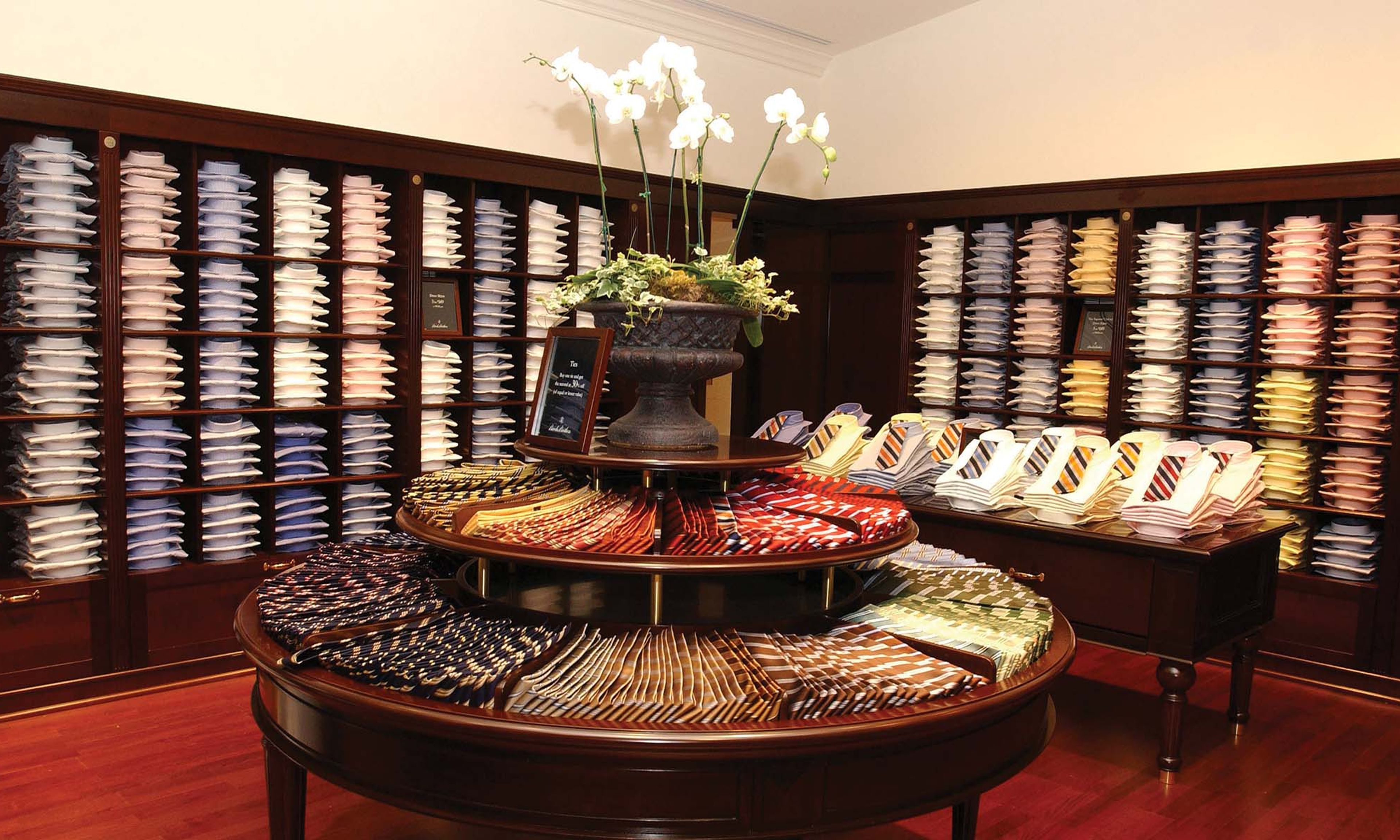
The sartorial confusion among men in positions of power raises a question: Is the dearth of well-dressed men the consequence of a dearth of good menswear stores? To be sure, our governing class cannot plausibly invoke this excuse since they, as part-time or full-time inhabitants of the nation’s capital, have access, at minimum, to the Washington, D.C., location of J. Press, the menswear store that, for over a century, was the preferred clothier for the Ivy League set and therefore wielded great influence on how society’s movers and shakers presented themselves. J. Press maintains a robust internet presence, and its trio of brick-and-mortar stores (it also operates in New York and its home base of New Haven, Conn.) remains vibrant, but it does not extend, in physical form, from sea to shining sea. Thus many men who might ordinarily dress acceptably, aided by the selections at J. Press, have to make do with Macy’s or Men’s Wearhouse or, at best, Jos. A. Bank.
In the middle of the last century, the situation was far different. While stores like J. Press and Brooks Brothers remained the national standard-bearers for Ivy League dress, numerous other local stores sprang up, or shifted gears, to specialize in Ivy-like menswear. An article in the November 22, 1954, issue of Life magazine was perhaps the first to take note of the trend. In “The Ivy Look Heads across U.S.,” two gentlemen are pictured on their home turf. Alex Dearborn, an insurance broker in Houston, is photographed petting a horse beside a split-rail fence, while William Magill, an airline executive in Atlanta, is shown near an airport hangar. Both are wearing natural-shouldered three-button suits of the sort favored by people like Averell Harriman, Elliot Richardson, and George H. W. Bush (not to mention the founder of the magazine you hold in your hands).
Not only were such suits no longer exclusive to the Eastern elite, Life noted, but allegedly “cut-rate clothiers,” including S. Klein, an advertisement for which highlighted all the salient features of the Ivy League aesthetic, were getting in on the action: “The popularity of the natural-looking suit has widened quickly in the last two years as men became dissatisfied with pale bulky suits and flashy ties left over from their postwar splurge.”
To confirm the historical record, I called up one of the few men on the planet who would know for certain: Richard Press, the grandson of J. Press founder Jacobi Press and the most enthusiastic and well-informed exponent of the style that his family’s store helped popularize. It turns out that Life had it right. “At that time, there was at least one Ivy League shop in most of the major cities coast to coast, and certainly in college towns, and there were Ivy departments in many department stores throughout the country,” Press told me. “I mean, if you were living in Steubenville, Ohio, and the president of the bank and the country club,” you were probably an Ivy graduate. “And you wanted to dress like the big shots.”
As it turns out, even J. Press once had to compete for the business of the Yale faculty, administration, and students who wanted to look sharp. “The J. Press competitors in New Haven in 1955 were the Yale Co-Op, which had the lower price, Fenn-Feinstein, White’s, Gentree’s, Arthur M. Rosenberg,” Richard Press said. “I can go on and on and on. And Saks Fifth Avenue had a collegiate department that was very Ivy League–oriented.”
One could live far from the geographical terrain of the Ivy League, then, and still dress as though one were on one’s way to a dinner at the Porcellian Club. Yet, even during the heyday of the Ivy-style stores, the customer base was fairly narrow. “If you had your Ivy shop in, let’s say, Dayton, Ohio, or Boise, Idaho,” Richard Press said, “the only ones that really adopted the style were the college kids, who were trying to copy the Ivy . . . mode of dress, or the corporate leadership of all of those towns, many of whom were alumni of the Ivy League.”
This is a welcome dose of realism. While most men in the 1950s wore suits when the occasion called for them — which was nearly all the time except when at home, mowing the lawn, or changing the oil in the station wagon — that doesn’t mean the suits they chose had any relationship to the aesthetic preferred by Bush, Buckley, and my father. By way of example, Press contrasts the natural-shoulder suits worn by Jimmy Stewart (Princeton ’32) with the square-shoulder suits worn by William Holden (dropped out of Pasadena Junior College) and Gary Cooper (dropped out of Grinnell). “Ronald Reagan [Eureka College ’32] was about as non-Ivy as you can get,” Press said. “Actually, Ronald Reagan in the ’40s and ’50s was the true American fashion of the business class. It wasn’t Ivy.”
Yet eventually the walls closed in on all traditional menswear, Ivy style or otherwise. “It reached its height from the mid ’50s through post-Kennedy through maybe ’65, when Vietnam and all the protests began,” Press reflected, with a touch of melancholy. Of course, the decline and fall did not happen all at once. In 1980, when Lisa Birnbach brought out the deadly accurate parody The Official Preppy Handbook, there were enough Ivy-style stores around the nation to fill a page and a half of shopping recommendations. J. Press and Brooks Brothers were there, but so were a panoply of lesser-known stores: the Bermuda Shop on Madison Avenue, Country Store of Concord in Massachusetts, Hillhouse in Providence, R.I., and Sousa & Lefkovits in, of all places, Southern California. Several of these stores have hung on as themselves — including H. Stockton in Atlanta — while others have become bastardized self-parodies (L.L.Bean and Lands’ End). Most, though, have gone the way of the dodo. These days, there’s a mere smattering of independent Ivy-style stores, and if you shop for this type of clothing (or order by phone or online) you know what and where they are: Cable Car Clothiers in San Francisco (which made the Preppy Handbook 44 years ago), O’Connell’s Clothing in Buffalo, N.Y., Ben Silver in Charleston, S.C.
Although I was born too late — in 1983 — to see the peak of these stores’ proliferation, I have strong secondhand proof of its occurrence. My father, who was born in 1937, dressed impeccably and very traditionally his entire life thanks to the ubiquity of these stores. He was raised in Marion, Ohio, which despite being the hometown of the underestimated Republican president Warren G. Harding was not then, nor is it today, a magnet for Ivy League imitators. Even so, he did not have to travel far to acquire the navy blue blazers, button-down shirts, and gray flannel trousers he sought: In the nearby college town of Delaware, Ohio, once stood a store by the quirky name of Wilson’s, C.J. of Course, and it was one of the area’s classic traditional clothiers. After my father moved to the state capital of Columbus to begin his career as a banker, he started to shop at Woodhouse Lynch Clothiers, one of the great regional traditional menswear stores. Columbus had enough men who needed or wanted to dress traditionally — state-government employees, executives, white-collar workers, and the academic community employed by Ohio State University — to sustain a 36-year run, from 1972 to 2008.
The co-founder, Thomas Lynch, died in 2022, but I got in touch with his widow, Mary Lou Lynch. She dates the peak of the store to sometime in the 1980s.
“He never got into the trends,” Mary Lou Lynch told me. “It was always the classics. The types of sports jackets and suits that he sold in 1980, the style of them, you still see people wearing now. They call it the clothing of presidents.” Her husband wrote out orders by hand, and he maintained a card file of each customer’s purchases. “He would know what they bought on March 10, 2001 — they bought a gray worsted suit or something like that,” Mary Lou said. “He’d go through the file, and then he’d contact them and say, ‘You know, that gray worsted you bought is now ten years old. It’s time for you to come in and look at something else.’ And they would.”
Lynch’s purpose was, then, to outfit a customer over the long haul. In my closet hang ties that once belonged to my father and that bear the label of Woodhouse Lynch; each is close to 50 years old and yet eminently wearable, enduring both in style and condition. But the ties that mattered most weren’t the sort worn around one’s neck — they were between Tom and his clients. “He always loved talking to people,” Mary Lou said. “Being located where he was, it was easy for the bankers, the attorneys, and the people down there in those buildings to come in at noontime or come in the afternoon or on their way to the Athletic Club to work out. To tell you the truth, when I first started coming up and visiting him, I said, ‘Your store is like Cheers with clothes.’ People would come in just to talk. They didn’t feel like they had to buy anything.”
With the gradual shuttering of all but the biggest names in Ivy style, we must come to terms with the decline not only of a kind of dress habit but also of the unique and intimate relationship it made possible between business owner and customer. Those of us who keep our closets stocked with Oxford cloth shirts ordered from Brooks Brothers, Shaggy Dog sweaters ordered from J. Press, and the occasional indulgent item ordered from O’Connell’s or Ben Silver are maintaining standards in menswear but missing the pleasure of patronizing physical stores: picking things out, trying them on, striking up conversations, and being validated in one’s choices or encouraged to make different ones. Maybe the reason people look so lousy today is that they don’t have a Tom Lynch or a Richard Press to advise them.
On a bright, mild, mid-November day, in search of a glimpse of what shopping for traditional menswear was like in my father’s time, I took a drive to the nearest store that approximated a Woodhouse Lynch: Cuffs Clothing in Chagrin Falls, a suburb of Cleveland about two and a half hours from where I live, just outside of Columbus. For some, its claim to fame is its status as an Hermès boutique, but when I walked into the two-story Colonial-style red-brick building perched on the banks of the Chagrin River, I might as well have been in New Haven in 1950: Instantly I was confronted with a pleasant abundance of beautiful, largely traditional garments — stacks of sweaters, shelves of shirts, a huge table of ties, drawers of bowties, racks of trousers.
Blissfully, I made my way from one small room to the next, overseen from afar by an unobtrusive but knowledgeable salesman. A picture of Winston Churchill hung near the crackling fireplace; sports memorabilia, much of it related to Cleveland, was inconspicuously placed among the goods. Once or twice, I drifted into the ladies’ section — all those scarves and such from Hermès — but it was a realm distinct from the masculine flavor of the rest of the store. Upstairs, rooms held fabric for the store’s made-to-measure business — a fantasy for another day. After much picking up and putting down, I decided on an early Christmas gift for myself: a beautiful light-pink cable-knit cashmere sweater by Ralph Lauren. It was the sort of item I could have bought online but without the thrill of discovery, the sense of occasion, even the slight feeling of clubbiness — the idea that other like-minded good dressers were shopping in the store at the same time I was — combined with the very un-clubby feeling of relief: I wasn’t the only one left who prized these things.
Walking out with the sweater, I knew what I had been missing all my life — and what so many other men, in their logo T-shirts and cargo pants, have been missing, too. The national chains like Brooks Brothers fill a need, but they’re not enough. I have to believe that if more men could shop at a Cuffs around the corner, men everywhere would be better dressed. Some percentage would always resist, such as the defiant Fetterman, for whom dressing like a slob despite access to fine clothiers inside the Beltway is part of his brand. But many others, those who simply aren’t familiar with the principles of dressing well, would have a world opened up to them, with trained salespeople there to help them correct their mistakes. Perhaps eventually they’d stride into the office and the bar and impress their colleagues and friends. And nattiness would catch on, for what is widely worn is copied. Isn’t that how fashion works in any generation? Yes, mine is an “if you build it, they will come” argument, but it’s worth a shot.












Comments