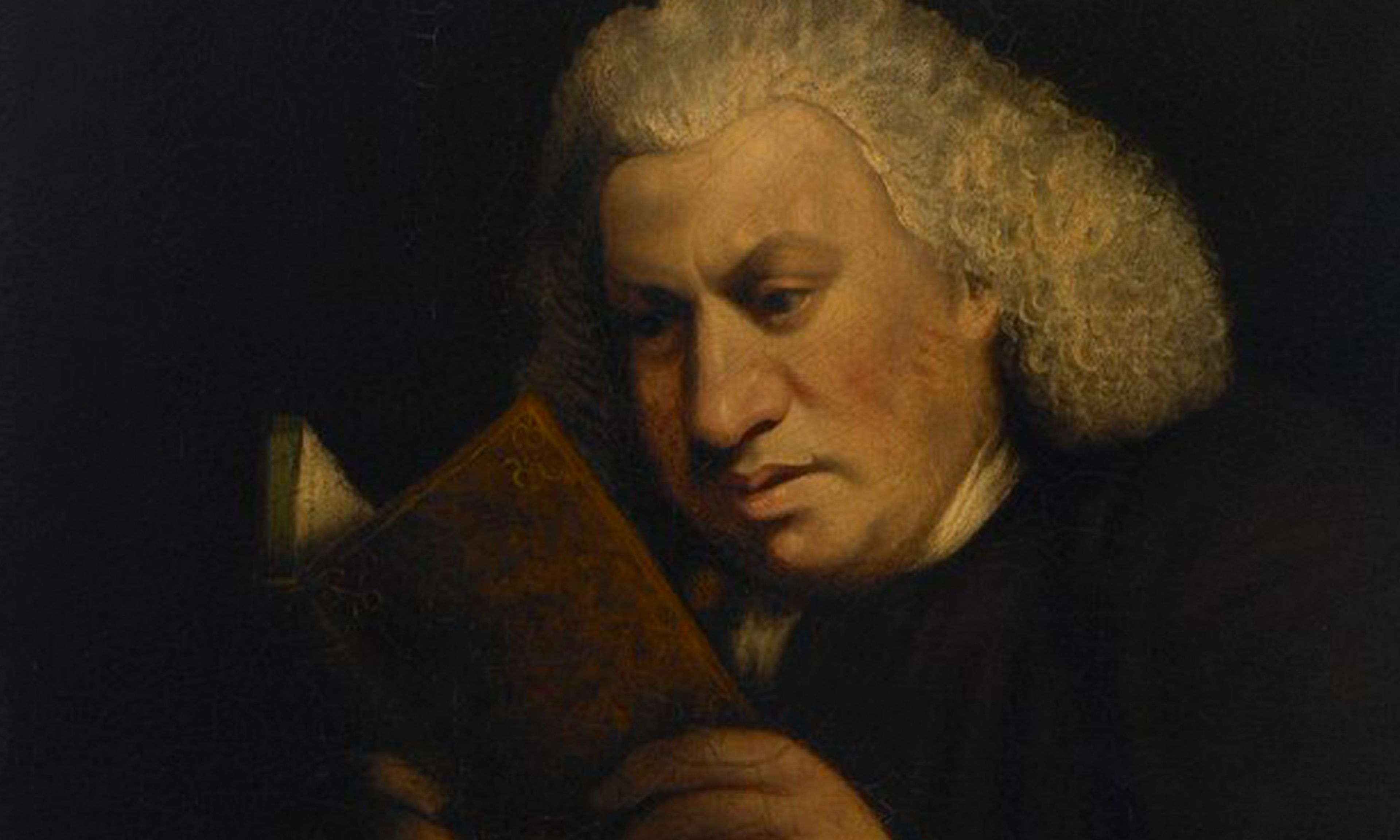
Samuel Johnson — creator not of the first English dictionary, but of the first great one — wickedly mocked his own trade when he defined lexicographer as “a writer of dictionaries; a harmless drudge, that busies himself in tracing the original, and detailing the signification of words.” But aren’t dictionaries serious business? Aren’t those who drudge away at them anything but harmless? These questions are worth exploring.
Dictionaries are repositories of erudition, monuments to linguistic authority. They’re battlefields in cultural and political struggles. Last year, a kerfuffle broke out in southwest Florida about their danger: A school district made headlines for rejecting a donation of dictionaries. The district was forced to do so because of a new state law intended to fight “indoctrination” in schools. The statute required that all reading materials in schools, whether bought or donated, be “selected” by a certified education-media specialist. But since schools couldn’t for the time being make new hires — including media specialists — many struggled to comply with the new law, causing delays in the selection of reading materials and eyebrow-raising outcomes like rejecting the donated dictionaries. Think of the words they contain! (You know the ones.)
Dictionaries have sometimes been announced with almost messianic fervor; they have been decried as evidence of cultural collapse; they have been relied on in judicial decisions (as we saw in a previous column). They are works of almost superhuman endurance, produced by people who devote themselves for years or even decades to wearisome labor. As commodities in a fiercely competitive publishing business, they can keep a company afloat for generations or sink it in a few years. They are also often beautiful objects, products of genuine innovations in typography and book design.
Lexicography is also perhaps the ultimate illustration of delayed gratification. Imagine working for years, day by day, on the minutest points of language, keeping up a painstaking accuracy without which the entire project will ruin your reputation. Imagine a monklike routine that entails a forced seclusion. You have minimal interaction with others because conversation, if it becomes at all frequent, fritters away the time of not just one person but at least two. Imagine a quota system by which you must complete a certain number of entries per hour if you’re to make the publishing deadline several years hence — and you must do this day by day, without fail. Imagine, too, that you’re a solo lexicographer in olden times: You’ve made a deal that provides for a certain sum of money once you finish a given letter of the alphabet, but you’re discovering, through your exhaustive research, that the letter “A” (for starters) contains more than twice as many words as you or anyone else thought. In effect, your hourly wage has been slashed by 60 percent. That has happened to many a dictionary-writer.
By the time you reach “C,” the most prolific letter in the alphabet, you wonder whether you can continue to subsist, much less retain your sanity.
And what will the gratification be, in the end? Universal adulation? Riches? No. It will be simply the knowledge of a job well done — a job whose intricacies can be appreciated by almost no other human being besides yourself. Certainly not by anybody else you know. You can’t really hope for praise, only for escaping reproach. That’s how Samuel Johnson put it in 1755.
And yet lexicographers can have a tremendous impact on the world. Perhaps even more than poets, they deserve the moniker “unacknowledged legislators of the world.” Not just huge sums of money but also people’s lives may depend on the interpretation of a word. When judges take the legislature at its word, they want to discover the most plausible meaning. Dictionaries are cited by courts more often than any other type of scholarship.
But quite apart from what happens in court, people in general can become exercised about what dictionaries say. In the 1980s, Robert W. Burchfield, chief editor of the Oxford English Dictionary, received anonymous death threats prompted by the inclusion of a racially charged term. And just last year, Merriam-Webster had to shut down its offices over emailed death threats incited by the editors’ newly revised treatment of transgender-related terms like boy and girl: “The moron who created this fake definition,” wrote the culprit, “should be hunted down and shot. I am sick and tired of these cultural Marxists denying science and destroying the English Language.” The man was found and apprehended. He pleaded guilty to two counts of interstate transmission of threatening communications to commit violence and was sentenced to one year in prison.
Other examples of the breathtaking adventures in lexicography might be cited. Sometimes the exploits occur purely within the confines of domesticity. Consider Thomas Cooper, a lexicographer who worked long before computers or even photocopiers existed. In the mid 1550s, he was seven years into his marriage and halfway through his big Latin dictionary. He had labored for more than a decade, and he worked late each night to bring it closer to completion. There was one master copy of his manuscript. His resentful wife had come to view that stack of papers as an enormous symbol of his connubial neglect. And so late one night, after her dictionary-crazed husband had fallen into a slumber, she tossed his beloved manuscript into the fire, turning the whole thing to ash. Cooper somehow forgave his wife, calmly started anew, and completed the dictionary in 1565.
When Samuel Johnson defined lexicographer secondarily as a harmless drudge, I believe he meant to be denotatively accurate with drudge but self-deprecatingly facetious with harmless. On that point, I’ll issue a guarantee: If you rely on my assertion, I’ll indemnify you and hold you harmless.











Comments